スピノザ『政治論』
Tractatus Politicus
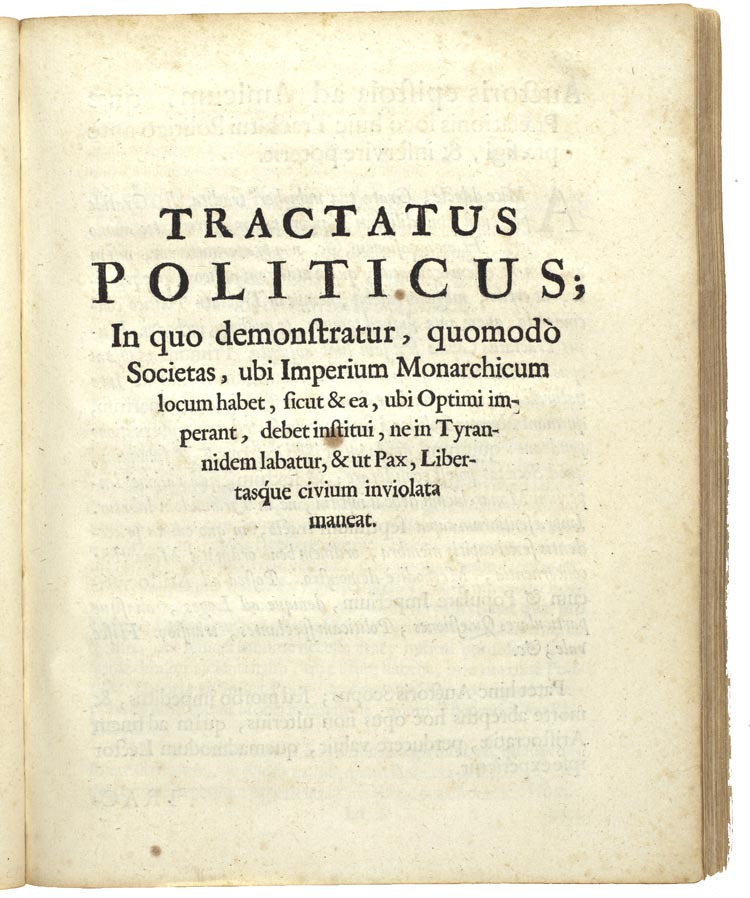
The title page of the Tractatus politicus in the Opera Posthuma.
☆ 『政治論』(Tractatus politicus, TP)は、バルーフ・スピノザが書いた最後の未完の論考である。1675年から77年にかけて書かれ、1677年に死後出版された。この論文には 「In quo demonstratur, quomodo Societas, ubi Imperium Monarchicum locum habet, sicut et ea, ubi Optimi imperant, debet institui, ne in Tyrannidem labatur, et ut Pax, Libertasque civium inviolata maneat. 」という副題がついている。(君主制であれ貴族制であれ、社会が専制政治に陥らないように、また市民の平和と自由が侵害されないように、どのように統治す るのが最善であるかが示されている」)。
| Tractatus
politicus (TP) or Political Treatise was the last and incomplete
treatise written by Baruch Spinoza. It was written in 1675–77 and
published posthumously in 1677. This treatise has the subtitle, "In quo
demonstratur, quomodo Societas, ubi Imperium Monarchicum locum habet,
sicut et ea, ubi Optimi imperant, debet institui, ne in Tyrannidem
labatur, et ut Pax, Libertasque civium inviolata maneat." ("In which it
is demonstrated how a society, may it be a monarchy or an aristocracy,
can be best governed, so as not to fall into tyranny, and so that the
peace and liberty of the citizens remain unviolated"). Summary The Political Treatise has eleven Chapters: I. Introduction, II. Of Natural law (referring to his Theologico-Political Treatise), III. Of the Right of Supreme Authorities, IV. Of the Function of Supreme Authorities, V. Of best State of Dominion, VI. to VII. Of Monarchy, VIII. to X. Of Aristocracy, XI. Of Democracy. As in Aristotle's Politics, Spinoza analyzes each form of government: monarchy, aristocracy, and democracy without affirming which of these is the best. Unlike Aristotle, Spinoza argued in the last chapter that democracy is not "rule of majority", but freedom for all by the natural law. This unfinished work includes Spinoza's only discussion of women, whom he considered unsuitable to hold political power, at odds with his usual radical stances on other hierarchies.[1][2] The treatise also characterizes the notion of peace in Chapter V, section 4, affirming that "Peace is not mere absence of war, but is a virtue that springs from force of character." In the same Chapter, section 7 Niccolò Machiavelli is referred to as stating that the prince should establish and maintain dominion, though why Machiavelli did this is not clear, with the suggestion that Machiavelli is showing how imprudent it is to try to remove a tyrant if one is unable to remove the causes of his being a tyrant. Indeed, it has been suggested that the Political Treatise is an extended response to the authoritarian rule of William of Orange following the invasion of the Netherlands by France in 1672 and which continued as Spinoza was writing the text.[3] |
『政
治論』(Tractatus politicus,
TP)は、バルーフ・スピノザが書いた最後の不完全な論考である。1675年から77年にかけて書かれ、1677年に死後出版された。この論文には
「In quo demonstratur, quomodo Societas, ubi Imperium Monarchicum locum
habet, sicut et ea, ubi Optimi imperant, debet institui, ne in
Tyrannidem labatur, et ut Pax, Libertasque civium inviolata maneat.
」という副題がついている。(君主制であれ貴族制であれ、社会が専制政治に陥らないように、また市民の平和と自由が侵害されないように、どのように統治す
るのが最善であるかが示されている」)。 要約 『政治論』には11の章がある: I. 序論、II. I.序論、II.自然法について(『神学政治学論考』に言及)、III. 最高機関の権利について、IV. 最高権力者の機能について、V.最高の支配状態について、VI.からVII. 君主制について、VIII.からX.まで、貴族制について、XI. 民主主義について。 アリストテレスの『政治学』と同様に、スピノザは君主制、貴族制、民主制というそれぞれの政治形態を分析しているが、どれが最良であるかは断言していな い。アリストテレスとは異なり、スピノザは最終章で、民主主義とは「多数決の支配」ではなく、自然法則による万人の自由であると主張した。この未完の著作 には、スピノザが政治的権力を握るにはふさわしくないと考えた女性についてのスピノザ唯一の論考が含まれており、他の階層についての彼の通常の急進的な姿 勢とは相反するものであった[1][2]。 この論文はまた、第五章第四節で平和の概念を特徴づけており、「平和とは単に戦争がないことではなく、人格の力から湧き出る美徳である 」と断言している。同章第7節では、ニッコロ・マキアヴェッリが「王子は支配権を確立し、維持すべきである」と述べていることが紹介されているが、なぜマ キアヴェッリがこのようなことをしたのかは明らかではなく、マキアヴェッリは、暴君である原因を取り除くことができないのであれば、暴君を排除しようとす ることがいかに軽率であるかを示しているのではないかとの指摘がある。実際、『政治論集』は、1672年のフランスによるオランダ侵攻後、スピノザが執筆 中も続いていたオレンジ公ウィリアムの権威主義的支配に対する拡大解釈であるとも指摘されている[3]。 |
|
English translations 1883 by R. H. M. Elwes in the first volume of The Chief Works of Benedict de Spinoza (George Bell & Sons, London). 1958 by A. G. Wernham in The Political Works of Spinoza, with introduction and notes; also includes an abriged version of the Tractatus Theologico-Politicus (Clarendon Press, Oxford). 2000 by Samuel Shirley, with introduction and notes by Steven Barbone and Lee Race, and a Prefatory essay by Douglas Den Uyl (Hacket Publications). Latter added to his translation of the Complete Works in one volume, with introduction and notes by Michael L. Morgan (also Hacket Publications, 2002). 2016 by Edwin Curley, in the second volume of The Collected Works of Spinoza (Princeton University Press; first volume issued in 1985). |
英訳 1883年、R. H. M. Elwesによる『The Chief Works of Benedict de Spinoza』第1巻(George Bell & Sons, London)。 1958年、A.G.ワーナムによる『スピノザ政治著作集』(序論と注釈付き)。 2000年 Samuel Shirley著、Steven BarboneとLee Raceによる序文と注、Douglas Den Uylによる序文付き(ハケット出版)。その後、マイケル・L・モーガンによる序文と註を付した全集1巻の翻訳が加えられた(同じくハケット・パブリケー ションズ、2002年)。 2016年 エドウィン・カーリー著『スピノザ著作集』第2巻(プリンストン大学出版局、第1巻は1985年発行)。 |
| Theologico-Political Treatise Natural law Form of government |
神学・政治論 自然法 政府の形態 |
| References 1. Nadler, Steven. Spinoza, A Life. 2nd edition. Cambridge: Cambridge University Press 2018, p. 495 2. Israel, Jonathan I. Spinoza, Life and Legacy. Oxford: Oxford University Press 2023, 895-96 3. Bartholomew Begley, "Spinoza, Before and After the Rampjaar". The European Legacy Toward New Paradigms Volume 27, 2022 - Issue 6: https://www.tandfonline.com/doi/full/10.1080/10848770.2022.2083912 |
参考文献 1. ナドラー、スティーブン。『スピノザ、その生涯』第2版。ケンブリッジ:ケンブリッジ大学出版局、2018年、495頁 2. イスラエル、ジョナサン・I。『スピノザ、その生涯と遺産』。オックスフォード:オックスフォード大学出版局、2023年、895-96頁 3. バーソロミュー・ベグリー「ランプヤー前後におけるスピノザ」『新パラダイムへ向けたヨーロッパの遺産』第27巻、2022年 - 第6号: https://www.tandfonline.com/doi/full/10.1080/10848770.2022.2083912 |
| https://en.wikipedia.org/wiki/Tractatus_Politicus |
|
| Der Tractatus Politicus (neulateinisch)
ist ein posthum veröffentlichter Politischer Traktat von Baruch de
Spinoza. Die staatstheoretischen Ideen knüpfen unmittelbar an die
Affektenlehre im dritten Teil der Ethik an. 1677, kurz nach Spinozas
Tod in Amsterdam, wurde das Werk von Freunden redigiert und
veröffentlicht und 1678 zusammen mit Hobbes Leviathan in Holland
verboten. Spinoza vertrat die Ansicht, dass die Natur des Menschen, also auch sein egoistischer Selbsterhaltungsdrang, als Pate für eine Staatstheorie stehen muss und nicht seine Neigung zur Utopie. Er wandte sich damit gegen Ideen, wie sie Anfang des 17. Jahrhunderts Johann Valentin Andreae, Tommaso Campanella oder Francis Bacon aufgestellt haben. Die utopischen Staatstheorien waren im frühen 17. Jahrhundert sehr beliebt. Spinoza vertrat hingegen die Auffassung, dass man den Menschen nehmen muss, wie er ist, und nicht wie er sein soll. Man muss ihn in seiner Gefolgschaft, nicht so sehr nach seiner Vernunft, vielmehr nach seinen Handlungen und Affekten beurteilen. Recht, sagte Spinoza, ist die Macht oder das Vermögen. Gesetze oder Regeln der Natur weisen jedem Individuum seine Wirkungsmöglichkeiten zu. Naturrecht ist im Prinzip all das, was ist. Es bestimmt das Sein des Menschen im Naturzustand. Im Naturrecht ist nur das verboten, was niemand vermag. Positives Recht ist gesetztes Recht; es setzt Übereinkunft, Übertragung von Machtbefugnissen und Herrschaft voraus. Dabei gibt das Individuum aber nie sich selbst, sein Recht, seine Macht dem Herrschenden preis. Spinoza ließ trotz auffällig vieler Gemeinsamkeiten im Unterschied zu Thomas Hobbes Staatstheorie im Leviathan das Einzelinteresse der Individuen im Gesellschaftsvertrag als naturrechtliche Gegebenheit bestehen. Die naturgebundenen Affekte des Menschen spielte er in den Gesellschaftskonzepten von Monarchie, Oligarchie und Demokratie durch. Dabei wog er völlig wertneutral die Möglichkeiten des Einzelnen in der Gesellschaft ab und entwarf Gesellschaftsverträge für die einzelnen möglichen Staatsgebilde. Allerdings ist der Abschnitt über die Demokratie nicht zu Ende gebracht. |
『政
治論』(新ラテン語)は、バルーク・デ・スピノザの死後に出版された政治に関する論文だ。国家論の考え方は、『倫理学(エチカ)』の第3部にある感情論に
直接つながっている。1677年、スピノザがアムステルダムで亡くなって間もなく、この著作は友人たちによって編集・出版されたが、1678年にホッブズ
の『リヴァイアサン』とともにオランダで禁止された。 スピノザは、人間の性質、つまり利己的な自己保存の欲求が、ユートピアへの傾向ではなく、国家理論の基盤となるべきだと考えていた。それにより、17世紀 初頭にヨハン・ヴァレンティン・アンドレア、トマソ・カンパネッラ、フランシス・ベーコンが提唱したような考えに反対した。17世紀初頭、ユートピア的な 国家理論は大変人気があった。しかし、スピノザは、人間はありのままの姿で受け入れるべきであり、あるべき姿で受け入れるべきではないという見解を主張し た。人間は、その理性よりも、その行動や感情に基づいて評価すべきである。 スピノザは、権利とは力、あるいは能力であると述べた。自然法則や規則は、各個人にその影響力の範囲を割り当てる。自然法は、原則として、存在するものす べてである。それは、自然状態における人間の存在を決定する。自然法では、誰もできないことだけが禁止されている。実定法は制定された法律であり、合意、 権力の委譲、支配を前提とする。しかし、個人は決して自分自身、自分の権利、自分の権力を支配者に委ねることはない。トマス・ホッブズの『リヴァイアサン』における国家論とは多くの共通点があるにもかかわらず、スピノザは、社会契約における個人の利益は自然法の事実として存続するとした。 彼は、君主制、寡頭制、民主主義という社会概念の中で、人間のもつ自然的な感情を考察した。その際、彼は社会における個人の可能性を完全に価値中立的に評価し、個々の可能な国家構造のための社会契約を草案した。ただし、民主主義に関する部分は完成に至っていない。 |
| Ausgaben n.lat Amsterdam 1677 in opera posthuma n.lat Jena 1803 |
出版 n.lat アムステルダム 1677 年、死後出版 n.lat イェーナ 1803 年 |
| Übersetzungen Abhandlungen über Politik, übers. von Berthold Auerbach (in Spinoza’s Sämtliche Werke, 2. Auflage, Stuttgart 1871) Digitalisat Abhandlung vom Staate, übers. von Carl Gebhardt, Leipzig 1907 (5. Auflage, Hamburg 1977) Politischer Traktat. übers. von Wolfgang Bartuschat, Hamburg 1994 (2. Auflage, Hamburg 2010) Lizenzpflichtiges Digitalisat |
翻訳 政治に関する論文、ベルトルト・アウアーバッハ訳(『スピノザ全集』第 2 版、シュトゥットガルト、1871 年) デジタル版 国家に関する論文、カール・ゲブハルト訳、ライプツィヒ、1907 年(第 5 版、ハンブルク、1977 年) 政治論文、ヴォルフガング・バルトゥシャット訳、ハンブルク、1994年(第2版、ハンブルク、2010年) ライセンスが必要なデジタル化資料 |
| Literatur Heinrich Christoph Wilhelm von Sigwart: Vergleichung der Staatstheorien Baruch Spinozas und T. Hobbes. Tübingen 1842. Étienne Balibar: Spinoza und die Politik. tentare Verlag, Freising 2025. |
参考文献 ハインリッヒ・クリストフ・ヴィルヘルム・フォン・ジグヴァルト:バルーク・スピノザとT・ホッブズの国家論の比較。テュービンゲン、1842年。 エティエンヌ・バリバル:スピノザと政治。テンタレ出版社、フライジング、2025年。 |
| https://de.wikipedia.org/wiki/Tractatus_politicus |
リ ンク
文 献
そ の他の情報
Copyleft, CC, Mitzub'ixi Quq Chi'j, 1996-2099

☆
 ☆
☆