
構成/構築された情動理論
Theory of constructed
emotion
☆構
築された感情の理論(旧称:感情の概念的行為モデル[1])は、感情の経験と認識を説明するためにリサ・フェルドマン・バレット(Lisa Feldman Barrett, b.1962)が提案した感情科学の理論
である[2][3]。この理論は、感情の事例は、必要に応じてその瞬間に脳によって予測的に構築されると主張する。それは社会的構築、心理的構築、神経構
築から導かれている[3](→「アフェクト=情動(affect)」)。
| The theory of constructed emotion
(formerly the conceptual act model of emotion[1]) is a theory in
affective science proposed by Lisa Feldman Barrett to explain the
experience and perception of emotion.[2][3] The theory posits that
instances of emotion are constructed predictively by the brain in the
moment as needed. It draws from social construction, psychological
construction, and neuroconstruction.[3] |
構
築された感情の理論(旧称:感情の概念的行為モデル[1])は、感情の経験と認識を説明するためにリサ・フェルドマン・バレットが提案した感情科学の理論
である[2][3]。この理論は、感情の事例は、必要に応じてその瞬間に脳によって予測的に構築されると主張する。それは社会的構築、心理的構築、神経構
築から導かれている[3]。 |
| Motivation Barrett proposed the theory to resolve what she calls the "emotion paradox,"[1] which she claims has perplexed emotion researchers for decades, and describes as follows: People have vivid and intense experiences of emotion in day-to-day life: they report seeing emotions like "anger", "sadness", and "happiness" in others, and they report experiencing "anger", "sadness" and so on themselves. Nevertheless, psychophysiological and neuroscientific evidence has failed to yield consistent support for the existence of such discrete categories of experience.[4] Instead, the empirical evidence suggests that what exists in the brain and body is affect, and emotions are constructed by multiple brain networks working in tandem.[5][6] Most other theories of emotion assume that emotions are genetically endowed, not learned. Other scientists believe there are circuits in the brain: an anger circuit, a fear circuit, and so on. Charles Darwin, in The Expression of the Emotions in Man and Animals, used examples to support the idea that emotions and their "expressions are a universal part of human nature", and that people can recognize and express emotions without any training. The theory of constructed emotion calls this assumption into question. It suggests that these emotions (often called "basic emotions") are not biologically hardwired, but instead are phenomena that emerge in consciousness "in the moment" from more fundamental ingredients. |
動機 バレットは、彼女が「感情のパラドックス」と呼ぶものを解決するためにこの理論を提案した[1]。彼女は、このパラドックスが何十年もの間、感情の研究者 を困惑させてきたと主張し、次のように説明している。人々は日常生活の中で、鮮やかで強烈な感情を経験している。他者に「怒り」、「悲しみ」、「喜び」と いった感情を見たと報告し、また自分自身が「怒り」、「悲しみ」などを経験したと報告する。それにもかかわらず、心理生理学的および神経科学的な証拠は、 こうした個別の経験カテゴリーの存在を一貫して裏付けるには至っていない。[4] むしろ実証的証拠は、脳と身体に存在するものは情動=アフェクト(affect)であり、感情は複数の脳ネットワークが連携して構築されることを示唆している。[5] [6] 他の感情理論のほとんどは、感情が学習されたものではなく遺伝的に備わっていると仮定している。他の科学者たちは、脳内に回路が存在すると考えている:怒 りの回路、恐怖の回路などだ。チャールズ・ダーウィンは『人間と動物の感情の表現』において、感情とその「表現は人間性の普遍的な部分である」という考え を例を用いて支持し、人は訓練なしに感情を認識し表現できると主張した。 構築された感情理論はこの前提に疑問を呈する。いわゆる「基本感情」と呼ばれるこれらの感情は、生物学的に固定されたものではなく、より根本的な要素から「その瞬間」に意識の中で生じる現象であると示唆している。 |
| Statement of the theory The theory is given in simplified form as:[2] "In every waking moment, your brain uses past experience, organized as concepts, to guide your actions and give your sensations meaning. When the concepts involved are emotion concepts, your brain constructs instances of emotion." In greater detail, instances of emotion are constructed throughout the entire brain by multiple brain networks in collaboration. Ingredients going into this construction include interoception, concepts, and social reality.[2] Interoceptive predictions provide information about the state of the body and ultimately produce basic, affective feelings of pleasure, displeasure, arousal, and calmness. Concepts are culturally embodied knowledge, including "emotion concepts". Social reality provides the collective agreement and language that make the perception of emotion possible among people who share a culture. As an analogy, consider the experience of color. People experience colors as discrete categories: blue, red, yellow, and so on, and these categories vary in different cultures. The physics of color, however, is actually continuous, with wavelengths measured in nanometers along a scale from ultraviolet to infrared. When a person experiences an object as "blue", she is (unconsciously) using her color concepts to categorize this wavelength.[7] And in fact, people experience a whole range of wavelengths as "blue." Likewise, emotions are commonly thought of as discrete and distinct — fear, anger, happiness — while affect (produced by interoception) is continuous. The theory of constructed emotion suggests that at a given moment, the brain predicts and categorizes the present moment (of continuous affect) via interoceptive predictions and the "emotion concepts" from one's culture, to construct an instance of emotion, just as one perceives discrete colors. This process instantiates the experience of "having an emotion". For example, if someone's brain predicts the presence of a snake as well as the unpleasant affect that would result upon encountering a snake ("interoceptive prediction"), that brain might categorize and construct an experience of "fear." This process takes place before any actual sensory input of a snake reaches conscious awareness. In contrast, a "basic emotions" researcher would say that the person first sees the snake, and this sensory input triggers a dedicated "fear circuit" in the brain. |
理論の声明 理論は簡略化された形で次のように示される:[2] 「目覚めているあらゆる瞬間において、脳は概念として組織化された過去の経験を用いて行動を導き、感覚に意味を与える。関与する概念が感情概念である場合、脳は感情の事例を構築する」 より詳細に説明すると、感情の事例は複数の脳ネットワークが連携して脳全体で構築される。この構築に用いられる要素には、内受容、概念、社会的現実が含ま れる[2]。内受容的予測は身体の状態に関する情報を提供し、最終的に快・不快、興奮、平静といった基本的な情動的感覚を生み出す。概念とは「感情概念」 を含む、文化的に体現された知識である。社会的現実とは、文化を共有する人々の間で感情の知覚を可能にする、集合的な合意と言語を提供するものである。 例えとして、色の体験を考えてみよう。人々は色を青、赤、黄といった離散的なカテゴリーとして体験するが、これらのカテゴリーは文化によって異なる。しか し色の物理的性質は実際には連続的であり、波長はナノメートル単位で測定され、紫外線から赤外線までの尺度を持つ。人が物体を「青」として経験する時、彼 女は(無意識に)自身の色概念を用いてこの波長を分類しているのだ[7]。実際、人々は幅広い波長を「青」として経験する。 同様に、感情もまた離散的で明確なものと見なされることが多い——恐怖、怒り、幸福など——一方で情動(内受容によって生み出される)は連続的である。構 築された感情の理論は、ある瞬間において、脳が内受容的予測と自身の文化に由来する「感情概念」を通じて、現在の瞬間(連続的な情動)を予測し分類し、離 散的な色を認識するように感情の事例を構築すると示唆している。このプロセスが「感情を持つ」という体験を具体化するのだ。 例えば、ある人の脳が蛇の存在と、蛇に出会った際に生じる不快な情動(「内受容的予測」)を予測した場合、その脳は「恐怖」という体験を分類・構築するか もしれない。このプロセスは、蛇の実際の感覚入力が意識に到達する前に起こる。これに対し、「基本感情」の研究者は、まず人格が蛇を視認し、この感覚入力 が脳内の専用の「恐怖回路」を起動させると主張する。 |
| Earlier incarnations of the theory Early incarnations of the theory were phrased in terms of core affect rather than interoception. Core affect is a neurophysiological state characterized along two dimensions:[8] Pleasure vs. displeasure, measured along a continuous scale from positive to negative. High arousal vs. low arousal, measured along a continuous scale between these endpoints. According to the original conceptual act model, emotion is generated when a person categorizes his/her core affective state using knowledge about emotion. This theory combines elements of linguistic relativity and affective neuroscience. The term "core affect" was first used in print by Russell and Barrett in 1999 in Journal of Personality and Social Psychology[9] where it is used to refer to the affective feelings that are part of every conscious state (as discussed by Wundt in his 1889 System der Philosophie).[10] The term "core affect" also appears to have been used as a phrase that relates to neuropsychological understanding of behavior as a morbid affect at the roots of any type of human behavior.[11] |
理論の初期段階 理論の初期段階では、内受容ではなく中核感情を用いて表現されていた。中核感情とは、二つの次元で特徴づけられる神経生理学的状態である:[8] 快楽と不快、正から負への連続的な尺度で測定される。 高覚醒と低覚醒、これらの両端点の間で連続的な尺度で測定される。 元の概念的行為モデルによれば、感情は、人格が感情に関する知識を用いて自分のコア感情状態を分類するときに生じる。この理論は、言語相対性理論と感情神経科学の要素を組み合わせたものである。 「コア感情」という用語は、1999年にラッセルとバレットが『Journal of Personality and Social Psychology』誌で初めて使用した[9]。そこでは、あらゆる意識状態の一部である感情的な感覚を指すために使用されている(ヴントが1889年 の『System der Philosophie』で論じている)。[10] 「コア感情」という用語は、あらゆる人間行動の根源にある病的な感情として、行動の神経心理学的理解に関連するフレーズとしても使用されているようだ。 [11] |
| Other researchers Joseph LeDoux has reached similar views.[12] The theory denies "essentialism" of brain areas exclusively dedicated to emotion, such as the seven primary affective systems proposed by the affective neuroscientist Jaak Panksepp. (Note that Barrett and Panksepp use the word "affect" to mean different things. Barrett defines affect as a basic feature of consciousness,[3] akin to light and dark or loudness and softness,[2] consisting of a combination of valence and arousal, consistent with the original definition of affect by Wilhelm Wundt. Panksepp uses the term in the plural, "affects," to refer to his proposed seven systems.) Panksepp characterized the theory of constructed emotion as an "attributional–dimensional constructivist view of human emotions [which] postulates that positive and negative core affects are the basic feelings—the primary processes—from which emotional concepts are cognitively and socially constructed".[13] (Since the theory of constructed emotion is not about core affect,[3] this statement likely refers to Barrett's older conceptual act theory.) |
他の研究者 ジョセフ・ルドゥも同様の見解に達している[12]。 この理論は、感情神経科学者のジャック・パンクセップが提唱した 7 つの主要な感情システムなど、感情に専ら関与する脳領域の「本質主義」を否定している(バレットとパンクセップは「感情」という言葉を異なる意味で用いて いることに留意されたい)。バレットは、感情を、意識の基本的な特徴[3]、つまり明暗や大小のようなものと定義している[2]。これは、ヴァレンスと覚 醒の組み合わせで構成されており、ヴィルヘルム・ヴントによる感情の本来の定義と一致している。パンクセップは、この用語を複数形「感情」として、彼が提 案した 7 つのシステムを指すために使用している。パンクセップは、構築された感情の理論を「人間の感情に関する帰属的・次元的構成主義的見解」と特徴づけ、「ポジ ティブおよびネガティブな中核的感情が、感情の概念が認知的および社会的に構築される基礎となる感情、すなわち一次的プロセスである」と仮定している。 [13] (構築された感情の理論は中核的感情に関するものではないため[3]、この記述はおそらくバレットの古い概念的行為理論を指しているものと思われる。 |
| References 1. Barrett, L. F. (2006). "Solving the emotion paradox: Categorization and the experience of emotion". Personality and Social Psychology Review. 10 (1): 20–46. doi:10.1207/s15327957pspr1001_2. PMID 16430327. S2CID 7750265. 2. Barrett, Lisa Feldman (2017). How Emotions are Made: The Secret Life of the Brain. Houghton Mifflin Harcourt. ISBN 9780544133310. 3. Barrett, L. F. (2016). "The theory of constructed emotion: An active inference account of interoception and categorization". Social Cognitive and Affective Neuroscience. 12 (1): 20–46. doi:10.1093/scan/nsw154. PMC 5390700. PMID 27798257. 4. Barrett, L. F.; Lindquist, K.; Bliss-Moreau, E.; Duncan, S.; Gendron, M.; Mize, J.; Brennan, L. (2007). "Of mice and men: Natural kinds of emotion in the mammalian brain?". Perspectives on Psychological Science. 2 (3): 297–312. doi:10.1111/j.1745-6916.2007.00046.x. PMC 2597798. PMID 19079552. 5. Barrett, L. F. (2006). "Emotions as natural kinds?". Perspectives on Psychological Science. 1 (1): 28–58. doi:10.1111/j.1745-6916.2006.00003.x. PMID 26151184. S2CID 6950937. 6. Barrett, L. F.; Wager, T. (2006). "The structure of emotion: Evidence from the neuroimaging of emotion". Current Directions in Psychological Science. 15 (2): 79–85. CiteSeerX 10.1.1.470.7762. doi:10.1111/j.0963-7214.2006.00411.x. S2CID 14489624. 7. Davidoff, J (2001). "Language and perceptual categorization" (PDF). Trends in Cognitive Sciences. 5 (9): 382–387. doi:10.1016/s1364-6613(00)01726-5. PMID 11520702. S2CID 12975180. 8. Russell, J. A.; Barrett, L. F. (1999). "Core affect, prototypical emotional episodes, and other things called emotion: Dissecting the elephant". Journal of Personality and Social Psychology. 76 (5): 805–819. doi:10.1037/0022-3514.76.5.805. PMID 10353204. 9. Russell, James A.; Barrett, Lisa Feldman (1999). "Core affect, prototypical emotional episodes, and other things called emotion: Dissecting the elephant" (PDF). Journal of Personality and Social Psychology. 76 (5): 805–819. doi:10.1037/0022-3514.76.5.805. PMID 10353204. 10. Wundt, Wilhelm Max (1889). System der Philosophie (in German). Leipzig, Germany: Engelmann. 11. Segarra, Efrain (June 1983). "A Neuropsychological of Human Behavior and Therapeutic Change". University of Massachusetts Amherst. {{cite journal}}: Cite journal requires |journal= (help) 12. Ledoux, J.; Narain, C. (2014-01-01). "A Conversation with Joseph LeDoux". Cold Spring Harbor Symposia on Quantitative Biology. 79: 279–281. doi:10.1101/sqb.2014.79.12. ISSN 0091-7451. PMID 26092896. 13. Panksepp, Jaak (2007). "Neurologizing the Psychology of Affects: How Appraisal-Based Constructivism and Basic Emotion Theory Can Coexist". Perspectives on Psychological Science. 2 (3): 281–296. doi:10.1111/j.1745-6916.2007.00045.x. ISSN 1745-6916. JSTOR 40212207. PMID 26151970. S2CID 205908135. |
参考文献 1. バレット、L. F. (2006). 「感情のパラドックスを解く:分類と感情の経験」. Personality and Social Psychology Review. 10 (1): 20–46. doi:10.1207/s15327957pspr1001_2. PMID 16430327. S2CID 7750265. 2. バレット、リサ・フェルドマン (2017). 『感情はどのように作られるか:脳の秘密の生活』. ホートン・ミフリン・ハーコート. ISBN 9780544133310. 3. バレット、L. F. (2016). 「構築された感情の理論:内受容と分類に関する能動的推論の説明」. Social Cognitive and Affective Neuroscience. 12 (1): 20–46. doi:10.1093/scan/nsw154. PMC 5390700. PMID 27798257. 4. バレット、L. F.、リンドクイスト、K.、ブリス・モロー、E.、ダンカン、S.、ジェンドロン、M.、マイズ、J.、ブレナン、L. (2007). 「マウスと人間:哺乳類の脳における感情の自然の種類?」。心理科学の視点。2 (3): 297–312. doi:10.1111/j.1745-6916.2007.00046.x. PMC 2597798. PMID 19079552. 5. バレット、L. F. (2006). 「感情は自然の種類か?」. 心理学の視点. 1 (1): 28–58. doi:10.1111/j.1745-6916.2006.00003.x. PMID 26151184. S2CID 6950937. 6. バレット、L. F.、ウェイジャー、T. (2006). 「感情の構造:感情の神経画像からの証拠」。心理科学の現在の方向性。15 (2): 79–85. CiteSeerX 10.1.1.470.7762. doi:10.1111/j.0963-7214.2006.00411.x. S2CID 14489624。 7. Davidoff, J (2001). 「言語と知覚的分類」 (PDF). Trends in Cognitive Sciences. 5 (9): 382–387. doi:10.1016/s1364-6613(00)01726-5. PMID 11520702。S2CID 12975180。 8. ラッセル、J. A.、バレット、L. F. (1999)。「中核感情、典型的な感情エピソード、および感情と呼ばれるその他のもの:象の解剖」。Journal of Personality and Social Psychology(人格と社会心理学ジャーナル)。76 (5): 805–819。doi:10.1037/0022-3514.76.5.805. PMID 10353204. 9. Russell, James A.; Barrett, Lisa Feldman (1999). 「中核感情、典型的な感情エピソード、および感情と呼ばれるその他のもの:象の解剖」 (PDF). 人格・社会心理学ジャーナル。76 (5): 805–819. doi:10.1037/0022-3514.76.5.805. PMID 10353204. 10. Wundt, Wilhelm Max (1889). System der Philosophie (ドイツ語). ドイツ、ライプツィヒ: Engelmann. 11. Segarra, Efrain (1983年6月). 「人間行動と治療的変化の神経心理学」. マサチューセッツ大学アマースト校. {{cite journal}}: Cite journal requires |journal= (help) 12. レドゥー, J.; ナレイン, C. (2014-01-01). 「ジョセフ・レドゥーとの対話」. コールスプリングハーバー定量生物学シンポジウム. 79: 279–281. doi:10.1101/sqb.2014.79.12. ISSN 0091-7451. PMID 26092896. 13. Panksepp, Jaak (2007). 「感情の心理学を神経学化する:評価に基づく構成主義と基本感情理論が共存する方法」. Perspectives on Psychological Science. 2 (3): 281–296. doi:10.1111/j.1745-6916.2007.00045.x. ISSN 1745-6916. JSTOR 40212207. PMID 26151970. S2CID 205908135. |
| https://en.wikipedia.org/wiki/Theory_of_constructed_emotion |
|
☆さ
★情動はこうしてつくられる : 脳の隠れた働きと構成主義的情動理論 / リサ・フェルドマン・バレット [著] ; 高橋洋訳, 紀伊國屋書店 , 2019(→「感情/情動」のページより)
心理学のみならず多くの学問分野を揺さぶる、自身の《構成主義的情動理論》を解説するととも に、情動の仕組みを知ることで得られる心身の健康の向上から法制度の見直しまで、実践的なアイデアを提案する。情動は〈理性のコントロールが及ばず自動的 に引き起こされる反応〉ではない。 〈幸福の神経回路〉などないし、〈怒りのニューロン〉も特定の部位もない。 情動を経験したり知覚したりするためには〈情動概念〉が必要である。 「怖れ」の概念がなければ、怖れを経験することはできない。 「悲しみ」の概念がなければ、他者の悲しみを知覚することはできない。 なぜ情動は自動的に生じていると感じるのか。 理性はどれだけ情動をコントロールできるか。 イヌは情動を経験しているのか。 情動は病気にどのように影響を及ぼすか。 子どもの「心の知能」はどのように高められるのか。
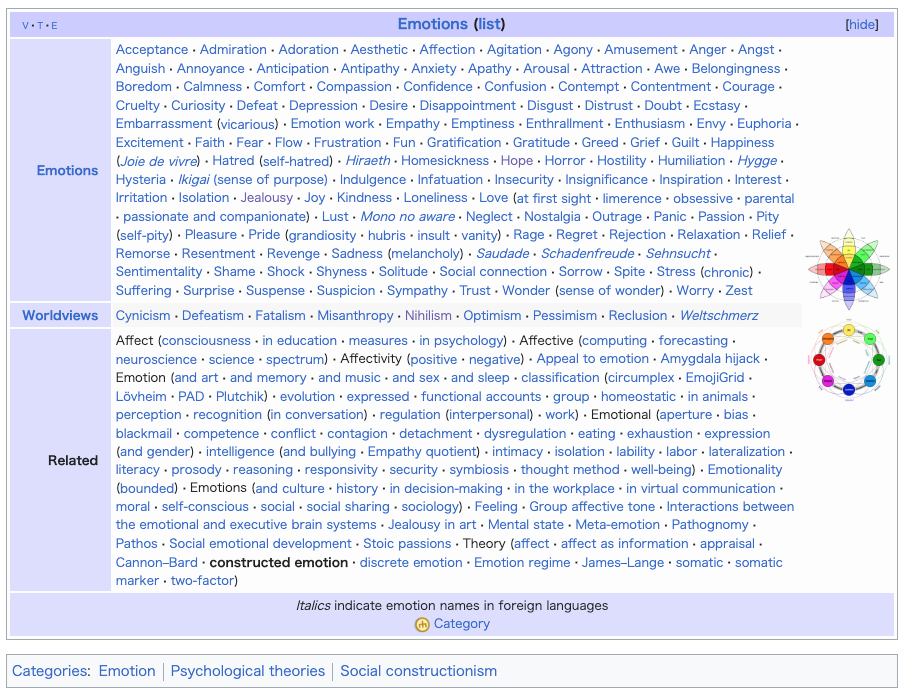
☆感情リスト集(クリックすると拡大します)
☆
リ ンク
文 献
そ の他の情報
CC
Copyleft,
CC, Mitzub'ixi Quq Chi'j, 1996-2099