
因果性
Causality
☆ 因果関係(因果性)[Causality] とは、ある事象、過程、状態、または主体(すなわち原因)が、別の事象、過程、状態、または対象(すなわち結果)の生じることに寄与す る影響のことである。この場合、原因は結果に対して少なくとも部分的に責任を負い、結果は原因に少なくとも部分的に依存している。[1] 何かの原因は、その事象や過程の背後にある理由として説明することもできる。[2] 一般に、ある過程には複数の原因があり得る[1]。これらはその過程の因果的要因とも呼ばれ、すべてその過程の過去に位置する。一方、ある結果は、多くの 他の結果の原因、すなわち因果的要因となり得るが、それらはすべてその結果の未来に位置する。したがって、原因と結果の区別は、過去と未来の区別から導か れるか、あるいはその区別をもたらすものである。前者の見解は物理学においてより一般的であるが[3]、一部の著者は、因果関係は時間や空間の概念よりも 形而上学的に先行すると主張してきた[4][5][6]。因果関係は、世界がどのように進行するかを示す抽象概念である[7]。その意味で、因果関係は基 本的な概念であり、さらに根本的な概念によって説明される対象というよりは、他の進行概念を説明する手段としてより適していると考えられる。この概念は、 能動性や効力といった概念に似ている。このため、それを把握するには直観的な飛躍が必要となるかもしれない[8][9]。したがって、因果関係は日常言語 の構造に暗黙的に含まれている[10]だけでなく、科学的な因果表記の言語においても明示的に表されている。
★ 英語圏におけるアリストテレス哲学の研究では、「原因(cause)」という言葉は専門的な技術用語として用いられる。これはアリストテレスの用語 αἰτία[アイティア]の翻訳であり、アリストテレスはこれを「説明」あるいは「『なぜ』という問いへの答え」と捉えていた。アリストテレスは、この4 種類の答えを、 物質的、形式的、能動的、目的的「原因」として分類した。この場合、「原因」とは説明対象(explanandum)に対する説明要因 (explanans)であり、異なる種類の「原因」が検討されていることを認識できないと、無益な議論に陥る恐れがある。アリストテレスの四つの説明様 式のうち、本稿の関心事に最も近いのは「能動的」なものである。
☆ディヴィッド・ヒュームは、合理主義への反対の一環として、純粋な理性だけでは効率的因果関係 [efficient causality]の現実性を証明できないと論じた。その代わりに、彼は習慣や精 神的な慣習に訴え、人間の知識はすべて経験にのみ由来すると指摘した。 因果関係というテーマは、現代哲学においても依然として主要なテーマである。ヒュームは帰納的推論と因果関係の信念は合理的に正当化することができず、そ の代わりに習慣と精神的な習慣から生まれると主張した。私たちはある事象が別 の事象を引き起こすことを実際に認識することはなく、事象の「一定の連関」を経験するだけである。この帰納法の問題は、過去の経験から因果関係を推論する ためには、未来が過去と似ていることを前提にする必要があり、この前提自体が過去の経験に基づくことができないことを意味している。哲学的合理主義者の反 対者であるヒュームは、人間の行動を支配するのは理性よりもむしろ情熱(あるいは情動)であるとし、「理性は情熱の奴隷であり、また そうでなければな らない」と有名に宣言していたヒュームはまた感傷主義者で、倫理が抽象的道徳原理よりも感情または情緒に基づいていると主張していた。彼は道徳的な現象の 自然主義的な説明への初期のコ ミットメントを維持し、通常、最初に明確にis-ought問題、または事実の声明だけでは何がなされるべきかという規範的な結論を決して生じさせること ができないという考えを説明したとみなされている。またヒュームは人間が自己という概念を持つことを否定し、人間は感覚の束を経験するだけであり、自己は この因果的に結びついた知覚の束に過ぎないとした 。ヒュームの自由意志の両立論は、因果的決定論を人間の自由と完全に両立するものとしている。 奇跡の否定や神の存在に対する設計からの議論など、宗教哲学に関する彼の見解は当時としては特に議論を呼ぶものであった(→「ディヴィッド・ヒューム」)。
「こ れは、アリストテレスが説く、私たちが第一原理を理解し、それゆえに知恵を獲得する方法に対する反論の可能性に対処することを目的としている。アリスト テレスは、無限の因果系列という考えは不合理であり、それゆえに、それ自体が原因となることのない第一原因が存在しなければならないと答えている。この考 えは、第12巻でさらに発展し、そこで彼は「神」の存在を支持する論拠を展開している」アリストテレス『形而上学』第2巻(α).
++
| Causality is an
influence by which one event, process, state, or subject (i.e., a
cause) contributes to the production of another event, process, state,
or object (i.e., an effect) where the cause is at least partly
responsible for the effect, and the effect is at least partly dependent
on the cause.[1] The cause of something may also be described as the
reason behind the event or process.[2] In general, a process can have multiple causes,[1] which are also said to be causal factors for it, and all lie in its past. An effect can in turn be a cause of, or causal factor for, many other effects, which all lie in its future. Thus, the distinction between cause and effect either follows from or else provides the distinction between past and future. While the former viewpoint is more prevalent in physics,[3] some writers have held that causality is metaphysically prior to notions of time and space.[4][5][6] Causality is an abstraction that indicates how the world progresses.[7] As such, it is a basic concept, and one might expect it to be more apt as an explanation of other concepts of progression than as something to be explained by yet more fundamental ideas. The concept is like those of agency and efficacy. For this reason, a leap of intuition may be needed to grasp it.[8][9] Accordingly, causality is implicit in the structure of ordinary language,[10] as well as explicit in the language of scientific causal notation. In English studies of Aristotelian philosophy, the word "cause" is used as a specialized technical term, the translation of Aristotle's term αἰτία, by which Aristotle meant "explanation" or "answer to a 'why' question". Aristotle categorized the four types of answers as material, formal, efficient, and final "causes". In this case, the "cause" is the explanans for the explanandum, and failure to recognize that different kinds of "cause" are being considered can lead to futile debate. Of Aristotle's four explanatory modes, the one nearest to the concerns of the present article is the "efficient" one. David Hume, as part of his opposition to rationalism, argued that pure reason alone cannot prove the reality of efficient causality; instead, he appealed to custom and mental habit, observing that all human knowledge derives solely from experience. The topic of causality remains a staple in contemporary philosophy. |
因果関係(因果性)[Causality]とは、ある事象、過
程、状態、または主体(すなわち
原因)が、別の事象、過程、状態、または対象(すなわち結果)の生じることに寄与する影響のことである。この場合、原因は結果に対して少なくとも部分的に
責任を負い、結果は原因に少なくとも部分的に依存している。[1] 何かの原因は、その事象や過程の背後にある理由として説明することもできる。[2] 一般に、ある過程には複数の原因があり得る[1]。これらはその過程の因果的要因とも呼ばれ、すべてその過程の過去に位置する。一方、ある結果は、多くの 他の結果の原因、すなわち因果的要因となり得るが、それらはすべてその結果の未来に位置する。したがって、原因と結果の区別は、過去と未来の区別から導か れるか、あるいはその区別をもたらすものである。前者の見解は物理学においてより一般的であるが[3]、一部の著者は、因果関係は時間や空間の概念よりも 形而上学的に先行すると主張してきた[4][5][6]。因果関係は、世界がどのように進行するかを示す抽象概念である[7]。その意味で、因果関係は基 本的な概念であり、さらに根本的な概念によって説明される対象というよりは、他の進行概念を説明する手段としてより適していると考えられる。この概念は、 能動性や効力といった概念に似ている。このため、それを把握するには直観的な飛躍が必要となるかもしれない[8][9]。したがって、因果関係は日常言語 の構造に暗黙的に含まれている[10]だけでなく、科学的な因果表記の言語においても明示的に表されている。 英語圏におけるアリストテレス哲学の研究では、「原因(cause)」という言葉は専門的な技術用語として用いられる。これはアリストテレスの用語 αἰτίαの翻訳であり、アリストテレスはこれを「説明」あるいは「『なぜ』という問いへの答え」と捉えていた。アリストテレスは、この4種類の答えを、 物質的、形式的、能動的、目的的「原因」として分類した。この場合、「原因」とは説明対象(explanandum)に対する説明要因 (explanans)であり、異なる種類の「原因」が検討されていることを認識できないと、無益な議論に陥る恐れがある。アリストテレスの四つの説明様 式のうち、本稿の関心事に最も近いのは「能動的」なものである。 デヴィッド・ヒュームは、合理主義への反対の一環として、純粋な理性だけでは効率的因果関係の現実性を証明できないと論じた。その代わりに、彼は習慣や精 神的な慣習に訴え、人間の知識はすべて経験にのみ由来すると指摘した。 因果関係というテーマは、現代哲学においても依然として主要なテーマである。 |
| Concept Metaphysics The nature of cause and effect is a concern of the subject known as metaphysics. Kant thought that time and space were notions prior to human understanding of the progress or evolution of the world, and he also recognized the priority of causality. But he did not have the understanding that came with knowledge of Minkowski geometry and the special theory of relativity, that the notion of causality can be used as a prior foundation from which to construct notions of time and space.[4][5][6] |
概念 形而上学 因果関係の性質は、形而上学と呼ばれる学問の対象である。カントは、時間と空間が、世界の進展や進化に関する人間の理解に先行する(=ア・プリオリな)概 念であると考え、また因果関係の優先性も認めていた。しかし、ミンコフスキー幾何学や特殊相対性理論の知識によって得られたような、因果関係の概念が時間 と空間の概念を構築するための先行する基礎として用いられるという理解は、彼にはなかった。[4][5][6] |
| Ontology A general metaphysical question about cause and effect is: "what kind of entity can be a cause, and what kind of entity can be an effect?" One viewpoint on this question is that cause and effect are of one and the same kind of entity, causality being an asymmetric relation between them. That is to say, it would make good sense grammatically to say either "A is the cause and B the effect" or "B is the cause and A the effect", though only one of those two can be actually true. In this view, one opinion, proposed as a metaphysical principle in process philosophy, is that every cause and every effect is respectively some process, event, becoming, or happening.[5] An example is 'his tripping over the step was the cause, and his breaking his ankle the effect'. Another view is that causes and effects are 'states of affairs', with the exact natures of those entities being more loosely defined than in process philosophy.[11] Another viewpoint on this question is the more classical one, that a cause and its effect can be of different kinds of entity. For example, in Aristotle's efficient causal explanation, an action can be a cause while an enduring object is its effect. For example, the generative actions of his parents can be regarded as the efficient cause, with Socrates being the effect, Socrates being regarded as an enduring object, in philosophical tradition called a 'substance', as distinct from an action. |
オントロジー 因果関係に関する一般的な形而上学的な問いは、「どのような実体が原因となり得、どのような実体が結果となり得るか」というものだ。 この問いに対する一つの見解は、原因と結果は同一種の実体であり、因果関係はそれらの間の非対称的な関係であるというものだ。つまり、「Aが原因でBが結 果である」と言うのも、「Bが原因でAが結果である」と言うのも文法的には妥当だが、実際に真であるのはそのうちのどちらか一方だけだということだ。この 見解において、プロセス哲学において形而上学的原理として提唱された一つの意見は、あらゆる原因とあらゆる結果は、それぞれ何らかのプロセス、事象、生 成、あるいは出来事であるというものである。[5] 例として、「彼が段差につまずいたことが原因であり、足首を骨折したことが結果である」が挙げられる。別の見解では、原因と結果は「事象」であり、それら の実体の正確な性質はプロセス哲学よりも緩やかに定義される。[11] この問題に関するもう一つの視点は、より古典的なもので、原因とその結果は異なる種類の実体となり得るとするものである。例えば、アリストテレスの効率的 因果説明において、行為は原因となり得る一方で、永続的な対象はその結果となり得る。例えば、両親の生成的行為は効率的原因と見なされ、ソクラテスはその 結果と見なされる。ここでソクラテスは、行為とは区別される、哲学的伝統において「実体」と呼ばれる永続的な対象として扱われる。 |
| Epistemology Since causality is a subtle metaphysical notion, considerable intellectual effort, along with exhibition of evidence, is needed to establish knowledge of it in particular empirical circumstances. According to David Hume, the human mind is unable to perceive causal relations directly. On this ground, the scholar distinguished between the regularity view of causality and the counterfactual notion.[12] According to the counterfactual view, X causes Y if and only if, without X, Y would not exist. Hume interpreted the latter as an ontological view, i.e., as a description of the nature of causality; but, given the limitations of the human mind, advised using the former (stating, roughly, that X causes Y if and only if the two events are spatiotemporally conjoined, and X precedes Y) as an epistemic definition of causality. We need an epistemic concept of causality in order to distinguish between causal and noncausal relations. The contemporary philosophical literature on causality can be divided into five major approaches to causality. These include the (mentioned above) regularity, probabilistic, counterfactual, mechanistic, and manipulationist views. The five approaches can be shown to be reductive, i.e., they define causality in terms of relations of other types.[13] According to this reading, they define causality in terms of, respectively, empirical regularities (constant conjunctions of events), changes in conditional probabilities, counterfactual conditions, mechanisms underlying causal relations, and invariance under intervention. |
認識論 因果関係は微妙な形而上学的概念であるため、特定の経験的状況においてその知識を確立するには、証拠の提示に加え、相当な知的努力が必要となる。デヴィッ ド・ヒュームによれば、人間の心は因果関係を直接知覚することができない。この根拠に基づき、同学者は因果関係に関する規則性説と反事実的観念とを区別し た[12]。反事実的観念によれば、XがYを引き起こすのは、XがなければYが存在しない場合に限られる。ヒュームは後者を存在論的見解、すなわち因果性 の本質に関する記述として解釈したが、人間の精神の限界を考慮し、前者を(大まかに言えば、二つの事象が時空間的に結合しており、かつXがYに先行する場 合に限り、XがYを引き起こすとする)因果性の認識論的定義として用いるよう提言した。因果関係と非因果関係を区別するためには、認識論的な因果概念が必 要である。因果関係に関する現代の哲学文献は、因果関係に対する5つの主要なアプローチに分類できる。これらには、(前述の)規則性論、確率論、反事実的 論、機械論、および操作論が含まれる。これら5つのアプローチは還元的であることが示せる。すなわち、それらは他の種類の関係を用いて因果性を定義してい るのだ。[13] この解釈によれば、それらはそれぞれ、経験的規則性(事象の恒常的な結合)、条件付き確率の変化、反事実的条件、因果関係の根底にあるメカニズム、および 介入下での不変性によって因果性を定義している。 |
| Geometrical significance Causality has the properties of antecedence and contiguity.[14][15] These are topological, and are ingredients for space-time geometry. As developed by Alfred Robb, these properties allow the derivation of the notions of time and space.[16] Max Jammer writes "the Einstein postulate ... opens the way to a straightforward construction of the causal topology ... of Minkowski space."[17] Causal efficacy propagates no faster than light.[18] Thus, the notion of causality is metaphysically prior to the notions of time and space. In practical terms, this is because use of the relation of causality is necessary for the interpretation of empirical experiments. Interpretation of experiments is needed to establish the physical and geometrical notions of time and space. |
幾何学的意義 因果関係には、先行性と隣接性という性質がある。[14][15] これらは位相学的性質であり、時空幾何学の構成要素である。アルフレッド・ロブが展開したように、これらの性質によって時間と空間の概念を導き出すことが できる。[16] マックス・ジャマーは、「アインシュタインの仮説は……ミンコフスキー空間の因果的位相を直接的に構築する道を開く」と記している。[17] 因果的効力は光速を超えて伝播しない。[18] したがって、因果性の概念は、時間と空間の概念よりも形而上学的に先行する。実用的な観点から言えば、これは経験的実験の解釈に因果関係の用いが不可欠で あるためだ。時間と空間の物理的・幾何学的概念を確立するには、実験の解釈が必要となる。 |
| Volition The deterministic world-view holds that the history of the universe can be exhaustively represented as a progression of events following one after the other as cause and effect.[15] Incompatibilism holds that determinism is incompatible with free will, so if determinism is true, "free will" does not exist. Compatibilism, on the other hand, holds that determinism is compatible with, or even necessary for, free will.[19] |
意志 決定論の世界観によれば、宇宙の歴史は、原因と結果として次々と連鎖する出来事の進行として、網羅的に表現できるとされる。[15] 不相容論は、決定論は自由意志と相容れないとするため、もし決定論が真実ならば、「自由意志」は存在しないことになる。一方、適合主義は、決定論は自由意 志と相容れる、あるいは自由意志にとって必要不可欠であると主張する。[19] |
| Necessary and sufficient causes A similar concept occurs in logic, for this see Necessary and sufficient conditions Causes may sometimes be distinguished into two types: necessary and sufficient.[20] A third type of causation, which requires neither necessity nor sufficiency, but which contributes to the effect, is called a "contributory cause". Necessary causes If x is a necessary cause of y, then the presence of y necessarily implies the prior occurrence of x. The presence of x, however, does not imply that y will occur.[21] Sufficient causes If x is a sufficient cause of y, then the presence of x necessarily implies the subsequent occurrence of y. However, another cause z may alternatively cause y. Thus the presence of y does not imply the prior occurrence of x.[21] Contributory causes For some specific effect, in a singular case, a factor that is a contributory cause is one among several co-occurrent causes. It is implicit that all of them are contributory. For the specific effect, in general, there is no implication that a contributory cause is necessary, though it may be so. In general, a factor that is a contributory cause is not sufficient, because it is by definition accompanied by other causes, which would not count as causes if it were sufficient. For the specific effect, a factor that is on some occasions a contributory cause might on some other occasions be sufficient, but on those other occasions it would not be merely contributory.[22] J. L. Mackie argues that usual talk of "cause" in fact refers to INUS conditions (insufficient but non-redundant parts of a condition which is itself unnecessary but sufficient for the occurrence of the effect).[23] An example is a short circuit as a cause for a house burning down. Consider the collection of events: the short circuit, the proximity of flammable material, and the absence of firefighters. Together these are unnecessary but sufficient to the house's burning down (since many other collections of events certainly could have led to the house burning down, for example shooting the house with a flamethrower in the presence of oxygen and so forth). Within this collection, the short circuit is an insufficient (since the short circuit by itself would not have caused the fire) but non-redundant (because the fire would not have happened without it, everything else being equal) part of a condition which is itself unnecessary but sufficient for the occurrence of the effect. So, the short circuit is an INUS condition for the occurrence of the house burning down. However, Mackie's INUS account succumbs to the problem of joint effects of a common cause: it incorrectly identifies one effect of a common cause as an instantiated INUS condition for another effect of the same common cause, even though the two effects are not causally related.[24] Modern regularity theories aim to overcome this problem using so-called non-redundant regularities.[25][26] |
必要かつ十分な原因 論理学にも同様の概念が見られる。これについては「必要かつ十分な条件」を参照のこと 原因は、時に「必要」と「十分」の2種類に区別されることがある。[20] 必要性も十分性も求めないが、結果に寄与する第三の種類の因果関係は、「寄与的原因」と呼ばれる。 必然的原因 もしxがyの必然的原因であるならば、yの存在は必然的にxの先行する発生を意味する。しかし、xの存在は、yが発生することを意味するわけではない。 [21] 十分な原因 もしxがyの十分な原因であるならば、xの存在は必然的にyのその後の発生を意味する。しかし、別の原因zが代わりにyを引き起こす可能性もある。した がって、yの存在はxの先行する発生を意味するわけではない。[21] 寄与的原因 特定の効果について、個別の事例において、寄与的原因である要因とは、同時に生じている複数の原因のうちの一つである。それらすべてが寄与的原因であるこ とは暗黙の了解である。特定の効果について、一般に、寄与的原因が必然的であるという含意はないが、そうである可能性はある。一般に、寄与的原因である要 因は十分条件ではない。なぜなら、定義上、他の原因を伴うものであり、もしそれが十分条件であれば、それらの他の原因は原因として数えられないからであ る。特定の効果に関して、ある場合には寄与的原因である要因が、別の場合には十分条件となることもあるが、その別の場合には、それは単なる寄与的原因では ない。[22] J. L. マッキーは、日常的な「原因」という言及は、実際にはINUS条件(結果の発生にとってそれ自体は不必要だが十分な条件のうち、不十分ではあるが冗長では ない部分)を指していると論じている。[23] 例として、家が全焼する原因としての短絡が挙げられる。以下の事象の集合を考えてみよう:短絡、可燃物の近接、そして消防士の不在。これらを合わせると、 家屋が全焼することに対して不必要ではあるが十分である(酸素が存在する中で火炎放射器で家を撃つなど、他にも多くの事象の集合が家屋の全焼につながり得 たはずだからだ)。この集合において、短絡は不十分(短絡だけでは火災を引き起こさなかったため)だが非冗長(他の条件がすべて等しい場合、短絡がなけれ ば火災は発生しなかったため)な、結果の発生にとってそれ自体は不必要だが十分な条件の一部である。したがって、短絡は家が燃え落ちるという結果の発生に 対するINUS条件である。 しかし、マッキーのINUS説は、共通原因による複合効果の問題に直面している。すなわち、共通原因による二つの効果の間には因果関係がないにもかかわら ず、一方の効果を、同じ共通原因による別の効果の具体化されたINUS条件であると誤って特定してしまうのである。[24] 現代の規則性理論は、いわゆる非冗長な規則性を利用することで、この問題を克服しようとしている。[25][26] |
| Contrasted with conditionals icon This section needs additional citations for verification. Please help improve this article by adding citations to reliable sources in this section. Unsourced material may be challenged and removed. Find sources: "Causality" – news · newspapers · books · scholar · JSTOR (January 2017) (Learn how and when to remove this message) Conditional statements are not statements of causality. An important distinction is that statements of causality require the antecedent to precede or coincide with the consequent in time, whereas conditional statements do not require this temporal order. Confusion commonly arises since many different statements in English may be presented using "If ..., then ..." form (and, arguably, because this form is far more commonly used to make a statement of causality). The two types of statements are distinct, however. For example, all of the following statements are true when interpreting "If ..., then ..." as the material conditional: 1. If Barack Obama is president of the United States in 2011, then Germany is in Europe. 2. If George Washington is president of the United States in 2011, then ⟨arbitrary statement⟩. The first is true since both the antecedent and the consequent are true. The second is true in sentential logic and indeterminate in natural language, regardless of the consequent statement that follows, because the antecedent is false. The ordinary indicative conditional has somewhat more structure than the material conditional. For instance, although the first is the closest, neither of the preceding two statements seems true as an ordinary indicative reading. But the sentence: If Shakespeare of Stratford-on-Avon did not write Macbeth, then someone else did. intuitively seems to be true, even though there is no straightforward causal relation in this hypothetical situation between Shakespeare's not writing Macbeth and someone else's actually writing it. Another sort of conditional, the counterfactual conditional, has a stronger connection with causality, yet even counterfactual statements are not all examples of causality. Consider the following two statements: 1. If A were a triangle, then A would have three sides. 2. If switch S were thrown, then bulb B would light. In the first case, it would be incorrect to say that A's being a triangle caused it to have three sides, since the relationship between triangularity and three-sidedness is that of definition. The property of having three sides actually determines A's state as a triangle. Nonetheless, even when interpreted counterfactually, the first statement is true. An early version of Aristotle's "four cause" theory is described as recognizing "essential cause". In this version of the theory, that the closed polygon has three sides is said to be the "essential cause" of its being a triangle.[27] This use of the word 'cause' is of course now far obsolete. Nevertheless, it is within the scope of ordinary language to say that it is essential to a triangle that it has three sides. A full grasp of the concept of conditionals is important to understanding the literature on causality. In everyday language, loose conditional statements are often enough made, and need to be interpreted carefully. Questionable cause Main article: Questionable cause Fallacies of questionable cause, also known as causal fallacies, non-causa pro causa (Latin for "non-cause for cause"), or false cause, are informal fallacies where a cause is incorrectly identified. |
条件文との対比 アイコン この節には、検証のために追加の出典が必要である。信頼できる情報源へ の出典をこの節に追加し、この記事の改善に協力してほしい。出典のない記述は異議を唱えられ、削除される可能性がある。 出典を探す:「因果関係」 – ニュース · 新聞 · 書籍 · 学術文献 · JSTOR (2017年1月) (このメッセージの削除方法と時期について) 条件文は因果関係の記述ではない。重要な違いは、因果関係の文では、前提が結果に時間的に先行するか、あるいは同時である必要があるのに対し、条件文では この時間的順序を必要としない点にある。英語では多くの異なる文が「If ..., then ...」という形式で表現されるため(また、この形式が因果関係の文を作るのにはるかに頻繁に使われることも一因として)、しばしば混同が生じる。しか し、この2種類の文は明確に区別される。 例えば、「If ..., then ...」を物質的条件文として解釈した場合、以下の文はすべて真となる: 1. もし2011年にバラク・オバマがアメリカ合衆国大統領であるなら、ドイツはヨーロッパにある。 2. もし2011年にジョージ・ワシントンがアメリカ合衆国大統領であるなら、⟨任意の文⟩。 前件と後件の両方が真であるため、最初の文は真である。2番目の文は、後件が何であれ、前件が偽であるため、命題論理においては真であるが、自然言語にお いては不確定である。 通常の直説法条件文は、材料条件文よりも多少構造が複雑である。例えば、最初の文が最も近いものの、前述の2つの文はいずれも、通常の直説法としての解釈 では真には思えない。しかし、次の文: もしストラトフォード・アポン・エイヴォンのシェイクスピアが『マクベス』を書かなかったのなら、他の誰かが書いたのだ。 この仮定的な状況において、シェイクスピアが『マクベス』を書かなかったことと、他の誰かが実際にそれを書いたこととの間に、直接的な因果関係はないにも かかわらず、直感的には真であるように思われる。 別の種類の条件文である反事実的条件文は、因果関係との結びつきがより強いが、それでも反事実的文のすべてが因果関係の例であるわけではない。次の二つの 文を考えてみよう: 1. Aが三角形であれば、Aには三つの辺があるだろう。 2. スイッチSが入れられれば、電球Bが点灯するだろう。 最初のケースでは、Aが三角形であることがAに3つの辺を持たせた原因だと言うのは誤りである。なぜなら、三角形であることと3つの辺を持つこととの関係 は、定義上の関係だからだ。3つの辺を持つという性質こそが、実際にAの三角形としての状態を決定している。とはいえ、反事実的に解釈したとしても、最初 の文は真である。アリストテレスの「四因説」の初期のバージョンは、「本質的原因」を認めるものとして説明されている。この理論のバージョンでは、閉じた 多角形が3つの辺を持つことが、それが三角形であることの「本質的原因」であると言われる。[27] もちろん、この「原因」という言葉の使い方は、現在ではすっかり時代遅れとなっている。それにもかかわらず、三角形にとって3つの辺を持つことが本質的で あると言うことは、日常言語の範囲内にある。 条件文の概念を完全に把握することは、因果性に関する文献を理解するために重要である。日常言語では、大まかな条件文がしばしば用いられるため、注意深く 解釈する必要がある。 疑わしい原因 本記事:疑わしい原因 疑わしい原因の誤謬は、因果的誤謬、non-causa pro causa(ラテン語で「原因ではないものを原因とする」の意)、あるいは偽の原因とも呼ばれ、原因が誤って特定される非形式的誤謬である。 |
| Theories Main article: Causal model Counterfactual theories Main article: Counterfactual conditional Counterfactual theories define causation in terms of a counterfactual relation, and can often be seen as "floating" their account of causality on top of an account of the logic of counterfactual conditionals. Counterfactual theories reduce facts about causation to facts about what would have been true under counterfactual circumstances.[28] The idea is that causal relations can be framed in the form of "Had C not occurred, E would not have occurred." This approach can be traced back to David Hume's definition of the causal relation as that "where, if the first object had not been, the second never had existed."[29] More full-fledged analysis of causation in terms of counterfactual conditionals only came in the 20th century after development of the possible world semantics for the evaluation of counterfactual conditionals. In his 1973 paper "Causation," David Lewis proposed the following definition of the notion of causal dependence:[30] An event E causally depends on C if, and only if, (i) if C had occurred, then E would have occurred, and (ii) if C had not occurred, then E would not have occurred. Causation is then analyzed in terms of counterfactual dependence. That is, C causes E if and only if there exists a sequence of events C, D1, D2, ... Dk, E such that each event in the sequence counterfactually depends on the previous. This chain of causal dependence may be called a mechanism. Note that the analysis does not purport to explain how we make causal judgements or how we reason about causation, but rather to give a metaphysical account of what it is for there to be a causal relation between some pair of events. If correct, the analysis has the power to explain certain features of causation. Knowing that causation is a matter of counterfactual dependence, we may reflect on the nature of counterfactual dependence to account for the nature of causation. For example, in his paper "Counterfactual Dependence and Time's Arrow," Lewis sought to account for the time-directedness of counterfactual dependence in terms of the semantics of the counterfactual conditional.[31] If correct, this theory can serve to explain a fundamental part of our experience, which is that we can causally affect the future but not the past. One challenge for the counterfactual account is overdetermination, whereby an effect has multiple causes. For instance, suppose Alice and Bob both throw bricks at a window and it breaks. If Alice hadn't thrown the brick, then it still would have broken, suggesting that Alice wasn't a cause; however, intuitively, Alice did cause the window to break. The Halpern-Pearl definitions of causality take account of examples like these.[32] The first and third Halpern-Pearl conditions are easiest to understand: AC1 requires that Alice threw the brick and the window broke in the actual work. AC3 requires that Alice throwing the brick is a minimal cause (cf. blowing a kiss and throwing a brick). Taking the "updated" version of AC2(a), the basic idea is that we have to find a set of variables and settings thereof such that preventing Alice from throwing a brick also stops the window from breaking. One way to do this is to stop Bob from throwing the brick. Finally, for AC2(b), we have to hold things as per AC2(a) and show that Alice throwing the brick breaks the window. (The full definition is a little more involved, involving checking all subsets of variables.) |
理論 本記事:因果モデル 反事実的理論 本記事:反事実的条件文 反事実的理論は、因果関係を反事実的関係を用いて定義し、その因果性の説明を、反事実的条件文の論理に関する説明の上に「浮かせている」と見なされること が多い。反事実的理論は、因果関係に関する事実を、反事実的な状況下で真であったであろうことに関する事実へと還元する。[28] その考え方は、因果関係を「もしCが起こらなかったならば、Eは起こらなかっただろう」という形式で定式化できるというものだ。このアプローチは、デ ヴィッド・ヒュームによる因果関係の定義、「もし第一の対象が存在しなかったならば、第二の対象は決して存在しなかったであろう」にまで遡ることができ る。[29] 反事実的条件文を用いた因果関係のより本格的な分析は、反事実的条件文の評価のための可能世界意味論が発展した後の20世紀になって初めて行われた。 1973年の論文「Causation」において、デヴィッド・ルイスは因果的依存という概念について以下の定義を提案した。[30] 事象EがCに因果的に依存するのは、かつかつ、(i) Cが発生していたならば、Eも発生していただろう、かつ (ii) Cが発生していなかったならば、Eも発生しなかったであろう、という場合に限られる。 こうして、因果関係は反事実的依存の観点から分析される。すなわち、CがEを引き起こすとは、事象C、D1、D2、…、Dk、Eからなる一連の事象が存在 し、その一連の各事象が前の事象に反事実的に依存している場合に限る。この因果的依存の連鎖は、メカニズムと呼ばれることがある。 なお、この分析は、我々がどのように因果的判断を下すか、あるいはどのように因果関係について推論するかを説明することを意図するものではなく、むしろ、 ある二つの事象の間に因果関係が存在することの本質について形而上学的な説明を与えることを意図している。もし正しければ、この分析は因果関係の特定の特 徴を説明する力を持つ。因果関係が反事実的依存の問題であることを知れば、反事実的依存の本質について考察することで、因果関係の本質を説明することがで きる。例えば、ルイスは論文「反事実的依存と時間の矢」において、反事実的条件文の意味論を用いて、反事実的依存の時間指向性を説明しようとした [31]。もし正しければ、この理論は、私たちが未来には因果的に影響を与えられるが、過去には与えられないという、私たちの経験の根本的な部分を説明す るのに役立つ。 反事実的説明における一つの課題は、結果に複数の原因が存在する「過剰決定」である。例えば、アリスとボブが共に窓にレンガを投げつけ、窓が割れたと仮定 しよう。もしアリスがレンガを投げていなければ、窓はそれでも割れていたはずであり、これはアリスが原因ではなかったことを示唆する。しかし直観的には、 アリスは窓を割る原因となったのである。ハルパーン=パールによる因果関係の定義は、このような例を考慮に入れている。[32] ハルパーン=パールの条件のうち、第1条件と第3条件は最も理解しやすい。AC1は、現実の世界においてアリスがレンガを投げ、窓が割れたことを要求す る。AC3は、アリスがレンガを投げたことが最小の原因であることを要求する(例:キスを飛ばすこととレンガを投げることを比較せよ)。AC2(a)の 「更新版」を採ると、基本的な考え方は、アリスがレンガを投げるのを防ぐことが窓が割れるのを防ぐことにもつながるような変数とその設定の集合を見つけな ければならないということだ。これを行う一つの方法は、ボブがレンガを投げるのを防ぐことである。最後に、AC2(b)については、AC2(a)の条件を 満たした上で、アリスがレンガを投げると窓が割れることを示さなければならない。(完全な定義はもう少し複雑で、変数のすべての部分集合をチェックする必 要がある。) |
| Probabilistic causation Main article: Probabilistic causation Interpreting causation as a deterministic relation means that if A causes B, then A must always be followed by B. In this sense, war does not cause deaths, nor does smoking cause cancer or emphysema. As a result, many turn to a notion of probabilistic causation. Informally, A ("The person is a smoker") probabilistically causes B ("The person has now or will have cancer at some time in the future"), if the information that A occurred increases the likelihood of Bs occurrence. Formally, P{B|A}≥ P{B} where P{B|A} is the conditional probability that B will occur given the information that A occurred, and P{B} is the probability that B will occur having no knowledge whether A did or did not occur. This intuitive condition is not adequate as a definition for probabilistic causation because of its being too general and thus not meeting our intuitive notion of cause and effect. For example, if A denotes the event "The person is a smoker," B denotes the event "The person now has or will have cancer at some time in the future" and C denotes the event "The person now has or will have emphysema some time in the future," then the following three relationships hold: P{B|A} ≥ P{B}, P{C|A} ≥ P{C} and P{B|C} ≥ P{B}. The last relationship states that knowing that the person has emphysema increases the likelihood that he will have cancer. The reason for this is that having the information that the person has emphysema increases the likelihood that the person is a smoker, thus indirectly increasing the likelihood that the person will have cancer. However, we would not want to conclude that having emphysema causes cancer. Thus, we need additional conditions such as temporal relationship of A to B and a rational explanation as to the mechanism of action. It is hard to quantify this last requirement and thus different authors prefer somewhat different definitions.[citation needed] |
確率的因果関係 本記事:確率的因果関係 因果関係を決定論的な関係として解釈すると、AがBを引き起こす場合、Aの後に必ずBが続くことになる。この意味では、戦争は死を引き起こさず、喫煙もが んや肺気腫を引き起こさない。その結果、多くの人が確率的因果関係の概念に目を向ける。平易に言えば、A(「その人は喫煙者である」)がB(「その人は現 在、あるいは将来のある時点でがんを患っている」)を確率的に引き起こすとは、Aが発生したという情報がBの発生確率を高める場合を指す。形式的には、P {B|A}≥ P{B}となる。ここで、P{B|A}はAが発生したという情報がある場合にBが発生する条件付き確率であり、P{B}はAが発生したかどうかの知識がな い場合にBが発生する確率である。この直観的な条件は、あまりにも一般的であり、したがって我々の直観的な因果関係の概念を満たさないため、確率的因果関 係の定義としては不十分である。例えば、Aを「その人は喫煙者である」という事象とし、 Bを「その人物が現在がんを患っている、あるいは将来何らかの時点でがんを患う」という事象とし、Cを「その人物が現在肺気腫を患っている、あるいは将来 何らかの時点で肺気腫を患う」という事象とする場合、以下の3つの関係が成立する:P{B|A} ≥ P{B}、P{C|A} ≥ P{C}、およびP{B|C} ≥ P{B}。最後の関係は、その人物が肺気腫を患っていることを知ることで、その人物ががんを患う可能性が高まることを示している。その理由は、その人物が 肺気腫を患っているという情報を持つことで、その人物が喫煙者である可能性が高まり、ひいては間接的にその人物ががんを患う可能性が高まるからである。し かし、肺気腫ががんを引き起こすという結論を下すことは望ましくない。したがって、AとBの時間的関係や、作用メカニズムに関する合理的な説明といった追 加の条件が必要となる。この最後の要件を定量化することは困難であるため、著者によって多少異なる定義が好まれる。[出典が必要] |
| Causal calculus When experimental interventions are infeasible or illegal, the derivation of a cause-and-effect relationship from observational studies must rest on some qualitative theoretical assumptions, for example, that symptoms do not cause diseases, usually expressed in the form of missing arrows in causal graphs such as Bayesian networks or path diagrams. The theory underlying these derivations relies on the distinction between conditional probabilities, as in  , and interventional probabilities, as
in , and interventional probabilities, as
in  .
The former reads: "the probability of finding cancer in a person known
to smoke, having started, unforced by the experimenter, to do so at an
unspecified time in the past", while the latter reads: "the probability
of finding cancer in a person forced by the experimenter to smoke at a
specified time in the past". The former is a statistical notion that
can be estimated by observation with negligible intervention by the
experimenter, while the latter is a causal notion which is estimated in
an experiment with an important controlled randomized intervention. It
is specifically characteristic of quantal phenomena that observations
defined by incompatible variables always involve important intervention
by the experimenter, as described quantitatively by the observer
effect.[vague] In classical thermodynamics, processes are initiated by
interventions called thermodynamic operations. In other branches of
science, for example astronomy, the experimenter can often observe with
negligible intervention. .
The former reads: "the probability of finding cancer in a person known
to smoke, having started, unforced by the experimenter, to do so at an
unspecified time in the past", while the latter reads: "the probability
of finding cancer in a person forced by the experimenter to smoke at a
specified time in the past". The former is a statistical notion that
can be estimated by observation with negligible intervention by the
experimenter, while the latter is a causal notion which is estimated in
an experiment with an important controlled randomized intervention. It
is specifically characteristic of quantal phenomena that observations
defined by incompatible variables always involve important intervention
by the experimenter, as described quantitatively by the observer
effect.[vague] In classical thermodynamics, processes are initiated by
interventions called thermodynamic operations. In other branches of
science, for example astronomy, the experimenter can often observe with
negligible intervention.The theory of "causal calculus"[33] (also known as do-calculus, Judea Pearl's Causal Calculus, Calculus of Actions) permits one to infer interventional probabilities from conditional probabilities in causal Bayesian networks with unmeasured variables. One very practical result of this theory is the characterization of confounding variables, namely, a sufficient set of variables that, if adjusted for, would yield the correct causal effect between variables of interest. It can be shown that a sufficient set for estimating the causal effect of � {\displaystyle X} on � {\displaystyle Y} is any set of non-descendants of � {\displaystyle X} that � {\displaystyle d}-separate � {\displaystyle X} from � {\displaystyle Y} after removing all arrows emanating from � {\displaystyle X}. This criterion, called "backdoor", provides a mathematical definition of "confounding" and helps researchers identify accessible sets of variables worthy of measurement.  |
因果計算 実験的介入が実行不可能または違法である場合、観察研究から因果関係を導き出すには、いくつかの定性的な理論的仮定に依拠しなければならない。例えば、症 状が疾患を引き起こすことはないという仮定であり、これは通常、ベイジアンネットワークやパスダイアグラムなどの因果グラフにおいて、矢印が欠落している 形で表現される。これらの導出の根底にある理論は、次のような条件付き確率の区別に依拠している。 、および介入確率、例えば。
前者は「実験者による強制を受けずに、過去のある不特定の時点で喫煙を開始したことが分かっている人物において、がんが見つかる確率」と解釈され、後者は
「実験者によって過去のある特定の時点で喫煙を強制された人物において、がんが見つかる確率」と解釈される。前者は、実験者による介入を無視できる程度の
観察によって推定可能な統計的概念であるのに対し、後者は、重要な制御された無作為介入を伴う実験において推定される因果的概念である。互いに相容れない
変数によって定義される観測には、常に実験者による重要な介入が伴うことは、観測者効果によって定量的に記述されるように、量子現象の特異な特徴である。
[曖昧]
古典熱力学において、過程は熱力学的操作と呼ばれる介入によって開始される。天文学など他の科学分野では、実験者は介入をほとんど伴わずに観測できること
が多い。「因果計算」[33](do-calculus、ジュディア・パールによる因果計算、行動計算とも呼ばれる)の理論は、未測定変数を含む因果ベイジアン ネットワークにおいて、条件付き確率から介入確率を推論することを可能にする。この理論の極めて実用的な成果の一つは、交絡変数の特徴付けである。すなわ ち、調整を行えば、関心のある変数間の正しい因果効果が得られるような、十分な変数の集合である。� {\displaystyle X}が � {\displaystyle Y}に及ぼす因果効果を推定するための十分な集合は、 � {\displaystyle X}から発するすべての矢印を除去した後、 � {\displaystyle d}分離 � {\displaystyle X}と � {\displaystyle Y}を分離する、 � {\displaystyle X}から発するすべての矢印を除去した後の集合である。この「バックドア」と呼ばれる基準は、「交絡」の数学的定義を提供し、研究者が測定に値する利用可 能な変数の集合を特定するのに役立つ。  |
| Structure learning While derivations in causal calculus rely on the structure of the causal graph, parts of the causal structure can, under certain assumptions, be learned from statistical data. The basic idea goes back to Sewall Wright's 1921 work[34] on path analysis. A "recovery" algorithm was developed by Rebane and Pearl (1987)[35] which rests on Wright's distinction between the three possible types of causal substructures allowed in a directed acyclic graph (DAG): 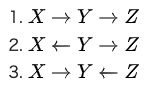 Type 1 and type 2 represent the same statistical dependencies (i.e., � {\displaystyle X} and � {\displaystyle Z} are independent given � {\displaystyle Y}) and are, therefore, indistinguishable within purely cross-sectional data. Type 3, however, can be uniquely identified, since � {\displaystyle X} and � {\displaystyle Z} are marginally independent and all other pairs are dependent. Thus, while the skeletons (the graphs stripped of arrows) of these three triplets are identical, the directionality of the arrows is partially identifiable. The same distinction applies when � {\displaystyle X} and � {\displaystyle Z} have common ancestors, except that one must first condition on those ancestors. Algorithms have been developed to systematically determine the skeleton of the underlying graph and, then, orient all arrows whose directionality is dictated by the conditional independencies observed.[33][36][37][38] Alternative methods of structure learning search through the many possible causal structures among the variables, and remove ones which are strongly incompatible with the observed correlations. In general this leaves a set of possible causal relations, which should then be tested by analyzing time series data or, preferably, designing appropriately controlled experiments. In contrast with Bayesian Networks, path analysis (and its generalization, structural equation modeling), serve better to estimate a known causal effect or to test a causal model than to generate causal hypotheses. For nonexperimental data, causal direction can often be inferred if information about time is available. This is because (according to many, though not all, theories) causes must precede their effects temporally. This can be determined by statistical time series models, for instance, or with a statistical test based on the idea of Granger causality, or by direct experimental manipulation. The use of temporal data can permit statistical tests of a pre-existing theory of causal direction. For instance, our degree of confidence in the direction and nature of causality is much greater when supported by cross-correlations, ARIMA models, or cross-spectral analysis using vector time series data than by cross-sectional data. https://en.wikipedia.org/wiki/Causality |
構造学習 因果計算における導出は因果グラフの構造に依存するが、特定の仮定の下では、因果構造の一部を統計データから学習することができる。この基本的な考え方 は、1921年にセウォール・ライトが発表した経路分析に関する研究[34]に遡る。RebaneとPearl(1987年)[35]によって、「回復」 アルゴリズムが開発された。これは、有向非循環グラフ(DAG)において許容される3つのタイプの因果部分構造に関するライトの区別に基づいている: タイプ1とタイプ2は、同じ統計的依存関係を表す(すなわち、� {\displaystyle X} と � {\displaystyle Z} は、 � {\displaystyle Y})であり、したがって純粋な横断面データ内では区別できない。しかし、タイプ3は、 � {\displaystyle X}と � {\displaystyle Z}が周辺的に独立しており、他のすべてのペアが依存関係にあるため、一意に特定できる。したがって、これら3つの3項組の骨格(矢印を除いたグラフ)は 同一であるが、矢印の方向性は部分的に識別可能である。 � {\displaystyle X} と � {\displaystyle Z} に共通の祖先がある場合にも同様の区別が適用されるが、その場合はまずそれらの祖先を条件付けなければならない。基礎となるグラフの骨格を体系的に決定 し、その後、観察された条件付き独立性によって方向性が決定されるすべての矢印の方向を定めるためのアルゴリズムが開発されている。[33][36] [37] [38] 構造学習の代替手法では、変数間の多くの可能な因果構造を探索し、観測された相関と強く矛盾するものを排除する。一般に、これにより一連の可能な因果関係 が残り、これらは時系列データの分析、あるいはより望ましいのは適切に制御された実験の設計によって検証されるべきである。ベイジアンネットワークとは対 照的に、パス分析(およびその一般化である構造方程式モデリング)は、因果仮説を生成するよりも、既知の因果効果を推定したり、因果モデルを検証したりす るのに適している。 非実験データの場合、時間に関する情報が利用可能であれば、因果の方向性を推論できることが多い。これは(すべてではないが多くの理論によれば)、原因は 時間的に結果に先行しなければならないからである。これは、例えば統計的時系列モデルや、グレンジャー因果性の概念に基づく統計的検定、あるいは直接的な 実験操作によって決定できる。時系列データを用いることで、既存の因果方向性に関する理論の統計的検定が可能となる。例えば、因果関係の方向性や性質に対 する確信度は、横断的データによる場合よりも、ベクトル時系列データを用いた相互相関、ARIMAモデル、あるいはクロススペクトル分析によって裏付けら れた場合の方が、はるかに高くなる。 https://en.wikipedia.org/wiki/Causality |
| Derivation theories Nobel laureate Herbert A. Simon and philosopher Nicholas Rescher[39] claim that the asymmetry of the causal relation is unrelated to the asymmetry of any mode of implication that contraposes. Rather, a causal relation is not a relation between values of variables, but a function of one variable (the cause) on to another (the effect). So, given a system of equations, and a set of variables appearing in these equations, we can introduce an asymmetric relation among individual equations and variables that corresponds perfectly to our commonsense notion of a causal ordering. The system of equations must have certain properties, most importantly, if some values are chosen arbitrarily, the remaining values will be determined uniquely through a path of serial discovery that is perfectly causal. They postulate the inherent serialization of such a system of equations may correctly capture causation in all empirical fields, including physics and economics. |
導出理論 ノーベル賞受賞者のハーバート・A・サイモンと哲学者ニコラス・レッシャー[39]は、因果関係の非対称性は、対置を行ういかなる含意の様式との非対称性 とも無関係であると主張している。むしろ、因果関係は変数の値間の関係ではなく、ある変数(原因)から別の変数(結果)への関数である。したがって、方程 式系と、これらの方程式に現れる変数の集合が与えられれば、個々の方程式と変数との間に、我々の常識的な因果順序の概念に完全に合致する非対称的な関係を 導入することができる。この連立方程式系は特定の性質を持たなければならない。最も重要なのは、一部の値が恣意的に選ばれたとしても、残りの値は完全に因 果的な一連の発見の過程を通じて一意に決定されるということだ。彼らは、このような連立方程式系に内在する一連化が、物理学や経済学を含むあらゆる経験的 分野における因果関係を正しく捉えることができると仮定している。 |
| Manipulation theories Some theorists have equated causality with manipulability.[40][41][42][43] Under these theories, x causes y only in the case that one can change x in order to change y. This coincides with commonsense notions of causations, since often we ask causal questions in order to change some feature of the world. For instance, we are interested in knowing the causes of crime so that we might find ways of reducing it. These theories have been criticized on two primary grounds. First, theorists complain that these accounts are circular. Attempting to reduce causal claims to manipulation requires that manipulation is more basic than causal interaction. But describing manipulations in non-causal terms has provided a substantial difficulty. The second criticism centers around concerns of anthropocentrism. It seems to many people that causality is some existing relationship in the world that we can harness for our desires. If causality is identified with our manipulation, then this intuition is lost. In this sense, it makes humans overly central to interactions in the world. Some attempts to defend manipulability theories are recent accounts that do not claim to reduce causality to manipulation. These accounts use manipulation as a sign or feature in causation without claiming that manipulation is more fundamental than causation.[33][44] |
操作理論 一部の理論家は、因果関係と操作可能性を同一視している。[40][41][42][43] これらの理論によれば、xがyを引き起こすのは、yを変えるためにxを変えることができる場合に限られる。これは、私たちがしばしば世界の何らかの特徴を 変えるために因果関係について問うことから、常識的な因果関係の概念と一致する。例えば、我々は犯罪を減らす方法を見つけるために、その原因を知りたいと 考える。 これらの理論は、主に2つの点で批判されてきた。第一に、理論家たちは、こうした説明が循環論法であると指摘する。因果的主張を操作に還元しようとするな ら、操作が因果的相互作用よりも基礎的な概念でなければならない。しかし、操作を非因果的な用語で記述することは、大きな困難を伴ってきた。 第二の批判は、人間中心主義への懸念に焦点を当てている。多くの人々にとって、因果関係とは、我々の欲望のために利用し得る、世界に実在する関係であるよ うに思われる。もし因果関係が我々の操作と同一視されるならば、この直観は失われる。この意味で、それは世界における相互作用において人間を過度に中心的 な存在にしてしまう。 操作可能性理論を擁護しようとする最近の試みの中には、因果関係を操作に還元するとは主張しないものがある。これらの説明では、操作が因果関係よりも根本 的であると主張することなく、操作を因果関係における兆候や特徴として用いている。[33][44] |
| Process theories Some theorists are interested in distinguishing between causal processes and non-causal processes (Russell 1948; Salmon 1984).[45][46] These theorists often want to distinguish between a process and a pseudo-process. As an example, a ball moving through the air (a process) is contrasted with the motion of a shadow (a pseudo-process). The former is causal in nature while the latter is not. Salmon (1984)[45] claims that causal processes can be identified by their ability to transmit an alteration over space and time. An alteration of the ball (a mark by a pen, perhaps) is carried with it as the ball goes through the air. On the other hand, an alteration of the shadow (insofar as it is possible) will not be transmitted by the shadow as it moves along. These theorists claim that the important concept for understanding causality is not causal relationships or causal interactions, but rather identifying causal processes. The former notions can then be defined in terms of causal processes. 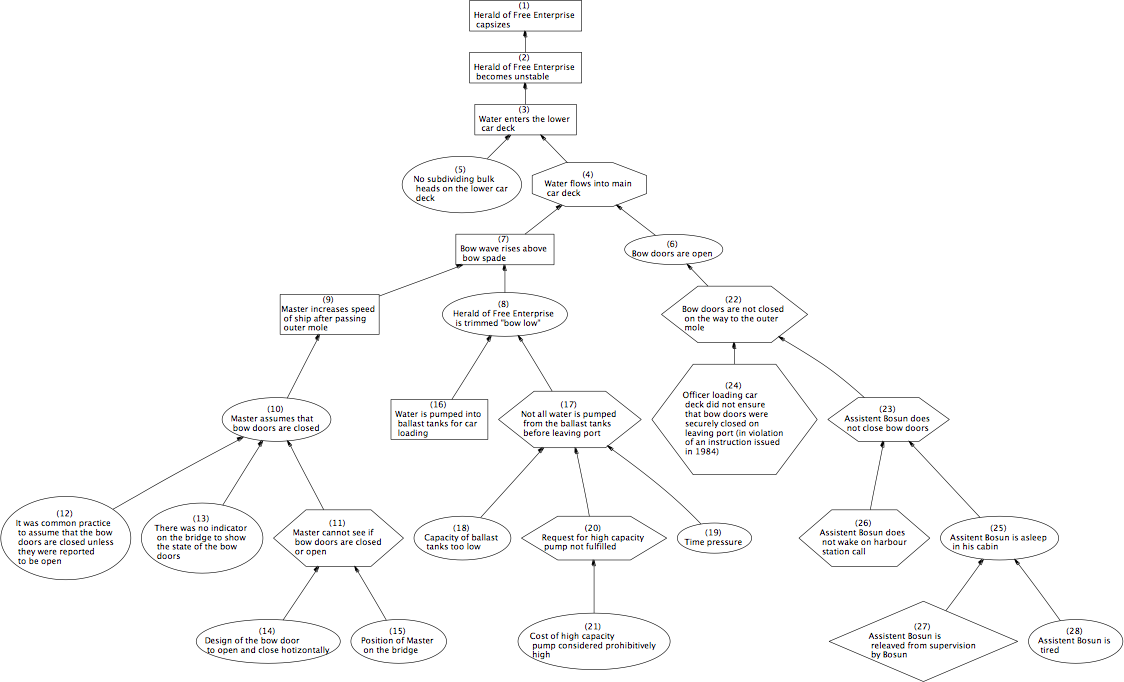 A subgroup of the process theories is the mechanistic view on causality. It states that causal relations supervene on mechanisms. While the notion of mechanism is understood differently, the definition put forward by the group of philosophers referred to as the 'New Mechanists' dominate the literature.[47] |
プロセス理論 一部の理論家は、因果的プロセスと非因果的プロセスを区別することに興味を持っている(ラッセル 1948; サーモン 1984)。[45][46] これらの理論家は、しばしばプロセスと疑似プロセスを区別しようとする。例として、空中を移動するボール(プロセス)は、影の動き(疑似プロセス)と対比 される。前者は本質的に因果的であるが、後者はそうではない。 サーモン(1984)[45]は、因果的プロセスは、空間と時間を超えて変化を伝達する能力によって識別できると主張する。ボールへの変化(例えばペンに よる印)は、ボールが空中を移動するにつれてそれに伴って運ばれる。一方、影の変化(それが可能である限り)は、影が移動するにつれて伝達されることはな い。 これらの理論家たちは、因果性を理解するための重要な概念は、因果関係や因果的相互作用ではなく、むしろ因果的プロセスを特定することであると主張する。 そうすれば、前者の概念は因果的プロセスに基づいて定義することができる。 プロセス理論の一派に、因果性に関する機械論的見解がある。これは、因果関係がメカニズムに随伴すると主張するものである。メカニズムの概念については異 なる解釈があるが、いわゆる「新機械論者」と呼ばれる哲学者グループが提唱した定義が、関連文献において主流となっている。[47] |
| Fields Science For the scientific investigation of efficient causality, the cause and effect are each best conceived of as temporally transient processes. Within the conceptual frame of the scientific method, an investigator sets up several distinct and contrasting temporally transient material processes that have the structure of experiments, and records candidate material responses, normally intending to determine causality in the physical world.[48] For instance, one may want to know whether a high intake of carrots causes humans to develop the bubonic plague. The quantity of carrot intake is a process that is varied from occasion to occasion. The occurrence or non-occurrence of subsequent bubonic plague is recorded. To establish causality, the experiment must fulfill certain criteria, only one example of which is mentioned here. For example, instances of the hypothesized cause must be set up to occur at a time when the hypothesized effect is relatively unlikely in the absence of the hypothesized cause; such unlikelihood is to be established by empirical evidence. A mere observation of a correlation is not nearly adequate to establish causality. In nearly all cases, establishment of causality relies on repetition of experiments and probabilistic reasoning. Hardly ever is causality established more firmly than as more or less probable. It is most convenient for establishment of causality if the contrasting material states of affairs are precisely matched, except for only one variable factor, perhaps measured by a real number. |
分野 科学 効率的因果関係の科学的探究においては、原因と結果はそれぞれ、時間的に一過性のプロセスとして捉えるのが最適である。 科学的方法の概念的枠組みにおいて、研究者は実験の構造を持つ、互いに区別され対照的な複数の時間的に一過性の物質的プロセスを設定し、候補となる物質的 反応を記録する。通常、その目的は物理世界における因果関係を特定することにある。[48] 例えば、ニンジンの大量摂取が人間に腺ペストを発症させるかどうかを知りたい場合がある。ニンジンの摂取量は、その都度変化するプロセスである。その後、 腺ペストが発生するか否かが記録される。因果関係を確立するためには、実験が一定の基準を満たさなければならないが、ここではその一例のみを挙げる。例え ば、仮説上の原因が存在しない場合には仮説上の結果が生じる可能性が比較的低いという状況下で、仮説上の原因が生じるように設定しなければならない。その ような低可能性は、経験的証拠によって立証されなければならない。相関関係の単なる観察だけでは、因果関係を確立するには到底不十分である。ほとんどすべ てのケースにおいて、因果関係の確立は実験の反復と確率的推論に依存している。因果関係が「多かれ少なかれ確率的」という程度以上に確固として確立される ことは、ほとんどない。対照となる状況が、実数で測定されるかもしれない単一の変数要因を除いて、正確に一致している場合、因果関係の確立には最も都合が 良い。 |
| Physics Main article: Causality (physics) One has to be careful in the use of the word cause in physics. Properly speaking, the hypothesized cause and the hypothesized effect are each temporally transient processes. For example, force is a useful concept for the explanation of acceleration, but force is not by itself a cause. More is needed. For example, a temporally transient process might be characterized by a definite change of force at a definite time. Such a process can be regarded as a cause. Causality is not inherently implied in equations of motion, but postulated as an additional constraint that needs to be satisfied (i.e. a cause always precedes its effect). This constraint has mathematical implications[49] such as the Kramers-Kronig relations. Causality is one of the most fundamental and essential notions of physics.[50] Causal efficacy cannot 'propagate' faster than light. Otherwise, reference coordinate systems could be constructed (using the Lorentz transform of special relativity) in which an observer would see an effect precede its cause (i.e. the postulate of causality would be violated). Causal notions appear in the context of the flow of mass-energy. Any actual process has causal efficacy that can propagate no faster than light. In contrast, an abstraction has no causal efficacy. Its mathematical expression does not propagate in the ordinary sense of the word, though it may refer to virtual or nominal 'velocities' with magnitudes greater than that of light. For example, wave packets are mathematical objects that have group velocity and phase velocity. The energy of a wave packet travels at the group velocity (under normal circumstances); since energy has causal efficacy, the group velocity cannot be faster than the speed of light. The phase of a wave packet travels at the phase velocity; since phase is not causal, the phase velocity of a wave packet can be faster than light.[51] Causal notions are important in general relativity to the extent that the existence of an arrow of time demands that the universe's semi-Riemannian manifold be orientable, so that "future" and "past" are globally definable quantities. |
物理学 主な記事:因果関係(物理学) 物理学において「原因」という言葉を使う際には注意が必要だ。厳密に言えば、仮説上の原因と仮説上の結果は、いずれも時間的に一過性の過程である。例え ば、力は加速度を説明する上で有用な概念だが、力そのものが原因というわけではない。それ以上の要素が必要となる。例えば、時間的に一過性の過程は、特定 の時刻における力の明確な変化によって特徴づけられることがある。そのような過程は原因と見なすことができる。因果関係は運動方程式に本質的に含まれてい るわけではなく、満たされるべき追加の制約(すなわち、原因は常に結果に先行する)として仮定される。この制約には、クラマース・クローニヒの関係式のよ うな数学的な含意がある[49]。 因果関係は、物理学において最も基本的かつ不可欠な概念の一つである[50]。因果的効力は光速を超えて「伝播」することはできない。そうでなければ、 (特殊相対性理論のローレンツ変換を用いて)ある観測者が原因に先立って結果を目撃するような参照座標系を構築できてしまうことになる(すなわち、因果関 係の仮定が破られることになる)。 因果性の概念は、質量・エネルギーの流れという文脈において現れる。いかなる実際の過程も、光速を超えて伝播することのできない因果的効力を有する。対照 的に、抽象概念には因果的効力がない。その数学的表現は、通常の意味での「伝播」はしないが、光速を超える大きさを持つ仮想的または名目上の「速度」を指 すことはあり得る。例えば、波動包は群速度と位相速度を持つ数学的対象である。波動包のエネルギーは(通常の状況下では)群速度で伝播する。エネルギーに は因果的効力があるため、群速度は光速を超えることはできない。波動包の位相は位相速度で伝播する。位相には因果性がないため、波動包の位相速度は光速を 超えることができる。[51] 因果的な概念は一般相対性理論において重要であり、時間の矢の存在は、宇宙の半リーマン多様体が可微分であることを要求する。それによって、「未来」と 「過去」が全域的に定義可能な量となるのである。 |
| Engineering A causal system is a system with output and internal states that depends only on the current and previous input values. A system that has some dependence on input values from the future (in addition to possible past or current input values) is termed an acausal system, and a system that depends solely on future input values is an anticausal system. Acausal filters, for example, can only exist as postprocessing filters, because these filters can extract future values from a memory buffer or a file. We have to be very careful with causality in physics and engineering. Cellier, Elmqvist, and Otter[52] describe causality forming the basis of physics as a misconception, because physics is essentially acausal. In their article they cite a simple example: "The relationship between voltage across and current through an electrical resistor can be described by Ohm's law: V = IR, yet, whether it is the current flowing through the resistor that causes a voltage drop, or whether it is the difference between the electrical potentials on the two wires that causes current to flow is, from a physical perspective, a meaningless question". In fact, if we explain cause-effect using the law, we need two explanations to describe an electrical resistor: as a voltage-drop-causer or as a current-flow-causer. There is no physical experiment in the world that can distinguish between action and reaction. |
工学 因果的システムとは、出力と内部状態が、現在および過去の入力値のみに依存するシステムのことである。将来の入力値(過去の入力値や現在の入力値に加え て)に何らかの依存性を持つシステムは非因果的システムと呼ばれ、将来の入力値のみに依存するシステムは反因果的システムである。例えば、非因果的フィル タは、メモリバッファやファイルから将来の値を抽出できるため、後処理フィルタとしてのみ存在し得る。 物理学や工学において、因果性については細心の注意を払わなければならない。Cellier、Elmqvist、およびOtter[52]は、物理学の本 質は非因果的であるため、物理学の基礎を成す因果性を誤解であると述べている。彼らの論文では、次のような単純な例が挙げられている。「電気抵抗器の両端 の電圧と、抵抗器を流れる電流の関係は、オームの法則(V = IR)で記述できる。しかし、抵抗器を流れる電流が電圧降下を引き起こすのか、それとも2本の導線上の電位差が電流を流す原因となるのかは、物理的な観点 からは無意味な問いである」。実際、この法則を用いて因果関係を説明する場合、電気抵抗器を記述するには二つの説明が必要となる。すなわち、電圧降下の原 因として、あるいは電流の流れる原因としてである。作用と反作用を区別できる物理実験は、この世に存在しない。 |
Biology, medicine and
epidemiology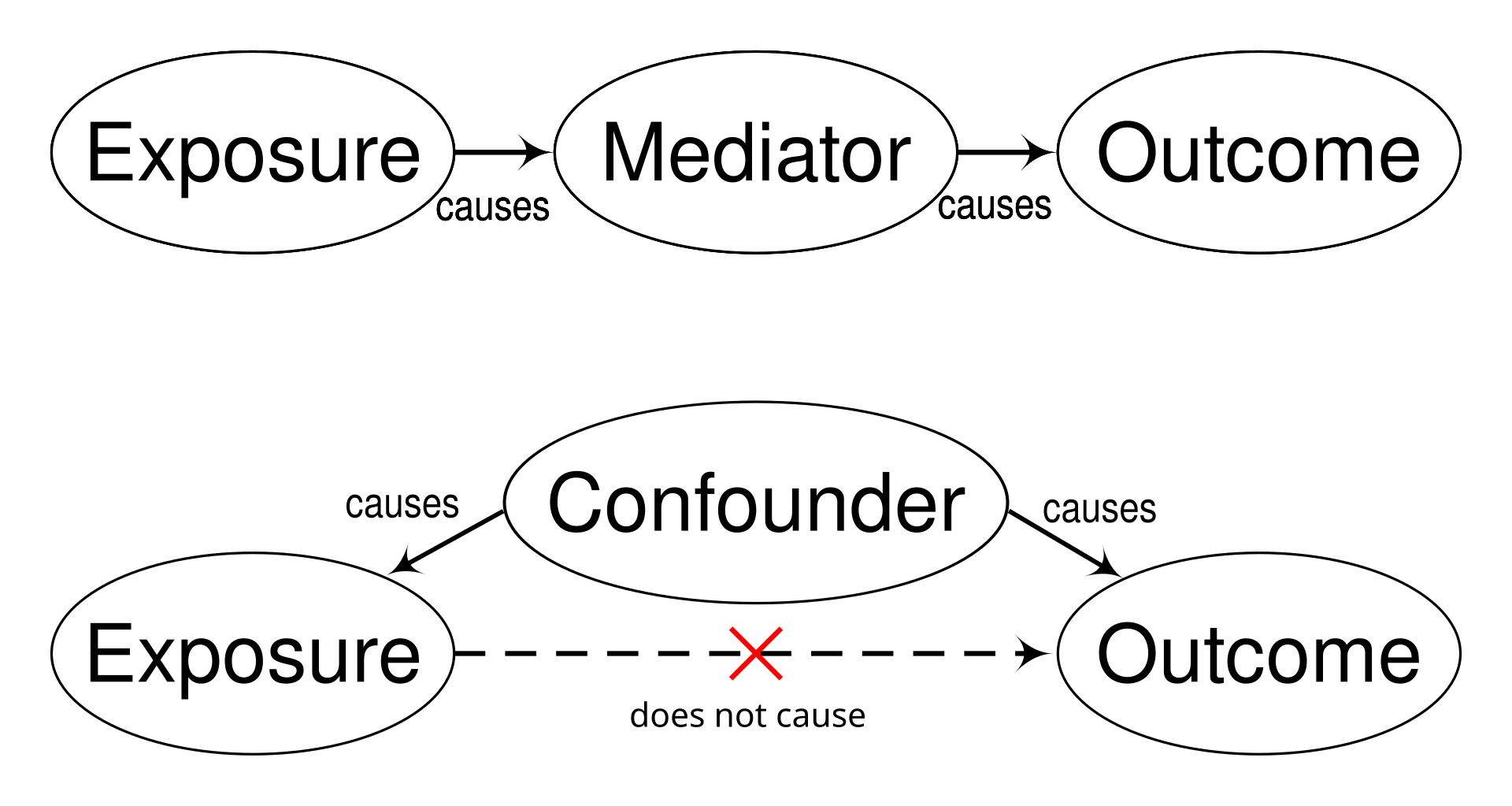 Whereas a mediator is a factor in the causal chain (top), a confounder is a spurious factor incorrectly suggesting causation (bottom). Austin Bradford Hill built upon the work of Hume and Popper and suggested in his paper "The Environment and Disease: Association or Causation?" that aspects of an association such as strength, consistency, specificity, and temporality be considered in attempting to distinguish causal from noncausal associations in the epidemiological situation. (See Bradford Hill criteria.) He did not note however, that temporality is the only necessary criterion among those aspects. Directed acyclic graphs (DAGs) are increasingly used in epidemiology to help enlighten causal thinking.[53] Causality plays an essential role in the field of Network Physiology[54][55][56]to study the mechanisms through which physiological and organ systems exchange, process, and integrate information within an adaptive dynamic network to generate states and functions at the organism level[57][58][59]. |
生物学、医学、疫学 媒介因子は因果関係の連鎖における要因であるのに対し(上)、交絡因子は誤って因果関係を示唆する偽の要因である(下)。 オースティン・ブラッドフォード・ヒルはヒュームとポッパーの研究を基に、論文「環境と疾病:関連か因果か?」において、疫学的な状況下で因果的な関連と 非因果的な関連を区別しようとする際には、関連の強さ、一貫性、特異性、時間的関係といった側面を考慮すべきであると提唱した。(ブラッドフォード・ヒル の基準を参照。)しかし彼は、これらの側面の中で時間的関係だけが唯一の必須基準であるとは指摘しなかった。有向非循環グラフ(DAG)は、因果的思考を 明確にするために疫学においてますます多用されている。[53] 因果性は、ネットワーク生理学の分野において不可欠な役割を果たしている[54][55][56]。これは、適応的な動的ネットワーク内で、生理学的シス テムや臓器系が情報を交換、処理、統合し、生物体レベルでの状態や機能を生成するメカニズムを研究するためである[57][58][59]。 |
| Psychology Main article: Causal reasoning Psychologists take an empirical approach to causality, investigating how people and non-human animals detect or infer causation from sensory information, prior experience and innate knowledge. Attribution: Attribution theory is the theory concerning how people explain individual occurrences of causation. Attribution can be external (assigning causality to an outside agent or force—claiming that some outside thing motivated the event) or internal (assigning causality to factors within the person—taking personal responsibility or accountability for one's actions and claiming that the person was directly responsible for the event). Taking causation one step further, the type of attribution a person provides influences their future behavior. The intention behind the cause or the effect can be covered by the subject of action. See also accident; blame; intent; and responsibility. Causal powers Whereas David Hume argued that causes are inferred from non-causal observations, Immanuel Kant claimed that people have innate assumptions about causes. Within psychology, Patricia Cheng[9] attempted to reconcile the Humean and Kantian views. According to her power PC theory, people filter observations of events through an intuition that causes have the power to generate (or prevent) their effects, thereby inferring specific cause-effect relations. Causation and salience Our view of causation depends on what we consider to be the relevant events. Another way to view the statement, "Lightning causes thunder" is to see both lightning and thunder as two perceptions of the same event, viz., an electric discharge that we perceive first visually and then aurally. Naming and causality David Sobel and Alison Gopnik from the Psychology Department of UC Berkeley designed a device known as the blicket detector which would turn on when an object was placed on it. Their research suggests that "even young children will easily and swiftly learn about a new causal power of an object and spontaneously use that information in classifying and naming the object."[60] Perception of launching events Some researchers such as Anjan Chatterjee at the University of Pennsylvania and Jonathan Fugelsang at the University of Waterloo are using neuroscience techniques to investigate the neural and psychological underpinnings of causal launching events in which one object causes another object to move. Both temporal and spatial factors can be manipulated.[61] See Causal Reasoning (Psychology) for more information. Statistics and economics See also: Causal graph Statistics and economics usually employ pre-existing data or experimental data to infer causality by regression methods. The body of statistical techniques involves substantial use of regression analysis. Typically a linear relationship such as  {\displaystyle y_{i}} is the ith
observation of the dependent variable (hypothesized to be the caused
variable),
�
�
,
�
{\displaystyle x_{j,i}} for j=1,...,k is the ith observation on the jth
independent variable (hypothesized to be a causative variable), and
�
�
{\displaystyle e_{i}} is the error term for the ith observation
(containing the combined effects of all other causative variables,
which must be uncorrelated with the included independent variables). If
there is reason to believe that none of the
�
�
{\displaystyle x_{j}}s is caused by y, then estimates of the
coefficients
�
�
{\displaystyle a_{j}} are obtained. If the null hypothesis that
�
�
=
0
{\displaystyle a_{j}=0} is rejected, then the alternative hypothesis
that
�
�
≠
0
{\displaystyle a_{j}\neq 0} and equivalently that
�
�
{\displaystyle x_{j}} causes y cannot be rejected. On the other hand,
if the null hypothesis that
�
�
=
0
{\displaystyle a_{j}=0} cannot be rejected, then equivalently the
hypothesis of no causal effect of
�
�
{\displaystyle x_{j}} on y cannot be rejected. Here the notion of
causality is one of contributory causality as discussed above: If the
true value
�
�
≠
0
{\displaystyle a_{j}\neq 0}, then a change in
�
�
{\displaystyle x_{j}} will result in a change in y unless some other
causative variable(s), either included in the regression or implicit in
the error term, change in such a way as to exactly offset its effect;
thus a change in
�
�
{\displaystyle x_{j}} is not sufficient to change y. Likewise, a change
in
�
�
{\displaystyle x_{j}} is not necessary to change y, because a change in
y could be caused by something implicit in the error term (or by some
other causative explanatory variable included in the model).
The above way of testing for causality requires belief that there is no
reverse causation, in which y would cause
�
�
{\displaystyle x_{j}}. This belief can be established in one of several
ways. First, the variable
�
�
{\displaystyle x_{j}} may be a non-economic variable: for example, if
rainfall amount
�
�
{\displaystyle x_{j}}is hypothesized to affect the
futures price y of
some agricultural commodity, it is impossible that in fact the futures
price affects rainfall amount (provided that cloud seeding is never
attempted). Second, the instrumental variables technique may be
employed to remove any reverse causation by introducing a role for
other variables (instruments) that are known to be unaffected by the
dependent variable. Third, the principle that effects cannot precede
causes can be invoked, by including on the right side of the regression
only variables that precede in time the dependent variable; this
principle is invoked, for example, in testing for Granger causality and
in its multivariate analog, vector autoregression, both of which
control for lagged values of the dependent variable while testing for
causal effects of lagged independent variables. {\displaystyle y_{i}} is the ith
observation of the dependent variable (hypothesized to be the caused
variable),
�
�
,
�
{\displaystyle x_{j,i}} for j=1,...,k is the ith observation on the jth
independent variable (hypothesized to be a causative variable), and
�
�
{\displaystyle e_{i}} is the error term for the ith observation
(containing the combined effects of all other causative variables,
which must be uncorrelated with the included independent variables). If
there is reason to believe that none of the
�
�
{\displaystyle x_{j}}s is caused by y, then estimates of the
coefficients
�
�
{\displaystyle a_{j}} are obtained. If the null hypothesis that
�
�
=
0
{\displaystyle a_{j}=0} is rejected, then the alternative hypothesis
that
�
�
≠
0
{\displaystyle a_{j}\neq 0} and equivalently that
�
�
{\displaystyle x_{j}} causes y cannot be rejected. On the other hand,
if the null hypothesis that
�
�
=
0
{\displaystyle a_{j}=0} cannot be rejected, then equivalently the
hypothesis of no causal effect of
�
�
{\displaystyle x_{j}} on y cannot be rejected. Here the notion of
causality is one of contributory causality as discussed above: If the
true value
�
�
≠
0
{\displaystyle a_{j}\neq 0}, then a change in
�
�
{\displaystyle x_{j}} will result in a change in y unless some other
causative variable(s), either included in the regression or implicit in
the error term, change in such a way as to exactly offset its effect;
thus a change in
�
�
{\displaystyle x_{j}} is not sufficient to change y. Likewise, a change
in
�
�
{\displaystyle x_{j}} is not necessary to change y, because a change in
y could be caused by something implicit in the error term (or by some
other causative explanatory variable included in the model).
The above way of testing for causality requires belief that there is no
reverse causation, in which y would cause
�
�
{\displaystyle x_{j}}. This belief can be established in one of several
ways. First, the variable
�
�
{\displaystyle x_{j}} may be a non-economic variable: for example, if
rainfall amount
�
�
{\displaystyle x_{j}}is hypothesized to affect the
futures price y of
some agricultural commodity, it is impossible that in fact the futures
price affects rainfall amount (provided that cloud seeding is never
attempted). Second, the instrumental variables technique may be
employed to remove any reverse causation by introducing a role for
other variables (instruments) that are known to be unaffected by the
dependent variable. Third, the principle that effects cannot precede
causes can be invoked, by including on the right side of the regression
only variables that precede in time the dependent variable; this
principle is invoked, for example, in testing for Granger causality and
in its multivariate analog, vector autoregression, both of which
control for lagged values of the dependent variable while testing for
causal effects of lagged independent variables.Regression analysis controls for other relevant variables by including them as regressors (explanatory variables). This helps to avoid false inferences of causality due to the presence of a third, underlying, variable that influences both the potentially causative variable and the potentially caused variable: its effect on the potentially caused variable is captured by directly including it in the regression, so that effect will not be picked up as an indirect effect through the potentially causative variable of interest. Given the above procedures, coincidental (as opposed to causal) correlation can be probabilistically rejected if data samples are large and if regression results pass cross-validation tests showing that the correlations hold even for data that were not used in the regression. Asserting with certitude that a common-cause is absent and the regression represents the true causal structure is in principle impossible.[62] The problem of omitted variable bias, however, has to be balanced against the risk of inserting Causal colliders, in which the addition of a new variable � � + 1 {\displaystyle x_{j+1}} induces a correlation between � � {\displaystyle x_{j}} and � {\displaystyle y} via Berkson's paradox.[33] Apart from constructing statistical models of observational and experimental data, economists use axiomatic (mathematical) models to infer and represent causal mechanisms. Highly abstract theoretical models that isolate and idealize one mechanism dominate microeconomics. In macroeconomics, economists use broad mathematical models that are calibrated on historical data. A subgroup of calibrated models, dynamic stochastic general equilibrium (DSGE) models are employed to represent (in a simplified way) the whole economy and simulate changes in fiscal and monetary policy.[63] Statistical and economic analyses often rely on regression methods applied to observational or pre‑existing data to infer causal relationships[64]. Experimental designs, in contrast, establish causality by systematically manipulating independent variables under controlled conditions[65]. Experiments therefore provide stronger internal validity[66] because causal mechanisms are demonstrated directly rather than inferred from patterns in observational data[67]. |
心理学 主な記事:因果推論 心理学者は因果関係に対して実証的なアプローチを取り、人間や動物が感覚情報、過去の経験、生得的な知識からどのように因果関係を検知または推論するかを 調査している。 帰属:帰属理論とは、人々が個々の因果関係の発生をどのように説明するかに関する理論である。帰属には、外的帰属(外部の要因や力に因果関係を帰する―― 何らかの外部要因が事象を引き起こしたと主張すること)と、内的帰属(個人の内的要因に因果関係を帰する――自身の行動に対して個人的な責任や説明責任を 負い、その人物が事象に対して直接責任があると主張すること)がある。因果関係をさらに一歩進めると、人がどのような帰属を行うかによって、その人の将来 の行動に影響が及ぶ。 原因や結果の背後にある意図は、行為主体によって説明されることがある。関連項目:事故、非難、意図、責任。 因果的力 デヴィッド・ヒュームは、原因は非因果的な観察から推論されると主張したのに対し、イマヌエル・カントは、人間には原因に関する生得的な前提があると主張 した。心理学の分野では、パトリシア・チェン[9]がヒューム的見解とカント的見解の調和を図ろうとした。彼女の「力PC理論」によれば、人間は、原因に はその効果を生み出す(あるいは防ぐ)力があるという直観を通じて事象の観察をフィルタリングし、それによって特定の因果関係を推論する。 因果関係と顕著性 因果関係に対する我々の見方は、何が関連する出来事であるかという認識に依存する。「稲妻が雷を引き起こす」という主張を別の角度から見るなら、稲妻と雷 を同一の出来事、すなわち、まず視覚的に、次に聴覚的に知覚される放電現象の二つの知覚として捉えることができる。 命名と因果性 カリフォルニア大学バークレー校心理学部のデビッド・ソベルとアリソン・ゴプニックは、「ブリケット・ディテクター」と呼ばれる装置を設計した。これは、 物体が置かれると作動するものである。彼らの研究によれば、「幼い子供でさえ、物体の新たな因果的力について容易かつ迅速に学び、その情報を自発的に用い て物体を分類し、命名する」ことが示唆されている。[60] 発動事象の知覚 ペンシルベニア大学のアンジャン・チャタジーやウォータールー大学のジョナサン・フゲルサングら一部の研究者は、ある物体が別の物体の動きを引き起こす 「因果的な発動事象」の神経学的・心理学的基盤を解明するため、神経科学の手法を用いている。時間的要因と空間的要因の両方を操作することが可能である。 [61] 詳細については「因果推論(心理学)」を参照のこと。 統計学と経済学 関連項目:因果グラフ 統計学と経済学では通常、既存のデータや実験データを用いて回帰分析法により因果関係を推論する。統計的手法の体系には、回帰分析の多用が含まれる。典型 的には、次のような線形関係が用いられる。 {\displaystyle y_{i}=a_{0}+a_{1}x_{1,i}+a_{2}x_{2,i}+\dots +a_{k}x_{k,i}+e_{i}} が仮定され、ここで � � {\displaystyle y_{i}} は従属変数(原因変数であると仮定される)の i 番目の観測値であり、 � � , � {\displaystyle x_{j,i}} (j=1,...,k)は j 番目の独立変数(原因変数であると仮定される)の i 番目の観測値であり、 � � {\displaystyle e_{i}} は i 番目の観測値に対する誤差項であり(他のすべての原因変数の複合効果を含み、これらは含まれる独立変数と無相関でなければならない)。 � � {\displaystyle x_{j}} のいずれもが y によって引き起こされていないと考える理由がある場合、係数 � � {\displaystyle a_{j}} の推定値が得られる。 � � = 0 {\displaystyle a_{j}=0}という帰無仮説が棄却される場合、 � � ≠ 0 {\displaystyle a_{j}\neq 0}という対立仮説、すなわち � � {\displaystyle x_{j}}がyを引き起こすという仮説は棄却できない。一方、 � � = 0 {\displaystyle a_{j}=0} を棄却できない場合、等価的に、 � � {\displaystyle x_{j}} が y に与える因果効果がないという仮説も棄却できない。ここでいう因果性の概念は、前述の寄与的因果性である。もし真の値 � � ≠ 0 {\displaystyle a_{j}\neq 0} であるならば、 � � {\displaystyle x_{j}} の変化は、回帰モデルに含まれるか、あるいは誤差項に暗黙的に含まれる他の因果変数が、その効果を正確に相殺するような形で変化しない限り、y の変化をもたらすことになる。したがって、 � � {\displaystyle x_{j}} の変化だけでは y を変化させるには十分ではない。同様に、 � � {\displaystyle x_{j}} の変化は y を変化させるために必要ではない。なぜなら、y の変化は誤差項に暗黙的に含まれる何か(あるいはモデルに含まれる他の因果的説明変数)によって引き起こされる可能性があるからである。 上記の因果関係の検定方法は、yが � � {\displaystyle x_{j}}を引き起こすという逆の因果関係が存在しないという前提を必要とする。この前提はいくつかの方法で確立できる。第一に、変数 � � {\displaystyle x_{j}}が非経済変数である場合である。例えば、降水量が � � {\displaystyle x_{j}} が、ある農産物の先物価格yに影響を与えると仮定される場合、実際には先物価格が降水量に影響を与えることはあり得ない(人工降雨が試みられ ることがないという前提の下で)。第二に、従属変数の影響を受けないことが知られている他の変数(計器変数)を導入することで、逆因果関係を排除するため に計器変数法を用いることができる。第三に、回帰式の右辺に、従属変数より時間的に先行する変数のみを含めることで、「効果は原因に先行し得ない」という 原則を適用できる。この原則は、例えばグレンジャー因果性の検定や、その多変量版であるベクトル自己回帰(VAR)において用いられており、いずれも遅行 した従属変数の値を制御しつつ、遅行した独立変数の因果的効果を検定するものである。 回帰分析では、他の関連変数を説明変数として含めることで、それらを調整する。これにより、潜在的な原因変数と潜在的な結果変数の両方に影響を与える第三 の潜在変数の存在による、誤った因果関係の推論を回避できる。その変数が潜在的な結果変数に及ぼす影響は、回帰分析に直接含めることで捕捉されるため、そ の影響が関心のある潜在的な原因変数を通じた間接的な影響として検出されることはない。上記の手順を踏まえると、データサンプルが十分に大きく、かつ回帰 結果が交差検証テストに合格し(回帰に使用されなかったデータにおいても相関が成立することを示す場合)、因果的ではない(偶然の)相関を確率的に棄却す ることができる。共通要因が存在せず、回帰が真の因果構造を表していると断言することは、原則として不可能である。[62] しかし、省略変数バイアスの問題は、因果的コライダーを導入するリスクと天秤にかけなければならない。因果的コライダーとは、新しい変数 � � + 1 {\displaystyle x_{j+1}} を追加することで、バークソンのパラドックスを介して � � {\displaystyle x_{j}} と � {\displaystyle y} の間に相関が生じる現象である。[33] 観察データや実験データの統計モデルを構築することに加え、経済学者は公理的(数学的)モデルを用いて因果メカニズムを推論し、表現する。一つのメカニズ ムを孤立させ理想化した、高度に抽象的な理論モデルがミクロ経済学を支配している。マクロ経済学では、経済学者は歴史的データに基づいて調整された広範な 数学的モデルを用いる。調整済みモデルの一種である動学的確率的一般均衡(DSGE)モデルは、経済全体を(簡略化した形で)表現し、財政政策や金融政策 の変化をシミュレートするために用いられる。[63] 統計的・経済的分析は、因果関係を推論するために、観察データや既存のデータに回帰分析法を適用することが多い[64]。対照的に、実験デザインは、制御 された条件下で独立変数を体系的に操作することで因果関係を確立する[65]。したがって、実験は、観察データのパターンから推論するのではなく、因果メ カニズムを直接実証するため、より強い内部妥当性を提供する[66][67]。 |
Management Used in management and engineering, an Ishikawa diagram shows the factors that cause the effect. Smaller arrows connect the sub-causes to major causes. For quality control in manufacturing in the 1960s, Kaoru Ishikawa developed a cause and effect diagram, known as an Ishikawa diagram or fishbone diagram. The diagram categorizes causes, such as into the six main categories shown here. These categories are then sub-divided. Ishikawa's method identifies "causes" in brainstorming sessions conducted among various groups involved in the manufacturing process. These groups can then be labeled as categories in the diagrams. The use of these diagrams has now spread beyond quality control, and they are used in other areas of management and in design and engineering. Ishikawa diagrams have been criticized for failing to make the distinction between necessary conditions and sufficient conditions. It seems that Ishikawa was not even aware of this distinction.[68] |
経営 経営や工学の分野で使用される石川図は、結果を引き起こす要因を示すものである。小さな矢印が、主要な原因とそれに関連する二次的な原因をつなぐ。 1960年代の製造業における品質管理のために、石川馨は「石川図」または「フィッシュボーン図」として知られる原因と結果の図を開発した。この図は、こ こに示す6つの主要なカテゴリーなどに原因を分類する。これらのカテゴリーはさらに細分化される。石川の手法では、製造プロセスに関わる様々なグループに よるブレインストーミングを通じて「原因」を特定する。これらのグループは、図表上で各カテゴリーとしてラベル付けされる。この図表の使用は現在、品質管 理の枠を超えて広がり、経営の他の分野や設計、エンジニアリングでも用いられている。石川図は、必要条件と十分条件の区別ができていないという批判を受け ている。石川自身、この区別を認識していなかったようだ。[68] |
| Humanities History In the discussion of history, events are sometimes considered as if in some way being agents that can then bring about other historical events. Thus, the combination of poor harvests, the hardships of the peasants, high taxes, lack of representation of the people, and kingly ineptitude are among the causes of the French Revolution. This is a somewhat Platonic and Hegelian view that reifies causes as ontological entities. In Aristotelian terminology, this use approximates to the case of the efficient cause. Some philosophers of history such as Arthur Danto have claimed that "explanations in history and elsewhere" describe "not simply an event—something that happens—but a change".[69] Like many practicing historians, they treat causes as intersecting actions and sets of actions which bring about "larger changes", in Danto's words: to decide "what are the elements which persist through a change" is "rather simple" when treating an individual's "shift in attitude", but "it is considerably more complex and metaphysically challenging when we are interested in such a change as, say, the break-up of feudalism or the emergence of nationalism".[70] Much of the historical debate about causes has focused on the relationship between communicative and other actions, between singular and repeated ones, and between actions, structures of action or group and institutional contexts and wider sets of conditions.[71] John Gaddis has distinguished between exceptional and general causes (following Marc Bloch) and between "routine" and "distinctive links" in causal relationships: "in accounting for what happened at Hiroshima on August 6, 1945, we attach greater importance to the fact that President Truman ordered the dropping of an atomic bomb than to the decision of the Army Air Force to carry out his orders."[72] He has also pointed to the difference between immediate, intermediate and distant causes.[73] For his part, Christopher Lloyd puts forward four "general concepts of causation" used in history: the "metaphysical idealist concept, which asserts that the phenomena of the universe are products of or emanations from an omnipotent being or such final cause"; "the empiricist (or Humean) regularity concept, which is based on the idea of causation being a matter of constant conjunctions of events"; "the functional/teleological/consequential concept", which is "goal-directed, so that goals are causes"; and the "realist, structurist and dispositional approach, which sees relational structures and internal dispositions as the causes of phenomena".[74] |
人文学 歴史 歴史論において、出来事は、あたかも何らかの形で主体となり、他の歴史的出来事を引き起こし得るかのように捉えられることがある。したがって、不作、農民 の苦難、重税、民衆の代表権の欠如、そして王の無能さといった要素の組み合わせが、フランス革命の原因の一つとされる。これは、原因を存在論的な実体とし て物象化する、ある種プラトン的かつヘーゲル的な見解である。アリストテレス的な用語法を用いれば、この用法は「効率的原因」のケースに近い。 アーサー・ダントのような一部の歴史哲学者は、「歴史やその他の分野における説明」は「単に出来事――起こる何か――ではなく、変化」を記述するものであ ると主張してきた。[69] 多くの実務的な歴史家と同様、彼らは原因を、「より大きな変化」をもたらす交差する行動や一連の行動として扱う。ダントの言葉を借りれば、「変化を通じて 持続する要素は何か」を決定することは、個人の「態度の変化」を扱う場合には「かなり単純」だが、 「例えば封建制の崩壊やナショナリズムの台頭といった変化に関心を向ける場合、それはかなり複雑であり、形而上学的な難題となる」[70] 原因に関する歴史的議論の多くは、伝達的行為とその他の行為、単発的な行為と反復的な行為、そして行為、行為の構造、あるいは集団や制度的文脈と、より広 範な条件群との関係に焦点を当ててきた。[71] ジョン・ガディスは(マルク・ブロクに倣い)例外的な原因と一般的な原因を区別し、因果関係における「日常的な」連関と「特異な」連関を区別している。 「1945年8月6日に広島で何が起きたかを説明する際、我々は、陸軍航空隊がその命令を実行するという決定よりも、トルーマン大統領が原子爆弾の投下を 命じたという事実に、より大きな重要性を置く。」 [72] 彼はまた、直接的原因、中間的原因、遠因の異なる概念にも言及している。[73] 一方、クリストファー・ロイドは、歴史において用いられる4つの「因果関係の一般的概念」を提示している。すなわち、「宇宙の現象は全能の存在、あるいは そのような最終原因の産物である、あるいはそこから発するものであると主張する形而上学的理想主義的概念」; 「経験論的(あるいはヒューム的)規則性概念。これは、因果関係とは事象の恒常的な結合の問題であるという考えに基づく」;「機能的/目的論的/結果論的 概念」。これは「目的志向的であり、したがって目的こそが原因となる」;そして「実在論的、構造主義的、および素質論的アプローチ。これは、関係構造や内 的素質を現象の原因と見なす」。[74] |
| Law Main article: Causation (law) According to law and jurisprudence, legal cause must be demonstrated to hold a defendant liable for a crime or a tort (i.e. a civil wrong such as negligence or trespass). It must be proven that causality, or a "sufficient causal link" relates the defendant's actions to the criminal event or damage in question. Causation is also an essential legal element that must be proven to qualify for remedy measures under international trade law.[75] |
法 本記事:因果関係(法) 法および判例によれば、被告を犯罪または不法行為(すなわち、過失や不法侵入などの民事上の違法行為)について責任追及するためには、法的な因果関係が立 証されなければならない。被告の行為と当該の犯罪事象または損害との間に因果関係、すなわち「十分な因果的関連性」が存在することが証明されなければなら ない。また、因果関係は、国際貿易法に基づく救済措置の対象となるために証明されなければならない不可欠な法的構成要件でもある。[75] |
| History Hindu philosophy See also: Karma Vedic period (c. 1750–500 BCE) literature contains early discussions of karma.[76] Karma is the belief held by Hinduism and other Indian religions that a person's actions cause certain effects in the current life and/or in future life, positively or negatively. The various philosophical schools (darshanas) provide different accounts of the subject. A doctrine of satkaryavada affirms that the effect inheres in the cause in some way. The effect is thus either a real or apparent modification of the cause. A doctrine of asatkaryavada affirms that the effect does not inhere in the cause, but is a new arising. In Brahma Samhita, Brahma describes Krishna as the prime cause of all causes.[77] Bhagavad-gītā 18.14 identifies five causes for any action (knowing which it can be perfected): the body, the individual soul, the senses, the efforts and the supersoul. According to Monier-Williams, in the Nyāya causation theory from Sutra I.2.I,2 in the Vaisheshika philosophy, from causal non-existence is effectual non-existence; but, not effectual non-existence from causal non-existence. A cause precedes an effect. With a threads and cloth metaphors, three causes are: 1. Co-inherence cause: resulting from substantial contact, 'substantial causes', threads are substantial to cloth, corresponding to Aristotle's material cause. 2. Non-substantial cause: Methods putting threads into cloth, corresponding to Aristotle's formal cause. 3. Instrumental cause: Tools to make the cloth, corresponding to Aristotle's efficient cause. Monier-Williams also proposed that Aristotle's and the Nyaya's causality are considered conditional aggregates necessary to man's productive work.[78] |
歴史 ヒンドゥー哲学 関連項目:カルマ ヴェーダ時代(紀元前1750年頃~紀元前500年頃)の文献には、カルマに関する初期の議論が含まれている。[76] カルマとは、ヒンドゥー教やその他のインドの宗教において、人の行いが現世および/または来世において、肯定的あるいは否定的な特定の結果をもたらすとい う信念である。様々な哲学学派(ダルシャナ)は、この主題について異なる解釈を示している。サトカルヤヴァーダ(有因説)の教義は、結果が何らかの形で原 因に内在していると主張する。したがって、結果は原因の現実的あるいは表層的な変容である。アサトカルヤヴァーダ(無因説)の教義は、結果は原因に内在す るものではなく、新たに生じるものであると主張する。『ブラフマ・サンヒター』において、ブラフマはクリシュナを「すべての原因の第一の原因」として描写 している。[77] 『バガヴァッド・ギーター』18.14は、あらゆる行為の五つの原因(これらを知ることで行為は完成される)を挙げている。すなわち、身体、個我、感覚器 官、努力、そして超我である。 モニエ=ウィリアムズによれば、ヴァイシェーシカ哲学の『スートラ』I.2.I,2に示されるニャーヤの因果論において、原因の非存在からは結果の非存在 が生じるが、原因の非存在から結果の非存在が生じることはない。原因は結果に先行する。糸と布の隠喩を用いれば、三つの原因は以下の通りである: 1. 共在原因:実体的な接触から生じる「実体的原因」。糸は布にとって実体であり、アリストテレスの「材料原因」に相当する。 2. 非実体的原因:糸を布に織り込む方法であり、アリストテレスの形式的原因に相当する。 3. 手段的原因:布を作るための道具であり、アリストテレスの効率的原因に相当する。 モニエ=ウィリアムズはまた、アリストテレスとニャーヤの因果性は、人間の生産的活動に必要な条件付き集合体であると見なされることを提唱した。[78] |
| Buddhist philosophy See also: Pratītyasamutpāda Karma is the causality principle focusing on 1) causes, 2) actions, 3) effects, where it is the mind's phenomena that guide the actions that the actor performs. Buddhism trains the actor's actions for continued and uncontrived virtuous outcomes aimed at reducing suffering. This follows the Subject–verb–object structure.[citation needed] The general or universal definition of pratityasamutpada (or "dependent origination" or "dependent arising" or "interdependent co-arising") is that everything arises in dependence upon multiple causes and conditions; nothing exists as a singular, independent entity. A traditional example in Buddhist texts is of three sticks standing upright and leaning against each other and supporting each other. If one stick is taken away, the other two will fall to the ground.[79][80] Causality in the Chittamatrin Buddhist school approach, Asanga's (c. 400 CE) mind-only Buddhist school, asserts that objects cause consciousness in the mind's image. Because causes precede effects, which must be different entities, then subject and object are different. For this school, there are no objects which are entities external to a perceiving consciousness. The Chittamatrin and the Yogachara Svatantrika schools accept that there are no objects external to the observer's causality. This largely follows the Nikayas approach.[81][82][83][84] The Vaibhashika (c. 500 CE) is an early Buddhist school which favors direct object contact and accepts simultaneous cause and effects. This is based in the consciousness example which says, intentions and feelings are mutually accompanying mental factors that support each other like poles in tripod. In contrast, simultaneous cause and effect rejectors say that if the effect already exists, then it cannot effect the same way again. How past, present and future are accepted is a basis for various Buddhist school's causality viewpoints.[85][86][87] All the classic Buddhist schools teach karma. "The law of karma is a special instance of the law of cause and effect, according to which all our actions of body, speech, and mind are causes and all our experiences are their effects."[88] |
仏教哲学 関連項目:縁起 カルマとは、1)原因、2)行為、3)結果に焦点を当てた因果の原理であり、行為者が行う行為を導くのは心の現象である。仏教は、苦悩を減らすことを目的 として、絶え間なく、かつ不作為な善の結果をもたらすよう、行為者の行為を鍛える。これは主語・動詞・目的語の構造に従っている。[出典必要] 縁起(または「依存生起」「相互依存的共生起」)の一般的あるいは普遍的な定義は、あらゆるものは複数の原因と条件に依存して生じるというものであり、単 独で独立した実体として存在するものは何もない。仏教経典における伝統的な例えとして、3本の棒が互いに寄りかかり、支え合って直立している様子が挙げら れる。一本を取り除けば、残りの二本は地面に倒れる。[79][80] チッタマートラ派の因果論的アプローチ、すなわちアサンガ(紀元400年頃)の唯心論的仏教学派は、対象が心の中にその像として意識を引き起こすと主張す る。原因は結果に先行し、それらは異なる実体でなければならないため、主体と対象は異なるものである。この学派にとって、知覚する意識の外側に実体として 存在する対象は存在しない。チッタマートラ派とヨーガチャーラ・スヴァタントリカ派は、観察者の因果関係の外側に対象が存在しないことを認めている。これ は主にニカーヤの立場に従うものである。[81][82][83] [84] ヴァイバシカ派(紀元500年頃)は、対象との直接的な接触を重視し、原因と結果の同時性を認める初期の仏教宗派である。これは、意図と感情が三脚の脚の ように互いに支え合う、相互に随伴する心所であるという意識の例に基づいている。対照的に、原因と結果の同時性を否定する立場は、結果がすでに存在してい るならば、それが再び同じように作用することはできないと主張する。過去・現在・未来をいかに捉えるかが、諸仏教派の因果観の基礎となっている。[85] [86][87] すべての古典仏教派は業(カルマ)を説く。「業の法則とは、因果の法則の特殊な事例であり、それによれば、私たちの身体・言語・心のすべての行為は原因で あり、すべての経験はその結果である。」[88] |
★ 西洋哲学における因果性(の歴史)
| Western philosophy Aristotelian Main articles: Four causes and Potentiality and actuality Aristotle identified four kinds of answer or explanatory mode to various "Why?" questions. He thought that, for any given topic, all four kinds of explanatory mode were important, each in its own right. As a result of traditional specialized philosophical peculiarities of language, with translations between ancient Greek, Latin, and English, the word 'cause' is nowadays in specialized philosophical writings used to label Aristotle's four kinds.[27][89] In ordinary language, the word 'cause' has a variety of meanings, the most common of which refers to efficient causation, which is the topic of the present article. Material cause, the material whence a thing has come or that which persists while it changes, as for example, one's mother or the bronze of a statue (see also substance theory).[90] Formal cause, whereby a thing's dynamic form or static shape determines the thing's properties and function, as a human differs from a statue of a human or as a statue differs from a lump of bronze.[91] Efficient cause, which imparts the first relevant movement, as a human lifts a rock or raises a statue. This is the main topic of the present article. Final cause, the criterion of completion, or the end; it may refer to an action or to an inanimate process. Examples: Socrates takes a walk after dinner for the sake of his health; earth falls to the lowest level because that is its nature. Of Aristotle's four kinds or explanatory modes, only one, the 'efficient cause' is a cause as defined in the leading paragraph of this present article. The other three explanatory modes might be rendered material composition, structure and dynamics, and, again, criterion of completion. The word that Aristotle used was αἰτία. For the present purpose, that Greek word would be better translated as "explanation" than as "cause" as those words are most often used in current English. Another translation of Aristotle is that he meant "the four Becauses" as four kinds of answer to "why" questions.[27] Aristotle assumed efficient causality as referring to a basic fact of experience, not explicable by, or reducible to, anything more fundamental or basic. In some works of Aristotle, the four causes are listed as (1) the essential cause, (2) the logical ground, (3) the moving cause, and (4) the final cause. In this listing, a statement of essential cause is a demonstration that an indicated object conforms to a definition of the word that refers to it. A statement of logical ground is an argument as to why an object statement is true. These are further examples of the idea that a "cause" in general in the context of Aristotle's usage is an "explanation".[27] The word "efficient" used here can also be translated from Aristotle as "moving" or "initiating".[27] Efficient causation was connected with Aristotelian physics, which recognized the four elements (earth, air, fire, water), and added the fifth element (aether). Water and earth by their intrinsic property gravitas or heaviness intrinsically fall toward, whereas air and fire by their intrinsic property levitas or lightness intrinsically rise away from, Earth's center—the motionless center of the universe—in a straight line while accelerating during the substance's approach to its natural place. As air remained on Earth, however, and did not escape Earth while eventually achieving infinite speed—an absurdity—Aristotle inferred that the universe is finite in size and contains an invisible substance that holds planet Earth and its atmosphere, the sublunary sphere, centered in the universe. And since celestial bodies exhibit perpetual, unaccelerated motion orbiting planet Earth in unchanging relations, Aristotle inferred that the fifth element, aither, that fills space and composes celestial bodies intrinsically moves in perpetual circles, the only constant motion between two points. (An object traveling a straight line from point A to B and back must stop at either point before returning to the other.) Left to itself, a thing exhibits natural motion, but can—according to Aristotelian metaphysics—exhibit enforced motion imparted by an efficient cause. The form of plants endows plants with the processes nutrition and reproduction, the form of animals adds locomotion, and the form of humankind adds reason atop these. A rock normally exhibits natural motion—explained by the rock's material cause of being composed of the element earth—but a living thing can lift the rock, an enforced motion diverting the rock from its natural place and natural motion. As a further kind of explanation, Aristotle identified the final cause, specifying a purpose or criterion of completion in light of which something should be understood. Aristotle himself explained, Cause means (a) in one sense, that as the result of whose presence something comes into being—e.g., the bronze of a statue and the silver of a cup, and the classes which contain these [i.e., the material cause]; (b) in another sense, the form or pattern; that is, the essential formula and the classes which contain it—e.g. the ratio 2:1 and number in general is the cause of the octave—and the parts of the formula [i.e., the formal cause]. (c) The source of the first beginning of change or rest; e.g. the man who plans is a cause, and the father is the cause of the child, and in general that which produces is the cause of that which is produced, and that which changes of that which is changed [i.e., the efficient cause]. (d) The same as "end"; i.e. the final cause; e.g., as the "end" of walking is health. For why does a man walk? "To be healthy", we say, and by saying this we consider that we have supplied the cause [the final cause]. (e) All those means towards the end which arise at the instigation of something else, as, e.g., fat-reducing, purging, drugs, and instruments are causes of health; for they all have the end as their object, although they differ from each other as being some instruments, others actions [i.e., necessary conditions]. — Metaphysics, Book 5, section 1013a, translated by Hugh Tredennick[92] Aristotle further discerned two modes of causation: proper (prior) causation and accidental (chance) causation. All causes, proper and accidental, can be spoken as potential or as actual, particular or generic. The same language refers to the effects of causes, so that generic effects are assigned to generic causes, particular effects to particular causes, and actual effects to operating causes. Averting infinite regress, Aristotle inferred the first mover—an unmoved mover. The first mover's motion, too, must have been caused, but, being an unmoved mover, must have moved only toward a particular goal or desire. |
西洋哲学 アリストテレス派 主な記事:四因説、潜在性と現実性 (可能態と現実態) アリストテレスは、様々な「なぜ?」という問いに対する答え、すなわち説明の様式を四種類に分類した。彼は、どのような主題であれ、これら四種類の説明様 式は、それぞれが独自の意義において重要であると考えていた。古代ギリシャ語、ラテン語、英語間の翻訳に伴う伝統的な哲学用語の特殊性により、今日では専 門的な哲学文献において、「原因」という言葉はアリストテレスの4種類を表すために用いられている。[27][89] 一般言語において、「原因」という言葉には様々な意味があるが、最も一般的なものは「効率的原因」を指し、それが本記事の主題である。 質的要因とは、物事が由来する物質、あるいは物事が変化する間も存続する物質を指す。例えば、人の母親や彫像の青銅などがこれにあたる(実体論も参照)。 [90] 形式的要因とは、物事の動的な形式や静的な形状が、その物事の性質や機能を決定するものである。例えば、人間が人間の彫像と異なるように、あるいは彫像が 青銅の塊と異なるように。[91] 効率的要因。最初の関連する運動を与えるもので、例えば人間が岩を持ち上げたり、像を立てたりする場合である。これが本記事の主な主題である。 最終的要因。完成の基準、あるいは目的であり、行為や無生物の過程を指す場合がある。例:ソクラテスは健康のために夕食後に散歩をする;土はそれがその性 質であるため、最も低い位置へと落ちる。 アリストテレスの四種の説明様式のうち、本記事の冒頭段落で定義された「原因」に該当するのは、「効率的原因」のみである。他の三つの説明様式は、それぞ れ「物質的構成」、「構造と力学」、そして「完成の基準」と訳すことができる。アリストテレスが用いた言葉は「αἰτία」である。本稿の目的上、このギ リシャ語は、現代英語で最も頻繁に使われる「原因」という訳語よりも、「説明」と訳す方が適切だろう。アリストテレスの解釈として、彼が「四つの『な ぜ』」を、「なぜ」という問いに対する四種類の答えとして意図していたという見方もある。[27] アリストテレスは、効率的因果性を、より根本的あるいは基本的な何ものによっても説明できず、また還元できない経験の基本的な事実を指すものとして想定し た。 アリストテレスのいくつかの著作では、四つの原因は(1)本質的原因、(2)論理的根拠、(3)動的原因、(4)目的的原因として列挙されている。この列 挙において、本質的要因の記述とは、ある対象が、それを指す言葉の定義に合致することを示すものである。論理的根拠の記述とは、ある対象に関する命題がな ぜ真であるかについての論証である。これらは、アリストテレスの用法における文脈で、一般的に「原因」とは「説明」であることを示すさらなる例である。 [27] ここで用いられている「効率的(efficient)」という言葉は、アリストテレスにおいては「動的な」あるいは「開始する」と訳すこともできる。 [27] 効率的因果関係は、四元素(土、空気、火、水)を認め、第五の元素(エーテル)を加えたアリストテレス物理学と結びついていた。水と土は、その固有の性質 である「重さ(gravitas)」によって本質的に地球の中心——宇宙の不動の中心——に向かって落下し、一方、空気と火は、その固有の性質である「軽 さ(levitas)」によって本質的にそこから離れて上昇する。これらは、物質がその自然の場所へと近づくにつれて加速しながら、直線的に動く。 しかし、空気は地球上に留まり、無限の速度に達して地球から逃れることはなかった(これは不合理である)。そこでアリストテレスは、宇宙の大きさは有限で あり、地球とその大気、すなわち宇宙の中心にある「月下界」を保持する目に見えない物質が含まれていると推論した。また、天体は地球を周回する際、不変の 関係性を保ちながら、加速度のない永続的な運動を示すため、アリストテレスは、空間を満たし天体を構成する第五の元素「エーテル」が、本質的に永続的な円 運動をしていると推論した。これは二点間における唯一の定常運動である。(点Aから点Bへ直線を移動し、再び点Bから点Aへ戻る物体は、一方の点で停止し なければ、もう一方の点へ戻ることはできない。) 物事は放っておけば自然運動を示すものの、アリストテレスの形而上学によれば、能因によって付与された強制運動を示すこともできる。植物の形式は植物に栄 養摂取と生殖の過程を与え、動物の形式はこれに運動を加え、人間の形式はこれらの上に理性を加える。岩は通常、自然運動を示す――これは岩が土の元素から 成るという物質的原因によって説明される――が、生き物は岩を持ち上げることができる。これは、岩をその自然な場所や自然な運動から逸脱させる強制運動で ある。さらなる説明の類型として、アリストテレスは最終原因を特定し、物事を理解すべき根拠となる目的や完成の基準を明示した。 アリストテレス自身は次のように説明した。 原因とは (a) ある意味では、その存在の結果として何かが生じるもの――例えば、彫像の青銅や杯の銀、そしてこれらを含む類(すなわち、物質的原因)のことである; (b) 別の意味では、形式または様式、すなわち本質的な定式とそれを包含する類——例えば、2:1の比率や一般に数というものはオクターブの原因であり、定式の 構成要素——を指す。 (c) 変化または静止の最初の始まりの源。例えば、計画を立てる者は原因であり、父は子の原因であり、一般に、生み出すものは生み出されるものの原因であり、変 化させるものは変化するものの原因である[すなわち、実因]。 (d) 「目的」と同義、すなわち最終原因。例えば、歩行の「目的」は健康である。なぜなら、人はなぜ歩くのか。「健康になるため」と我々は言うが、こう言うこと で、我々は原因(最終原因)を提示したと考えているのである。 (e) 他の何かの働きかけによって生じる、目的に向けたあらゆる手段、例えば、減脂剤、下剤、薬物、器具などは、健康の原因である。なぜなら、それらはすべて目 的をその対象としているが、あるものは器具であり、他のものは行為(すなわち、必要条件)であるという点で互いに異なるからである。 —『形而上学』第5巻、1013a節、ヒュー・トレデニック訳[92] アリストテレスはさらに、二つの原因の様式を区別した。すなわち、真の原因(先行原因)と偶発的原因(偶然の原因)である。真の原因であれ偶発的原因であ れ、すべての原因は、潜在的または現実的、個別的または一般的として語ることができる。 同様の表現は原因の結果についても用いられる。すなわち、一般的な結果は一般的な原因に、個別の結果は個別の原因に、そして現実的な結果は作用する原因に 帰属する。 無限後退を回避するため、アリストテレスは第一動者――すなわち不動の動者――を導き出した。第一動者の運動もまた、何らかの原因によって引き起こされた に違いないが、不動の動者である以上、特定の目的や欲望に向かってのみ動いたに違いない。 |
| Pyrrhonism While the plausibility of causality was accepted in Pyrrhonism,[93] it was equally accepted that it was plausible that nothing was the cause of anything.[94] Middle Ages In line with Aristotelian cosmology, Thomas Aquinas posed a hierarchy prioritizing Aristotle's four causes: "final > efficient > material > formal".[95] Aquinas sought to identify the first efficient cause—now simply first cause—as everyone would agree, said Aquinas, to call it God. Later in the Middle Ages, many scholars conceded that the first cause was God, but explained that many earthly events occur within God's design or plan, and thereby scholars sought freedom to investigate the numerous secondary causes.[96] After the Middle Ages See also: Humean definition of causality For Aristotelian philosophy before Aquinas, the word cause had a broad meaning. It meant 'answer to a why question' or 'explanation', and Aristotelian scholars recognized four kinds of such answers. With the end of the Middle Ages, in many philosophical usages, the meaning of the word 'cause' narrowed. It often lost that broad meaning, and was restricted to just one of the four kinds. For authors such as Niccolò Machiavelli, in the field of political thinking, and Francis Bacon, concerning science more generally, Aristotle's moving cause was the focus of their interest. A widely used modern definition of causality in this newly narrowed sense was assumed by David Hume.[95] He undertook an epistemological and metaphysical investigation of the notion of moving cause. He denied that we can ever perceive cause and effect, except by developing a habit or custom of mind where we come to associate two types of object or event, always contiguous and occurring one after the other.[12] In Part III, section XV of his book A Treatise of Human Nature, Hume expanded this to a list of eight ways of judging whether two things might be cause and effect. The first three: 1. "The cause and effect must be contiguous in space and time." 2. "The cause must be prior to the effect." 3. "There must be a constant union betwixt the cause and effect. 'Tis chiefly this quality, that constitutes the relation." And then additionally there are three connected criteria which come from our experience and which are "the source of most of our philosophical reasonings": 4. "The same cause always produces the same effect, and the same effect never arises but from the same cause. This principle we derive from experience, and is the source of most of our philosophical reasonings." 5. Hanging upon the above, Hume says that "where several different objects produce the same effect, it must be by means of some quality, which we discover to be common amongst them." 6. And "founded on the same reason": "The difference in the effects of two resembling objects must proceed from that particular, in which they differ." And then two more: 7. "When any object increases or diminishes with the increase or diminution of its cause, 'tis to be regarded as a compounded effect, deriv'd from the union of the several different effects, which arise from the several different parts of the cause." 8. An "object, which exists for any time in its full perfection without any effect, is not the sole cause of that effect, but requires to be assisted by some other principle, which may forward its influence and operation." In 1949, physicist Max Born distinguished determination from causality. For him, determination meant that actual events are so linked by laws of nature that certainly reliable predictions and retrodictions can be made from sufficient present data about them. He describes two kinds of causation: nomic or generic causation and singular causation. Nomic causality means that cause and effect are linked by more or less certain or probabilistic general laws covering many possible or potential instances; this can be recognized as a probabilized version of Hume's criterion 3. An occasion of singular causation is a particular occurrence of a definite complex of events that are physically linked by antecedence and contiguity, which may be recognized as criteria 1 and 2.[14] |
ピュロン主義 ピュロン主義においては、因果関係の妥当性は認められていたが[93]、何ものも何ものの原因ではないという可能性も同様に認められていた[94]。 中世 アリストテレスの宇宙論に沿って、トマス・アクィナスはアリストテレスの四原因を「目的原因 > 効率原因 > 質料原因 > 形式原因」の順に優先順位をつけた階層を提示した。[95] アクィナスは、第一の効率的要因――現在では単に第一原因と呼ばれる――を特定しようとした。アクィナスは、誰もがそれを神と呼ぶことに同意するだろうと 述べた。中世後期には、多くの学者が第一原因が神であることを認めたが、多くの地上の出来事は神の設計や計画の範囲内で起こると説明し、それによって学者 たちは数多くの二次的原因を調査する自由を求めた。[96] 中世以降 関連項目:ヒューム的因果性の定義 アクィナス以前のアリストテレス哲学において、「原因」という言葉は広い意味を持っていた。それは「なぜという問いへの答え」あるいは「説明」を意味し、 アリストテレス派の学者たちはそのような答えを四種類として認識していた。中世の終わりと共に、多くの哲学的用法において、「原因」という言葉の意味は狭 まった。しばしばその広い意味を失い、四種類のうちのただ一つに限定されるようになった。政治思想の分野におけるニッコロ・マキアヴェッリや、より一般的 な科学に関するフランシス・ベーコンといった著者たちにとって、アリストテレスの「動因」こそが彼らの関心の的であった。この新たに狭められた意味での因 果関係に関する、現代で広く用いられている定義は、デヴィッド・ヒュームによって前提とされた。[95] 彼は「動因」という概念について、認識論的かつ形而上学的な考察を行った。ヒュームは、常に隣接し、互いに続いて起こる二種類の対象や事象を関連付けると いう、心の習慣や慣習を養う以外には、我々が原因と結果を認識することは決してできないと否定した。[12] 著書『人間本性論』第3部第15節において、ヒュームはこの考えを、二つの事物が原因と結果であるかどうかを判断する8つの方法のリストへと展開した。最 初の3つは以下の通りである: 1. 「原因と結果は、空間的・時間的に隣接していなければならない。」 2. 「原因は結果に先立って存在しなければならない。」 3. 「原因と結果の間には、不変の結びつきがなければならない。この性質こそが、その関係を構成する主たる要素である。」 さらに、私たちの経験に由来し、「私たちの哲学的推論の大部分の源泉」となる、関連する3つの基準がある: 4. 「同じ原因は常に同じ効果を生み出し、同じ効果は同じ原因からしか生じない。この原理は経験から導き出されるものであり、我々の哲学的推論の大部分の源泉 である。」 5. 上記に基づいて、ヒュームは「複数の異なる対象が同じ効果を生み出す場合、それはそれらの間に共通していると我々が発見する何らかの性質によってでなけれ ばならない」と述べている。 6. そして「同じ理由に基づいて」:「二つの類似した対象の効果の違いは、それらが異なるその特定の点に起因するに違いない。」 さらに二つ: 7. 「ある対象がその原因の増減に伴って増減するとき、それは複合的な効果と見なされるべきであり、それは原因のいくつかの異なる部分から生じるいくつかの異 なる効果の結合に由来するものである。」 8. 「いかなる効果も伴わずに、完全な状態で一定期間存在する対象は、その効果の唯一の原因ではなく、その影響と作用を促進する何らかの他の原理による補助を 必要とする。」 1949 年、物理学者マックス・ボルンは、決定論と因果性を区別した。彼にとって、決定論とは、実際の事象が自然法則によって結びつけられているため、それらに関 する十分な現在のデータから、確実に信頼できる予測や逆推論が可能であることを意味した。彼は、二種類の因果性を記述している。すなわち、ノミック(一般 的)因果性と、特異的因果性である。 ノミックな因果性とは、原因と結果が、多くの可能な事例や潜在的な事例を網羅する、多かれ少なかれ確実あるいは確率的な一般法則によって結びついているこ とを意味する。これはヒュームの基準3の確率化された版として認識できる。特異的因果性の事例とは、先行性と隣接性によって物理的に結びつけられた、明確 な事象の複合体の特定の発生であり、これは基準1および2として認識できる。[14] |
| General Catch-22 (logic) Causal research Causal inference Causality (book) Causation (sociology) Cosmological argument Domino effect Sequence of events Mathematics Causal filter Causal system Causality conditions Chaos theory Physics Anthropic principle Arrow of time Butterfly effect Chain reaction Delayed choice quantum eraser Feedback Grandfather paradox Quantum Zeno effect Retrocausality Schrödinger's cat Wheeler–Feynman absorber theory Philosophy Aetiology Arche (ἀρχή) Causa sui Chance (philosophy) Chicken or the egg Condition of possibility Determinism Mill's Methods Newcomb's paradox Non sequitur (logic) Ontological paradox Philosophy of history Post hoc ergo propter hoc Predestination paradox Proximate and ultimate causation Quidditism Supervenience Philosophy of mind Synchronicity Statistics Causal loop diagram Causal Markov condition Correlation does not imply causation Experimental design Granger causality Linear regression Randomness Causal model (structural causal model) Rubin causal model Validity (statistics) Psychology and medicine Adverse effect Clinical trial Force dynamics Iatrogenesis Nocebo Placebo Scientific control Suggestibility Suggestion Pathology and epidemiology Causal inference Epidemiology Etiology Molecular pathology Molecular pathological epidemiology Pathogenesis Pathology Sociology and economics Causation in economics Instrumental variable Root cause analysis Self-fulfilling prophecy Supply and demand Unintended consequence Virtuous circle and vicious circle Environmental issues Causes of global warming Causes of deforestation Causes of land degradation Causes of soil contamination Causes of habitat fragmentation |
一般 キャッチ22(論理学) 因果関係の研究 因果推論 『因果性』(書籍) 因果関係(社会学) 宇宙論的論証 ドミノ効果 事象の連鎖 数学 因果フィルター 因果系 因果条件 カオス理論 物理学 人擇原理 時間の矢 バタフライ効果 連鎖反応 遅延選択量子消去 フィードバック 祖父のパラドックス 量子ゼノ効果 逆因果性 シュレーディンガーの猫 ウィーラー・ファインマン吸収体理論 哲学 病因論 アルケー(ἀρχή) 自己原因 偶然(哲学) 鶏が先か卵が先か 可能性条件 決定論 ミルの方法論 ニューカムのパラドックス 非帰結(論理学) 存在論的パラドックス 歴史哲学 後故故に因 予定説のパラドックス 近因と遠因 クィディティズム 随伴性 心哲学 シンクロニシティ 統計学 因果ループ図 因果マルコフ条件 相関は因果を意味しない 実験計画法 グレンジャー因果性 線形回帰 ランダム性 因果モデル(構造的因果モデル) ルービン因果モデル 妥当性(統計学) 心理学と医学 有害作用 臨床試験 力学 医原性 ノセボ プラセボ 科学的統制 暗示性 暗示 病理学と疫学 因果推論 疫学 病因論 分子病理学 分子病理疫学 病因 病理学 社会学と経済学 経済学における因果関係 計器変数 根本原因分析 自己成就予言 需要と供給 意図しない結果 好循環と悪循環 環境問題 地球温暖化の原因 森林破壊の原因 土地劣化の原因 土壌汚染の原因 生息地の分断化の原因 |
| References 01. Compare: Bunge, Mario (1979) [1959]. Causality and Modern Science. Vol. 187 (3rd, revised ed.). New York: Dover. pp. 123–124. doi:10.1038/187092A0. ISBN 978-0-486-14487-0. S2CID 4290073. Multiple causation has been defended, and even taken for granted, by the most diverse thinkers [...] simple causation is suspected of artificiality on account of its very simplicity. Granted, the assignment of a single cause (or effect) to a set of effects (or causes) may be a superficial, nonilluminating hypothesis. But so is usually the hypothesis of simple causation. Why should we remain satisfied with statements of causation, instead of attempting to go beyond the first simple relation that is found? {{cite book}}: |journal= ignored (help) "cause". Cambridge Dictionary. 30 October 2024. Retrieved 31 October 2024. Halliwell, J. J.; Pérez-Mercader, Juan; Zurek, Wojciech H., eds. (1994). Physical Origins of Time Asymmetry. Cambridge University Press. ISBN 978-0-521-43328-0. Robb, A. A. (1911). Optical Geometry of Motion. Cambridge: W. Heffer and Sons Ltd. Retrieved 12 May 2021. Whitehead, A.N. (2010) [1929]. Process and Reality. An Essay in Cosmology. Gifford Lectures Delivered in the University of Edinburgh During the Session 1927–1928. Cambridge: Cambridge University Press. ISBN 978-1-4391-1836-8. Malament, David B. (July 1977). "The class of continuous timelike curves determines the topology of spacetime" (PDF). Journal of Mathematical Physics. 18 (7): 1399–1404. Bibcode:1977JMP....18.1399M. doi:10.1063/1.523436. Archived (PDF) from the original on 9 October 2022. Mackie, J.L. (2002) [1980]. The Cement of the Universe: a Study of Causation. Oxford: Oxford University Press. p. 1. ... it is part of the business of philosophy to determine what causal relationships in general are, what it is for one thing to cause another, or what it is for nature to obey causal laws. As I understand it, this is an ontological question, a question about how the world goes on. Whitehead, A.N. (1929). Process and Reality. An Essay in Cosmology. Gifford Lectures Delivered in the University of Edinburgh During the Session 1927–1928, Macmillan, New York; Cambridge University Press, Cambridge UK, "The sole appeal is to intuition." Cheng, P.W. (1997). "From Covariation to Causation: A Causal Power Theory". Psychological Review. 104 (2): 367–405. doi:10.1037/0033-295x.104.2.367. 10. Copley, Bridget (27 January 2015). Causation in Grammatical Structures. Oxford University Press. ISBN 978-0-19-967207-3. Retrieved 30 January 2016. Armstrong, D.M. (1997). A World of States of Affairs, Cambridge University Press, Cambridge UK, ISBN 0-521-58064-1, pp. 89, 265. Hume, David (1888). A Treatise on Human Nature. Oxford: Clarendon Press. Maziarz, Mariusz (2020). The Philosophy of Causality in Economics: Causal Inferences and Policy Proposals. New York & London: Routledge. Born, M. (1949). Natural Philosophy of Cause and Chance, Oxford University Press, London, p. 9. Sklar, L. (1995). Determinism, pp. 117–119 in A Companion to Metaphysics, edited by Kim, J. Sosa, E., Blackwell, Oxford UK, pp. 177–181. Robb, A.A. (1936). Geometry of Time and Space, Cambridge University Press, Cambridge UK. Jammer, M. (1982). 'Einstein and quantum physics', pp. 59–76 in Albert Einstein: Historical and Cultural Perspectives; the Centennial Symposium in Jerusalem, edited by G. Holton, Y. Elkana, Princeton University Press, Princeton NJ, ISBN 0-691-08299-5, p. 61. Naber, G.L. (1992). The Geometry of Minkowski Spacetime: An Introduction to the Mathematics of the Special Theory of Relativity, Springer, New York, ISBN 978-1-4419-7837-0, pp. 4–5. Watson, G. (1995). Free will, pp. 175–182 in A Companion to Metaphysics, edited by Kim, J. Sosa, E., Blackwell, Oxford UK, pp. 177–181. 20. Epp, Susanna S.: "Discrete Mathematics with Applications, Third Edition", pp. 25–26. Brooks/Cole – Thomson Learning, 2004. ISBN 0-534-35945-0 "Causal Reasoning". www.istarassessment.org. Archived from the original on 24 February 2021. Retrieved 2 March 2016. Riegelman, R. (1979). "Contributory cause: Unnecessary and insufficient". Postgraduate Medicine. 66 (2): 177–179. doi:10.1080/00325481.1979.11715231. PMID 450828. Mackie, John Leslie (1974). The Cement of the Universe: A Study of Causation. Clarendon Press. ISBN 978-0-19-824405-9. Andreas, Holger; Guenther, Mario (2021), "Regularity and Inferential Theories of Causation", in Zalta, Edward N. (ed.), The Stanford Encyclopedia of Philosophy (Fall 2021 ed.), Metaphysics Research Lab, Stanford University, retrieved 8 October 2025 Baumgartner, Michael (2013). "A Regularity Theoretic Approach to Actual Causation". Erkenntnis. 78 (S1): 85–109. doi:10.1007/s10670-013-9438-3. ISSN 0165-0106. Andreas, Holger; Günther, Mario (2024). "A Regularity Theory of Causation". Pacific Philosophical Quarterly. 105 (1): 2–32. doi:10.1111/papq.12447. ISSN 1468-0114. Graham, D.W. (1987). Aristotle's Two Systems Archived 1 July 2015 at the Wayback Machine, Oxford University Press, Oxford UK, ISBN 0-19-824970-5 Ney, Alyssa (23 February 2023). Metaphysics: An Introduction (2 ed.). London: Routledge. doi:10.4324/9781351141208. ISBN 978-1-351-14120-8. Hume, David (1748). An Enquiry concerning Human Understanding. Sec. VII. 30. Lewis, David (1973). "Causation". The Journal of Philosophy. 70 (17): 556–567. doi:10.2307/2025310. JSTOR 2025310. Lewis, David (1979). "Counterfactual Dependence and Time's Arrow". Noûs. 13 (4): 455–476. doi:10.2307/2215339. JSTOR 2215339. Halpern, Joseph Y. (2016). Actual Causality. The MIT Press. Pearl, Judea (2000). Causality: Models, Reasoning, and Inference Archived 31 August 2021 at the Wayback Machine, Cambridge University Press. Wright, S. "Correlation and Causation". Journal of Agricultural Research. 20 (7): 557–585. Rebane, G. and Pearl, J., "The Recovery of Causal Poly-trees from Statistical Data Archived 26 July 2020 at the Wayback Machine", Proceedings, 3rd Workshop on Uncertainty in AI, (Seattle) pp. 222–228, 1987 Spirites, P. and Glymour, C., "An algorithm for fast recovery of sparse causal graphs", Social Science Computer Review, Vol. 9, pp. 62–72, 1991. Spirtes, P. and Glymour, C. and Scheines, R., Causation, Prediction, and Search, New York: Springer-Verlag, 1993 Verma, T. and Pearl, J., "Equivalence and Synthesis of Causal Models", Proceedings of the Sixth Conference on Uncertainty in Artificial Intelligence, (July, Cambridge, Massachusetts), pp. 220–227, 1990. Reprinted in P. Bonissone, M. Henrion, L.N. Kanal and J.F.\ Lemmer (Eds.), Uncertainty in Artificial Intelligence 6, Amsterdam: Elsevier Science Publishers, B.V., pp. 225–268, 1991 Simon, Herbert; Rescher, Nicholas (1966). "Cause and Counterfactual". Philosophy of Science. 33 (4): 323–340. doi:10.1086/288105. S2CID 224834481. 40. Collingwood, R. (1940) An Essay on Metaphysics. Clarendon Press. Gasking, D (1955). "Causation and Recipes". Mind. 64 (256): 479–487. doi:10.1093/mind/lxiv.256.479. Menzies, P.; Price, H. (1993). "Causation as a Secondary Quality". British Journal for the Philosophy of Science. 44 (2): 187–203. CiteSeerX 10.1.1.28.9736. doi:10.1093/bjps/44.2.187. S2CID 160013822. von Wright, G. (1971) Explanation and Understanding. Cornell University Press. Woodward, James (2003). Making Things Happen A Theory of Causal Explanation. Oxford University Press. ISBN 0-19-515527-0. Salmon, W. (1984) Scientific Explanation and the Causal Structure of the World Archived 12 December 2022 at the Wayback Machine. Princeton University Press. Russell, B. (1948). Human Knowledge. Simon and Schuster. Williamson, Jon (2011). "Mechanistic theories of causality part I". Philosophy Compass. 6 (6): 421–432. doi:10.1111/j.1747-9991.2011.00400.x. Born, M. (1949). Natural Philosophy of Cause and Chance, Oxford University Press, Oxford UK, p. 18: "... scientific work will always be the search for causal interdependence of phenomena." Kinsler, P. (2011). "How to be causal". Eur. J. Phys. 32 (6): 1687–1700. arXiv:1106.1792. Bibcode:2011EJPh...32.1687K. doi:10.1088/0143-0807/32/6/022. S2CID 56034806. 50. Einstein, A. (1910/2005). 'On Boltzmann's Principle and some immediate consequences thereof', unpublished manuscript of a 1910 lecture by Einstein, translated by B. Duplantier and E. Parks, reprinted on pp. 183–199 in Einstein,1905–2005, Poincaré Seminar 2005, edited by T. Damour, O. Darrigol, B. Duplantier, V. Rivasseau, Birkhäuser Verlag, Basel, ISBN 3-7643-7435-7, from Einstein, Albert: The Collected Papers of Albert Einstein, 1987–2005, Hebrew University and Princeton University Press; p. 183: "All natural science is based upon the hypothesis of the complete causal connection of all events." Griffiths, David (2017). Introduction to electrodynamics (Fourth ed.). Cambridge University Press. p. 418. ISBN 978-1-108-42041-9. Cellier, Francois E., Hilding Elmqvist, and Martin Otter. "Modeling from physical principles." The Control Handbook, 1996 by CRC Press, Inc., ed. William S. Levine (1996): 99-108. Chiolero, A; Paradis, G; Kaufman, JS (1 January 2014). "Assessing the possible direct effect of birth weight on childhood blood pressure: a sensitivity analysis". American Journal of Epidemiology. 179 (1): 4–11. doi:10.1093/aje/kwt228. PMID 24186972. Bashan, Amir; Bartsch, Ronny P.; Kantelhardt, Jan. W.; Havlin, Shlomo; Ivanov, Plamen Ch. (28 February 2012). "Network physiology reveals relations between network topology and physiological function". Nature Communications. 3 (1) 702. arXiv:1203.0242. doi:10.1038/ncomms1705. ISSN 2041-1723. Ivanov, Plamen Ch.; Bartsch, Ronny P. (2014), "Network Physiology: Mapping Interactions Between Networks of Physiologic Networks", Understanding Complex Systems, Cham: Springer International Publishing, pp. 203–222, doi:10.1007/978-3-319-03518-5_10, ISBN 978-3-319-03517-8, retrieved 20 January 2026 Ivanov, Plamen Ch. (30 June 2021). "The New Field of Network Physiology: Building the Human Physiolome". Frontiers in Network Physiology. 1 711778. doi:10.3389/fnetp.2021.711778. ISSN 2674-0109. Sparacino, Laura; Pinto, Helder; Barà, Chiara; Antonacci, Yuri; Pernice, Riccardo; Rocha, Ana Paula; Faes, Luca (6 January 2026). "Quantifying coupling and causality in dynamic bivariate systems: a unified framework for time-domain, spectral, and information-theoretic analysis". Frontiers in Network Physiology. 5 1687132. doi:10.3389/fnetp.2025.1687132. ISSN 2674-0109. Difrancesco, S.; van Baardewijk, J. U.; Cornelissen, A. S.; Varon, C.; Hendriks, R. C.; Brouwer, A. M. (15 March 2023). "Exploring the use of Granger causality for the identification of chemical exposure based on physiological data". Frontiers in Network Physiology. 3 1106650. doi:10.3389/fnetp.2023.1106650. hdl:2066/296310. ISSN 2674-0109. Porta, Alberto; Faes, Luca (February 2016). "Wiener–Granger Causality in Network Physiology With Applications to Cardiovascular Control and Neuroscience". Proceedings of the IEEE. 104 (2): 282–309. doi:10.1109/jproc.2015.2476824. ISSN 0018-9219. 60. Gopnik, A; Sobel, David M. (September–October 2000). "Detecting Blickets: How Young Children Use Information about Novel Causal Powers in Categorization and Induction". Child Development. 71 (5): 1205–1222. doi:10.1111/1467-8624.00224. PMID 11108092. Straube, B; Chatterjee, A (2010). "Space and time in perceptual causality". Frontiers in Human Neuroscience. 4: 28. doi:10.3389/fnhum.2010.00028. PMC 2868299. PMID 20463866. Henschen, Tobias (2018). "The in-principle inconclusiveness of causal evidence in macroeconomics". European Journal for the Philosophy of Science. 8 (3): 709–733. doi:10.1007/s13194-018-0207-7. S2CID 158264284. Maziarz Mariusz, Mróz Robert (2020). "A rejoinder to Henschen: the issue of VAR and DSGE models". Journal of Economic Methodology. 27 (3): 266–268. doi:10.1080/1350178X.2020.1731102. S2CID 212838652. Souza-Neto, Valério; Moyle, Brent; Santos, Glauber Eduardo de Oliveira; Jiang, Yawei (16 June 2025). "Leveraging experimental designs in tourism economics research". Tourism Economics 13548166251351277. doi:10.1177/13548166251351277. ISSN 1354-8166. Viglia, Giampaolo; Dolnicar, Sara (1 January 2020). "A review of experiments in tourism and hospitality". Annals of Tourism Research. 80 102858. Bibcode:2020AnnTR..8002858V. doi:10.1016/j.annals.2020.102858. ISSN 0160-7383. Kawagoe, Toshiji; Takizawa, Hirokazu (2019). "Diversity of Experimental Methods in Economics: An Introduction". In Kawagoe, Toshiji; Takizawa, Hirokazu (eds.). Diversity of Experimental Methods in Economics. Singapore: Springer. pp. 1–19. doi:10.1007/978-981-13-6065-7_1. ISBN 978-981-13-6065-7. List, John A. (3 April 2007). "Field Experiments: A Bridge between Lab and Naturally Occurring Data". The B.E. Journal of Economic Analysis & Policy. 6 (2) 0000102202153806371747. doi:10.2202/1538-0637.1747. ISSN 1935-1682. Gregory, Frank Hutson (1992). "Cause, Effect, Efficiency & Soft Systems Models, Warwick Business School Research Paper No. 42" . Journal of the Operational Research Society. 44 (4): 333–344. doi:10.1057/jors.1993.63. ISSN 0160-5682. S2CID 60817414. Danto, Arthur (1965) Analytical Philosophy of History, 233. 70. Danto, Arthur (1965) Analytical Philosophy of History, 249. Hewitson, Mark (2014) History and Causality, 86–116. Gaddis, John L. (2002), The Landscape of History: How Historians Map the Past, 64. Gaddis, John L. (2002), The Landscape of History: How Historians Map the Past, 95. Lloyd, Christopher (1993) Structures of History, 159. Ahn, Dukgeun; Moon, William J. (6 May 2010). "Alternative Approach to Causation Analysis in Trade Remedy Investigations". Journal of World Trade. doi:10.54648/TRAD2010039. SSRN 1601531. Krishan, Y. (6 August 2010). "The Vedic Origins of the Doctrine of Karma". South Asian Studies. 4 (1): 51–55. doi:10.1080/02666030.1988.9628366. "Brahma Samhita, Chapter 5: Hymn to the Absolute Truth". Bhaktivedanta Book Trust. Archived from the original on 7 May 2014. Retrieved 19 May 2014. Williams, Monier (1875). Indian Wisdom or Examples of the Religious, Philosophical and Ethical Doctrines of the Hindus. London: Oxford. p. 81. Macy, Joanna (1991). "Dependent Co-Arising as Mutual Causality". Mutual Causality in Buddhism and General Systems Theory: The Dharma of Natural Systems. Albany: State University of New York Press. p. 56. ISBN 0-7914-0636-9. 80. Tanaka, Kenneth K. (1985). "Simultaneous Relation (Sahabhū-hetu): A Study in Buddhist Theory of Causation". The Journal of the International Association of Buddhist Studies. 8 (1): 94, 101. Hopkins, Jeffrey (15 June 1996). Meditation on Emptiness (Rep Sub ed.). Wisdom Publications. p. 367. ISBN 978-0-86171-110-9. Lusthaus, Dan. "What is and isn't Yogācāra". Yogacara Buddhism Research Associations. Resources for East Asian Language and Thought, A. Charles Muller Faculty of Letters, University of Tokyo [Site Established July 1995]. Retrieved 30 January 2016. Suk-Fun, Ng (2014). "Time and causality in Yogācāra Buddhism". The HKU Scholars Hub. Makeham, John (1 April 2014). Transforming Consciousness: Yogacara Thought in Modern China (1st ed.). Oxford University Press. p. 253. ISBN 978-0-19-935813-7. Hopkins, Jeffrey (15 June 1996). Meditation on Emptiness (Rep Sub ed.). Wisdom Publications. p. 339. ISBN 978-0-86171-110-9. Klien, Anne Carolyn (1 January 1987). Knowledge And Liberation: Tibetan Buddhist Epistemology In Support Of Transformative Religious Experience (2nd ed.). Snow Lion. p. 101. ISBN 978-1-55939-114-6. Retrieved 30 January 2016. Bartley, Christopher (30 July 2015). An Introduction to Indian Philosophy: Hindu and Buddhist Ideas from Original Sources (Kindle ed.). Bloomsbury Academic. ISBN 978-1-4725-2851-3. Retrieved 30 January 2016. Kelsang Gyatso, Geshe (1995). Joyful Path of Good Fortune: The Complete Guide to the Buddhist Path to Enlightenment (2nd ed rev ed.). London: Tharpa. ISBN 978-0-948006-46-3. OCLC 34411408. "WISDOM SUPREME | Aristotle's Four Causes". Archived from the original on 15 August 2018. Retrieved 9 October 2012. 90. Soccio, D.J. (2011). Archetypes of Wisdom: An Introduction to Philosophy, 8th Ed.: An Introduction to Philosophy. Wadsworth. p. 167. ISBN 978-1-111-83779-2. Falcon, Andrea (2012). Edward N. Zalta (ed.). "Aristotle on Causality". The Stanford Encyclopedia of Philosophy (Winter 2012 ed.). In the Physics, Aristotle builds on his general account of the four causes by developing explanatory principles that are specific to the study of nature. Here Aristotle insists that all four modes of explanation are called for in the study of natural phenomena, and that the job of "the student of nature is to bring the why-question back to them all in the way appropriate to the science of nature" (Phys. 198 a 21–23). The best way to understand this methodological recommendation is the following: the science of nature is concerned with natural bodies insofar as they are subject to change, and the job of the student of nature is to provide the explanation of their natural change. The factors that are involved in the explanation of natural change turn out to be matter, form, that which produces the change, and the end of this change. Note that Aristotle does not say that all four explanatory factors are involved in the explanation of each and every instance of natural change. Rather, he says that an adequate explanation of natural change may involve a reference to all of them. Aristotle goes on by adding a specification on his doctrine of the four causes: the form and the end often coincide, and they are formally the same as that which produces the change (Phys. 198 a 23–26). Aristotle. Aristotle in 23 Volumes, Vols.17, 18, translated by Hugh Tredennick. Cambridge, MA, Harvard University Press; London, William Heinemann Ltd. 1933, 1989. Archived 4 March 2021 at the Wayback Machine (hosted at perseus.tufts.edu.) Sextus Empiricus, Outlines of Pyrrhonism Book III Chapter 5 Section 17 Sextus Empiricus, Outlines of Pyrrhonism Book III Chapter 5 Section 20 William E. May (April 1970). "Knowledge of Causality in Hume and Aquinas". The Thomist. 34. Archived from the original on 1 May 2011. Retrieved 6 April 2011. 96. O'Meara, T.F. (2018). "The dignity of being a cause". Open Theology. 4 (1): 186–191. doi:10.1515/opth-2018-0013. |
参考文献 01. 参照:Bunge, Mario (1979) [1959]. 『因果性と現代科学』第187巻(第3版、改訂版)。ニューヨーク:ドーバー。123–124頁。doi:10.1038/187092A0。ISBN 978-0-486-14487-0。S2CID 4290073。多重因果性は、最も多様な思想家たちによって擁護され、さらには当然のことと見なされてきた [...] 単純な因果関係は、その単純さゆえに人為的であるとの疑いをかけられている。確かに、 一連の効果(あるいは原因)に対して単一の原因(あるいは効果)を割り当てることは、表面的で、何も明らかにしない仮説かもしれない。しかし、単純な因果 関係の仮説も通常は同様である。なぜ我々は、最初に発見された単純な関係を超えていく試みをするのではなく、因果関係の記述に満足し続けなければならない のか? {{cite book}}: |journal= が無視された (ヘルプ) 「cause」。ケンブリッジ辞書。2024年10月30日。2024年10月31日閲覧。 Halliwell, J. J.; Pérez-Mercader, Juan; Zurek, Wojciech H., 編 (1994). 『時間の非対称性の物理的起源』。ケンブリッジ大学出版局。ISBN 978-0-521-43328-0。 ロブ, A. A. (1911). 『運動の光学幾何学』. ケンブリッジ: W. Heffer and Sons Ltd. 2021年5月12日閲覧。 ホワイトヘッド, A.N. (2010) [1929]. 『プロセスと実在:宇宙論に関する一論考』。1927–1928年度エディンバラ大学ギフォード講義。ケンブリッジ:ケンブリッジ大学出版局。ISBN 978-1-4391-1836-8。 マラメント、デビッド・B. (1977年7月)。「連続的な時様曲線のクラスが時空の位相を決定する」 (PDF)。『Journal of Mathematical Physics』。18 (7): 1399–1404。Bibcode:1977JMP....18.1399M。doi:10.1063/1.523436。2022年10月9日にオリ ジナルからアーカイブ(PDF)。 マッキー、J.L. (2002) [1980]. 『宇宙のセメント:因果関係の研究』. オックスフォード:オックスフォード大学出版局. p. 1. ... 一般的な因果関係とは何か、あるものが別のものを引き起こすとはどういうことか、あるいは自然が因果法則に従うとはどういうことかを決定することは、哲学 の役割の一部である。私の理解では、これは存在論的な問いであり、世界がどのように成り立っているかについての問いである。 ホワイトヘッド, A.N. (1929). 『プロセスと実在:宇宙論的エッセイ』. 1927–1928年度エディンバラ大学ギフォード・レクチャー, マクミラン, ニューヨーク; ケンブリッジ大学出版局, ケンブリッジ(英国), 「唯一の拠り所は直観にある。」 チェン, P.W. (1997). 「 『共変から因果へ:因果力理論』」。『Psychological Review』104 (2): 367–405. doi:10.1037/0033-295x.104.2.367. 10. コプリー、ブリジット(2015年1月27日)。『文法構造における因果性』。オックスフォード大学出版局。ISBN 978-0-19-967207-3。2016年1月30日閲覧。 アームストロング, D.M. (1997). 『事象の状態の世界』, ケンブリッジ大学出版局, ケンブリッジ(英国), ISBN 0-521-58064-1, pp. 89, 265. ヒューム、デイヴィッド(1888)。『人間本性論』。オックスフォード:クラレンドン・プレス。 マジアーズ、マリウシュ(2020)。『経済学における因果性の哲学:因果推論と政策提言』。ニューヨーク&ロンドン:ラウトリッジ。 ボーン、M.(1949 年)。『原因と偶然の自然哲学』、オックスフォード大学出版局、ロンドン、p. 9。 スクラール、L.(1995)。『決定論』、『形而上学コンパニオン』(キム・J、ソーサ・E編)所収、ブラックウェル、オックスフォード(英国)、 pp. 117–119、pp. 177–181。 ロブ, A.A. (1936). 『時と空間の幾何学』, ケンブリッジ大学出版局, 英国ケンブリッジ. ジャマー, M. (1982). 「アインシュタインと量子物理学」, pp. 59–76 in 『アルバート・アインシュタイン:歴史的・文化的展望;エルサレムにおける生誕100周年記念シンポジウム』, G. ホルトン、Y. エルカナ編, プリンストン大学出版局, ニュージャージー州プリンストン, ISBN 0-691-08299-5、61頁。 ネイバー、G.L. (1992). 『ミンコフスキー時空の幾何学:特殊相対性理論の数学入門』、スプリンガー、ニューヨーク、ISBN 978-1-4419-7837-0、4–5頁。 ワトソン、G. (1995). 『自由意志』、『形而上学のコンパニオン』所収、pp. 175–182、編者:キム、J.、ソサ、E.、ブラックウェル、オックスフォード、英国、pp. 177–181。 20. エップ, スザンナ・S.: 『応用離散数学 第3版』, pp. 25–26. ブルックス・コール – トムソン・ラーニング, 2004. ISBN 0-534-35945-0 「因果的推論」. www.istarassessment.org. 2021年2月24日にオリジナルからアーカイブされた。2016年3月2日に閲覧。 リーゲルマン, R. (1979). 「寄与原因:不必要かつ不十分」. 『Postgraduate Medicine』. 66 (2): 177–179. doi:10.1080/00325481.1979.11715231. PMID 450828. マッキー, ジョン・レスリー (1974). 『宇宙の接着剤:因果関係の研究』. クラレンドン・プレス. ISBN 978-0-19-824405-9. アンドレアス、ホルガー;ギュンター、マリオ(2021)、「規則性と因果関係の推論理論」、ザルタ、エドワード・N.(編)、『スタンフォード哲学百科 事典』(2021年秋版)、メタフィジックス・リサーチ・ラボ、スタンフォード大学、2025年10月8日閲覧 バウムガルトナー、マイケル(2013)。「実在的因果性に対する規則性理論的アプローチ」。『Erkenntnis』。78 (S1): 85–109. doi:10.1007/s10670-013-9438-3. ISSN 0165-0106. アンドレアス、ホルガー;ギュンター、マリオ(2024年)。「因果関係の規則性理論」。『Pacific Philosophical Quarterly』。105 (1): 2–32. doi:10.1111/papq.12447. ISSN 1468-0114. Graham, D.W. (1987). 『アリストテレスの二つの体系』[2015年7月1日ウェイバックマシンにアーカイブ], オックスフォード大学出版局, オックスフォード(英国), ISBN 0-19-824970-5 ネイ、アリッサ(2023年2月23日)。『形而上学:入門』(第2版)。ロンドン:ラウトリッジ。doi: 10.4324/9781351141208。ISBN 978-1-351-14120-8。 ヒューム、デイヴィッド(1748年)。『人間知性論』。第VII節。 30. ルイス、デイヴィッド(1973年)。「因果性」。『哲学ジャーナル』。70 (17): 556–567. doi:10.2307/2025310. JSTOR 2025310. ルイス、デイヴィッド(1979)。「反事実的依存と時間の矢」。『ヌース』。13 (4): 455–476. doi:10.2307/2215339. JSTOR 2215339. ハルパーン、ジョセフ・Y.(2016)。『Actual Causality』. The MIT Press. パール、ジュデア(2000)。『Causality: Models, Reasoning, and Inference』 2021年8月31日ウェイバックマシンにアーカイブ, ケンブリッジ大学出版局。 ライト、S. 「相関と因果関係」。『Journal of Agricultural Research』. 20 (7): 557–585. Rebane, G. and Pearl, J., 「The Recovery of Causal Poly-trees from Statistical Data Archived 26 July 2020 at the Wayback Machine」, Proceedings, 3rd Workshop on Uncertainty in AI, (Seattle) pp. 222–228, 1987 スピリテス, P. および グリモア, C., 「疎な因果グラフを高速に復元するアルゴリズム」, 『Social Science Computer Review』, 第9巻, pp. 62–72, 1991. スピリテス, P. および グリモア, C. および シャインズ, R., 『Causation, Prediction, and Search』, ニューヨーク: Springer-Verlag, 1993 Verma, T. and Pearl, J., 「因果モデルの同値性と合成」, 第6回人工知能における不確実性に関する会議論文集, (1990年7月, マサチューセッツ州ケンブリッジ), pp. 220–227, 1990. P. Bonissone, M. Henrion, L.N. Kanal および J.F. Lemmer(編)、『Uncertainty in Artificial Intelligence 6』、アムステルダム:Elsevier Science Publishers, B.V.、pp. 225–268、1991年 Simon, Herbert; Rescher, Nicholas (1966). 「原因と反事実的条件法」。『Philosophy of Science』. 33 (4): 323–340. doi:10.1086/288105. S2CID 224834481. 40. コリングウッド, R. (1940) 『形而上学に関する一論』. クラレンドン・プレス. ガスキング, D (1955). 「因果関係とレシピ」. 『マインド』. 64 (256): 479–487. doi:10.1093/mind/lxiv.256.479. メンジーズ, P.; プライス, H. (1993). 「二次的性質としての因果性」. 『英国科学哲学ジャーナル』. 44 (2): 187–203. CiteSeerX 10.1.1.28.9736. doi:10.1093/bjps/44.2.187. S2CID 160013822. フォン・ライト, G. (1971) 『説明と理解』. コーネル大学出版局. ウッドワード, ジェームズ (2003). 『物事を起こす:因果的説明の理論』. オックスフォード大学出版局. ISBN 0-19-515527-0. サーモン, W. (1984) 『科学的説明と世界の因果構造』 2022年12月12日ウェイバックマシンにアーカイブ. プリンストン大学出版局. ラッセル, B. (1948). 『人間の知識』. サイモン・アンド・シュスター. ウィリアムソン、ジョン(2011年)。「因果性の機械論的理論 第1部」。『フィロソフィー・コンパス』。6 (6): 421–432. doi:10.1111/j.1747-9991.2011.00400.x. ボーン、M.(1949 年)。『原因と偶然の自然哲学』、オックスフォード大学出版局、英国オックスフォード、p. 18:「... 科学的な仕事は、常に現象の因果的相互依存性の探求である。」 キンズラー、P. (2011). 「いかにして因果的であるか」。『Eur. J. Phys.』 32 (6): 1687–1700. arXiv:1106.1792. Bibcode:2011EJPh...32.1687K. doi:10.1088/0143-0807/32/6/022. S2CID 56034806. 50. アインシュタイン, A. (1910/2005). 『ボルツマンの原理とその直接的な帰結について』、アインシュタインによる1910年の講演の未発表原稿、B. デュプランティエおよびE. パークスによる翻訳、T. ダムール、O. ダリゴール、B. デュプランティエ、V. 編『Einstein,1905–2005, Poincaré Seminar 2005』の183–199頁に再録 リヴァソー編、『Einstein, 1905–2005, Poincaré Seminar 2005』(Birkhäuser Verlag, Basel, ISBN 3-7643-7435-7)の183–199頁に再録。出典:Einstein, Albert: The Collected Papers of Albert Einstein, 1987–2005, Hebrew University and Princeton University Press; p. 183: 「すべての自然科学は、あらゆる事象の完全な因果関係という仮説に基づいている。」 グリフィス、デビッド(2017)。『電磁気学入門』(第4版)。ケンブリッジ大学出版局。p. 418。ISBN 978-1-108-42041-9。 セリエ、フランソワ・E、ヒルディング・エルムクヴィスト、およびマーティン・オッター。「物理的原理に基づくモデリング」。『制御ハンドブック』、 1996年、CRCプレス社、編:ウィリアム・S・レヴィーン(1996年):99-108頁。 キオレロ, A; パラディス, G; カウフマン, JS (2014年1月1日). 「出生体重が小児期の血圧に及ぼす直接的な影響の可能性の評価:感度分析」. 『American Journal of Epidemiology』. 179 (1): 4–11. doi:10.1093/aje/kwt228. PMID 24186972. Bashan, Amir; Bartsch, Ronny P.; Kantelhardt, Jan. W.; Havlin, Shlomo; Ivanov, Plamen Ch. (2012年2月28日). 「ネットワーク生理学が明らかにするネットワークトポロジーと生理機能の関係」. Nature Communications. 3 (1) 702. arXiv:1203.0242. doi:10.1038/ncomms1705. ISSN 2041-1723. Ivanov, Plamen Ch.; Bartsch, Ronny P. (2014), 「Network Physiology: Mapping Interactions Between Networks of Physiologic Networks」, Understanding Complex Systems, Cham: Springer International Publishing, pp. 203–222, doi:10.1007/978-3-319-03518-5_10, ISBN 978-3-319-03517-8, 2026年1月20日閲覧 Ivanov, Plamen Ch. (2021年6月30日). 「ネットワーク生理学という新分野:ヒト生理オームの構築」. Frontiers in Network Physiology. 1 711778. doi:10.3389/fnetp.2021.711778. ISSN 2674-0109. Sparacino, Laura; Pinto, Helder; Barà, Chiara; Antonacci, Yuri; Pernice, Riccardo; Rocha, Ana Paula; Faes, Luca (2026年1月6日)。「動的二変量システムにおける結合と因果関係の定量化:時間領域、スペクトル、情報理論的解析のための統一フレームワーク」。 Frontiers in Network Physiology. 5 1687132. doi:10.3389/fnetp.2025.1687132. ISSN 2674-0109. ディフランチェスコ, S.; van Baardewijk, J. U.; Cornelissen, A. S.; Varon, C.; Hendriks, R. C.; Brouwer, A. M. (2023年3月15日). 「生理学的データに基づく化学物質曝露の特定におけるグレンジャー因果性の活用に関する検討」. Frontiers in Network Physiology. 3 1106650. doi:10.3389/fnetp.2023.1106650. hdl:2066/296310. ISSN 2674-0109. ポルタ、アルベルト;ファエス、ルカーチ(2016年2月)。「心血管制御および神経科学への応用を伴うネットワーク生理学におけるウィーナー・グレン ジャー因果性」。『Proceedings of the IEEE』。104 (2): 282–309. doi:10.1109/jproc.2015.2476824. ISSN 0018-9219. 60. ゴプニック, A; ソベル, デビッド・M. (2000年9月–10月). 「ブリケットの検出:幼児が分類と帰納において新規の因果力に関する情報をどのように利用するか」. Child Development. 71 (5): 1205–1222. doi:10.1111/1467-8624.00224. PMID 11108092. Straube, B; Chatterjee, A (2010). " 知覚的因果性における空間と時間」。『Frontiers in Human Neuroscience』4: 28. doi:10.3389/fnhum.2010.00028. PMC 2868299. PMID 20463866. ヘンシェン、トビアス(2018)。「マクロ経済学における因果的証拠の原則的な決定的でない性質」 . 『European Journal for the Philosophy of Science』. 8 (3): 709–733. doi:10.1007/s13194-018-0207-7. S2CID 158264284. Maziarz Mariusz, Mróz Robert (2020). 「ヘンシェンへの反論:VARモデルとDSGEモデルの問題点」。『Journal of Economic Methodology』。27 (3): 266–268. doi:10.1080/1350178X.2020.1731102. S2CID 212838652. スーザ=ネト、ヴァレリオ;モイル、ブレント;サントス、グラウベル・エドゥアルド・デ・オリヴェイラ;ジャン、ヤウェイ(2025年6月16日)。「観 光経済学研究における実験設計の活用」。『ツーリズム・エコノミクス』13548166251351277。doi: 10.1177/13548166251351277。ISSN 1354-8166. ヴィリア, ジャンパオロ; ドルニカー, サラ (2020年1月1日). 「観光・ホスピタリティ分野における実験のレビュー」. Annals of Tourism Research. 80 102858. Bibcode:2020AnnTR..8002858V. doi:10.1016/j.annals.2020.102858. ISSN 0160-7383. 川越俊治; 滝沢博和 (2019). 「経済学における実験手法の多様性:序論」。川越俊治、滝沢博和(編)『経済学における実験手法の多様性』。シンガポール:スプリンガー。pp. 1–19。doi:10.1007/978-981-13-6065-7_1. ISBN 978-981-13-6065-7. リスト, ジョン・A. (2007年4月3日). 「フィールド実験:実験室データと自然発生データの架け橋」. 『B.E. Journal of Economic Analysis & Policy』. 6 (2) 0000102202153806371747. doi:10.2202/1538-0637.1747. ISSN 1935-1682. Gregory, Frank Hutson (1992). 「原因、結果、効率性およびソフトシステムモデル、ウォーリック・ビジネス・スクール研究論文第42号」. 『オペレーションズ・リサーチ学会誌』. 44 (4): 333–344. doi:10.1057/jors.1993.63. ISSN 0160-5682. S2CID 60817414. ダント、アーサー(1965)『歴史の分析哲学』、233頁。 70. ダント、アーサー(1965)『歴史の分析哲学』、249頁。 ヒューイットソン、マーク(2014)『歴史と因果性』、86–116頁。 ガディス、ジョン・L. (2002), 『歴史の風景:歴史家が過去を地図化する方法』, 64. ガディス、ジョン・L. (2002), 『歴史の風景:歴史家が過去を地図化する方法』, 95. ロイド、クリストファー (1993) 『歴史の構造』, 159. アン・ドゥクグン、ムーン・ウィリアム・J.(2010年5月6日)。「貿易救済措置調査における因果関係分析への代替的アプローチ」。『Journal of World Trade』。doi:10.54648/TRAD2010039。SSRN 1601531。 クリシャン、Y.(2010年8月6日)。「カルマの教義のヴェーダ的起源」。『South Asian Studies』。4 (1): 51–55. doi:10.1080/02666030.1988.9628366. 「ブラフマ・サンヒタ、第5章:絶対真理への賛歌」。バクティヴェダンタ・ブック・トラスト。2014年5月7日にオリジナルからアーカイブされた。 2014年5月19日に閲覧。 ウィリアムズ、モニエ(1875年)。『インドの叡智、あるいはヒンドゥー教の宗教的・哲学的・倫理的教義の事例』。ロンドン:オックスフォード。p. 81。 メイシー、ジョアンナ(1991)。「相互因果性としての縁起」。『仏教と一般システム理論における相互因果性:自然システムのダルマ』。オールバニ: ニューヨーク州立大学出版局。56頁。ISBN 0-7914-0636-9。 80. ケネス・K・タナカ(1985年)。「同時関係(サハブー・ヘトゥ):仏教の因果論に関する研究」。『国際仏教学会誌』。8巻1号:94、101頁。 ホプキンス、ジェフリー(1996年6月15日)。『空の瞑想』(改訂版)。ウィズダム・パブリケーションズ。367頁。ISBN 978-0-86171-110-9。 ルスタウス、ダン。「 『ヨーガチャーラとは何か、そうでないものは何か』. ヨーガチャーラ仏教研究協会. 東アジア言語思想リソース、A. チャールズ・ミュラー東京大学文学部 [1995年7月開設]. 2016年1月30日閲覧. Ng, Suk-Fun (2014). 「ヨーガチャーラ仏教における時間と因果性」. 香港大学学者ハブ. メイクハム、ジョン(2014年4月1日)。『意識の変容:現代中国における唯識思想』(第1版)。オックスフォード大学出版局。p. 253。ISBN 978-0-19-935813-7。 ホプキンス、ジェフリー(1996年6月15日)。『空の瞑想』(改訂増補版)。ウィズダム・パブリケーションズ。p. 339. ISBN 978-0-86171-110-9. クライン、アン・キャロリン(1987年1月1日)。『知識と解脱:変容的な宗教的体験を支えるチベット仏教の認識論』(第2版)。スノー・ライオン。 p. 101. ISBN 978-1-55939-114-6. 2016年1月30日閲覧。 バートリー、クリストファー(2015年7月30日)。『インド哲学入門:原典に基づくヒンドゥー教と仏教の思想』(Kindle版)。ブルームズベ リー・アカデミック。ISBN 978-1-4725-2851-3。2016年1月30日閲覧。 ケルサン・ギャツォ、ゲシェ(1995年)。『幸福への喜びの道:悟りへの仏教の道完全ガイド』(第2版改訂版)。ロンドン:タルパ。ISBN 978-0-948006-46-3。OCLC 34411408。 「至高の知恵 | アリストテレスの四因」 。2018年8月15日にオリジナルからアーカイブされた。2012年10月9日に閲覧。 90. ソッチオ、D.J.(2011)。『知恵の原型:哲学入門』第8版:哲学入門。ワズワース。p. 167。ISBN 978-1-111-83779-2。 ファルコン、アンドレア(2012年)。エドワード・N・ザルタ(編)。「因果性に関するアリストテレス」。『スタンフォード哲学百科事典』(2012年 冬版)。『物理学』において、アリストテレスは四因に関する一般的な説明を基盤とし、自然研究に特化した説明原理を展開している。ここでアリストテレス は、自然現象の研究においては四つの説明様式すべてが必要であると主張し、「自然の研究者の務めは、自然科学にふさわしい方法で、その『なぜ』という問い をそれらすべてに立ち戻らせることである」(『物理学』198 a 21–23)と述べている 。この方法論的提言を理解する最良の方法は、次の通りである。自然科学は、自然体が変化の対象となる限りにおいてそれを扱うものであり、 そして自然研究者の任務は、それらの自然な変化に対する説明を提供することにある。自然な変化の説明に関与する要因は、物質、形相、変化をもたらすもの、 そしてこの変化の目的であることが判明する。アリストテレスは、自然な変化のあらゆる事例の説明にこれら4つの説明要因すべてが関与するとは言わないこと に注意すべきだ。むしろ、彼は、自然な変化の適切な説明には、これらすべてへの言及が含まれる可能性があると言っているのだ。アリストテレスはさらに、四 因説について次のような補足を行っている。すなわち、形相と目的はしばしば一致し、それらは形式的には変化をもたらすものと同一である(『物理学』 198a 23–26)。 アリストテレス。『アリストテレス全集』全23巻、第17巻、第18巻、ヒュー・トレデニック訳。マサチューセッツ州ケンブリッジ、ハーバード大学出版 局;ロンドン、ウィリアム・ハイネマン社、1933年、1989年。2021年3月4日、ウェイバックマシンにアーカイブ (perseus.tufts.eduにてホスト)。 セクストス・エンピリコス、『ピュロン主義の概説』第3巻第5章第17節 セクストス・エンピリコス、『ピュロン主義の概説』第3巻第5章第20節 ウィリアム・E・メイ(1970年4月)。「ヒュームとアクィナスにおける因果関係の認識」。『The Thomist』34号。2011年5月1日にオリジナルからアーカイブされた。2011年4月6日に閲覧。 96. O'Meara, T.F. (2018). 「原因であることの高貴さ」。『Open Theology』. 4 (1): 186–191. doi:10.1515/opth-2018-0013. |
| Further reading Chisholm, Hugh, ed. (1911). "Causation" . Encyclopædia Britannica. Vol. 5 (11th ed.). Cambridge University Press. pp. 557–558. Arthur Danto (1965). Analytical Philosophy of History. Cambridge University Press. Idem, 'Complex Events', Philosophy and Phenomenological Research, 30 (1969), 66–77. Idem, 'On Explanations in History', Philosophy of Science, 23 (1956), 15–30. Green, Celia (2003). The Lost Cause: Causation and the Mind-Body Problem. Oxford: Oxford Forum. ISBN 0-9536772-1-4 Includes three chapters on causality at the microlevel in physics. Hewitson, Mark (2014). History and Causality. Palgrave Macmillan. ISBN 978-1-137-37239-0. Little, Daniel (1998). Microfoundations, Method and Causation: On the Philosophy of the Social Sciences. New York: Transaction. Lloyd, Christopher (1993). The Structures of History. Oxford: Blackwell. Idem (1986). Explanation in Social History. Oxford: Blackwell. Maurice Mandelbaum (1977). The Anatomy of Historical Knowledge. Baltimore: Johns Hopkins Press. Judea Pearl (2000). Causality: Models of Reasoning and Inference CAUSALITY, 2nd Edition, 2009 Archived 9 August 2011 at the Wayback Machine Cambridge University Press ISBN 978-0-521-77362-1 Rosenberg, M. (1968). The Logic of Survey Analysis. New York: Basic Books, Inc. Spirtes, Peter, Clark Glymour and Richard Scheines Causation, Prediction, and Search, MIT Press, ISBN 0-262-19440-6 University of California journal articles, including Judea Pearl's articles between 1984 and 1998 Search Results - Technical Reports Archived 5 July 2022 at the Wayback Machine. Miguel Espinoza, Théorie du déterminisme causal, L'Harmattan, Paris, 2006. ISBN 2-296-01198-5. |
追加文献(さらに読む) チザム、ヒュー編(1911年)。「因果関係」『ブリタニカ国際大百科事典』第5巻(第11版)。ケンブリッジ大学出版局。557–558頁。 アーサー・ダント(1965年)。『歴史の分析哲学』。ケンブリッジ大学出版局。 同著、「Complex Events」、『Philosophy and Phenomenological Research』、30 (1969)、66–77。 同著、「On Explanations in History」、『Philosophy of Science』、23 (1956)、15–30。 Green, Celia (2003)。『失われた原因:因果性と心身問題』。オックスフォード:オックスフォード・フォーラム。ISBN 0-9536772-1-4。物理学におけるミクロレベルの因果性に関する3つの章を含む。 ヒューイットソン、マーク(2014)。『歴史と因果性』。パルグレイブ・マクミラン。ISBN 978-1-137-37239-0。 リトル、ダニエル(1998)。『ミクロ基礎、方法、および因果性:社会科学の哲学について』。ニューヨーク:トランザクション。 ロイド、クリストファー(1993)。『歴史の構造』。オックスフォード:ブラックウェル。 同著(1986)。『社会史における説明』。オックスフォード:ブラックウェル。 モーリス・マンデルバウム(1977)。『歴史的知識の解剖』。ボルチモア:ジョンズ・ホプキンス大学出版局。 ジュデア・パール(2000)。『因果性:推論と推論のモデル』CAUSALITY、第2版、2009年 2011年8月9日ウェイバックマシンにアーカイブ ケンブリッジ大学出版局 ISBN 978-0-521-77362-1 ローゼンバーグ, M. (1968). 『調査分析の論理』. ニューヨーク: ベーシック・ブックス社. スピルテス, ピーター、クラーク・グリモア、リチャード・シャインズ 『因果関係、予測、および探索』, MITプレス, ISBN 0-262-19440-6 カリフォルニア大学ジャーナル論文(1984年から1998年までのジュデア・パールの論文を含む)検索結果 - 技術報告書 2022年7月5日ウェイバックマシンにアーカイブ済み。 ミゲル・エスピノサ、『因果的決定論の理論』、ラルマタン、パリ、2006年。ISBN 2-296-01198-5。 |
| https://en.wikipedia.org/wiki/Causality |
リ ンク
文 献
そ の他の情報
CC
Copyleft,
CC, Mitzub'ixi Quq Chi'j, 1996-2099