社会規範と規範形成
Social norm and Norm
formation
☆
社会的規範とは、集団が共有する許容される行動の基準である。[1]
社会的規範は、社会の成員の行動を支配する非公式な了解である場合もあれば、規則や法律として成文化される場合もある。[2]
社会的規範的影響、すなわち社会的規範は、人間の行動変化の強力な推進力と見なされ、人間の行動を説明する主要な理論によってよく組織化され組み込まれて
いる。[3]
制度は複数の規範から構成される。規範とは行動に関する共有された社会的信念である。したがって、私的に保持され行動に関わらない「思想」「態度」「価値
観」とは区別される。[4] 規範は文脈、社会集団、歴史的状況に依存する。[5]
学者は規範を三つに分類する:規制的規範(行動を制約する)、構成的規範(関心を形成する)、規範的規範(行為者がすべきことを規定する)。[6][7]
[3]
規範の効果は「適切性の論理」と「結果の論理」によって決定される。前者は行為者が社会的適切性ゆえに規範に従うことを意味し、後者は費用便益計算ゆえに
従うことを意味する。[8]
また、社会規範は進化的に安定した戦略の一部として出現すると見る立場もある[9]。そこでは第三者による制裁を通じて規範が安定化する[10]。
規範のライフサイクルには三つの段階が確認されている:(1) 規範の出現 –
規範起業家が特定の行動の望ましさや適切性を他者に説得しようとする段階;(2) 規範のカスケード – 規範が広く受け入れられる段階;そして
(3) 規範の内面化 – 規範が「当然のもの」として受け入れられる段階である。[7]
規範の強度は様々である:頻繁に違反される規範もあれば、深く内面化され違反が稀な規範もある。[4][3]
規範の存在は、集団内および集団間の行動パターン、ならびに集団内での規範の言説化を通じて検出可能である。[4]
| A social norm or
norm is a shared standard of acceptable behavior by a group.[1] Social
norms can both be informal understandings that govern the behavior of
members of a society, as well as be codified into rules and laws.[2]
Social normative influences or social norms, are deemed to be powerful
drivers of human behavioural changes and well organized and
incorporated by major theories which explain human behaviour.[3]
Institutions are composed of multiple norms. Norms are shared social
beliefs about behavior; thus, they are distinct from "ideas",
"attitudes", and "values", which can be held privately, and which do
not necessarily concern behavior.[4] Norms are contingent on context,
social group, and historical circumstances.[5] Scholars distinguish between regulative norms (which constrain behavior), constitutive norms (which shape interests), and prescriptive norms (which prescribe what actors ought to do).[6][7][3] The effects of norms can be determined by a logic of appropriateness and logic of consequences; the former entails that actors follow norms because it is socially appropriate, and the latter entails that actors follow norms because of cost-benefit calculations.[8] Others see social norms emerging as part of an evolutionarily stable strategy,[9] where they stabilize through third-party punishment.[10] Three stages have been identified in the life cycle of a norm: (1) Norm emergence – norm entrepreneurs seek to persuade others of the desirability and appropriateness of certain behaviors; (2) Norm cascade – when a norm obtains broad acceptance; and (3) Norm internalization – when a norm acquires a "taken-for-granted" quality.[7] Norms are robust to various degrees: some norms are often violated whereas other norms are so deeply internalized that norm violations are infrequent.[4][3] Evidence for the existence of norms can be detected in the patterns of behavior within and across groups, as well as the articulation of norms in group discourse.[4] |
社会的規範とは、集団が共有する許容される行動の基準である。[1]
社会的規範は、社会の成員の行動を支配する非公式な了解である場合もあれば、規則や法律として成文化される場合もある。[2]
社会的規範的影響、すなわち社会的規範は、人間の行動変化の強力な推進力と見なされ、人間の行動を説明する主要な理論によってよく組織化され組み込まれて
いる。[3]
制度は複数の規範から構成される。規範とは行動に関する共有された社会的信念である。したがって、私的に保持され行動に関わらない「思想」「態度」「価値
観」とは区別される。[4] 規範は文脈、社会集団、歴史的状況に依存する。[5] 学者は規範を三つに分類する:規制的規範(行動を制約する)、構成的規範(関心を形成する)、規範的規範(行為者がすべきことを規定する)。[6][7] [3] 規範の効果は「適切性の論理」と「結果の論理」によって決定される。前者は行為者が社会的適切性ゆえに規範に従うことを意味し、後者は費用便益計算ゆえに 従うことを意味する。[8] また、社会規範は進化的に安定した戦略の一部として出現すると見る立場もある[9]。そこでは第三者による制裁を通じて規範が安定化する[10]。 規範のライフサイクルには三つの段階が確認されている:(1) 規範の出現 – 規範起業家が特定の行動の望ましさや適切性を他者に説得しようとする段階;(2) 規範のカスケード – 規範が広く受け入れられる段階;そして (3) 規範の内面化 – 規範が「当然のもの」として受け入れられる段階である。[7] 規範の強度は様々である:頻繁に違反される規範もあれば、深く内面化され違反が稀な規範もある。[4][3] 規範の存在は、集団内および集団間の行動パターン、ならびに集団内での規範の言説化を通じて検出可能である。[4] |
Definition Shaking hands after a sports match is an example of a social norm. There are varied definitions of social norms, but there is agreement among scholars that norms are:[11] 1. social and shared among members of a group, 2. related to behaviors and shape decision-making, 3. proscriptive or prescriptive 4. socially acceptable way of living by a group of people in a society. In 1965, Jack P. Gibbs identified three basic normative dimensions that all concepts of norms could be subsumed under: 1. "a collective evaluation of behavior in terms of what it ought to be" 2. "a collective expectation as to what behavior will be" 3. "particular reactions to behavior" (including attempts sanction or induce certain conduct)[12] According to Ronald Jepperson, Peter Katzenstein and Alexander Wendt, "norms are collective expectations about proper behavior for a given identity."[13] Wayne Sandholtz argues against this definition, as he writes that shared expectations are an effect of norms, not an intrinsic quality of norms.[14] Sandholtz, Martha Finnemore and Kathryn Sikkink define norms instead as "standards of appropriate behavior for actors with a given identity."[14][7] In this definition, norms have an "oughtness" quality to them.[14][7] Michael Hechter and Karl-Dieter Opp define norms as "cultural phenomena that prescribe and proscribe behavior in specific circumstances."[15] Sociologists Christine Horne and Stefanie Mollborn define norms as "group-level evaluations of behavior."[16] This entails that norms are widespread expectations of social approval or disapproval of behavior.[16] Scholars debate whether social norms are individual constructs or collective constructs.[11] Economist and game theorist Peyton Young defines norms as "patterns of behavior that are self-enforcing within a group."[5] He emphasizes that norms are driven by shared expectations: "Everyone conforms, everyone is expected to conform, and everyone wants to conform when they expect everyone else to conform."[5] He characterizes norms as devices that "coordinate people's expectations in interactions that possess multiple equilibria."[17] Concepts such as "conventions", "customs", "morals", "mores", "rules", and "laws" have been characterized as equivalent to norms.[12] Institutions can be considered collections or clusters of multiple norms.[7] Rules and norms are not necessarily distinct phenomena: both are standards of conduct that can have varying levels of specificity and formality.[14][16] Laws are a highly formal version of norms.[18][14][19] Laws, rules and norms may be at odds; for example, a law may prohibit something but norms still allow it.[16] Norms are not the equivalent of an aggregation of individual attitudes.[20] Ideas, attitudes and values are not necessarily norms, as these concepts do not necessarily concern behavior and may be held privately.[4][16] "Prevalent behaviors" and behavioral regularities are not necessarily norms.[16][11] Instinctual or biological reactions, personal tastes, and personal habits are not necessarily norms.[11] |
定義 スポーツ試合後の握手は社会的規範の一例だ。 社会的規範の定義は様々だが、学者たちは規範が以下の性質を持つ点で一致している:[11] 1. 社会的であり、集団の成員間で共有される 2. 行動に関連し意思決定を形作る 3. 禁止的または規定的である 4. 社会における人々の集団が社会的に受け入れられる生活様式である 1965年、ジャック・P・ギブスは、規範の概念をすべて包含できる3つの基本的な規範的側面を特定した。 1. 「あるべき姿という観点からの行動の集合的評価」 2. 「どのような行動があるべきかという集合的期待」 3. 「行動に対する特定の反応」(特定の行為を制裁または誘導する試みを含む)[12] ロナルド・ジェパーソン、ピーター・カッツェンスタイン、アレクサンダー・ウェントによれば、「規範とは、特定のアイデンティティに対して適切な行動につ いて集団が抱く期待である」[13]。ウェイン・サンドホルツは、この定義に異議を唱え、共有された期待は規範の結果であり、規範の本質的な性質ではない と記している[14]。サンドホルツ、マーサ・フィネモア、キャスリン・シッキンクは、規範を「特定のアイデンティティを持つ行為者にとって適切な行動の 基準」と定義している。この定義では、規範には「あるべき」という性質がある。 マイケル・ヘクターとカール=ディーター・オップは規範を「特定の状況下で行動を規定し禁止する文化的現象」と定義する[15]。社会学者クリスティン・ ホーンとステファニー・モルボーンは規範を「集団レベルでの行動評価」と定義する[16]。これは規範が行動に対する社会的承認・非承認の広範な期待であ ることを意味する[16]。社会規範が個人の構築物か集団の構築物かについては学者の間で議論がある[11]。 経済学者かつゲーム理論家のペイトン・ヤングは規範を「集団内で自己強制される行動パターン」と定義する。[5] 彼は規範が共有された期待によって駆動される点を強調する:「全員が順応し、全員が順応することが期待され、全員が他者も順応すると期待する時に順応を望 む」[5]。彼は規範を「複数の均衡状態を持つ相互作用において人々の期待を調整する装置」と特徴づける。[17] 「慣習」「習俗」「道徳」「風俗」「規則」「法律」といった概念は、規範と同等とみなされてきた。[12] 制度は複数の規範の集合体あるいはクラスターと見なせる。[7] 規則と規範は必ずしも異なる現象ではない。どちらも行動基準であり、具体性や形式性の程度は様々である。[14][16] 法は規範の高度に形式化された形態である。[18][14][19] 法・規則・規範は対立し得る。例えば法が禁止する行為を規範が容認する場合がある。[16] 規範は個人の態度の集合体とは同義ではない。[20] 思想・態度・価値観は必ずしも規範ではない。これらは行動に関わる概念ではなく、私的に保持される場合があるからだ。[4][16] 「一般的な行動」や行動の規則性は必ずしも規範ではない。[16][11] 本能的・生物学的反応、個人的な嗜好、習慣も必ずしも規範ではない。[11] |
| Emergence and transmission Groups may adopt norms in a variety of ways. Some stable and self-reinforcing norms may emerge spontaneously without conscious human design.[9][15] Peyton Young goes as far as to say that "norms typically evolve without top-down direction... through interactions of individuals rather than by design."[5] Norms may develop informally, emerging gradually as a result of repeated use of discretionary stimuli to control behavior.[21][22] Not necessarily laws set in writing, informal norms represent generally accepted and widely sanctioned routines that people follow in everyday life.[23] These informal norms, if broken, may not invite formal legal punishments or sanctions, but instead encourage reprimands, warnings, or othering; incest, for example, is generally thought of as wrong in society, but many jurisdictions do not legally prohibit it. Norms may also be created and advanced through conscious human design by norm entrepreneurs.[24][25] Norms can arise formally, where groups explicitly outline and implement behavioral expectations. Legal norms typically arise from design.[15][26] A large number of these norms we follow 'naturally' such as driving on the right side of the road in the US and on the left side in the UK, or not speeding in order to avoid a ticket. Martha Finnemore and Kathryn Sikkink identify three stages in the life cycle of a norm:[7] 1. Norm emergence: Norm entrepreneurs seek to persuade others to adopt their ideas about what is desirable and appropriate. 2. Norm cascade: When a norm has broad acceptance and reaches a tipping point, with norm leaders pressuring others to adopt and adhere to the norm. 3. Norm internalization: When the norm has acquired a "taken-for-granted" quality where compliance with the norm is nearly automatic. They argue that several factors may raise the influence of certain norms:[7] Legitimation: Actors that feel insecure about their status and reputation may be more likely to embrace norms. Prominence: Norms that are held by actors seen as desirable and successful are more likely to diffuse to others. Intrinsic qualities of the norm: Norms that are specific, long-lasting, and universal are more likely to become prominent. Path dependency: Norms that are related to preexisting norms are more likely to be widely accepted. World time-context: Systemic shocks (such as wars, revolutions and economic crises) may motivate a search for new norms. Christina Horne and Stefanie Mollborn have identified two broad categories of arguments for the emergence of norms:[16] 1. Consequentialism: norms are created when an individual's behavior has consequences and externalities for other members of the group. 2. Relationalism: norms are created because people want to attract positive social reactions. In other words, norms do not necessarily contribute to the collective good. Per consequentialism, norms contribute to the collective good. However, per relationalism, norms do not necessarily contribute to the collective good; norms may even be harmful to the collective.[16] Some scholars have characterized norms as essentially unstable, thus creating possibilities for norm change.[14][27][28][29] According to Wayne Sandholtz, actors are more likely to persuade others to modify existing norms if they possess power, can reference existing foundational meta-norms, and can reference precedents.[30] Social closeness between actors has been characterized as a key component in sustaining social norms.[31] Transfer of norms between groups Individuals may also import norms from a previous organization to their new group, which can get adopted over time.[32][33] Without a clear indication of how to act, people typically rely on their history to determine the best course forward; what was successful before may serve them well again. In a group, individuals may all import different histories or scripts about appropriate behaviors; common experience over time will lead the group to define as a whole its take on the right action, usually with the integration of several members' schemas.[33] Under the importation paradigm, norm formation occurs subtly and swiftly[33] whereas with formal or informal development of norms may take longer. Groups internalize norms by accepting them as reasonable and proper standards for behavior within the group. Once firmly established, a norm becomes a part of the group's operational structure and hence more difficult to change. While possible for newcomers to a group to change its norms, it is much more likely that the new individual will adopt the group's norms, values, and perspectives, rather than the other way around.[21] |
出現と伝播 集団は様々な方法で規範を採用する。 安定した自己強化的規範は、人間の意識的な設計なしに自発的に出現することがある。[9][15] ペイトン・ヤングは「規範は通常、トップダウンの指示なしに進化する...設計ではなく個人の相互作用を通じて」とまで述べている。[5] 規範は非公式に発展し、行動を制御するための裁量的刺激の反復使用の結果として徐々に現れることもある。[21][22] 必ずしも文書化された法律ではなく、非公式な規範は人々が日常生活で従う、一般的に受け入れられ広く容認された慣行を表す。[23] こうした非公式な規範は、破られた場合、正式な法的罰則や制裁を招くことはないが、代わりに叱責、警告、あるいは他者化を促すことがある。例えば近親相姦 は、社会では一般的に間違っているとみなされているが、多くの法域では法的に禁止されていない。 規範は、規範起業家による意識的な人間の設計を通じて創造され、推進されることもある。[24][25] 規範は、集団が行動の期待を明示的に概説し実施する場合、正式に生じることがある。法的規範は通常、設計から生まれる[15][26]。私たちが「自然 に」従う規範の多くは、米国では道路の右側通行、英国では左側通行、あるいは罰金を避けるための速度制限遵守などである。 マーサ・フィネモアとキャスリン・シッキンクは規範のライフサイクルを三段階に分類している: [7] 1. 規範の創出:規範起業家が、望ましく適切なものについての自らの考えを他者に採用させるよう説得を試みる段階。 2. 規範のカスケード:規範が広く受け入れられ転換点に達し、規範リーダーが他者に対して規範の採用と順守を圧迫する段階。 3. 規範の内面化:規範が「当然のもの」としての性質を獲得し、規範への順守がほぼ自動的になる段階。 彼らは、特定の規範の影響力を高める要因として以下を挙げる:[7] 正当化:地位や評判に不安を感じる主体は規範を受け入れやすい。 顕在性:望ましく成功していると見なされる主体が持つ規範は他者へ拡散しやすい。 規範の本質的特性:具体的・永続的・普遍的な規範は顕在化しやすくなる。 経路依存性:既存の規範と関連する規範は広く受け入れられやすい。 世界的な時間的文脈:システム的ショック(戦争、革命、経済危機など)は新たな規範の模索を促す可能性がある。 クリスティーナ・ホーンとステファニー・モールボーンは、規範の出現に関する議論を大きく二つのカテゴリーに分類している[16]: 1. 帰結主義:個人の行動が集団の他のメンバーに結果や外部性をもたらす時に規範が生まれる。 2. 関係主義:人々が肯定的な社会的反応を引き寄せたいと望むため規範が生まれる。つまり規範は必ずしも集団の利益に寄与するわけではない。 帰結主義によれば、規範は集団の利益に寄与する。しかし関係主義によれば、規範は必ずしも集団の利益に寄与せず、むしろ集団に有害である可能性すらある。[16] 規範は本質的に不安定であり、規範変化の可能性を生み出すと指摘する学者もいる。[14][27][28][29] ウェイン・サンドホルツによれば、行為者は権力を有し、既存の基盤的メタ規範を参照でき、先例を引用できる場合に、他者を説得して既存規範を変更させやす い。[30] 行為者間の社会的親密性は、社会規範を維持する重要な要素とされる。[31] 集団間の規範移転 個人は以前の組織から規範を持ち込み、それが時間をかけて新しい集団に採用されることもある。[32][33] 行動の明確な指針がない場合、人々は通常、過去の経験に基づいて最善の進路を判断する。過去に成功した方法は再び役立つ可能性がある。集団内では、個人が それぞれ異なる行動規範に関する歴史やシナリオを持ち込むことがある。時間の経過とともに共有される経験が、通常は複数のメンバーの認知枠組みを統合しな がら、集団全体として「正しい行動」の解釈を定義する方向に導く[33]。この「持ち込み」パラダイムでは、規範形成は微妙かつ迅速に起こる[33]。一 方、規範の正式または非公式な発展にはより長い時間を要する可能性がある。 集団は規範を、集団内行動の合理的かつ適切な基準として受け入れ、内面化する。一度確立された規範は集団の運営構造の一部となり、変更が困難になる。集団 の新参者が規範を変える可能性はあるが、むしろ新参者が集団の規範・価値観・視点を採用する可能性の方がはるかに高い[21]。 |
Deviance from social norms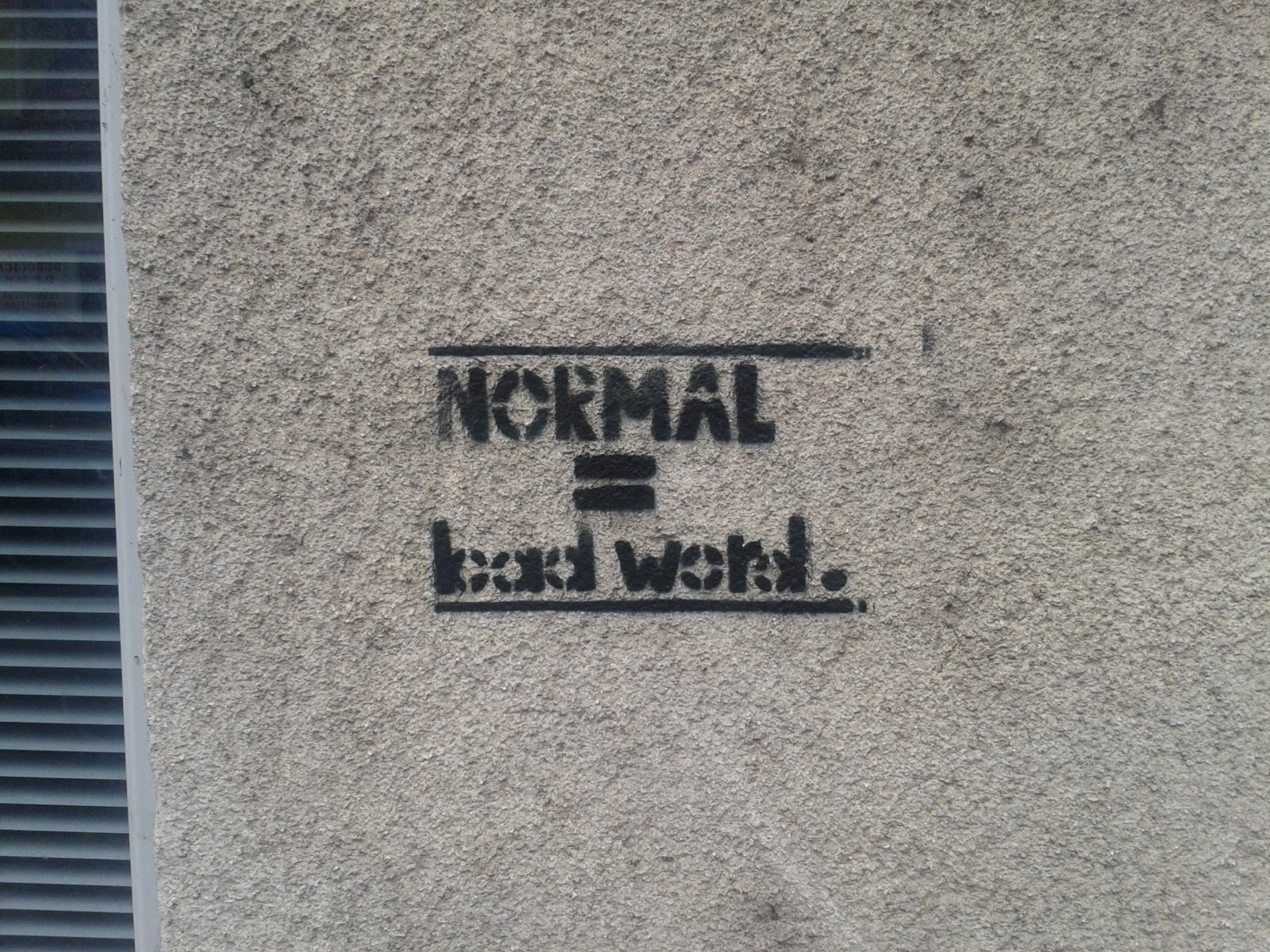 "Normal = bad word", a graffiti in Ljubljana, Slovenia Deviance is defined as "nonconformity to a set of norms that are accepted by a significant number of people in a community or society"[34] More simply put, if group members do not follow a norm, they become tagged as a deviant. In the sociological literature, this can often lead to them being considered outcasts of society. Yet, deviant behavior amongst children is somewhat expected. Except the idea of this deviance manifesting as a criminal action, the social tolerance given in the example of the child is quickly withdrawn against the criminal. Crime is considered one of the most extreme forms of deviancy according to scholar Clifford R. Shaw.[35] What is considered "normal" is relative to the location of the culture in which the social interaction is taking place. In psychology, an individual who routinely disobeys group norms runs the risk of turning into the "institutionalized deviant." Similar to the sociological definition, institutionalized deviants may be judged by other group members for their failure to adhere to norms. At first, group members may increase pressure on a non-conformist, attempting to engage the individual in conversation or explicate why he or she should follow their behavioral expectations. The role in which one decides on whether or not to behave is largely determined on how their actions will affect others.[36] Especially with new members who perhaps do not know any better, groups may use discretionary stimuli to bring an individual's behavior back into line. Over time, however, if members continue to disobey, the group will give-up on them as a lost cause; while the group may not necessarily revoke their membership, they may give them only superficial consideration.[21] If a worker is late to a meeting, for example, violating the office norm of punctuality, a supervisor or other co-worker may wait for the individual to arrive and pull him aside later to ask what happened. If the behavior continues, eventually the group may begin meetings without him since the individual "is always late." The group generalizes the individual's disobedience and promptly dismisses it, thereby reducing the member's influence and footing in future group disagreements. Group tolerance for deviation varies across membership; not all group members receive the same treatment for norm violations. Individuals may build up a "reserve" of good behavior through conformity, which they can borrow against later. These idiosyncrasy credits provide a theoretical currency for understanding variations in group behavioral expectations.[37] A teacher, for example, may more easily forgive a straight-A student for misbehaving—who has past "good credit" saved up—than a repeatedly disruptive student. While past performance can help build idiosyncrasy credits, some group members have a higher balance to start with.[37] Individuals can import idiosyncrasy credits from another group; childhood movie stars, for example, who enroll in college, may experience more leeway in adopting school norms than other incoming freshmen. Finally, leaders or individuals in other high-status positions may begin with more credits and appear to be "above the rules" at times.[21][37] Even their idiosyncrasy credits are not bottomless, however; while held to a more lenient standard than the average member, leaders may still face group rejection if their disobedience becomes too extreme. Deviance also causes multiple emotions one experiences when going against a norm. One of those emotions widely attributed to deviance is guilt. Guilt is connected to the ethics of duty which in turn becomes a primary object of moral obligation. Guilt is followed by an action that is questioned after its doing.[38] It can be described as something negative to the self as well as a negative state of feeling. Used in both instances, it is both an unpleasant feeling as well as a form of self-punishment. Using the metaphor of "dirty hands",[39] it is the staining or tainting of oneself and therefore having to self cleanse away the filth. It is a form of reparation that confronts oneself as well as submitting to the possibility of anger and punishment from others. Guilt is a point in both action and feeling that acts as a stimulus for further "honorable" actions. A 2023 study found that non-industrial societies varied in their punishments of norm violations. Punishment varied based on the types of norm violations and the socio-economic system of the society. The study "found evidence that reputational punishment was associated with egalitarianism and the absence of food storage; material punishment was associated with the presence of food storage; physical punishment was moderately associated with greater dependence on hunting; and execution punishment was moderately associated with social stratification."[40] |
社会規範からの逸脱 「正常=悪しき言葉」スロベニア・リュブリャナの落書き 逸脱とは「コミュニティや社会において多数の人々が受け入れる規範への非適合」と定義される[34]。より平たく言えば、集団の成員が規範に従わない場 合、彼らは逸脱者とレッテルを貼られる。社会学文献では、これがしばしば社会からの追放者扱いにつながる。しかし、子どもの脱線行為はある程度予想される ものだ。この脱線が犯罪行為として現れるという概念を除けば、子どもの例で示された社会的寛容は、犯罪者に対しては即座に取り消される。学者クリフォー ド・R・ショーによれば、犯罪は脱線の最も極端な形態の一つと見なされている。[35] 「正常」とされるものは、社会的相互作用が行われる文化の場所によって相対的である。心理学において、集団規範を日常的に破る個人は「制度化された逸脱 者」となるリスクを負う。社会学的定義と同様に、制度化された逸脱者は規範に従わないことで他の集団メンバーから判断される可能性がある。当初、集団メン バーは非順応者への圧力を強め、対話を試みたり、行動規範に従うべき理由を説明しようとする。行動の是非を決める役割は、その行動が他者に与える影響に よって大きく左右される[36]。特に知識不足の新規メンバーに対しては、集団は裁量的な刺激を用いて個人の行動を規範に復帰させることがある。しかし時 間が経つにつれ、メンバーが従わない場合、集団はその者を「救いようのない存在」と見なすようになる。必ずしもメンバー資格を剥奪するわけではないが、表 面的な配慮しか示さなくなる[21]。例えば、従業員が会議に遅刻し、時間厳守という職場の規範に違反した場合、上司や同僚はその人物が到着するのを待 ち、後で呼び出して事情を尋ねるかもしれない。この行動が続けば、最終的にグループは「あの人はいつも遅刻する」という理由で、その者を待たずに会議を始 めるようになる。グループはその個人の不従順を一般化し、即座に無視する。これにより、将来のグループ内の意見対立において、そのメンバーの影響力と立場 は弱まる。 規範からの逸脱に対するグループの許容度は、メンバーによって異なる。規範違反に対して、全てのグループメンバーが同じ扱いを受けるわけではない。個人は 順応を通じて「貯金」となる良好な行動を蓄積し、後でそれを引き出すことができる。こうした特異性クレジットは、集団の行動期待における差異を理解するた めの理論的通貨を提供する[37]。例えば教師は、過去に「良いクレジット」を貯めている優等生の問題行動を、繰り返し授業を乱す生徒よりも容易に許容す るかもしれない。過去の行動が特異性クレジットの構築に寄与する一方で、一部のグループメンバーは最初からより高い残高を持つ。[37] 個人は別のグループから特異性クレジットを持ち込むことも可能だ。例えば、大学に入学した子役スターは、他の新入生よりも学校の規範を受け入れる際に大き な許容範囲を得られるかもしれない。最後に、リーダーやその他の高地位にある個人は、より多くのクレジットを持ってスタートし、時に「規則を超越した存 在」のように見えることがある。[21][37] ただし彼らの特異性クレジットも無限ではない。平均的なメンバーより寛容な基準で扱われるリーダーも、不服従が極端になればグループの拒絶に直面する可能 性がある。 逸脱は規範に背く際に生じる複数の感情も引き起こす。逸脱に広く帰せられる感情の一つが罪悪感だ。罪悪感は義務倫理と結びつき、それが道徳的義務の主要な 対象となる。罪悪感は、実行後に疑問を抱かれる行動に続くものだ。[38] それは自己に対する否定的なもの、また否定的な感情状態として説明できる。両方の意味で用いられるとき、それは不快な感情であると同時に自己懲罰の一形態 でもある。「汚れた手」という隠喩を用いれば、[39] それは自己を穢す行為であり、ゆえに自らその汚れを洗い流さねばならない。これは自己と向き合う償いの形態であると同時に、他者からの怒りや罰の可能性に 身を委ねる行為でもある。罪悪感は行動と感情の両面において、さらなる「名誉ある」行動を促す刺激点となる。 2023年の研究によれば、非工業社会における規範違反への罰則は多様であった。罰則は規範違反の種類と社会の社会経済システムに基づいて異なっていた。 この研究は「評判による罰が平等主義と食料貯蔵の欠如と関連している証拠を発見した。物質的罰は食料貯蔵の存在と関連していた。身体的罰は狩猟への依存度 の高さと中程度に関連していた。処刑による罰は社会階層化と中程度に関連していた」と報告している。[40] |
| Behavior Whereas ideas in general do not necessarily have behavioral implications, Martha Finnemore notes that "norms by definition concern behavior. One could say that they are collectively held ideas about behavior."[4] Norms running counter to the behaviors of the overarching society or culture may be transmitted and maintained within small subgroups of society. For example, Crandall (1988) noted that certain groups (e.g., cheerleading squads, dance troupes, sports teams, sororities) have a rate of bulimia, a publicly recognized life-threatening disease, that is much higher than society as a whole. Social norms have a way of maintaining order and organizing groups.[41] In the field of social psychology, the roles of norms are emphasized—which can guide behavior in a certain situation or environment as "mental representations of appropriate behavior".[42] It has been shown that normative messages can promote pro-social behavior, including decreasing alcohol use,[43] increasing voter turnout,[44] and reducing energy use.[45] According to the psychological definition of social norms' behavioral component, norms have two dimensions: how much a behavior is exhibited, and how much the group approves of that behavior.[46] |
行動 一般的に、考えは必ずしも行動に影響を与えるわけではない。しかしマーサ・フィネモアは「規範とは定義上、行動に関わるものだ。行動についての集合的に保持された考えだと言える」と指摘している[4]。 社会全体の行動様式や文化に反する規範は、社会の小さな集団内で伝達され維持されることがある。例えばクランドール(1988)は、特定の集団(チアリー ディングチーム、ダンスグループ、スポーツチーム、女子学生クラブなど)において、公に認知された生命を脅かす疾患である過食症の発症率が、社会全体より もはるかに高いことを指摘している。社会規範は秩序を維持し集団を組織化する手段を持つ。[41] 社会心理学の分野では、規範の役割が強調される。規範は「適切な行動の心的表象」として、特定の状況や環境における行動を導くことができる。[42] 規範的メッセージが、飲酒量の減少[43]、投票率の向上[44]、エネルギー使用量の削減[45]といった社会貢献的行動を促進できることが示されてい る。社会的規範の行動的要素に関する心理学的定義によれば、規範には二つの側面がある。すなわち、その行動がどの程度示されているか、そして集団がその行 動をどの程度承認しているかである。[46] |
| Social control Although not considered to be formal laws within society, norms still work to promote a great deal of social control.[47] They are statements that regulate conduct. The cultural phenomenon that is the norm is the prescriber of acceptable behavior in specific instances. Ranging in variations depending on culture, race, religion, and geographical location, it is the foundation of the terms some know as acceptable as not to injure others, the golden rule, and to keep promises that have been pledged.[48] Without them, there would be a world without consensus, common ground, or restrictions. Even though the law and a state's legislation is not intended to control social norms, society and the law are inherently linked and one dictates the other. This is why it has been said that the language used in some legislation is controlling and dictating for what should or should not be accepted. For example, the criminalization of familial sexual relations is said to protect those that are vulnerable, however even consenting adults cannot have sexual relationships with their relatives. The language surrounding these laws conveys the message that such acts are supposedly immoral and should be condemned, even though there is no actual victim in these consenting relationships.[49] Social norms can be enforced formally (e.g., through sanctions) or informally (e.g., through body language and non-verbal communication cues).[50] Because individuals often derive physical or psychological resources from group membership, groups are said to control discretionary stimuli; groups can withhold or give out more resources in response to members' adherence to group norms, effectively controlling member behavior through rewards and operant conditioning.[21] Social psychology research has found the more an individual values group-controlled resources or the more an individual sees group membership as central to his definition of self, the more likely he is to conform.[21] Social norms also allow an individual to assess what behaviors the group deems important to its existence or survival, since they represent a codification of belief; groups generally do not punish members or create norms over actions which they care little about.[21][32] Norms in every culture create conformity that allows for people to become socialized to the culture in which they live.[51] As social beings, individuals learn when and where it is appropriate to say certain things, to use certain words, to discuss certain topics or wear certain clothes, and when it is not. Thus, knowledge about cultural norms is important for impressions,[52] which is an individual's regulation of their nonverbal behavior. One also comes to know through experience what types of people he/she can and cannot discuss certain topics with or wear certain types of dress around. Typically, this knowledge is derived through experience (i.e. social norms are learned through social interaction).[52] Wearing a suit to a job interview in order to give a great first impression represents a common example of a social norm in the white collar work force. In his work "Order without Law: How Neighbors Settle Disputes", Robert Ellickson studies various interactions between members of neighbourhoods and communities to show how societal norms create order within a small group of people. He argues that, in a small community or neighborhood, many rules and disputes can be settled without a central governing body simply by the interactions within these communities.[53] |
社会的統制 社会において正式な法律とは見なされないものの、規範は依然として多くの社会的統制を促進する役割を果たしている。[47] 規範とは行動を規制する宣言である。規範という文化的現象は、特定の状況において許容される行動を規定するものである。文化、人種、宗教、地理的場所に よって様々な形で現れ、他人を傷つけないこと、黄金律、誓った約束を守るといった、一部の人々が「許容される」と認識する概念の基盤となる。[48] 規範がなければ、合意も共通基盤も制約もない世界が生まれる。法律や国家の立法が社会規範を制御する意図はないが、社会と法は本質的に結びついており、一 方が他方を規定する。だからこそ、一部の立法で使用される言語は、何が受け入れられるべきか否かを支配し指示していると指摘される。例えば、家族間の性的 関係を犯罪化することは脆弱な者を保護すると言われているが、同意した成人であっても親族との性的関係は許されない。こうした法律を取り巻く言語は、実際 の被害者が存在しない同意に基づく関係であっても、そのような行為は道徳に反し非難されるべきだというメッセージを伝えているのだ。[49] 社会的規範は、制裁といった形式的な手段でも、ボディランゲージや非言語的コミュニケーションといった非形式的な手段でも強制される。[50] 個人は集団所属から身体的・心理的資源を得るため、集団は裁量的刺激を制御すると言われる。集団は、メンバーの規範順守に応じて資源の付与や差し控えを行 い、報酬とオペラント条件付けを通じて効果的にメンバーの行動を制御するのだ。[21] 社会心理学の研究によれば、個人が集団が管理する資源を重視する度合いが高いほど、あるいは集団所属を自己定義の中核と見なす度合いが高いほど、同調する 可能性が高まる。[21] 社会規範はまた、信念の体系化を体現するため、個人が集団の存続や生存にとって重要な行動を評価することを可能にする。集団は通常、関心の薄い行動に対し てはメンバーを罰したり規範を設けたりしない。[21] [32] あらゆる文化における規範は、人々が生活する文化に社会化されるための同調を生み出す。[51] 社会的な存在として、個人は特定の発言や言葉の使用、話題や服装が適切な時と場所、そして不適切な時を学ぶ。したがって、文化的規範に関する知識は印象形 成[52](個人の非言語的行動の調節)にとって重要である。また人は経験を通じて、特定の話題を話し合える相手や、特定の服装を許容される相手を認識す るようになる。通常、この知識は経験から得られる(つまり社会的規範は社会的相互作用を通じて学習される)。[52] 良い第一印象を与えるために就職面接にスーツを着て行くことは、ホワイトカラー労働力における社会的規範の典型例だ。 ロバート・エリクソンは著書『法なき秩序:隣人による紛争解決』で、近隣住民やコミュニティ内の様々な相互作用を研究し、社会的規範が小集団内に秩序を生 み出す仕組みを明らかにしている。彼は、小規模なコミュニティや近隣地域では、中央統治機関がなくても、コミュニティ内の相互作用によって多くの規則や紛 争が解決されうると主張している[53]。 |
| Sociology In sociology, norms are seen as rules that bind an individual's actions to a specific sanction in one of two forms: a punishment or a reward.[54] Through regulation of behavior, social norms create unique patterns that allow for distinguishing characteristics to be made between social systems.[54] This creates a boundary that allows for a differentiation between those that belong in a specific social setting and those that do not.[54] For Talcott Parsons of the functionalist school, norms dictate the interactions of people in all social encounters. On the other hand, Karl Marx believed that norms are used to promote the creation of roles in society which allows for people of different levels of social class structure to be able to function properly.[51] Marx claims that this power dynamic creates social order. James Coleman used both micro and macro conditions for his theory.[54] For Coleman, norms start out as goal oriented actions by actors on the micro level.[54] If the benefits do not outweigh the costs of the action for the actors, then a social norm would emerge.[54] The norm's effectiveness is then determined by its ability to enforce its sanctions against those who would not contribute to the "optimal social order."[54] Heinrich Popitz is convinced that the establishment of social norms, that make the future actions of alter foreseeable for ego, solves the problem of contingency (Niklas Luhmann). In this way, ego can count on those actions as if they would already have been performed and does not have to wait for their actual execution; social interaction is thus accelerated. Important factors in the standardization of behavior are sanctions[55] and social roles. Operant conditioning The probability of these behaviours occurring again is discussed in the theories of B. F. Skinner, who states that operant conditioning plays a role in the process of social norm development. Operant conditioning is the process by which behaviours are changed as a function of their consequences. The probability that a behaviour will occur can be increased or decreased depending on the consequences of said behaviour. In the case of social deviance, an individual who has gone against a norm will contact the negative contingencies associated with deviance, this may take the form of formal or informal rebuke, social isolation or censure, or more concrete punishments such as fines or imprisonment. If one reduces the deviant behavior after receiving a negative consequence, then they have learned via punishment. If they have engaged in a behavior consistent with a social norm after having an aversive stimulus reduced, then they have learned via negative reinforcement. Reinforcement increases behavior, while punishment decreases behavior. As an example of this, consider a child who has painted on the walls of her house, if she has never done this before she may immediately seek a reaction from her mother or father. The form of reaction taken by the mother or father will affect whether the behaviour is likely to occur again in the future. If her parent is positive and approving of the behaviour it will likely reoccur (reinforcement) however, if the parent offers an aversive consequence (physical punishment, time-out, anger etc...) then the child is less likely to repeat the behaviour in future (punishment). Skinner also states that humans are conditioned from a very young age on how to behave and how to act with those around us considering the outside influences of the society and location one is in.[56][57] Built to blend into the ambiance and attitude around us, deviance is a frowned upon action. |
社会学 社会学において、規範とは個人の行動を特定の制裁(罰か報酬のいずれか)に結びつける規則と見なされる。[54] 行動を規制することで、社会規範は社会システム間の特徴を区別する独自のパターンを生み出す。[54] これにより境界が形成され、特定の社会的環境に属する者と属さない者を区別することが可能となる。[54] 機能主義学派のタルコット・パーソンズによれば、規範はあらゆる社会的遭遇における人々の相互作用を規定する。一方、カール・マルクスは、規範が社会にお ける役割の創出を促進するために用いられ、それによって異なる階層構造を持つ人々が適切に機能できるようになると考えた。[51] マルクスは、この力関係が社会秩序を生み出すと主張する. ジェームズ・コールマンは自身の理論にミクロとマクロの両条件を用いた。[54] コールマンによれば、規範はミクロレベルにおける行為者の目的指向的行動として始まる。[54] 行為者にとって行動の利益がコストを上回らない場合、社会的規範が出現する。[54] 規範の有効性は、その後「最適な社会秩序」に貢献しない者に対して制裁を執行する能力によって決定される。[54] ハインリヒ・ポピッツは、他者の将来の行動を自我にとって予測可能にする社会的規範の確立が、偶発性の問題を解決すると確信している(ニクラス・ルーマ ン)。これにより自我は、それらの行動が既に実行されたかのように頼ることができ、実際の遂行を待つ必要がなくなる。こうして社会的相互作用は加速され る。行動の標準化における重要な要素は制裁[55]と社会的役割である。 オペラント条件付け こうした行動が再び起こる確率については、B・F・スキナーの理論で論じられている。彼は、社会的規範形成の過程においてオペラント条件付けが役割を果た すと述べている。オペラント条件付けとは、行動の結果に応じて行動が変化する過程である。行動の結果次第で、その行動が起こる確率は増減する。 社会的逸脱の場合、規範に反した個人は逸脱に伴う否定的な結果に直面する。これは公式・非公式の非難、社会的孤立や糾弾、あるいは罰金や投獄といった具体 的な処罰の形をとる。負の結果を受けた後で逸脱行動を減らすなら、それは罰による学習だ。嫌悪刺激が減った後に社会的規範に沿った行動を取ったなら、それ は負の強化による学習だ。強化は行動を増やし、罰は行動を減らす。 例として、家の壁に落書きをした子供を考えてみよう。もしこれが初めての行為なら、母親や父親の反応をすぐに探るかもしれない。親の反応の形態が、その行 動が将来再び起こる可能性に影響する。親がその行動を肯定的に評価すれば、再発の可能性が高い(強化)。しかし親が嫌悪的な結果(体罰、タイムアウト、怒 りなど)を与えた場合、子供はその行動を将来繰り返す可能性が低くなる(罰)。 スキナーはまた、人間は幼い頃から、社会や環境といった外的影響を考慮しつつ、周囲の人々とどう振る舞いどう行動すべきかを条件付けられると述べている[56][57]。周囲の雰囲気や態度に溶け込むように設計されているため、逸脱行為は好ましくない行動とされるのだ。 |
| Focus theory of normative conduct Cialdini, Reno, and Kallgren developed the focus theory of normative conduct to describe how individuals implicitly juggle multiple behavioral expectations at once. Expanding on conflicting prior beliefs about whether cultural, situational or personal norms motivate action, the researchers suggested the focus of an individual's attention will dictate what behavioral expectation they follow.[58] |
規範的行動の焦点理論 チャルディーニ、レノ、カッルグレンは、個人が複数の行動期待を同時に暗黙的に調整する仕組みを説明するため、規範的行動の焦点理論を提唱した。文化的規 範・状況的規範・個人的規範のどれが行動を動機づけるかに関する従来の相反する見解を発展させ、研究者らは個人の注意の焦点がどの行動期待に従うかを決定 すると示唆した。[58] |
| Types There is no clear consensus on how the term norm should be used.[59] Martha Finnemore and Kathryn Sikkink distinguish between three types of norms:[7] 1. Regulative norms: they "order and constrain behavior" 2. Constitutive norms: they "create new actors, interests, or categories of action" 3. Evaluative and prescriptive norms: they have an "oughtness" quality to them Finnemore, Sikkink, Jeffrey W. Legro and others have argued that the robustness (or effectiveness) of norms can be measured by factors such as: The specificity of the norm: norms that are clear and specific are more likely to be effective[7][3] The longevity of the norm: norms with a history are more likely to be effective[7] The universality of the norm: norms that make general claims (rather than localized and particularistic claims) are more likely to be effective[7] The prominence of the norm: norms that are widely accepted among powerful actors are more likely to be effective[3] Christine Horne argues that the robustness of a norm is shaped by the degree of support for the actors who sanction deviant behaviors; she refers to norms regulating how to enforce norms as "metanorms."[60] According to Beth G. Simmons and Hyeran Jo, diversity of support for a norm can be a strong indicator of robustness.[61] They add that institutionalization of a norm raises its robustness.[61] It has also been posited that norms that exist within broader clusters of distinct but mutually reinforcing norms may be more robust.[62] Jeffrey Checkel argues that there are two common types of explanations for the efficacy of norms:[63] Rationalism: actors comply with norms due to coercion, cost-benefit calculations, and material incentives Constructivism: actors comply with norms due to social learning and socialization According to Peyton Young, mechanisms that support normative behavior include:[5] Coordination Social pressure Signaling Focal points Descriptive versus injunctive Descriptive norms depict what happens, while injunctive norms describe what should happen. Cialdini, Reno, and Kallgren (1990) define a descriptive norm as people's perceptions of what is commonly done in specific situations; it signifies what most people do, without assigning judgment. The absence of trash on the ground in a parking lot, for example, transmits the descriptive norm that most people there do not litter.[58][64] An Injunctive norm, on the other hand, transmits group approval about a particular behavior; it dictates how an individual should behave.[58][64][65][66] Watching another person pick up trash off the ground and throw it out, a group member may pick up on the injunctive norm that he ought not to litter. Prescriptive and proscriptive norms Prescriptive norms are unwritten rules that are understood and followed by society and indicate what we should do.[67] Expressing gratitude or writing a Thank You card when someone gives you a gift represents a prescriptive norm in American culture. Proscriptive norms, in contrast, comprise the other end of the same spectrum; they are similarly society's unwritten rules about what one should not do.[67] These norms can vary between cultures; while kissing someone you just met on the cheek is an acceptable greeting in some European countries, this is not acceptable, and thus represents a proscriptive norm in the United States. Subjective norms Subjective norms are determined by beliefs about the extent to which important others want a person to perform a behavior.When combined with attitude toward behavior, subjective norms shape an individual's intentions.[68] Social influences are conceptualized in terms of the pressure that people perceive from important others to perform, or not to perform, a behavior.[66] Social Psychologist Icek Azjen theorized that subjective norms are determined by the strength of a given normative belief and further weighted by the significance of a social referent, as represented in the following equation: SN ∝ Σnimi , where (n) is a normative belief and (m) is the motivation to comply with said belief.[69] |
類型 規範という用語の用法について明確な合意は存在しない。[59] マーサ・フィネモアとキャスリン・シッキンクは規範を三種類に分類する。[7] 1. 規制的規範:それらは「行動を秩序づけ、制約する」 2. 構成的規範:それらは「新たな主体、利害、行動のカテゴリーを創出する」 3. 評価的・規範的規範:これらは「あるべき姿」の性質を持つ フィネモア、シッキンク、ジェフリー・W・レグロらは、規範の強靭性(または有効性)は以下のような要素で測定できると主張している: 規範の特異性:明確で具体的な規範ほど有効である可能性が高い[7] [3] 規範の存続期間:歴史を持つ規範ほど効果的である可能性が高い[7] 規範の普遍性:一般的(局所的・個別的ではない)主張を行う規範ほど効果的である可能性が高い[7] 規範の顕在性:有力な行為者間で広く受け入れられている規範ほど効果的である可能性が高い[3] クリスティン・ホーンは、規範の強靭性は逸脱行為を制裁する主体への支持度によって形作られると主張する。彼女は規範の執行方法を規定する規範を「メタ規 範」と呼ぶ[60]。ベス・G・シモンズとヒェラン・ジョによれば、規範への支持の多様性は強靭性の強力な指標となり得る。[61] さらに彼女らは、規範の制度化がその頑健性を高めると付記している[61]。また、個別の規範群が相互に補強し合う広範なクラスター内に存在する規範はよ り頑健である可能性も提唱されている[62]。 ジェフリー・チェケルは、規範の有効性に関する二つの一般的な説明類型を提示する: [63] 合理主義:行為者は強制、費用便益計算、物質的インセンティブにより規範に従う 構成主義:行為者は社会的学習と社会化により規範に従う ペイトン・ヤングによれば、規範的行動を支えるメカニズムには以下が含まれる[5]: 調整 社会的圧力 シグナリング 焦点化 記述的規範と命令的規範 記述的規範は「実際に起きていること」を描写し、命令的規範は「起きるべきこと」を規定する。シアルディーニ、リノ、カルグレン(1990)は記述的規範 を「特定状況下で一般的に行われていることの認識」と定義する。これは大多数の行動を示すが、価値判断を伴わない。例えば駐車場にゴミが落ちていない状況 は、そこにいる大多数がポイ捨てしないという記述的規範を伝達する。[58] [64] 一方、命令的規範は特定の行動に対する集団の承認を伝える。個人がどう振る舞うべきかを指示する。[58][64][65][66] 例えば、誰かが地面のゴミを拾って捨てるのを見た集団の一員は、自分もゴミを捨ててはいけないという命令的規範を察知するかもしれない。 規範的規範と禁止的規範 規範的規範とは、社会が理解し従う不文律であり、我々がすべきことを示すものである。[67] 贈り物をもらった際に感謝を伝えたり、お礼状を書いたりすることは、アメリカ文化における規範的規範の一例だ。一方、禁止的規範は同じスペクトルの反対側 にある。同様に社会が暗黙裡に定めた、すべきでない行為に関するルールだ。[67] こうした規範は文化によって異なる。例えば頬へのキスが挨拶として受け入れられる欧州諸国がある一方、米国ではこれは受け入れられず、禁止的規範として機 能する。 主観的規範 主観的規範は、重要な他者がその人格に特定の行動をどの程度望んでいるかという信念によって決定される。行動に対する態度と組み合わさることで、主観的規 範は個人の意図を形成する。[68] 社会的影響は、重要な他者から行動を実行するよう、あるいは実行しないよう、人々が感じる圧力という観点から概念化される。[66] 社会心理学者アイセック・アジェンは、主観的規範は特定の規範的信念の強さに加え、社会的参照対象の重要性によって重み付けされると理論化した。以下の式 で表される:SN ∝ Σnimi (ここで(n)は規範的信念、(m)はその信念に従う動機である)。[69] |
| Mathematical representations Over the last few decades, several theorists have attempted to explain social norms from a more theoretical point of view. By quantifying behavioral expectations graphically or attempting to plot the logic behind adherence, theorists hoped to be able to predict whether or not individuals would conform. The return potential model and game theory provide a slightly more economic conceptualization of norms, suggesting individuals can calculate the cost or benefit behind possible behavioral outcomes. Under these theoretical frameworks, choosing to obey or violate norms becomes a more deliberate, quantifiable decision. Return potential model  Figure 1. The return potential model (reproduced from Jackson, 1965). Developed in the 1960s, the return potential model provides a method for plotting and visualizing group norms. In the regular coordinate plane, the amount of behavior exhibited is plotted on the X-axis (label a in Figure 1) while the amount of group acceptance or approval gets plotted on the Y-axis (b in Figure 1).[46] The graph represents the potential return or positive outcome to an individual for a given behavioral norm. Theoretically, one could plot a point for each increment of behavior how much the group likes or dislikes that action. For example, it may be the case that among first-year graduate students, strong social norms exist around how many daily cups of coffee a student drinks. If the return curve in Figure 1 correctly displays the example social norm, we can see that if someone drinks 0 cups of coffee a day, the group strongly disapproves. The group disapproves of the behavior of any member who drinks fewer than four cups of coffee a day; the group disapproves of drinking more than seven cups, shown by the approval curve dipping back below zero. As seen in this example, the return potential model displays how much group approval one can expect for each increment of behavior. Point of maximum return. The point with the greatest y-coordinate is called the point of maximum return, as it represents the amount of behavior the group likes the best.[46] While c in Figure 1 is labeling the return curve in general, the highlighted point just above it at X=6, represents the point of maximum return. Extending our above example, the point of maximum return for first-year graduate students would be 6 cups of coffee; they receive the most social approval for drinking exactly that many cups. Any more or any fewer cups would decrease the approval. Range of tolerable behavior. Label d represents the range of tolerable behavior, or the amount of action the group finds acceptable.[46] It encompasses all the positive area under the curve. In Figure 1, the range of tolerable behavior extends is 3, as the group approves of all behavior from 4 to 7 and 7-4=3. Carrying over our coffee example again, we can see that first-years only approve of having a limited number of cups of coffee (between 4 and 7); more than 7 cups or fewer than 4 would fall outside the range of tolerable behavior. Norms can have a narrower or wider range of tolerable behavior. Typically, a narrower range of behavior indicates a behavior with greater consequences to the group.[21] Intensity. The intensity of the norm tells how much the group cares about the norm, or how much group affect is at stake to be won or lost. It is represented in the return potential model by the total amount of area subsumed by the curve, regardless of whether the area is positive or negative.[46] A norm with low intensity would not vary far from the x-axis; the amount of approval or disapproval for given behaviors would be closer to zero. A high-intensity norm, however, would have more extreme approval ratings. In Figure 1, the intensity of the norm appears high, as few behaviors invoke a rating of indifference. Crystallization. Finally, norm crystallization refers to how much variance exists within the curve; translated from the theoretical back to the actual norm, it shows how much agreement exists between group members about the approval for a given amount of behavior.[46] It may be that some members believe the norm more central to group functioning than others. A group norm like how many cups of coffee first years should drink would probably have low crystallization since a lot of individuals have varying beliefs about the appropriate amount of caffeine to imbibe; in contrast, the norm of not plagiarizing another student's work would likely have high crystallization, as people uniformly agree on the behavior's unacceptability. Showing the overall group norm, the return potential model in Figure 1 does not indicate the crystallization. However, a return potential model that plotted individual data points alongside the cumulative norm could demonstrate the variance and allow us to deduce crystallization. Game theory Main article: Game theory Another general formal framework that can be used to represent the essential elements of the social situation surrounding a norm is the repeated game of game theory. Rational choice, a branch of game theory, deals with the relations and actions socially committed among rational agents.[70] A norm gives a person a rule of thumb for how they should behave. However, a rational person acts according to the rule only if it is beneficial for them. The situation can be described as follows. A norm gives an expectation of how other people act in a given situation (macro). A person acts optimally given the expectation (micro). For a norm to be stable, people's actions must reconstitute the expectation without change (micro-macro feedback loop). A set of such correct stable expectations is known as a Nash equilibrium. Thus, a stable norm must constitute a Nash equilibrium.[71] In the Nash equilibrium, no one actor has any positive incentive in individually deviating from a certain action.[72] Social norms will be implemented if the actions of that specific norm come into agreement by the support of the Nash equilibrium in the majority of the game theoretical approaches.[72] From a game-theoretical point of view, there are two explanations for the vast variety of norms that exist throughout the world. One is the difference in games. Different parts of the world may give different environmental contexts and different people may have different values, which may result in a difference in games. The other is equilibrium selection not explicable by the game itself. Equilibrium selection is closely related to coordination. For a simple example, driving is common throughout the world, but in some countries people drive on the right and in other countries people drive on the left (see coordination game). A framework called comparative institutional analysis is proposed to deal with the game theoretical structural understanding of the variety of social norms. |
数学的表現 過去数十年間、複数の理論家がより理論的な観点から社会的規範を説明しようと試みてきた。行動の期待値をグラフで定量化したり、規範遵守の背後にある論理 をプロットしようと試みたりすることで、理論家たちは個人が規範に従うかどうかを予測できると期待した。リターン・ポテンシャル・モデルとゲーム理論は規 範を少し経済学的に概念化し、個人が行動の結果に伴うコストや利益を計算できると示唆している。こうした理論的枠組みのもとでは、規範に従うか違反するか の選択は、より熟議され、定量化可能な決定となる。 リターン・ポテンシャル・モデル 図1. リターン・ポテンシャル・モデル(Jackson, 1965より転載)。 1960年代に開発されたリターン・ポテンシャル・モデルは、集団規範をプロットし可視化する手法を提供する。通常の座標平面において、示される行動の量 はX軸(図1のa)にプロットされ、集団の受容度または承認度はY軸(図1のb)にプロットされる。[46] このグラフは、特定の行動規範に対する個人への潜在的なリターンまたは肯定的結果を表す。理論的には、行動の増分ごとに、集団がその行動を好む度合いまた は嫌う度合いを示す点をプロットできる。例えば、大学院1年生の間では、学生が1日に飲むコーヒーの杯数に関して強い社会的規範が存在するかもしれない。 図1のリターン曲線がこの社会的規範を正しく示している場合、誰かが1日に0杯のコーヒーを飲むと、集団は強く不承認を示すことがわかる。グループは1日 4杯未満のコーヒー摂取を非難し、7杯を超える摂取も非難する。承認曲線が再びゼロを下回る点でそれが示されている。この例が示すように、リターンポテン シャルモデルは行動の増分ごとに期待できる集団承認の度合いを可視化する。 最大リターンの点。y座標が最大となる点を最大リターンの点と呼ぶ。これは集団が最も好む行動量を表す。[46] 図1ではcがリターン曲線全体を示しているが、その直上にあるX=6の位置が最大リターンの点を表す。上記の例を拡張すると、大学院1年生にとっての最大 リターン点は6杯のコーヒーとなる。彼らはちょうどこの杯数で最大の社会的承認を得る。それ以上でも以下でも承認は減少する。 許容される行動の範囲。ラベルdは許容される行動の範囲、つまり集団が受け入れ可能な行動の量を表す。[46] これは曲線下の全ての正の領域を含む。図1では、許容される行動の範囲は3である。なぜなら集団は4から7までの全ての行動を承認し、7-4=3だから だ。コーヒーの例を再び用いると、新入生が容認するのは限られた杯数(4~7杯)のみであることが分かる。7杯超または4杯未満は許容行動範囲外となる。 規範の許容行動範囲は狭くも広くもなり得る。一般的に範囲が狭い行動は、集団にとってより重大な結果を伴う行動を示す。[21] 強度。規範の強度とは、集団がその規範をどれほど重視しているか、あるいは集団感情の獲得・喪失がどれほど懸かっているかを示す。これはリターンポテン シャルモデルにおいて、曲線が占める領域の総量(正負を問わない)で表される[46]。強度の低い規範はx軸から大きく外れず、特定の行動に対する承認・ 非承認の度合いはゼロに近い。しかし強度が高い規範では、賛成評価が極端になる。図1では規範の強度が高く見える。なぜなら無関心評価がほとんど見られな いからだ。 結晶化。最後に規範の結晶化とは、曲線内に存在する変動の度合いを指す。理論から実際の規範へ置き換えると、特定の行動量に対する賛成評価について、集団 メンバー間の合意がどれだけ存在するかを示す。[46] 規範の重要性を、グループ機能において他者より強く信じるメンバーがいる可能性がある。例えば「新入生が飲むべきコーヒーの杯数」といった規範は、適切な カフェイン摂取量について個人の見解が分かれるため結晶化が低いだろう。対照的に「他学生の著作を盗用しない」規範は、その行為の容認不能性について人々 が一致しているため結晶化が高いと考えられる。図1の収益可能性モデルは集団規範全体を示すが、結晶化は示さない。しかし、累積規範と個々のデータポイン トを並べてプロットした収益可能性モデルなら、ばらつきを可視化し結晶化を推測できる。 ゲーム理論 詳細記事: ゲーム理論 規範を取り巻く社会的状況の本質的要素を表現できるもう一つの一般的な形式的枠組みが、ゲーム理論における反復ゲームである。ゲーム理論の一分野である合 理的選択は、合理的な主体間で社会的に約束された関係と行動を扱う[70]。規範は個人に、どう振る舞うべきかの経験則を与える。しかし合理的な個人は、 それが自分にとって有益な場合にのみその規則に従って行動する。状況は次のように説明できる。規範は、特定の状況下で他者がどう行動するかという期待(マ クロ)を与える。個人はその期待(ミクロ)に基づいて最適に行動する。規範が安定するためには、人々の行動が期待を変化なく再構成しなければならない(ミ クロ-マクロのフィードバックループ)。こうした正しい安定した期待の集合はナッシュ均衡として知られる。したがって、安定した規範はナッシュ均衡を構成 しなければならない[71]。ナッシュ均衡においては、特定の行動から個人が逸脱する積極的なインセンティブは誰にも存在しない[72]。ゲーム理論的ア プローチの大半では、特定の規範に基づく行動がナッシュ均衡の支持によって一致する場合、社会的規範は実現される。[72] ゲーム理論的観点から、世界中に存在する多種多様な規範には二つの説明がある。一つはゲームの違いだ。世界の異なる地域では環境的文脈が異なり、異なる人 々は異なる価値観を持つため、ゲームに差異が生じる可能性がある。もう一つは、ゲーム自体では説明できない均衡選択である。均衡選択は調整と密接に関連し ている。簡単な例として、運転は世界中で一般的だが、右側通行の国もあれば左側通行の国もある(調整ゲーム参照)。多様な社会規範のゲーム理論的構造的理 解に対処するため、比較制度分析と呼ばれる枠組みが提案されている。 |
| Anomie Breaching experiment Conformity Convention (norm) Cool (aesthetic) Dress code Enculturation Etiquette Heteronormativity Ideal (ethics) Ideology Morality Mores Norm (philosophy) Norm of reciprocity Normality (behavior) Normalization (sociology) Other (philosophy) Philosophical value Peer pressure Rule complex Social norms marketing Social structure Taboo |
アノミー 規範違反実験 同調性 慣習(規範) クール(美的) 服装規定 文化化 礼儀作法 ヘテロノーマティビティ 理想(倫理) イデオロギー 道徳 慣習 規範(哲学) 互恵性の規範 正常性(行動) 社会学における規範化 哲学における他者 哲学的価値 仲間からの圧力 規則体系 社会規範マーケティング 社会構造 タブー |
| References |
|
| Further reading logo Scholia has a topic profile for Social norm. Axelrod, Robert (1984). The Evolution of Cooperation. New York: Basic Books. ISBN 9780465021222. Appelbaum, R. P., Carr, D., Duneir, M., Giddens, A. (2009). Conformity, Deviance, and Crime. Introduction to Sociology, New York, NY: W. W. Norton & Company, Inc., p. 173. Becker, H. S. (1982). "Culture: A Sociological View". Yale Review. 71 (4): 513–527. Bicchieri, C. (2006). The Grammar of Society: The Nature and Dynamics of Social Norms, New York: Cambridge University Press. Blumer, H (1956). "Sociological Analysis and the 'Variable". American Sociological Review. 21 (6): 683–690. doi:10.2307/2088418. JSTOR 2088418. S2CID 146998430. Boyd, R. & Richerson, P.J. (1985). Culture and the Evolutionary Process, Chicago: University of Chicago Press. Burt, R.S. (1987). "Social Contagion and Innovation: Cohesive Versus Structural Equivalence". American Journal of Sociology. 92 (6): 1287–1335. doi:10.1086/228667. S2CID 22380365. Rimal, Rajiv N. (2016). "Social Norms: A Review". Review of Communication Research. 4 (1): 1–28. doi:10.12840/issn.2255-4165.2016.04.01.008 (inactive 18 July 2025). Cialdini, R (2007). "Descriptive Social Norms as Underappreciated Sources of Social Control". Psychometrika. 72 (2): 263–268. doi:10.1007/s11336-006-1560-6. S2CID 121708702. Druzin, Bryan H. (24 June 2012). "Eating Peas with One's Fingers: A Semiotic Approach to Law and Social Norms". International Journal for the Semiotics of Law - Revue internationale de Sémiotique juridique. 26 (2): 257–274. doi:10.1007/s11196-012-9271-z. S2CID 85439929. Durkheim, E. (1915). The Elementary Forms of the Religious Life, New York: Free Press. Elster, Jon (1 November 1989). "Social Norms and Economic Theory". Journal of Economic Perspectives. 3 (4): 99–117. doi:10.1257/jep.3.4.99. hdl:10535/3264. S2CID 154638062. Eriksson, K.; Strimling, P. (2025). "Everyday norms have become more permissive over time and vary across cultures". Communications Psychology (3): 145. doi:10.1038/s44271-025-00324-4. PMC 12504534. Fehr, Ernst; Fischbacher, Urs; Gächter, Simon (March 2002). "Strong reciprocity, human cooperation, and the enforcement of social norms" (PDF). Human Nature. 13 (1): 1–25. doi:10.1007/s12110-002-1012-7. PMID 26192593. S2CID 2901235. Archived (PDF) from the original on 2019-03-26. Fine, G.A. (2001). Social Norms, ed. by Michael Hechter and Karl-Dieter Opp, New York, NY: Russell Sage Foundation. Greif, A (1994). "Cultural Beliefs and the Organization of Society: A Historical and Theoretical Reflection on Collectivist and Individualist Societies". Journal of Political Economy. 102 (5): 912–950. doi:10.1086/261959. S2CID 153431326. Hechter, M. & Karl-Dieter Opp, eds. (2001). Social Norms, New York: Russell Sage Foundation. Heiss, J. (1981). "Social Roles", In Social Psychology: Sociological Perspectives, Rosenburg, M. & Turner, R.H. (eds.), New York: Basic Books. Hochschild, A. (1989). "The Economy of Gratitude", In D.D. Franks & E.D. McCarthy (Eds.), The Sociology of Emotions: Original Essays and Research Papers, Greenwich, CT: JAI Press. Horne, C. (2001). "Social Norms". In M. Hechter & K. Opp (Eds.), New York, NY: Russell Sage Foundation. Kahneman, D.; Miller, D.T. (1986). "Norm Theory: Comparing reality to its alternatives" (PDF). Psychological Review. 80 (2): 136–153. doi:10.1037/0033-295x.93.2.136. S2CID 7706059. Archived from the original (PDF) on 2020-07-11. Kollock, P (1994). "The emergence of exchange structures: An experimental study of uncertainty, commitment, and trust". American Journal of Sociology. 100 (2): 313–45. doi:10.1086/230539. S2CID 144646491. Kohn, M.L. (1977). Class and Conformity: A Study in Values, 2nd ed., Chicago, IL: University of Chicago Press. Macy, M.W.; Skvoretz, J. (1998). "The evolution of trust and cooperation between strangers: A computational model". American Sociological Review. 63 (5): 638–660. JSTOR 2657332. Mark, N (1998). "Birds of a feather sing together". Social Forces. 77 (2): 453–485. doi:10.1093/sf/77.2.453. S2CID 143739215. McElreath, Richard; Boyd, Robert; Richerson, Peter J. (February 2003). "Shared Norms and the Evolution of Ethnic Markers" (PDF). Current Anthropology. 44 (1): 122–130. doi:10.1086/345689. S2CID 8796947. Archived from the original (PDF) on 2019-03-07. Opp, K (1982). "The evolutionary emergence of norms". British Journal of Social Psychology. 21 (2): 139–149. doi:10.1111/j.2044-8309.1982.tb00522.x. Posner, Eric A. (1996). "The Regulation of Groups: The Influence of Legal and Nonlegal Sanctions on Collective Action". The University of Chicago Law Review. 63 (1): 133–197. doi:10.2307/1600068. JSTOR 1600068. Archived from the original on 2020-12-04. Retrieved 2020-07-09. Posner, E. (2000). Law and Social Norms. Cambridge MA: Harvard University Press Prentice, D. A.; Miller, D. T. (1993). "Pluralistic ignorance and alcohol use on campus: Some consequences of misperceiving the social norm". Journal of Personality and Social Psychology. 64 (2): 243–256. CiteSeerX 10.1.1.470.522. doi:10.1037/0022-3514.64.2.243. PMID 8433272. S2CID 24004422. Schultz, P. Wesley; Nolan, Jessica M.; Cialdini, Robert B.; Goldstein, Noah J.; Griskevicius, Vladas (25 November 2016). "The Constructive, Destructive, and Reconstructive Power of Social Norms". Psychological Science. 18 (5): 429–434. doi:10.1111/j.1467-9280.2007.01917.x. hdl:10211.3/199684. PMID 17576283. S2CID 19200458. Scott, J.F. (1971). Internalization of Norms: A Sociological Theory of Moral Commitment, Englewoods Cliffs, N.J.: Prentice–Hall. Ullmann-Margalit, E. (1977). The Emergence of Norms. Oxford: Oxford University Press. Yamagishi, T.; Cook, K.S.; Watabe, M. (1998). "Uncertainty, trust, and commitment formation in the United States and Japan". American Journal of Sociology. 104 (1): 165–194. doi:10.1086/210005. S2CID 144931651. Young, H.P. (2008). "Social norms". The New Palgrave Dictionary of Economics, 2nd Edition. External links Bicchieri, Cristina; Muldoon, Ryan. "Social Norms". In Zalta, Edward N. (ed.). Stanford Encyclopedia of Philosophy. |
追加文献(さらに読む) ロゴ Scholia には、社会的規範に関するトピックプロフィールがある。 Axelrod, Robert (1984).協力の進化。ニューヨーク:ベーシック・ブックス。ISBN 9780465021222。 Appelbaum, R. P., Carr, D., Duneir, M., Giddens, A. (2009). 順応、逸脱、犯罪。社会学入門、ニューヨーク、NY:W. W. Norton & Company, Inc.、173 ページ。 ベッカー、H. S. (1982)。「文化:社会学的見解」。イェール・レビュー。71 (4): 513–527。 Bicchieri, C. (2006). 『社会の文法:社会規範の性質と力学』, ニューヨーク: ケンブリッジ大学出版局. Blumer, H (1956). 「社会学的分析と『変数』」. 『アメリカ社会学評論』. 21 (6): 683–690. doi:10.2307/2088418. JSTOR 2088418. S2CID 146998430. ボイド, R. & リッチャーソン, P.J. (1985). 『文化と進化過程』, シカゴ: シカゴ大学出版局. バート, R.S. (1987). 「社会的伝染と革新:結束的同等性と構造的同等性の比較」. アメリカ社会学雑誌. 92 (6): 1287–1335. doi:10.1086/228667. S2CID 22380365. Rimal, Rajiv N. (2016). 「社会的規範:レビュー」. Review of Communication Research. 4 (1): 1–28. doi:10.12840/issn.2255-4165.2016.04.01.008 (2025年7月18日現在、アクセス不可). チャルディーニ、R(2007)。「過小評価されている社会統制の源泉としての記述的社会規範」。『サイコメトリカ』。72巻2号:263–268頁。doi:10.1007/s11336-006-1560-6。S2CID 121708702。 Druzin, Bryan H. (2012年6月24日). 「指でエンドウ豆を食べる:法と社会的規範への記号論的アプローチ」. International Journal for the Semiotics of Law - Revue internationale de Sémiotique juridique. 26 (2): 257–274. doi:10.1007/s11196-012-9271-z. S2CID 85439929. デュルケーム, E. (1915). 『宗教生活の初歩的形態』, ニューヨーク: フリープレス. エルスター, ジョン (1989年11月1日). 「社会的規範と経済理論」. 経済展望誌. 3 (4): 99–117. doi:10.1257/jep.3.4.99. hdl:10535/3264. S2CID 154638062. エリクソン, K.; ストリムリング, P. (2025). 「日常的な規範は時間とともに寛容になり、文化によって異なる」. コミュニケーション心理学 (3): 145. doi:10.1038/s44271-025-00324-4. PMC 12504534. フェール、エルンスト; フィッシュバッハー、ウルス; ゲヒター、サイモン (2002年3月). 「強い互恵性、人間の協力、そして社会規範の執行」 (PDF). ヒューマン・ネイチャー. 13 (1): 1–25. doi:10.1007/s12110-002-1012-7. PMID 26192593. S2CID 2901235. 2019年3月26日時点のオリジナルからアーカイブ (PDF). ファイン, G.A. (2001). 『社会的規範』, マイケル・ヘクターとカール=ディーター・オップ編, ニューヨーク州ニューヨーク: ラッセル・セージ財団. グライフ、A (1994). 「文化的信念と社会の組織化:集団主義社会と個人主義社会に関する歴史的・理論的考察」. 政治経済学ジャーナル. 102 (5): 912–950. doi:10.1086/261959. S2CID 153431326. ヘクター、M.、カール・ディーター・オップ編(2001)。『社会的規範』、ニューヨーク:ラッセル・セージ財団。 ハイス、J.(1981)。「社会的役割」、『社会心理学:社会学的視点』、ローゼンバーグ、M.、ターナー、R.H. 編、ニューヨーク:ベーシック・ブックス。 ホックシールド、A. (1989). 「感謝の経済学」, D.D. フランクス & E.D. マッカーシー (編), 『感情の社会学:オリジナルエッセイと研究論文』, グリニッジ、コネチカット州: JAI プレス. ホーン、C. (2001). 「社会的規範」. M. Hechter & K. Opp (編)、ニューヨーク、NY: Russell Sage Foundation。 Kahneman, D.; Miller, D.T. (1986). 「規範理論:現実とその代替案の比較」 (PDF). Psychological Review. 80 (2): 136–153. doi:10.1037/0033-295x.93.2.136. S2CID 7706059. 2020年7月11日にオリジナル (PDF) からアーカイブされた。 Kollock, P (1994). 「交換構造の出現:不確実性、コミットメント、信頼に関する実験的研究」. American Journal of Sociology. 100 (2): 313–45. doi:10.1086/230539. S2CID 144646491. Kohn, M.L. (1977). Class and Conformity: A Study in Values, 2nd ed., Chicago, IL: University of Chicago Press. メイシー、M.W.;スクヴォレッツ、J.(1998)。「見知らぬ者同士の信頼と協力の進化:計算モデル」。『アメリカ社会学評論』。63巻5号:638–660頁。JSTOR 2657332。 マーク、N(1998)。「類は友を呼ぶ」『社会力学』77巻2号、453–485頁。doi:10.1093/sf/77.2.453。S2CID 143739215。 マケルリース、リチャード;ボイド、ロバート;リッチャーソン、ピーター・J. (2003年2月)。「共有規範と民族的マーカーの進化」 (PDF). 現代人類学. 44 (1): 122–130. doi:10.1086/345689. S2CID 8796947. 2019-03-07にオリジナル (PDF) からアーカイブ. オップ、K(1982年)。「規範の進化的出現」。『英国社会心理学ジャーナル』。21巻2号:139–149頁。doi:10.1111/j.2044-8309.1982.tb00522.x。 ポズナー、エリック・A(1996年)。「集団の規制:法的制裁と非法的制裁が集団行動に及ぼす影響」『シカゴ大学法学レビュー』63巻1号: 133–197頁。doi:10.2307/1600068。JSTOR 1600068。2020年12月4日にオリジナルからアーカイブ。2020-07-09 取得。 ポズナー, E. (2000). 『法と社会的規範』. ケンブリッジ MA: ハーバード大学出版局 プレンティス, D. A.; ミラー, D. T. (1993). 「多元的無知とキャンパスにおけるアルコール使用:社会的規範の誤認識がもたらす結果」. Journal of Personality and Social Psychology. 64 (2): 243–256. CiteSeerX 10.1.1.470.522. doi:10.1037/0022-3514.64.2.243. PMID 8433272. S2CID 24004422. シュルツ, P. ウェズリー; ノーラン, ジェシカ M.; チャルディーニ, ロバート B.; ゴールドスタイン, ノア J.; グリスケヴィチウス, ヴラダス (2016年11月25日). 「社会的規範の建設的、破壊的、再構築的力」. 心理科学. 18 (5): 429–434. doi:10.1111/j.1467-9280.2007.01917.x. hdl:10211.3/199684. PMID 17576283. S2CID 19200458. Scott, J.F. (1971). 『規範の内面化:道徳的コミットメントの社会学的理論』, Englewoods Cliffs, N.J.: Prentice–Hall. Ullmann-Margalit, E. (1977). 『規範の出現』. Oxford: Oxford University Press. Yamagishi, T.; クック, K.S.; 渡部, M. (1998). 「米国と日本における不確実性、信頼、およびコミットメント形成」. アメリカ社会学雑誌. 104 (1): 165–194. doi:10.1086/210005. S2CID 144931651. ヤング, H.P. (2008). 「社会的規範」. 『ニュー・パルグレイブ経済学辞典』第2版. 外部リンク ビッキエリ, クリスティーナ; マルドゥーン, ライアン. 「社会的規範"Social Norms".」. ザルタ, エドワード N. (編). 『スタンフォード哲学百科事典』. |
| https://en.wikipedia.org/wiki/Social_norm |
リ ンク
文 献
そ の他の情報
CC
Copyleft,
CC, Mitzub'ixi Quq Chi'j, 1996-2099