
近代化論
Modernization theory
☆近代化理論(Modernization theory)
は、社会が経済的に近代化し、より豊かになり、教育水準が高くなるにつれて、その政治制度はますます自由民主主義的かつ合理主義的になる、と主張する。
1950年代および1960年代の「古典的」近代化理論は、シーモア・リップセットによって最も影響力を持って表現され、カール・マルクス、エミール・
デュルケーム、マックス・ヴェーバー、タルコット・パーソンズによる社会学的分析を参考にした。[2]
近代化理論は、1950年代から1960年代にかけて社会科学の主流のパラダイムであり、1991年にフランシス・フクヤマが冷戦の終結を近代化理論の立
証として論じたことで、再び注目を集めた。[3]
この理論は学者の間で多くの議論の対象となっている。[1][4][5][6]
批判派は、日本、ドイツ、ソ連など、工業化が安定した民主化につながらなかった事例や、ラテンアメリカの経済先進地域における民主主義の後退事例を強調し
ている。[4] 別の批判者は因果関係が逆転している(民主主義が経済的近代化を促進する可能性が高い)[7][1]
あるいは経済的近代化が民主主義の存続を助けるが民主化を促さない[8]
と主張する。他の研究者は経済発展が民主化を大きく予測する証拠を示し、この理論を支持している[9][10][4]。
| Modernization theory
or modernisation theory holds that as societies become more
economically modernized, wealthier, and more educated, their political
institutions become increasingly liberal democratic and rationalist.[1]
The "classical" theories of modernization of the 1950s and 1960s, most
influentially articulated by Seymour Lipset,[1] drew on sociological
analyses of Karl Marx, Emile Durkheim, Max Weber, and Talcott
Parsons.[2] Modernization theory was a dominant paradigm in the social
sciences in the 1950s and 1960s, and saw a resurgence after 1991, when
Francis Fukuyama wrote about the end of the Cold War as confirmation of
modernization theory.[3] The theory is the subject of much debate among scholars.[1][4][5][6] Critics have highlighted cases where industrialization did not prompt stable democratization, such as Japan, Germany, and the Soviet Union, as well as cases of democratic backsliding in economically advanced parts of Latin America.[4] Other critics argue the causal relationship is reverse (democracy is more likely to lead to economic modernization)[7][1] or that economic modernization helps democracies survive but does not prompt democratization.[8] Other scholars provide supporting evidence, showing that economic development significantly predicts democratization.[9][10][4] |
近代化理論は、社会が経済的に近代化し、より豊かになり、教育水準が高
くなるにつれて、その政治制度はますます自由民主主義的かつ合理主義的になる、と主張する。1950年代および1960年代の「古典的」近代化理論は、
シーモア・リップセットによって最も影響力を持って表現され、カール・マルクス、エミール・デュルケーム、マックス・ヴェーバー、タルコット・パーソンズ
による社会学的分析を参考にした。[2]
近代化理論は、1950年代から1960年代にかけて社会科学の主流のパラダイムであり、1991年にフランシス・フクヤマが冷戦の終結を近代化理論の立
証として論じたことで、再び注目を集めた。[3] この理論は学者の間で多くの議論の対象となっている。[1][4][5][6] 批判派は、日本、ドイツ、ソ連など、工業化が安定した民主化につながらなかった事例や、ラテンアメリカの経済先進地域における民主主義の後退事例を強調し ている。[4] 別の批判者は因果関係が逆転している(民主主義が経済的近代化を促進する可能性が高い)[7][1] あるいは経済的近代化が民主主義の存続を助けるが民主化を促さない[8] と主張する。他の研究者は経済発展が民主化を大きく予測する証拠を示し、この理論を支持している[9][10][4]。 |
| History Main article: History of modernisation theory The modernization theory of the 1950s and 1960s drew on classical evolutionary theory and a Parsonian reading of Weber's ideas about a transition from traditional to modern society.[11] Parsons had translated Weber's works into English in the 1930s and provided his own interpretation.[12][13][14] After 1945, the Parsonian version became widely used in sociology and other social sciences. Some of the thinkers associated with modernization theory are Marion J. Levy Jr., Gabriel Almond, Seymour Martin Lipset, Walt Rostow, Daniel Lerner, Lucian Pye, David Apter, Alex Inkeles, Cyril Edwin Black, Bert F. Hoselitz, Myron Weiner, and Karl Deutsch.[15] By the late 1960s opposition to modernization theory developed because the theory was too general and did not fit all societies in quite the same way.[16] Yet, with the end of the Cold War, a few attempts to revive modernization theory were carried out. Francis Fukuyama argued for the use of modernization theory as universal history.[3] A more academic effort to revise modernization theory was that of Ronald Inglehart and Christian Welzel in Modernization, Cultural Change, and Democracy (2005).[17] Inglehart and Welzel amended the 1960s version of modernization theory in significant ways. Counter to Lipset, who associated industrial growth with democratization,[18] Inglehart and Welzel did not see an association between industrialization and democratization. Rather, they held that only at a latter stage in the process of economic modernization, which various authors have characterized as post-industrial, did values conducive to democratization – which Inglehart and Welzel call "self-expression values" – emerge.[17] Nonetheless, these efforts to revive modernization theory were criticized by many, and the theory remained a controversial one.[19] |
歴史 主な記事:近代化理論の歴史 1950年代および1960年代の近代化理論は、古典的な進化論と、伝統社会から近代社会への移行に関するヴェーバーの考えをパーソンズが解釈した内容に基づいていた。パーソンズは1930年代にヴェーバーの著作を英語に翻訳し、独自の解釈を加えた。 1945年以降、パーソンズ版は社会学やその他の社会科学で広く使用されるようになった。近代化理論に関連する思想家としては、マリオン・J・レヴィ・ ジュニア、ガブリエル・アーモンド、シーモア・マーティン・リップセット、ウォルト・ロストウ、ダニエル・ラーナー、ルシアン・パイ、デビッド・アプ ター、アレックス・インケレス、シリル・エドウィン・ブラック、バート・F・ホセリッツ、マイロン・ワイナー、カール・ドイッチュなどがいる。[15] 1960年代後半には、近代化理論は一般化しすぎており、すべての社会に同じように当てはまるわけではないという理由で、この理論に対する反対意見が生ま れた。[16] しかし、冷戦の終結とともに、近代化理論を復活させようとするいくつかの試みが行われた。フランシス・フクヤマは、近代化理論を普遍的な歴史として活用す ることを主張した。[3] 近代化理論を修正するより学術的な試みとして、ロナルド・イングルハートとクリスチャン・ウェルツェルによる『近代化、文化的変化、そして民主主義』 (2005年)がある。[17] イングルハートとウェルツェルは1960年代の近代化理論を重要な点で修正した。産業成長と民主化を結びつけたリップセット[18]とは対照的に、彼らは 産業化と民主化の間に関連性を見出さなかった。むしろ彼らは、経済的近代化プロセスの後期段階(様々な研究者がポスト産業化と特徴づける段階)においての み、民主化を促進する価値観——イングルハートとウェルツェルが「自己表現的価値観」と呼ぶもの——が出現すると主張した。[17] しかしながら、近代化理論を復活させようとするこれらの試みは多くの批判を受け、同理論は依然として論争の的となっている。[19] |
| Modernization and democracy The relationship between modernization and democracy or democratization is one of the most researched studies in comparative politics. Many studies show that modernization has contributed to democracy in some countries. For example, Seymour Martin Lipset argued that modernization can turn into democracy.[20] There is academic debate over the drivers of democracy because there are theories that support economic growth as both a cause and effect of the institution of democracy. "Lipset's observation that democracy is related to economic development, first advanced in 1959, has generated the largest body of research on any topic in comparative politics,"[21] Anderson explains the idea of an elongated diamond in order to describe the concentration of power in the hands of a few at the top during an authoritarian leadership.[22] He develops this by giving an understanding of the shift in power from the elite class to the middle class that occurs when modernization is incorporated. Socioeconomic modernization allows for a democracy to further develop and influences the success of a democracy. Concluded from this, is the idea that as socioeconomic levels are leveled, democracy levels would further increase.[23] Larry Diamond and Juan Linz, who worked with Lipset in the book, Democracy in Developing Countries: Latin America, argue that economic performance affects the development of democracy in at least three ways. First, they argue that economic growth is more important for democracy than given levels of socioeconomic development. Second, socioeconomic development generates social changes that can potentially facilitate democratization. Third, socioeconomic development promotes other changes, like organization of the middle class, which is conducive to democracy.[24] As Seymour Martin Lipset put it, "All the various aspects of economic development—industrialization, urbanization, wealth and education—are so closely interrelated as to form one major factor which has the political correlate of democracy".[25] The argument also appears in Walt W. Rostow, Politics and the Stages of Growth (1971); A. F. K. Organski, The Stages of Political Development (1965); and David Apter, The Politics of Modernization (1965). In the 1960s, some critics argued that the link between modernization and democracy was based too much on the example of European history and neglected the Third World.[26] One historical problem with that argument has always been Germany, whose economic modernization in the 19th century came long before the democratization after 1918. Political science professor Berman, however, concludes that a process of democratization was underway in Imperial Germany, for "during these years Germans developed many of the habits and mores that are now thought by political scientists to augur healthy political development".[27] One contemporary problem for modernization theory is the argument of whether modernization implies more human rights for citizens or not.[28] China, one of the most rapidly growing economies in the world, can be observed as an example. The modernization theory implies that this should correlate to democratic growth in some regards, especially in relation to the liberalization of the middle and lower classes. However, active human rights abuses and constant oppression of Chinese citizens by the government seem to contradict the theory strongly. Interestingly enough, the irony is that increasing restrictions on Chinese citizens are a result of modernization theory. In the 1990s, the Chinese government wanted to reform the legal system and emphasized governing the country by law. This led to a legal awakening for citizens as they were becoming more educated on the law, yet more understanding of their inequality in relation to the government. Looking down the line in the 2000s, Chinese citizens saw even more opportunities to liberalize and were able to be a part of urbanization and could access higher levels of education. This in turn resulted in the attitudes of the lower and middle classes changing to more liberal ideas, which went against the CCP. Over time, this has led to their active participation in civil society activities and similar adjacent political groups in order to make their voices heard. Consequently, the Chinese government represses Chinese citizens at a more aggressive rate, all due to modernization theory.[29] Ronald Inglehart and Christian Welzel contend that the realization of democracy is not based solely on an expressed desire for that form of government, but democracies are born as a result of the admixture of certain social and cultural factors. They argue the ideal social and cultural conditions for the foundation of a democracy are born of significant modernization and economic development that result in mass political participation.[30] Randall Peerenboom explores the relationships among democracy, the rule of law and their relationship to wealth by pointing to examples of Asian countries, such as Taiwan and South Korea, which have successfully democratized only after economic growth reached relatively high levels and to examples of countries such as the Philippines, Bangladesh, Cambodia, Thailand, Indonesia and India, which sought to democratize at lower levels of wealth but have not done as well.[31] Adam Przeworski and others have challenged Lipset's argument. They say political regimes do not transition to democracy as per capita incomes rise. Rather, democratic transitions occur randomly, but once there, countries with higher levels of gross domestic product per capita remain democratic. Epstein et al. (2006) retest the modernization hypothesis using new data, new techniques, and a three-way, rather than dichotomous, classification of regimes. Contrary to Przeworski, this study finds that the modernization hypothesis stands up well. Partial democracies emerge as among the most important and least understood regime types.[32] Daron Acemoglu and James A. Robinson (2008) further weaken the case for Lipset's argument by showing that even though there is a strong cross-country correlation between income and democracy, once one controls for country fixed effects and removes the association between income per capita and various measures of democracy, there is "no causal effect of income on democracy."[33] In "Non-Modernization" (2022), they further argue that modernization theory cannot account for various paths of political development "because it posits a link between economics and politics that is not conditional on institutions and culture and that presumes a definite endpoint—for example, an 'end of history'."[34] Sirianne Dahlum and Carl Henrik Knutsen offer a test of the Ronald Inglehart and Christian Welzel revised version of modernization theory, which focuses on cultural traits triggered by economic development that are presumed to be conducive to democratization.[35] They find "no empirical support" for the Inglehart and Welzel thesis and conclude that "self-expression values do not enhance democracy levels or democratization chances, and neither do they stabilize existing democracies."[36] A meta-analysis by Gerardo L. Munck of research on Lipset's argument shows that a majority of studies do not support the thesis that higher levels of economic development leads to more democracy.[5] |
近代化と民主主義 近代化と民主主義、あるいは民主化との関係は、比較政治学において最も研究が進んでいる分野の一つである。多くの研究が、近代化が一部の国々で民主主義の 進展に貢献したことを示している。例えば、シーモア・マーティン・リップセットは、近代化は民主主義へと発展しうる、と主張した[20]。民主主義の推進 要因については、経済成長が民主主義制度の原因であると同時に結果でもあるとする理論もあるため、学術的な議論が繰り広げられている。「1959年に初め て提唱された、民主主義は経済発展と関連しているというリップセットの観察は、比較政治学におけるあらゆるテーマの中で最大の研究対象となっている」 [21]。 アンダーソンは、権威主義的指導体制下では、権力が少数のトップ層に集中していることを説明するために、細長いダイヤモンドの概念を用いて説明している。 [22] 彼は、近代化が進むにつれて、権力がエリート層から中産階級へと移行することを理解することで、この考えを発展させている。社会経済的な近代化は、民主主 義のさらなる発展を可能にし、民主主義の成功に影響を与える。このことから、社会経済的なレベルが平準化されるにつれて、民主主義のレベルはさらに高まる という考えが導き出される。[23] リプセットと共同で『発展途上国における民主主義:ラテンアメリカ』を執筆したラリー・ダイアモンドとフアン・リンツは、経済パフォーマンスが少なくとも 3 つの方法で民主主義の発展に影響を与えると主張している。第一に、経済成長は、一定の社会経済発展レベルよりも民主主義にとって重要であると彼らは主張す る。第二に、社会経済発展は、民主化を促進する可能性のある社会変化を生み出す。第三に、社会経済発展は、民主主義に資する中産階級の組織化など、他の変 化を促進する。[24] シーモア・マーティン・リップセットが述べたように、「経済発展のあらゆる側面、すなわち工業化、都市化、富、教育は、民主主義という政治的相関関係を持 つ一つの主要な要素を形成するほど密接に関連している」[25]。この議論は、ウォルト・W・ロストウの『政治と成長の段階』(1971年)、 A. F. K. オルガンスキー『政治発展の段階』(1965年)、デイヴィッド・アプター『近代化の政治学』(1965年)にも登場する。1960年代、一部の批評家 は、近代化と民主主義の関連性はヨーロッパの歴史の例に偏りすぎており、第三世界を見落としていると主張した。[26] この議論における歴史的問題の一つは常にドイツであった。同国の19世紀における経済的近代化は、1918年以降の民主化よりはるかに先行していた。しか し政治学教授バーマンは、帝政ドイツにおいて民主化プロセスが進行中だったと結論づけている。なぜなら「この時代、ドイツ人は政治学者たちが健全な政治発 展の前兆と見なす多くの習慣や道徳観を発展させた」からである。[27] 近代化理論の現代的な問題の一つは、近代化が市民の人権拡大を意味するかどうかという議論である[28]。世界で最も急速に成長する経済国の一つである中 国がその例として観察できる。近代化理論によれば、これは特に中下層階級のリベラリゼーションに関連して、ある程度の民主的成長と相関するはずだ。しか し、政府による積極的な人権侵害と中国市民への継続的な抑圧は、この理論と強く矛盾しているように見える。興味深いことに、皮肉なことに、中国市民への規 制強化は近代化理論の結果である。 1990年代、中国政府は法制度改革を推進し、法治国家を標榜した。これにより市民は法意識を目覚めさせ、法律に関する知識を深める一方で、政府との力関 係における自らの立場の弱さをより強く認識するようになった。2000年代に入ると、中国市民はさらに多くの自由化の機会を得て、都市化に参加し、より高 い教育を受けることが可能となった。これが下層・中産階級の思想を自由主義的傾向へと変容させ、中国共産党に対抗する姿勢を生んだ。時を経て、彼らは自ら の声を届けるため市民社会活動や関連政治団体へ積極的に参加するようになった。結果として中国政府は近代化理論に基づき、より強硬な姿勢で市民を抑圧して いる。[29] ロナルド・イングルハートとクリスチャン・ウェルツェルは、民主主義の実現は単にその統治形態への願望に基づくのではなく、特定の社会的・文化的要因が混 ざり合う結果として生まれると主張する。彼らは、民主主義の基盤となる理想的な社会的・文化的条件は、大規模な政治参加をもたらす著しい近代化と経済発展 から生まれると論じている。[30] ランドール・ピーレンボームは、民主主義と法の支配、そしてそれらと富の関係を考察している。台湾や韓国といったアジア諸国は、経済成長が比較的高い水準 に達した後に初めて民主化に成功した例である。一方、フィリピン、バングラデシュ、カンボジア、タイ、インドネシア、インドといった国々は、より低い富の 水準で民主化を試みたが、成功しなかった例である。[31] アダム・プシェヴォルスキらはリプセットの主張に異議を唱えている。彼らは、政治体制は一人当たり所得の上昇に伴って民主化へ移行するわけではないと述べ る。むしろ民主化移行はランダムに発生するが、いったん民主化を達成した国々では、一人当たり国内総生産(GDP)水準が高い国ほど民主主義を維持し続け るという。エプスタインら(2006)は新たなデータと手法を用い、二分法ではなく三分類による体制分類で近代化仮説を再検証した。プシェヴォルスキの見 解とは対照的に、本研究では近代化仮説が十分に成立すると結論づけている。部分的民主主義体制が最も重要でありながら最も理解されていない体制類型として 浮上した。[32] ダロン・アセモグルとジェームズ・A・ロビンソン(2008)は、所得 と民主主義の間に強い国際相関があるにもかかわらず、国固有の効果を制御し、一人当たり所得と様々な民主主義指標の関連性を除去すると、「所得が民主主義 に因果的影響を与えない」ことを示し、リプセットの主張をさらに弱めた。[33] 彼らは『非近代化』(2022年)において、近代化理論が政治発展の多様な経路を説明できないとさらに論じる。「なぜなら同理論は、制度や文化に依存しな い経済と政治の関連性を仮定し、明確な終着点——例えば『歴史の終わり』——を前提としているからだ」と。[34] シリアン・ダラムとカール・ヘンリック・クヌッセンは、ロナルド・イングルハートとクリスチャン・ウェルツェルによる近代化理論の改訂版を検証している。 この理論は、経済発展によって引き起こされ、民主化を促進すると想定される文化的特性に焦点を当てている。[35] 彼らはイングルハートとウェルツェルの説に「実証的裏付けがない」と結論づけ、「自己表現的価値観は民主主義の水準や民主化の可能性を高めず、既存の民主 主義を安定させることもない」と述べている。[36] リプセットの主張に関する研究をメタ分析したゲラルド・L・マンクは、大多数の研究が「経済発展の水準が高いほど民主主義が進む」という説を支持していないことを示している。[5] |
| Modernization and economic development Modernization theorists often saw traditions as obstacles to economic development. According to Seymour Martin Lipset, economic conditions are heavily determined by the cultural, social values present in that given society.[37] Furthermore, while modernization might deliver violent, radical change for traditional societies, it was thought worth the price. Critics insist that traditional societies were often destroyed without ever gaining the promised advantages.[38] Others point to improvements in living standards, physical infrastructure, education and economic opportunity to refute such criticisms. Modernization theorists such as Samuel P. Huntington held in the 1960s and 1970s that authoritarian regimes yielded greater economic growth than democracies.[39] However, this view had been challenged. In Democracy and Development: Political Institutions and Well-Being in the World, 1950–1990 (2000),[40] Adam Przeworski argued that "democracies perform as well economically as do authoritarian regimes."[41] A study by Daron Acemoglu, Suresh Naidu, Pascual Restrepo, and James A. Robinson shows that "democracy has a positive effect on GDP per capita."[42] |
近代化と経済発展 近代化の理論家たちは、伝統を経済発展の障害とみなすことが多い。シーモア・マーティン・リップセットによれば、経済状況は、その社会に存在する文化的、 社会的価値観によって大きく決定されるという。[37] さらに、近代化は伝統的な社会に暴力的な急進的な変化をもたらすかもしれないが、その代償は払う価値があると考えられていた。批評家たちは、伝統的な社会 は、約束された利点をまったく得ることなく、しばしば破壊されたと主張している[38]。一方、こうした批判に反論するために、生活水準、物理的インフ ラ、教育、経済的機会の改善を指摘する者もいる。 サミュエル・P・ハンティントンなどの近代化理論家は、1960年代から1970年代にかけて、権威主義体制は民主主義よりも大きな経済成長をもたらすと 主張した[39]。しかし、この見解には異論も出ている。アダム・プレヴォルスキは『民主主義と発展:1950年から1990年の世界の政治制度と福祉』 (2000年)の中で、 [40] アダム・プシェヴォルスキは「民主主義体制は権威主義体制と同等の経済的成果を上げる」と論じた[41]。ダロン・アセモグル、スレシュ・ナイドゥ、パス カル・レストレポ、ジェームズ・A・ロビンソンによる研究では「民主主義は一人当たりGDPにプラスの効果をもたらす」と示されている[42]。 |
| Modernization and globalization Globalization can be defined as the integration of economic, political and social cultures. It is argued that globalization is related to the spreading of modernization across borders. Global trade has grown continuously since the European discovery of new continents in the early modern period; it increased particularly as a result of the Industrial Revolution and the mid-20th century adoption of the intermodal container. Annual trans-border tourist arrivals rose to 456 million by 1990 and almost tripled since, reaching a total of over 1.2 billion in 2016.[43][44] Communication is another major area that has grown due to modernization. Communication industries have enabled capitalism to spread throughout the world. Telephony, television broadcasts, news services and online service providers have played a crucial part in globalization. Former U.S. president Lyndon B. Johnson was a supporter of the modernization theory and believed that television had potential to provide educational tools in development.[45] With the many apparent positive attributes to globalization there are also negative consequences. The dominant, neoliberal model of globalization often increases disparities between a society's rich and its poor.[46][citation needed] In major cities of developing countries there exist pockets where technologies of the modernised world, computers, cell phones and satellite television, exist alongside stark poverty. Globalists are globalization modernization theorists and argue that globalization is positive for everyone, as its benefits must eventually extend to all members of society, including vulnerable groups such as women and children. |
近代化とグローバル化 グローバル化とは、経済・政治・社会文化の統合と定義できる。グローバル化は国境を越えた近代化の拡散と関連していると言われる。 世界貿易は、近世におけるヨーロッパの新大陸発見以来、継続的に拡大してきた。特に産業革命と20世紀半ばのコンテナ輸送の導入により増加した。 国境を越える年間観光客数は1990年までに4億5600万人に達し、その後ほぼ3倍に増加し、2016年には総計12億人を超えた[43][44]。通 信も近代化によって成長した主要分野である。通信産業は資本主義の世界的拡散を可能にした。電話、テレビ放送、ニュースサービス、オンラインサービスプロ バイダーはグローバル化において重要な役割を果たした。元米国大統領リンドン・B・ジョンソンは近代化理論の支持者であり、テレビが開発における教育ツー ルを提供する可能性を信じていた。[45] グローバル化には多くの明らかな利点がある一方で、負の結果も存在する。支配的な新自由主義的グローバル化モデルは、しばしば社会の富裕層と貧困層の格差 を拡大させる。[46][出典が必要] 発展途上国の主要都市には、近代化された世界の技術であるコンピューター、携帯電話、衛星テレビが存在する一方で、深刻な貧困が蔓延する地域が点在してい る。グローバリストはグローバル化近代化理論の支持者であり、その恩恵は最終的に女性や子供といった脆弱なグループを含む社会の全構成員に及ぶため、グ ローバル化は全ての人にとって有益だと主張する。 |
| Applications United States foreign aid in the 1960s President John F. Kennedy (1961–1963) relied on economists W.W. Rostow on his staff and outsider John Kenneth Galbraith for ideas on how to promote rapid economic development in the "Third World", as it was called at the time. They promoted modernization models in order to reorient American aid to Asia, Africa and Latin America. In the Rostow version in his The Stages of Economic Growth (1960) progress must pass through five stages, and for underdeveloped world the critical stages were the second one, the transition, the third stage, the takeoff into self-sustaining growth. Rostow argued that American intervention could propel a country from the second to the third stage he expected that once it reached maturity, it would have a large energized middle class that would establish democracy and civil liberties and institutionalize human rights. The result was a comprehensive theory that could be used to challenge Marxist ideologies, and thereby repel communist advances.[47] The model provided the foundation for the Alliance for Progress in Latin America, the Peace Corps, Food for Peace, and the Agency for International Development (AID). Kennedy proclaimed the 1960s the "Development Decade" and substantially increased the budget for foreign assistance. Modernization theory supplied the design, rationale, and justification for these programs. The goals proved much too ambitious, and the economists in a few years abandoned the European-based modernization model as inappropriate to the cultures they were trying to impact.[48][49] Kennedy and his top advisers were working from implicit ideological assumptions regarding modernization. They firmly believed modernity was not only good for the target populations, but was essential to avoid communism on the one hand or extreme control of traditional rural society by the very rich landowners on the other. They believed America had a duty, as the most modern country in the world, to promulgate this ideal to the poor nations of the Third World. They wanted programs that were altruistic, and benevolent—and also tough, energetic, and determined. It was benevolence with a foreign policy purpose. Michael Latham has identified how this ideology worked out in three major programs: the Alliance for Progress, the Peace Corps, and the strategic hamlet program in South Vietnam. However, Latham argues that the ideology was a non-coercive version of the modernization goals of the imperialistic of Britain, France and other European countries in the 19th century.[50] |
応用例 1960年代のアメリカ合衆国の対外援助 ジョン・F・ケネディ大統領(1961–1963)は、当時の「第三世界」と呼ばれる地域における急速な経済発展を促進する方法について、スタッフ内の経 済学者W.W.ロストウと外部者のジョン・ケネス・ガルブレイスの意見に依拠した。彼らはアジア、アフリカ、ラテンアメリカへのアメリカの援助の方向転換 を図るため、近代化モデルを推進した。ロストウが著書『経済成長の段階』(1960年)で提唱したモデルによれば、発展途上国は5つの段階を経る必要があ り、重要なのは第2段階(移行期)と第3段階(自立的成長への飛躍)であった。ロストウは、アメリカの介入によって国を第二段階から第三段階へ推進できる と主張した。彼は、成熟段階に達すれば、活力ある大規模な中産階級が形成され、民主主義と市民的自由が確立され、人権が制度化されると予想した。その結 果、マルクス主義イデオロギーへの挑戦に利用可能な包括的理論が生まれ、それによって共産主義の進出を阻止したのである[47]。このモデルは、ラテンア メリカにおける進歩のための同盟、平和部隊、食糧平和計画、国際開発庁(AID)の基盤を提供した。ケネディは1960年代を「開発の10年」と宣言し、 対外援助予算を大幅に増額した。近代化理論はこれらの計画の設計図、理論的根拠、正当性を提供した。しかし目標は過度に野心的であり、数年後には経済学者 たちが欧州発の近代化モデルを、影響を与えようとした文化圏には不適切だと見なして放棄した[48][49]。 ケネディとその最高顧問たちは、近代化に関する暗黙のイデオロギー的前提に基づいて活動していた。彼らは近代化が対象地域にとって有益であるだけでなく、 一方で共産主義を、他方で富裕な地主による伝統的農村社会の極端な支配を回避するために不可欠だと固く信じていた。世界最先端の国として、アメリカにはこ の理想を第三世界の貧しい国民に広める義務があると考えた。彼らは利他的で慈悲深い、かつ厳しく、精力的に、断固としたプログラムを求めた。これは外交政 策目的を持った善意であった。マイケル・レイサムは、このイデオロギーが三つの主要プログラム——進歩のための同盟、平和部隊、南ベトナムにおける戦略集 落計画——でどのように機能したかを明らかにしている。しかしレイサムは、このイデオロギーは19世紀のイギリス、フランス、その他のヨーロッパ諸国によ る帝国主義的な近代化目標の非強制的なバージョンであったと論じている。[50] |
Criticisms and alternatives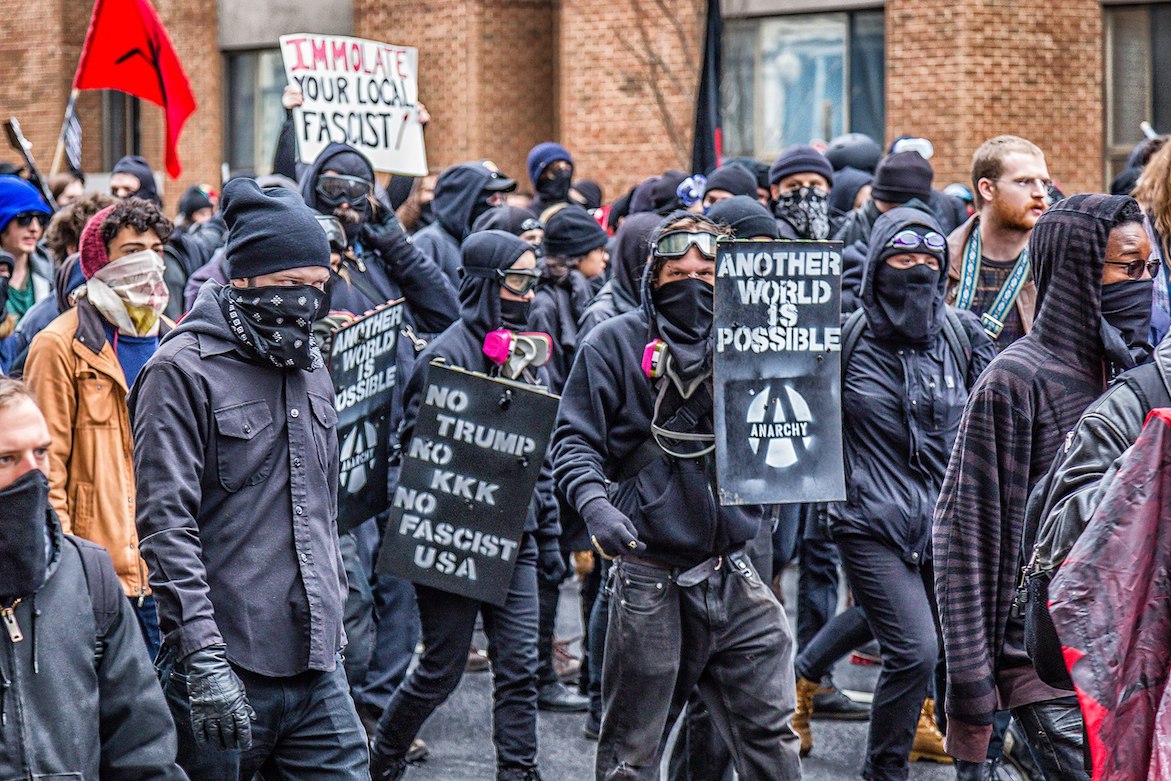 Anarchist protest against Trump and democratic backsliding in the United States, 2017 From the 1970s, modernization theory has been criticized by numerous scholars, including Andre Gunder Frank (1929–2005)[51] and Immanuel Wallerstein (1930–2019).[52] In this model, the modernization of a society required the destruction of the indigenous culture and its replacement by a more Westernized one. By one definition, modern simply refers to the present, and any society still in existence is therefore modern. Proponents of modernization typically view only Western society as being truly modern and argue that others are primitive or unevolved by comparison. That view sees unmodernized societies as inferior even if they have the same standard of living as western societies. Opponents argue that modernity is independent of culture and can be adapted to any society. Japan is cited as an example by both sides. Some see it as proof that a thoroughly modern way of life can exist in a non western society. Others argue that Japan has become distinctly more Western as a result of its modernization. As Tipps has argued, by conflating modernization with other processes, with which theorists use interchangeably (democratization, liberalization, development), the term becomes imprecise and therefore difficult to disprove.[16] The theory has also been criticised empirically, as modernization theorists ignore external sources of change in societies. The binary between traditional and modern is unhelpful, as the two are linked and often interdependent, and "modernization" does not come as a whole. Modernization theory has also been accused of being Eurocentric, as modernization began in Europe, with the Industrial Revolution, the French Revolution and the Revolutions of 1848[53] and has long been regarded as reaching its most advanced stage in Europe. Anthropologists typically make their criticism one step further and say that the view is ethnocentric and is specific to Western culture. Dependency theory One alternative model is dependency theory. It emerged in the 1950s and argues that the underdevelopment of poor nations in the Third World derived from systematic imperial and neo-colonial exploitation of raw materials.[54] Its proponents argue that resources typically flow from a "periphery" of poor and underdeveloped states to a "core" of wealthy states, enriching the latter at the expense of the former. It is a central contention of dependency theorists such as Andre Gunder Frank that poor states are impoverished and rich ones enriched by the way poor states are integrated into the "world system".[55] Dependency models arose from a growing association of southern hemisphere nationalists (from Latin America and Africa) and Marxists.[56] It was their reaction against modernization theory, which held that all societies progress through similar stages of development, that today's underdeveloped areas are thus in a similar situation to that of today's developed areas at some time in the past, and that, therefore, the task of helping the underdeveloped areas out of poverty is to accelerate them along this supposed common path of development, by various means such as investment, technology transfers, and closer integration into the world market. Dependency theory rejected this view, arguing that underdeveloped countries are not merely primitive versions of developed countries, but have unique features and structures of their own; and, importantly, are in the situation of being the weaker members in a world market economy.[57] Barrington Moore and comparative historical analysis Another line of critique of modernization theory was due to sociologist Barrington Moore Jr., in his Social Origins of Dictatorship and Democracy (1966).[58] In this classic book, Moore argues there were at least "three routes to the modern world" - the liberal democratic, the fascist, and the communist - each deriving from the timing of industrialization and the social structure at the time of transition. Counter to modernization theory, Moore held that there was not one path to the modern world and that economic development did not always bring about democracy.[59] Guillermo O'Donnell and bureaucratic authoritarianism Political scientist Guillermo O'Donnell, in his Modernization and Bureaucratic Authoritarianism (1973) challenged the thesis, advanced most notably by Seymour Martin Lipset,[18] that industrialization produced democracy. In South America, O'Donnell argued, industrialization generated not democracy, but bureaucratic authoritarianism. Acemoglu and Robinson and institutional economics Economists Daron Acemoglu and James A. Robinson (2022), argue that modernization theory cannot account for various paths of political development "because it posits a link between economics and politics that is not conditional on institutions and culture and that presumes a definite endpoint—for example, an 'end of history'."[34] |
批判と代替案 トランプと米国の民主主義後退に対するアナキストの抗議, 2017年 1970年代以降、近代化理論はアンドレ・ギュンダー・フランク(1929–2005)[51]やイマニュエル・ウォーラスティン(1930–2019) [52]を含む多くの学者から批判されてきた。このモデルでは、社会の近代化には土着文化の破壊と、より西洋化された文化への置き換えが必要とされる。あ る定義によれば、近代とは単に現在を指すものであり、したがって現存するあらゆる社会は近代的である。近代化の支持者は通常、西洋社会のみを真に近代的と 見なし、他の社会はそれに比べて原始的あるいは未発達だと主張する。この見解では、たとえ西洋社会と同等の生活水準を持っていたとしても、近代化されてい ない社会は劣っているとみなされる。反対派は、近代性は文化に依存せず、あらゆる社会に適応可能だと主張する。日本はこの両陣営から例として引用される。 一方では、非西洋社会においても完全に近代的な生活様式が存在し得る証拠と見なされる。他方では、日本は近代化の結果として明らかに西洋化が進んだと論じ られる。 ティップスが指摘するように、近代化を他のプロセス(民主化、自由化、発展)と混同し、理論家がそれらを互換的に用いることで、この用語は曖昧になり、反証が困難になる。[16] この理論は実証的にも批判されている。近代化理論家たちは社会における外部からの変化要因を無視しているからだ。伝統と近代という二項対立は無益である。両者は結びつき、しばしば相互依存しており、「近代化」は全体として到来するものではない。 近代化理論はまた、ヨーロッパ中心主義的であるとも非難されている。近代化はヨーロッパで始まり、産業革命、フランス革命、1848年革命[53]を経 て、長い間ヨーロッパで最も進んだ段階に達したと見なされてきたからだ。人類学者は通常、この批判をさらに一歩進め、この見解は民族中心主義的であり西洋 文化に特有のものだと主張する。 従属理論 代替モデルの一つが従属理論である。1950年代に提唱され、第三世界の貧しい国民の発展遅滞は、帝国主義および新植民地主義による原材料の体系的な搾取 に起因すると論じる[54]。支持者らは、資源が典型的に貧しく未開発な国家の「周辺部」から富裕な国家の「中心部」へ流れ、後者が前者を犠牲にして富を 蓄積すると主張する。アンドレ・ギュンダー・フランクら依存理論家の中核的主張は、貧しい国家が「世界システム」に組み込まれる方法によって貧困化し、豊 かな国家が富むというものである。[55] 依存モデルは、南半球(ラテンアメリカとアフリカ)のナショナリストとマルクス主義者の連携強化から生まれた。[56] これは近代化理論への反発であった。近代化理論は、全ての社会が類似の発展段階を経て進歩し、今日の未開発地域は過去に先進地域が経験した状況と類似して いるとする。したがって未開発地域の貧困脱却支援とは、投資・技術移転・世界市場への緊密な統合といった手段で、この想定される共通の発展経路に沿って加 速させることだと主張する。従属理論はこの見解を退け、未開発国は単に先進国の原始的な形態ではなく、独自の特性と構造を有していると主張した。さらに重 要なのは、世界市場経済において弱者としての立場にあるという点である。[57] バリントン・ムーアと歴史比較分析 近代化理論に対する別の批判は、社会学者バリントン・ムーア・ジュニアによる『独裁と民主主義の社会的起源』(1966年)に端を発する。[58] この古典的な著作の中で、ムーアは、少なくとも「近代世界への 3 つの道」、すなわち自由民主主義、ファシズム、共産主義があり、それぞれは工業化の時期と移行期の社会構造に由来すると論じている。近代化論とは対照的 に、ムーアは、近代世界への道は 1 つではなく、経済発展が必ずしも民主主義をもたらすわけではないと主張した。[59] ギジェルモ・オドネルと官僚的権威主義 政治学者のギジェルモ・オドネルは、著書『近代化と官僚的権威主義』(1973年)の中で、特にシーモア・マーティン・リップセット[18] が提唱した「工業化は民主主義を生み出す」という説に異議を唱えた。オドネルは、南米では工業化は民主主義ではなく、官僚的権威主義を生み出したと論じ た。 アセモグルとロビンソン、そして制度経済学 経済学者ダロン・アセモグルとジェームズ・A・ロビンソン(2022)は、近代化理論は「制度や文化に依存しない経済と政治の関連性を仮定し、例えば『歴史の終わり』のような明確な終着点を前提としている」ため、政治発展のさまざまな経路を説明できないと主張している。 |
| Anti-modernization Bielefeld School Consumerism Democracy and economic growth Dependency theory Development criticism Ecological modernization Globalization Gwangmu Reform timeline Idea of Progress Mass society Mediatization (media) Modernism Modernization theory (Nationalism) Outline of organizational theory Progressive Era (US, early 20th century) Postmodernism Postmodernity Western education |
反近代化 ビーレフェルト学派 消費主義 民主主義と経済成長 従属理論 開発批判 生態的近代化 グローバリゼーション 光武改革の年表 進歩の理念 大衆社会 メディア化(メディア) モダニズム 近代化理論(ナショナリズム) 組織理論の概要 プログレッシブ時代(米国、20世紀初頭) ポストモダニズム ポストモダニティ 西洋教育 |
| References |
|
| Further reading Bernstein, Henry (1971). "Modernization theory and the sociological study of development". Journal of Development Studies. 7 (2): 141–60. doi:10.1080/00220387108421356. Black, Cyril (1966). The Dynamics of Modernization: A Study in Comparative History. Harper & Row. Black, Cyril (1975). The Modernization of Japan and Russia. Brown, Richard D. (1976). Modernization: The Transformation of American Life, 1600–1865. Brown, Richard D. (1972). "Modernization and the Modern Personality in Early America, 1600–1865: A Sketch of a Synthesis". Journal of Interdisciplinary History. 2 (3): 201–28. doi:10.2307/202285. JSTOR 202285. Brugger, Bill; Hannan, Kate (1983). Modernization and revolution. Routledge. ISBN 978-0-7099-0695-7. Cammack, Paul Anthony, Capitalism and Democracy in the Third World: The Doctrine for Political Development. London: Leicester University Press, 1997 Dixon, Simon M. (1999). The modernisation of Russia, 1676–1825. Cambridge University Press. ISBN 978-0-521-37961-8. Eisenstadt, S. N., ed. (1968). The Protestant Ethic and Modernization: A Comparative View. Basic Books. Garon, Sheldon. "Rethinking Modernization and Modernity in Japanese History: A Focus on State-Society Relations" Journal of Asian Studies 53#2 (1994), pp. 346–366 online Gilman, Nils (2004). Mandarins of the Future: Modernization Theory in Cold War America. Johns Hopkins University Press. Goorha, Prateek (2010). "Modernization Theory". Oxford Research Encyclopedia of International Studies. Oxford University Press. doi:10.1093/acrefore/9780190846626.013.266. Groh, Arnold (2019). Theories of Culture. London: Routledge. ISBN 978-1-138-66865-2. Hua, Shiping; Zhong, Yang, eds. (2006). Political Civilization And Modernization in China: The Political Context of China's Transformation. Huntington, Samuel P. (1966). "Political Modernization: America vs. Europe". World Politics 18 (3): 378–414. Inglehart, Ronald & Welzel, Christian (2005). Modernization, Cultural Change and Democracy: The Human Development Sequence. New York: Cambridge University Press. ISBN 9780521846950.. Janos, Andrew C. Politics and Paradigms: Changing Theories of Change in Social Science. Stanford University Press, 1986 Jaquette, Jane S. (1982). "Women and Modernization Theory". World Politics. 34 (2): 267–73. doi:10.2307/2010265. JSTOR 2010265. S2CID 154657383. Jensen, Richard (2001). Illinois: A History, modernizers, traditionalists and post-moderns make state history Jensen, Richard (1980). "On Modernizing Frederick Jackson Turner: The Historiography of Regionalism". Western Historical Quarterly. 11 (3): 307–22. doi:10.2307/967565. JSTOR 967565. Kerr, Peter; Foster, Emma; Oaten, Alex; Begum, Neema (2018). "Getting back in the DeLorean: modernization vs. anti-modernization in contemporary British politics" (PDF). Policy Studies. 39 (3): 292–309. doi:10.1080/01442872.2018.1478407. ISSN 0144-2872. S2CID 158499629. Khan, Joel S. (2001). Modernity and exclusion. SAGE. ISBN 978-0-7619-6657-9. Knobl, Wolfgang (2003). "Theories That Won't Pass Away: The Never-ending Story". In Delanty, Gerard; Isin, Engin F. (eds.). Handbook of Historical Sociology. pp. 96–107. Leroy, Peter; van Tatenhove, Jan (2000). "Political modernization theory and environmental politics". Environment and Global Modernity. pp. 187–208. doi:10.4135/9781446220139.n9. ISBN 9780761967675. Lipset, Seymour Martin, ed. (1996). The Encyclopedia of Democracy. (4 vol.) Macionis, John J.; Plummer, Ken (2008). Sociology (4th ed.). Pearson Education. ISBN 978-0-13-205158-3. McGuigan, Jim (2006). Modernity and postmodern culture. Marshall, T. H.; Lipset, Seymour Martin, eds. (1965). Class, Citizenship, and Social Development. Mazlish, Bruce (1993). Conceptualizing Global History. Westview Press. Misa, Thomas J.; Brey, Philip; Feenberg, Andrew, eds. (2004). Modernity and Technology. MIT. Munck, Gerardo L. "Modernization Theory as a Case of Failed Knowledge Production." The Annals of Comparative Democratization 16, 3 (2018): 37–41. [5] Archived 2019-08-13 at the Wayback Machine Rodgers, Daniel T. (1977). "Tradition, Modernity, and the American Industrial Worker: Reflections and Critique". Journal of Interdisciplinary History. 7 (4): 655–81. doi:10.2307/202886. JSTOR 202886. So, Alvin Y. (1990). Social Change and Development: Modernization, Dependency and World-System Theories. SImmons, Joel W. (2024). "Democracy and Economic Growth: Theoretical Debates and Empirical Contributions". World Politics. Tipps, Dean C. (1973). "Modernization Theory and the Comparative Study of Societies: A Critical Perspective". Comparative Studies in Society and History. 15 (2): 199–226. doi:10.1017/S0010417500007039. JSTOR 178351. S2CID 145736971. Wagner, Peter (1993). A Sociology of Modernity: Liberty and Discipline. London: Routledge. ISBN 9780415081863. Wagner, Peter (2001). Theorizing Modernity. Inescapability and Attainability in Social Theory. London: SAGE. ISBN 978-0761951476. Wagner, Peter (2008). Modernity as Experience and Interpretation: A New Sociology of Modernity. Polity Press. ISBN 978-0-7456-4218-5. Wucherpfennig, Julian, and Franziska Deutsch. 2009. "Modernization and Democracy: Theories and Evidence Revisited." Living Reviews in Democracy Vol. 1, p. 1-9. 9p.[6] Young, Nancy Beck. "Modernization and Texas Historiography" in Beyond Texas through time: breaking away from past interpretations ed. by Walter L. Buenger and Arnoldo De Leon. (Texas A&M UP, 2011) pp.221-270. |
追加文献(さらに読む) バーンスタイン、ヘンリー(1971)。「近代化理論と社会学的な発展研究」。『開発研究ジャーナル』。7巻2号:141–60頁。doi:10.1080/00220387108421356。 ブラック、シリル(1966)。『近代化の力学:比較歴史学的研究』。ハーパー&ロウ。 ブラック、シリル(1975)。『日本とロシアの近代化』。 ブラウン、リチャード・D.(1976)。『近代化:アメリカ生活の変容、1600–1865』。 ブラウン、リチャード D. (1972). 「初期アメリカにおける近代化と現代的人格、1600-1865:統合の概略」. 学際歴史学雑誌. 2 (3): 201-28. doi:10.2307/202285. JSTOR 202285. Brugger, Bill; Hannan, Kate (1983). 『近代化と革命』. Routledge. ISBN 978-0-7099-0695-7. キャマック、ポール・アンソニー、『第三世界の資本主義と民主主義:政治発展の教義』. ロンドン:レスター大学出版、1997年 Dixon, Simon M. (1999). ロシアの近代化、1676–1825. ケンブリッジ大学出版局. ISBN 978-0-521-37961-8. Eisenstadt, S. N., ed. (1968). プロテスタントの倫理と近代化:比較研究. ベーシック・ブックス. ギャロン、シェルドン。「日本史における近代化と近代性の再考:国家と社会の関係に焦点を当てて」『アジア研究ジャーナル』53#2 (1994)、346-366 ページ オンライン ギルマン、ニルス (2004)。『未来のマンダリン:冷戦下のアメリカにおける近代化理論』ジョンズ・ホプキンズ大学出版局。 Goorha, Prateek (2010). 「近代化理論」. オックスフォード国際研究百科事典. オックスフォード大学出版局. doi:10.1093/acrefore/9780190846626.013.266. Groh, Arnold (2019). 文化の理論. ロンドン: Routledge. ISBN 978-1-138-66865-2。 Hua, Shiping; Zhong, Yang, eds. (2006). Political Civilization And Modernization in China: The Political Context of China's Transformation. Huntington, Samuel P. (1966). 「Political Modernization: America vs. Europe」. World Politics 18 (3): 378–414. イングルハート、ロナルド、ウェルゼル、クリスチャン (2005). 近代化、文化変化、民主主義:人間開発の順序. ニューヨーク:ケンブリッジ大学出版局. ISBN 9780521846950.. ジャノス、アンドルー C. 政治とパラダイム:社会科学における変化の理論の変化. スタンフォード大学出版局、1986年 ジャケット、ジェーン・S(1982)。「女性と近代化理論」。ワールド・ポリティクス。34 (2): 267–73. doi:10.2307/2010265. JSTOR 2010265. S2CID 154657383. Jensen, Richard (2001). Illinois: A History, modernizers, traditionalists and post-moderns make state history Jensen, Richard (1980). 「On Modernizing Frederick Jackson Turner: The Historiography of Regionalism」. Western Historical Quarterly. 11 (3): 307–22. doi:10.2307/967565. JSTOR 967565。 カー、ピーター、フォスター、エマ、オーテン、アレックス、ベグム、ニーマ (2018)。「デロリアンに戻る:現代英国政治における近代化対反近代化」 (PDF)。政策研究。39 (3): 292–309。doi:10.1080/01442872.2018.1478407. ISSN 0144-2872. S2CID 158499629. カーン、ジョエル・S.(2001)。『近代性と排除』SAGE。ISBN 978-0-7619-6657-9。 クノーブル、ヴォルフガング(2003)。「消え去らない理論:終わらない物語」。デランティ、ジェラルド;イシン、エンジン F.(編)。『歴史社会学ハンドブック』。96–107頁。 Leroy, Peter; van Tatenhove, Jan (2000). 「政治的近代化理論と環境政治」. 『環境とグローバルな近代性』. pp. 187–208. doi:10.4135/9781446220139.n9. ISBN 9780761967675. リップセット、シーモア・マーティン編(1996)。『民主主義の百科事典』(全 4 巻)。 マシオーニス、ジョン・J.、プラマー、ケン(2008)。『社会学』(第 4 版)。ピアソン・エデュケーション。ISBN 978-0-13-205158-3。 マクギガン、ジム (2006)。『モダニティとポストモダン文化』。 マーシャル、T. H.、リプセット、シーモア・マーティン、編 (1965)。『階級、市民権、社会開発』。 マズリッシュ、ブルース (1993)。『グローバル史の概念化』。ウェストビュー・プレス。 ミサ、トーマス J.、ブレイ、フィリップ、ファーンバーグ、アンドルー編(2004)。『近代性と技術』。MIT。 ムンク、ジェラルド L. 「知識生産の失敗事例としての近代化理論」『比較民主化年報』16、3 (2018): 37–41。[5] 2019年8月13日、ウェイバックマシンにアーカイブ ロジャース、ダニエル・T(1977)。「伝統、近代性、そしてアメリカの産業労働者:考察と批判」。学際的歴史学雑誌。7 (4): 655–81. doi:10.2307/202886. JSTOR 202886. ソー、アルヴィン・Y.(1990)。『社会変化と発展:近代化理論、従属理論、世界システム理論』。 シモンズ、ジョエル・W.(2024)。「民主主義と経済成長:理論的議論と実証的貢献」。『ワールド・ポリティクス』。 ティップス、ディーン・C.(1973)。「近代化理論と社会比較研究:批判的視点」『社会と歴史の比較研究』15巻2号:199–226頁。doi:10.1017/S0010417500007039。JSTOR 178351。S2CID 145736971。 ワグナー、ピーター(1993)。『近代性の社会学:自由と規律』。ロンドン:ラウトレッジ。ISBN 9780415081863。 ワグナー、ピーター(2001)。『近代性の理論化:社会理論における不可避性と達成可能性』。ロンドン:SAGE。ISBN 978-0761951476。 ワグナー、ピーター(2008)。『経験と解釈としての近代性:新たな近代性の社会学』。ポリティ・プレス。ISBN 978-0-7456-4218-5。 ヴッヘルフェンニヒ、ジュリアン、フランツィスカ・ドイチュ(2009)。「近代化と民主主義:理論と実証の再検討」。リビング・レビューズ・イン・デモクラシー 第1巻、1-9頁。9p.[6] ヤング、ナンシー・ベック。「近代化とテキサス史学」『時を超えてテキサスを越えて:過去の解釈からの脱却』ウォルター・L・ビューンガー、アルノルド・デ・レオン編(テキサスA&M大学出版、2011年)221-270頁。 |
| https://en.wikipedia.org/wiki/Modernization_theory |
リ ンク
文 献
そ の他の情報
CC
Copyleft,
CC, Mitzub'ixi Quq Chi'j, 1996-2099