歴史否定主義
Historical negationism
☆歴史的否定主義[Historical negationism][1] [2](歴史的否認主義とも呼ばれる)とは、歴史的記録の改竄[3][4]、軽視[5][6]、あるいは歪曲のことである。これは、新たな証拠や推論に基 づく歴史の学術的再解釈を包括するより広範な概念である「歴史修正主義」とは区別される。[7] 過去を改変し、影響を与えようとする試みにおいて、歴史的否定主義は、既知の偽造文書を本物として提示すること、本物の文書を信用できないとする巧妙だが 不合理な理由をでっち上げること、反対の事実を報告している書籍や資料に結論を帰属させること、特定の視点を支持するために統計データを操作すること、あ るいは伝統的または現代のテキストを意図的に誤訳することなど、正当な歴史的言説において許容されない手法を用いることで、非合法な歴史修正主義として機 能する。[8] ドイツなどの一部の国では、特定の歴史的出来事に対する否定主義的な改変を犯罪として規定しているが、他国では言論の自由の保護など様々な理由から、より 慎重な立場をとっている。また、過去には否定主義的な見解を義務付けた国もある。例えば米国のカリフォルニア州では、一部の児童がカリフォルニア・ジェノ サイドについて学ぶことを明示的に妨げられたとされている。[9][10] 否定主義の顕著な例としては、南軍の「失われた大義」、ドイツ国防軍(ヴェルマハト)の「清廉な神話」、そしてホロコースト、ナクバ、ホロドモール、アル メニア人虐殺、南京大虐殺の否定などが挙げられる。[11][12][13] 文学においては、ジョージ・オーウェルの『1984年』など、一部のフィクション作品で想像力豊かに描かれている。現代において、否定主義は、国家メディ ア、主流メディア、およびインターネットなどのニューメディアを通じて、政治的・宗教的な意図によって広まる可能性がある。[14]
☆歴史否定主義の影響と司法
| Ramifications and judicature 16 European countries as well as Canada and Israel have criminalized historical negationism of the Holocaust.[citation needed] The Council of Europe defines it as the "denial, gross minimisation, approval or justification of genocide or crimes against humanity" (article 6, Additional Protocol to the Convention on cybercrime). |
法的影響と司法 欧州16カ国に加え、カナダとイスラエルは、ホロコーストの歴史的否定を犯罪としている。[出典必要] 欧州評議会は、これを「ジェノサイドまたは人道に対する罪の否定、著しい軽視、容認、または正当化」と定義している(サイバー犯罪条約追加議定書第6条)。 |
| International law Main article: Additional Protocol to the Convention on Cybercrime Some council-member states proposed an additional protocol to the Council of Europe Cybercrime Convention, addressing materials and "acts of racist or xenophobic nature committed through computer networks"; it was negotiated from late 2001 to early 2002, and, on 7 November 2002, the Council of Europe Committee of Ministers adopted the protocol's final text[219] titled Additional Protocol to the Convention on Cyber-crime, Concerning the Criminalization of Acts of a Racist and Xenophobic Nature Committed through Computer Systems, ("Protocol").[220] It opened on 28 January 2003, and became current on 1 March 2006; as of 30 November 2011, 20 States have signed and ratified the Protocol, and 15 others have signed, but not yet ratified it (including Canada and South Africa).[221] The Protocol requires participant States to criminalize the dissemination of racist and xenophobic material, and of racist and xenophobic threats and insults through computer networks, such as the Internet.[219] Article 6, Section 1 of the Protocol specifically covers Holocaust denial, and other genocides recognized as such by international courts, established since 1945, by relevant international legal instruments. Section 2 of Article 6 allows a Party to the Protocol, at their discretion, only to prosecute the violator if the crime is committed with the intent to incite hatred or discrimination or violence; or to use a reservation, by allowing a Party not to apply Article 6 – either partly or entirely.[222] The Council of Europe's Explanatory Report of the Protocol says that the "European Court of Human Rights has made it clear that the denial or revision of 'clearly established historical facts – such as the Holocaust – ... would be removed from the protection of Article 10 by Article 17' of the European Convention on Human Rights" (see the Lehideux and Isorni judgement of 23 September 1998);[222] Two of the English-speaking states in Europe, Ireland and the United Kingdom, have not signed the additional protocol, (the third, Malta, signed on 28 January 2003, but has not yet ratified it).[221] On 8 July 2005 Canada became the only non-European state to sign the convention. They were joined by South Africa in April 2008. The United States government does not believe that the final version of the Protocol is consistent with the United States' First Amendment Constitutional rights and has informed the Council of Europe that the United States will not become a Party to the protocol.[219][223] |
国際法 本記事:サイバー犯罪条約の追加議定書 一部の加盟国は、欧州評議会サイバー犯罪条約に対し、資料および「コンピュータ・ネットワークを通じて行われる人種差別的または外国人排斥的な性質の行 為」に対処する追加議定書を提案した; 2001年末から2002年初頭にかけて交渉が行われ、2002年11月7日、欧州評議会閣僚委員会は「コンピュータシステムを通じて行われる人種差別的 および外国人排斥的な性質の行為の犯罪化に関するサイバー犯罪条約追加議定書」(以下「議定書」)と題する最終案を採択した[219]。[220] 2003年1月28日に署名開放され、2006年3月1日に発効した。2011年11月30日現在、20カ国が本議定書に署名・批准しており、さらに15 カ国が署名しているが、まだ批准には至っていない(カナダおよび南アフリカを含む)。[221] 本議定書は、参加国に対し、インターネットなどのコンピュータ・ネットワークを通じた人種差別的・外国人排斥的な資料、および人種差別的・外国人排斥的な 脅迫や侮辱の流布を犯罪化することを求めている。[219] 議定書第6条第1項は、ホロコーストの否定、および1945年以降に制定された関連する国際法文書により国際裁判所によってそのように認定されたその他の ジェノサイドを具体的に規定している。第6条第2項は、議定書の締約国に対し、その裁量により、憎悪、差別、または暴力を扇動する意図をもって犯罪が行わ れた場合にのみ違反者を起訴することを認めている。あるいは、留保を付すことにより、締約国が第6条を適用しないこと(一部または全部)を認めている。 [222] 欧州評議会の本議定書に関する解説報告書は、「欧州人権裁判所は、『ホロコーストのような明確に確立された歴史的事実』の否認または改竄は、「欧州人権条 約」第17条により第10条の保護の対象外となることを明らかにしている」と述べている(1998年9月23日のLehideux and Isorni判決参照); [222] 欧州の英語圏国家のうち、アイルランドと英国の2カ国は、この追加議定書に署名していない(3番目のマルタは2003年1月28日に署名したが、まだ批准 していない)。[221] 2005年7月8日、カナダは欧州以外の国として唯一、同条約に署名した。2008年4月には南アフリカもこれに加わった。米国政府は、議定書の最終案が 合衆国憲法修正第1条の権利と整合しないと考えており、欧州評議会に対し、米国は議定書の締約国にはならない旨を通知している。[219][223] |
| Domestic law There are domestic laws against negationism and hate speech (which may encompass negationism) in several countries, including: Austria (Article I §3 Verbotsgesetz 1947 with its 1992 updates and added paragraph §3h).[224] Belgium (Belgian Holocaust denial law).[225] Czech Republic.[226] France (Gayssot Act). Germany (§130(3) of the penal code).[227] Hungary.[228] Israel.[229] Lithuania.[230] Luxembourg.[231] Poland (Article 55 of the law establishing the Institute of National Remembrance 1998).[232] Portugal.[233] Romania.[234] Slovakia.[235] Switzerland (Article 261bis of the Penal Code).[236] Additionally, the Netherlands considers denying the Holocaust as a hate crime – which is a punishable offence.[237] Wider use of domestic laws include the 1990 French Gayssot Act that prohibits any "racist, anti-Semitic or xenophobic" speech,[237] and the Czech Republic[238] and Ukraine[239] have criminalized the denial and the minimization of Communist-era crimes. |
国内法 いくつかの国では、ネゲーション主義およびヘイトスピーチ(ネゲーション主義を含む場合がある)を禁じる国内法が存在する。これには以下が含まれる: オーストリア(1947年禁止法第1条第3項、1992年の改正および第3h項の追加を含む)。[224] ベルギー(ベルギーのホロコースト否定法)。[225] チェコ共和国。[226] フランス(ゲソ法)。 ドイツ(刑法第130条第3項)。[227] ハンガリー。[228] イスラエル。[229] リトアニア。[230] ルクセンブルク。[231] ポーランド(1998年国家記憶研究所設立法第55条)。[232] ポルトガル。[233] ルーマニア。[234] スロバキア。[235] スイス(刑法第261bis条)。[236] さらに、オランダではホロコーストの否定をヘイトクライムとみなしており、これは処罰の対象となる犯罪である。[237] 国内法におけるより広範な適用例としては、あらゆる「人種差別的、反ユダヤ的、または排外的な」発言を禁止する1990年のフランスのゲソ法[237]が あり、チェコ共和国[238]およびウクライナ[239]では、共産主義時代の犯罪の否定および軽視を犯罪化している。 |
| https://en.wikipedia.org/wiki/Historical_negationism |
★歴史否定主義の解説
| Historical
negationism,[1][2] also called historical denialism, is the
falsification,[3][4] trivialization,[5][6] or distortion of the
historical record. This is distinct from historical revisionism, a
broader term encompassing academic reinterpretations of history driven
by new evidence or reasoning.[7] In attempting to revise and influence
the past, historical negationism acts as illegitimate historical
revisionism by using techniques inadmissible in proper historical
discourse, such as presenting known forged documents as genuine,
inventing ingenious but implausible reasons for distrusting genuine
documents, attributing conclusions to books and sources that report the
opposite, manipulating statistical series to support the given point of
view, and deliberately mistranslating traditional or modern texts.[8] Some countries, such as Germany, have criminalized the negationist revision of certain historical events, while others take a more cautious position for various reasons, such as protection of free speech. Others have in the past mandated negationist views, such as the US state of California, where it is claimed that some schoolchildren have been explicitly prevented from learning about the California genocide.[9][10] Notable examples of negationism include the Lost Cause of the Confederacy, the clean Wehrmacht myth, and denials of the Holocaust, Nakba, Holodomor, the Armenian genocide and the Nanjing Massacre.[11][12][13] In literature, it has been imaginatively depicted in some works of fiction, such as Nineteen Eighty-Four by George Orwell. In modern times, negationism may spread via political, religious agendas through state media, mainstream media, and new media, such as the Internet.[14] |
歴史的否定主義[Historical
negationism][1][2](歴史的否認主義とも呼ばれる)とは、歴史
的記録の改竄[3][4]、軽視[5][6]、あるいは歪曲のことである。これは、新たな証拠や推論に基づく歴史の学術的再解釈を包括するより広範な概念
である「歴史修正主義」とは区別される。[7]
過去を改変し、影響を与えようとする試みにおいて、歴史的否定主義は、既知の偽造文書を本物として提示すること、本物の文書を信用できないとする巧妙だが
不合理な理由をでっち上げること、反対の事実を報告している書籍や資料に結論を帰属させること、特定の視点を支持するために統計データを操作すること、あ
るいは伝統的または現代のテキストを意図的に誤訳することなど、正当な歴史的言説において許容されない手法を用いることで、非合法な歴史修正主義として機
能する。[8] ドイツなどの一部の国では、特定の歴史的出来事に対する否定主義的な改変を犯罪として規定しているが、他国では言論の自由の保護など様々な理由から、より 慎重な立場をとっている。また、過去には否定主義的な見解を義務付けた国もある。例えば米国のカリフォルニア州では、一部の児童がカリフォルニア・ジェノ サイドについて学ぶことを明示的に妨げられたとされている。[9][10] 否定主義の顕著な例としては、南軍の「失われた大義」、ドイツ国防軍(ヴェルマハト)の「清廉な神話」、そしてホロコースト、ナクバ、ホロドモール、アル メニア人虐殺、南京大虐殺の否定などが挙げられる。[11][12][13] 文学においては、ジョージ・オーウェルの『1984年』など、一部のフィクション作品で想像力豊かに描かれている。現代において、否定主義は、国家メディ ア、主流メディア、およびインターネットなどのニューメディアを通じて、政治的・宗教的な意図によって広まる可能性がある。[14] |
| Origin of the term The term negationism (négationnisme) was first coined by the French historian Henry Rousso in his 1987 book The Vichy Syndrome which looked at the French popular memory of Vichy France and the French Resistance. Rousso posited that it was necessary to distinguish between legitimate historical revisionism in Holocaust studies and politically motivated denial of the Holocaust, which he termed negationism.[15] |
用語の由来 「ネガショニズム(négationnisme)」という用語は、フランスの歴史家アンリ・ルソーが1987年に著した『ヴィシー・シンドローム』におい て初めて提唱されたものである。同書は、ヴィシー政権下のフランスとフランス・レジスタンスに関するフランス国民の記憶を考察したものである。ルソーは、 ホロコースト研究における正当な歴史修正主義と、政治的な動機に基づくホロコーストの否定とを区別する必要があると主張し、後者を「ネガショニズム」と呼 んだ。[15] |
| Purposes Usually, the purpose of historical negation is to align with tribal or ideological beliefs, demonize an enemy, maintain group identity, or preserve social bonds, often through motivated reasoning and denial of established facts.[16] Ideological influence See also: Social influence and War of ideas The principal functions of negationist history are the abilities to control ideological and political influence. History is a social resource that contributes to shaping national identity, culture, and the public memory. Through the study of history, people are imbued with a particular cultural identity; therefore, by negatively revising history, the negationist can craft a specific, ideological identity. Because historians are credited as people who single-mindedly pursue truth, by way of fact, negationist historians capitalize on the historian's professional credibility, and present their pseudohistory as true scholarship. By adding a measure of credibility to the work of revised history, the ideas of the negationist historian are more readily accepted in the public mind. As such, professional historians recognize the revisionist practice of historical negationism as the work of "truth-seekers" finding different truths in the historical record to fit their political, social, and ideological contexts.[citation needed] |
目的 通常、歴史の否定の目的は、部族的あるいはイデオロギー的な信念に同調すること、敵を悪魔化すること、集団のアイデンティティを維持すること、あるいは社会的絆を保つことにある。これらは往々にして、動機づけられた推論や確立された事実の否定を通じて行われる。[16] イデオロギー的影響 関連項目:社会的影響、思想戦争 否定主義的歴史の主な機能は、イデオロギー的・政治的影響を制御する能力にある。 歴史は、国民的アイデンティティ、文化、そして公的記憶の形成に寄与する社会的資源である。歴史の学習を通じて、人々は特定の文化的アイデンティティを身 につける。したがって、歴史を否定的に改竄することで、否定論者は特定のイデオロギー的アイデンティティを構築することができる。歴史家は事実を通じてひ たすら真実を追求する者として評価されているため、否定論的歴史家は歴史家の専門的な信頼性を悪用し、自らの疑似歴史を真の学術研究として提示する。改変 された歴史の研究に一定の信頼性を付与することで、否定論的歴史家の主張は一般大衆の意識においてより容易に受け入れられるようになる。このように、専門 の歴史家たちは、歴史的否定主義という修正主義的実践を、自らの政治的、社会的、イデオロギー的文脈に合わせるために歴史的記録の中から異なる真実を見出 そうとする「真実の探求者」たちの活動であると認識している。[出典必要]ホロコーストの動機付けられた否定、すなわち彼が「否定主義」と呼んだものであ る。[15] |
| Political influence History provides insight into past political policies and consequences, and thus assists people in extrapolating political implications for contemporary society. Historical negationism is applied to cultivate a specific political myth, sometimes with official consent from the government, whereby self-taught, amateur, and dissident academic historians either manipulate or misrepresent historical accounts to achieve political ends. For example, after the late 1930s in the Soviet Union, the ideology of the Communist Party of the Soviet Union and historiography in the Soviet Union treated reality and the party line as the same intellectual entity, especially in regards to the Russian Civil War and peasant rebellions;[17] Soviet historical negationism advanced a specific, political, and ideological agenda about Russia and its place in world history.[18] |
政治的影響 歴史は過去の政治政策とその帰結についての洞察を与え、それによって人々が現代社会における政治的含意を推し量る手助けとなる。歴史的否定主義は、特定の 政治的神話を醸成するために用いられ、時には政府の公的な承認を得て、独学の歴史家やアマチュア、反体制派の学術歴史家らが、政治的目的を達成するために 歴史的記述を操作したり歪曲したりすることがある。例えば、1930年代後半以降のソビエト連邦において、ソビエト共産党のイデオロギーとソ連の歴史学 は、特にロシア内戦や農民反乱に関して、現実と党の路線を同一の知的実体として扱った[17]。ソ連の歴史的否定主義は、ロシアおよび世界史におけるその 位置づけについて、特定の政治的・イデオロギー的なアジェンダを推進した[18]。 |
| Techniques Main article: Pseudohistory Historical negationism applies the techniques of research, quotation, and presentation for deception of the reader and denial of the historical record. In support of the "revised history" perspective, the negationist historian uses false documents as genuine sources, presents specious reasons to distrust genuine documents, exploits published opinions by quoting out of historical context, manipulates statistics, and mistranslates texts in other languages.[19] The revision techniques of historical negationism operate in the intellectual space of public debate for the advancement of a given interpretation of history and the cultural perspective of the "revised history".[20] As a document, the revised history is used to negate the validity of the factual, documentary record, and so reframe explanations and perceptions of the discussed historical event, to deceive the reader, the listener, and the viewer; therefore, historical negationism functions as a technique of propaganda.[21] Rather than submit their works for peer review, negationist historians rewrite history and use logical fallacies to construct arguments that will obtain the desired results, a "revised history" that supports an agenda – political, ideological, religious, etc.[8] In the practice of historiography, the British historian Richard J. Evans describes the technical differences, between professional historians and negationist historians, commenting: "Reputable and professional historians do not suppress parts of quotations from documents that go against their own case, but take them into account, and, if necessary, amend their own case, accordingly. They do not present, as genuine, documents which they know to be forged, just because these forgeries happen to back up what they are saying. They do not invent ingenious, but implausible, and utterly unsupported reasons for distrusting genuine documents, because these documents run counter to their arguments; again, they amend their arguments, if this is the case, or, indeed, abandon them altogether. They do not consciously attribute their own conclusions to books and other sources, which, in fact, on closer inspection, actually say the opposite. They do not eagerly seek out the highest possible figures in a series of statistics, independently of their reliability, or otherwise, simply because they want, for whatever reason, to maximize the figure in question, but rather, they assess all the available figures, as impartially as possible, to arrive at a number that will withstand the critical scrutiny of others. They do not knowingly mistranslate sources in foreign languages to make them more serviceable to themselves. They do not willfully invent words, phrases, quotations, incidents and events, for which there is no historical evidence, to make their arguments more plausible."[22] |
手法 本記事:偽歴史 歴史的否定主義は、読者を欺き、歴史的記録を否定するために、調査、引用、提示といった手法を用いる。「改訂された歴史」という視点を支持するため、否定 主義の歴史家は、偽の文書を本物の資料として使用し、本物の文書を疑うよう説得力のない理由を提示し、歴史的文脈から切り離して引用することで公表された 意見を悪用し、統計を操作し、他言語のテキストを誤訳する。[19] 歴史的否定主義の改変技法は、特定の歴史解釈と「改変された歴史」という文化的視点を推進するために、公の議論という知的空間において機能する。[20] 文書として、「改変された歴史」は、事実に基づく文書記録の正当性を否定し、それによって議論の対象となる歴史的出来事に対する説明や認識を再構築し、読 者、聴衆、視聴者を欺くために用いられる。したがって、歴史的否定主義はプロパガンダの技法として機能する。[21] 否定主義の歴史家たちは、自らの著作をピアレビューに委ねるのではなく、歴史を書き換え、論理的誤謬を用いて、望ましい結果、すなわち政治的、イデオロ ギー的、宗教的などのアジェンダを支持する「改訂された歴史」を導き出すような論証を構築する。[8] 歴史学の実践において、英国の歴史家リチャード・J・エヴァンスは、専門の歴史家と否定主義の歴史家との技術的な違いについて次のように述べている。「信 頼できる専門の歴史家は、自らの主張に反する文書からの引用部分を隠蔽することはなく、それらを考慮に入れ、必要であればそれに応じて自らの主張を修正す る。彼らは、たとえその偽造文書が自らの主張を裏付けるものであったとしても、それが偽造であると知りながら、それを本物として提示することはない。ま た、本物の文書が自らの論拠に反するという理由だけで、巧妙ではあるが不合理で、全く根拠のない理由をでっち上げて、その文書を信用しないようなこともな い。そのような場合、彼らは論拠を修正するか、あるいは完全に放棄するのだ。彼らは、実際にはよく調べれば正反対のことを述べている書籍やその他の資料 に、意識的に自らの結論を帰属させたりはしない。彼らは、信頼性の高低にかかわらず、単に何らかの理由で当該数値を最大化したいために、統計データの中で 可能な限り高い数値を熱心に探し出したりはせず、むしろ、入手可能なすべての数値を可能な限り公平に評価し、他者の批判的な精査に耐えうる数値に到達しよ うとする。彼らは、自分たちの都合に合うように、外国語の資料を故意に誤訳したりはしない。また、自らの主張をより説得力のあるものにするために、歴史的 証拠のない言葉やフレーズ、引用、出来事や事件を意図的にでっち上げたりもしない。」[22] |
| Deception See also: Disinformation Deception includes falsifying information, obscuring the truth, and lying to manipulate public opinion about the historical event discussed in the revised history. The negationist historian applies the techniques of deception to achieve either a political or an ideological goal, or both. The field of history distinguishes among history books based upon credible, verifiable sources, which were peer-reviewed before publication; and deceptive history books, based upon unreliable sources, which were not submitted for peer review.[23][24] The distinction among types of history books rests upon the research techniques used in writing a history. Verifiability, accuracy, and openness to criticism are central tenets of historical scholarship. When these techniques are sidestepped, the presented historical information might be deliberately deceptive, a "revised history". |
欺瞞 関連項目:偽情報 欺瞞には、情報の改ざん、真実の隠蔽、そして改竄された歴史において論じられる歴史的出来事に関する世論を操作するための嘘が含まれる。否定主義の歴史家 は、政治的あるいはイデオロギー的な目的、あるいはその両方を達成するために、欺瞞の手法を用いる。歴史学の分野では、出版前にピアレビューを経た、信頼 性が高く検証可能な資料に基づく歴史書と、ピアレビューに提出されず、信頼性の低い資料に基づく欺瞞的な歴史書とを区別している。[23][24] 歴史書の種類の区別は、歴史を執筆する際に用いられる研究手法に基づいている。検証可能性、正確性、そして批判への開放性は、歴史学研究の中心的な原則で ある。これらの手法が回避されると、提示される歴史情報は意図的に欺瞞的なもの、すなわち「改変された歴史」となり得る。 |
| Denial See also: Conspiracy theory, Denialism, and Genocide denial Denial is defensively protecting information from being shared with other historians, and claiming that facts are untrue, especially denial of the war crimes and crimes against humanity perpetrated in the course of World War II (1939–1945) and the Holocaust (1933–1945). The negationist historian protects the historical-revisionism project by blame shifting, censorship, distraction, and media manipulation; occasionally, denial by protection includes risk management for the physical security of revisionist sources. |
否認 関連項目:陰謀論、否認主義、ジェノサイド否認 否認とは、情報を他の歴史家と共有されないよう防御的に守り、事実が虚偽であると主張することである。特に、第二次世界大戦(1939年~1945年)お よびホロコースト(1933年~1945年)の過程で犯された戦争犯罪や人道に対する罪の否認を指す。否定主義の歴史家は、責任転嫁、検閲、注意のそら し、メディア操作によって歴史修正主義のプロジェクトを守ろうとする。時折、保護を目的とした否定には、修正主義的な情報源の身体的安全を守るためのリス ク管理が含まれることもある。 |
| Relativization and trivialization See also: Holocaust trivialization Comparing certain historical atrocities to other crimes is the practice of relativization, interpretation by moral judgements, to alter public perception of the first historical atrocity. Although such comparisons often occur in negationist history, their pronouncement is not usually part of revisionist intentions upon the historical facts, but an opinion of moral judgement. The Holocaust and Nazism: The historian Deborah Lipstadt says that the concept of "comparable Allied wrongs", such as the expulsion of Germans after World War II from Nazi-colonized lands and the formal Allied war crimes, is at the centre of, and is a continually repeated theme of, contemporary Holocaust denial, and that such relativization presents "immoral equivalencies".[25] Some proponents of the Lost Cause of the Confederacy use certain historical examples of non-chattel slavery in discussions on the role of the slave system of the South, however insofar as it is to further this ideological point it obscures and downplays the specificities of the American slave system- both its place in history, and comparison to other such systems overall. For example, court decisions and statutes mandated multi-generational slavery unlike many other slave systems, and further beyond that stated that a freedman could never become a citizen of the United States. These measures, related to perpetuation and racist characterization besides further restrictions on life even outside slavery in support of it distinguished the system compared to all, or an overwhelming amount of historical systems Connected to the Lost Cause of the Confederacy is the Irish slaves myth, a pseudo-historical narrative which conflates the experiences of Irish indentured servants and enslaved Africans in the Americas. This distortion, which was historically promoted by Irish nationalists such as John Mitchel, has in the modern-day been promoted by white supremacists in the United States to negate the mistreatment experienced by African Americans (such as racism and segregation), also opposing slavery reparations.[26][27] |
相対化と軽視 関連項目:ホロコーストの軽視 特定の歴史的残虐行為を他の犯罪と比較することは、相対化という慣行であり、道徳的判断による解釈を通じて、最初の歴史的残虐行為に対する世間の認識を変 えようとするものである。こうした比較は否定論者の歴史観において頻繁に見られるが、その主張は通常、歴史的事実に対する修正主義的な意図の一部ではな く、道徳的判断に基づく意見に過ぎない。 ホロコーストとナチズム:歴史家のデボラ・リップシュタットは、第二次世界大戦後のナチス植民地からのドイツ人の追放や連合国の公式な戦争犯罪といった 「連合国による同等の過ち」という概念が、現代のホロコースト否定論の中心にあり、絶えず繰り返されるテーマであると述べている。また、そのような相対化 は「不道徳な同等性」を提示するものであるとしている。[25] 南部連合の「失われた大義」を主張する者の中には、南部の奴隷制度の役割に関する議論において、非財産的奴隷制の特定の歴史的事例を用いる者もいる。しか し、それがこのイデオロギー的な主張を補強するためである限り、それはアメリカ奴隷制度の特異性――歴史におけるその位置づけ、および他の同様の制度との 全体的な比較――を覆い隠し、軽視することになる。例えば、裁判所の判決や法令は、他の多くの奴隷制度とは異なり、多世代にわたる奴隷制を義務付けてい た。さらにそれ以上に、解放奴隷は決して合衆国の市民になることはできないと定めていた。これらの措置は、奴隷制の永続化や人種差別的な性格付けに関連す るだけでなく、奴隷制を支持するために奴隷制の外での生活さえもさらに制限するものであり、この制度を他のすべての、あるいは圧倒的多数の歴史的制度と比 較して際立たせていた 南軍の「失われた大義」と関連しているのが、アイルランド人奴隷神話である。これは、アメリカ大陸におけるアイルランド人年季奉仕者とアフリカ系奴隷の経 験を混同した、疑似歴史的な物語である。この歪曲された見解は、歴史的にはジョン・ミッチェルのようなアイルランドナショナリストによって広められ、現代 では米国の白人至上主義者によって、アフリカ系アメリカ人が経験した虐待(人種主義や人種隔離など)を否定し、奴隷制に対する賠償にも反対するために利用 されている。[26][27] |
| Book burning Main article: Book burning Repositories of literature have been targeted throughout history (e.g., the Grand Library of Baghdad, the burning of liturgical and historical books of the St. Thomas Christians by the archbishop of Goa Aleixo de Menezes[28]) including recently, such as the 1981 Burning of Jaffna library and the destruction of Iraqi libraries by ISIS during the fall of Mosul in 2014.[29] Similarly, British officials destroyed documents in Operation Legacy to avoid records on colonial rule falling into the hands of countries declaring independence from Britain and any scrutiny of the British state. Chinese book burning Main article: Burning of books and burying of scholars The Burning of books and burying of scholars (traditional Chinese: 焚書坑儒; simplified Chinese: 焚书坑儒; pinyin: fénshū kēngrú; lit. 'burning of books and burying (alive) of (Confucian) scholars'), or "Fires of Qin", refers to the burning of writings and slaughter of scholars during the Qin dynasty of ancient China, between the period of 213 and 210 BC. "Books" at this point refers to writings on bamboo strips, which were then bound together. The exact extent of the damage is hard to assess; technological books were to be spared[30] and even the "objectionable" books, poetry and philosophy in particular, were preserved in imperial archives and allowed to be kept by the official scholar. United States history Executive order to negate American history See also: Executive Order 14151; Executive Order 14172; Executive Order 14253; and Diversity, equity, and inclusion policies of the second Trump administration § Government purge During the second presidency of Donald Trump (2025–present), the National Park Service was ordered to police "negative" American history. In over 400 Federally managed properties, they displayed signs to encourage visitors to report information critical of American history. It was meant to counter what Trump considered "revisionist" history, such as at Indian massacre sites, Japanese internment sites, and particularly Civil Rights historical sites in the American South, which were all impacted by the order to police negative information.[31][32] Confederate revisionism Main articles: Lost Cause of the Confederacy, Neo-Confederate, and White supremacy in U.S. school curriculum The historical negationism of American Civil War revisionists and Neo-Confederates claims that the Confederate States (1861–1865) were the defenders rather than the instigators of the American Civil War, and that the Confederacy's motivation for secession from the United States was the maintenance of the Southern states' rights and limited government, rather than the preservation and expansion of chattel slavery.[33][34][35] Regarding Neo-Confederate revisionism of the U.S. Civil War, the historian Brooks D. Simpson says: "This is an active attempt to reshape historical memory, an effort by white Southerners to find historical justifications for present-day actions. The neo–Confederate movement's ideologues have grasped that if they control how people remember the past, they'll control how people approach the present and the future. Ultimately, this is a very conscious war for memory and heritage. It's a quest for legitimacy, the eternal quest for justification."[36] In the early 20th century, Mildred Rutherford, the historian general of the United Daughters of the Confederacy (UDC), led the attack against American history textbooks that did not present the "Lost Cause of the Confederacy" version of the history of the U.S. Civil War. To that pedagogical end, Rutherford assembled a "massive collection" of documents that included "essay contests on the glory of the Ku Klux Klan and personal tributes to faithful slaves".[37] About the historical negationism of the United Daughters of the Confederacy, the historian David Blight says: "All UDC members and leaders were not as virulently racist as Rutherford, but all, in the name of a reconciled nation, participated in an enterprise that deeply influenced the white supremacist vision of Civil War memory."[38] California genocide Between 1846 and 1873, following the conquest of California by the United States, the region's Indigenous Californian population plummeted from around 150,000 to around 30,000 due to disease, famine, forced removals, slavery, and massacres. Many historians refer to the massacres as the California genocide. Between 9,500 and 16,000 California Natives were killed by both government forces and white settlers in massacres during this period.[39][40][41][42][43][44][45] Despite the well documented evidence of the widespread massacres and atrocities, the public school curriculum and history textbooks approved by the California Department of Education ignore the history of this genocide.[10] According to author Clifford Trafzer, although many historians have pushed for recognition of the genocide in public school curricula, government-approved textbooks omit mention of the genocide because of the dominance of conservative publishing companies with an ideological impetus to deny the genocide, the fear of publishing companies being branded as un-American for discussing it, and the unwillingness of state and federal government officials to acknowledge the genocide due to the possibility of having to pay reparations to indigenous communities affected by it.[9] |
書物の焼却 本記事:書物の焼却 歴史を通じて、文学の宝庫は標的となってきた(例:バグダッドの大図書館、ゴアの大司教アレクシオ・デ・メネゼスによる聖トマス派キリスト教徒の典礼書お よび歴史書の焼却[28])。最近では、1981年のジャフナ図書館の焼却や、2014年のモスル陥落時にISISによって行われたイラクの図書館の破壊 などが挙げられる[29]。同様に、英国当局は「オペレーション・レガシー」において、植民地支配に関する記録が英国からの独立を宣言した諸国の手に渡 り、英国政府が精査されるのを避けるため、文書を破棄した。 中国における書物焼却 本記事:焚書坑儒 「焚書坑儒」(繁体字:焚書坑儒;簡体字:焚书坑儒;ピンイン:fénshū kēngrú;直訳: 「書を焼き、儒者を(生きたまま)埋める」)、あるいは「秦の焚書」とは、紀元前213年から210年にかけての古代中国の秦王朝時代に、書物が焼かれ、 学者が殺害された事件を指す。この時点での「書」とは、竹簡に書かれた文章を指し、それらは束ねられていた。被害の正確な規模を把握するのは困難である。 技術書は焼却を免れることになっていた[30]し、特に「不都合な」書物である詩や哲学書でさえ、宮廷の書庫に保存され、官吏の学者が所持することを許さ れていた。 アメリカ合衆国の歴史 アメリカ史を否定する大統領令 関連項目:大統領令第14151号; 大統領令第14172号;大統領令第14253号;および第2期トランプ政権の多様性・公平性・包摂(DEI)政策 § 政府による一掃 ドナルド・トランプの第2期大統領任期(2025年~現在)中、国立公園局は「否定的な」アメリカ史を監視するよう命じられた。連邦政府が管理する400 カ所以上の施設において、同局は訪問者に対し、アメリカ史を批判する情報を報告するよう促す看板を設置した。これは、トランプが「修正主義的」とみなした 歴史に対抗するためのものであり、インディアン虐殺の現場、日系人強制収容所、そして特にアメリカ南部の公民権運動の史跡などが、否定的な情報を監視せよ という命令の影響を受けた。[31][32] 南軍修正主義 主な記事:南軍の「失われた大義」、ネオ・コンフェデレート、および米国の学校カリキュラムにおける白人至上主義 アメリカ南北戦争の修正主義者やネオ・コンフェデレートによる歴史的否定主義は、南部連合(1861年–1865年)が南北戦争の引き金ではなく防衛者で あったと主張し、南部連合が合衆国から分離独立した動機は、人身奴隷制の維持や拡大ではなく、南部諸州の権利と限定政府の維持にあったとしている。 [33][34] [35] 米国南北戦争に関するネオ・コンフェデレート派の修正主義について、歴史家のブルックス・D・シンプソンは次のように述べている。「これは歴史的記憶を再 構築しようとする積極的な試みであり、現在の行動に対する歴史的正当化を見出そうとする南部白人たちの努力である。ネオ・コンフェデレート運動のイデオ ローグたちは、人々が過去をどう記憶するかを支配すれば、人々が現在や未来にどう向き合うかを支配できると悟っているのだ。結局のところ、これは記憶と遺 産をめぐる極めて意識的な戦いである。それは正当性を求める探求であり、正当化を求める永遠の探求なのだ。」[36] 20世紀初頭、南部連合の娘たち(UDC)の歴史担当総裁ミルドレッド・ラザフォードは、アメリカ南北戦争の歴史を「南部連合の失われた大義」という視点 で描いていないアメリカの歴史教科書に対する攻撃を主導した。その教育的な目的のために、ラザフォードは「クー・クラックス・クランの栄光に関する作文コ ンクールや、忠実な奴隷への個人的な賛辞」を含む「膨大な資料集」を編纂した。[37] 南部連合の娘たちの歴史的否定主義について、歴史家のデビッド・ブライトは次のように述べている。「UDCの全会員や指導者がラザフォードほど激しい人種 差別主義者だったわけではないが、和解した国民の名の下に、全員が南北戦争の記憶に対する白人至上主義的な世界観に深く影響を与えた事業に加担したの だ。」[38] カリフォルニア・ジェノサイド 1846年から1873年にかけて、米国によるカリフォルニア征服後、この地域の先住カリフォルニア住民の人口は、病気、飢饉、強制移住、奴隷制、そして 虐殺により、約15万人から約3万人に激減した。多くの歴史家は、これらの虐殺を「カリフォルニア・ジェノサイド」と呼んでいる。この期間中、政府軍と白 人入植者による虐殺で、9,500人から16,000人のカリフォルニア先住民が殺害された。[39][40][41][42][43][44][45] 広範な虐殺や残虐行為に関する証拠は十分に記録されているにもかかわらず、カリフォルニア州教育省が承認した公立学校のカリキュラムや歴史教科書は、この ジェノサイドの歴史を無視している。[10] 著者のクリフォード・トラフザーによれば、多くの歴史家が公立学校のカリキュラムにおけるジェノサイドの認定を求めてきたにもかかわらず、政府公認の教科 書ではジェノサイドへの言及が省かれている。その理由は、ジェノサイドを否定するイデオロギー的動機を持つ保守的な出版社の支配力、ジェノサイドについて 論じたことで「非アメリカ的」とレッテルを貼られることへの出版社の恐れ、そして影響を受けた先住民コミュニティへの賠償金を支払わなければならない可能 性を理由に、州および連邦政府当局者がジェノサイドを認めることを望んでいないことにある。[9] |
| War crimes Japanese war crimes Main articles: Japanese war crimes, Nanjing Massacre denial, and American cover-up of Japanese war crimes See also: Japanese imperialism and Controversies surrounding Yasukuni Shrine 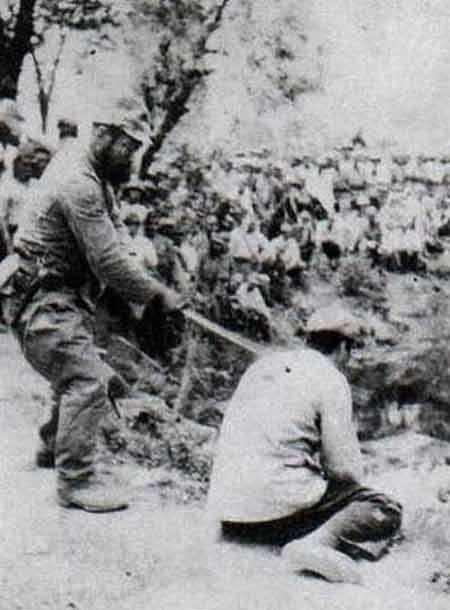 A Chinese POW about to be beheaded by a Japanese officer with a shin gunto during the Nanking Massacre The post-war minimization of the war crimes of Japanese imperialism is an example of "illegitimate" historical revisionism;[46] some contemporary Japanese revisionists, such as Yūko Iwanami (granddaughter of General Hideki Tojo), propose that Japan's invasion of China, and World War II, itself, were justified reactions to the Western imperialism of the time.[47] On 2 March 2007, Japanese prime minister Shinzo Abe denied that the military had forced women into sexual slavery during the war, saying, "The fact is, there is no evidence to prove there was coercion". Before he spoke, some Liberal Democratic Party legislators also sought to revise Yōhei Kōno's apology to former comfort women in 1993;[48] likewise, there was the controversial negation of the six-week Nanking Massacre in 1937–1938.[49] In 2021, Harvard Law School professor J. Mark Ramseyer published the book The Comfort Women Hoax, in which he questioned prevailing historical interpretations of the Japanese military “comfort women” system. The book prompted criticism from historians.[50] Shinzō Abe was general secretary of a group of parliament members concerned with history education (Japanese: 日本の前途と歴史教育を考える若手議員の会) that is associated with the Japanese Society for History Textbook Reform, and was a special advisor to Nippon Kaigi, which are two openly revisionist groups denying, downplaying, or justifying various Japanese war crimes. Editor-in-chief of the conservative Yomiuri Shimbun Tsuneo Watanabe criticized the Yasukuni Shrine as a bastion of revisionism: "The Yasukuni Shrine runs a museum where they show items in order to encourage and worship militarism. It's wrong for the prime minister to visit such a place".[51] Other critics[who?] note that men, who would contemporarily be perceived as "Korean" and "Chinese", are enshrined for the military actions they effected as Japanese Imperial subjects.[citation needed] |
戦争犯罪 日本の戦争犯罪 主な記事:日本の戦争犯罪、南京大虐殺の否定、および日本の戦争犯罪に関する米国の隠蔽 関連項目:日本帝国主義、靖国聖堂をめぐる論争 南京大虐殺の際、日本軍将校に新軍刀で斬首されようとしている中国人捕虜 戦後における日本帝国主義の戦争犯罪の軽視は、「非正当な」歴史修正主義の一例である[46]。岩波裕子(東条英機将軍の孫娘)のような現代の日本の修正 主義者の中には、日本の中国侵攻や第二次世界大戦そのものが、当時の西洋帝国主義に対する正当な反応であったと主張する者もいる。[47] 2007年3月2日、日本の安倍晋三首相は、戦時中に軍が女性を性奴隷として強制した事実を否定し、「事実として、強制があったことを証明する証拠はな い」と述べた。彼の発言に先立ち、一部の自民党議員も、1993年に河野洋平が行った元慰安婦への謝罪声明の修正を求めていた[48]。同様に、1937 年から1938年にかけての6週間にわたる南京大虐殺の否定も物議を醸した。[49] 2021年、ハーバード・ロースクールのJ・マーク・ラムセイヤー教授は著書『The Comfort Women Hoax』を出版し、日本軍の「慰安婦」制度に関する一般的な歴史的解釈に疑問を呈した。この本は歴史家たちから批判を招いた。[50] 安倍晋三は、日本歴史教科書改革協会と関連する「日本の前途と歴史教育を考える若手議員の会」の幹事長を務め、また日本会議の特別顧問も務めていた。これ ら二つの団体は、日本の様々な戦争犯罪を否定、軽視、あるいは正当化する公然たる修正主義団体である。保守系紙・読売新聞の渡辺恒夫編集長は、靖国神社を 修正主義の牙城として批判した。「靖国神社は、ミリタリズムを鼓舞し崇拝するために物品を展示する博物館を運営している。首相がそのような場所を参拝する のは間違っている」。[51] 他の批評家[誰?]は、現代では「韓国人」や「中国人」と見なされるであろう男性たちが、日本帝国臣民として行った軍事行動のために祀られていると指摘し ている。[要出典] |
| Hiroshima and Nagasaki bombings Further information: Atomic bombings of Hiroshima and Nagasaki See also: Debate over the atomic bombings of Hiroshima and Nagasaki The Hibakusha ("explosion-affected people") of Hiroshima and Nagasaki seek compensation from their government and criticize it for failing to "accept responsibility for having instigated and then prolonged an aggressive war long after Japan's defeat was apparent, resulting in a heavy toll in Japanese, Asian and American lives".[52] EB Sledge expressed concern that such revisionism, in his words "mellowing", would allow the harsh facts of the history that led to the bombings to be forgotten.[53] Historians Hill and Koshiro have stated that attempts to minimize the importance of the bombings as "righteous revenge and salvation" would be revisionism, and that while the Japanese should recognize their atrocities led the bombing, Americans also have to accept the fact that their own actions "caused massive destruction and suffering that has lasted for fifty years".[54] |
広島・長崎への原爆投下 詳細情報:広島・長崎への原爆投下 関連項目:広島・長崎への原爆投下をめぐる議論 広島と長崎の被爆者は、政府に対して補償を求めており、政府が「日本の敗北が明らかになった後もなお侵略戦争を煽り、長引かせ、その結果、日本、アジア、 そしてアメリカの多くの命が失われたことに対する責任を受け入れていない」と批判している。[52] E・B・スレッジは、このような修正主義、すなわち彼の言葉でいう「穏健化」によって、原爆投下に至った歴史の過酷な事実が忘れ去られてしまうことを懸念 した。[53] 歴史家のヒルとコシロは、原爆投下を「正義の報復と救済」としてその重要性を軽視しようとする試みは修正主義にあたると述べ、日本人は自らの残虐行為が原 爆投下を招いたことを認めるべきである一方、アメリカ人もまた、自らの行動が「50年にわたる甚大な破壊と苦悩をもたらした」という事実を受け入れなけれ ばならないと指摘している。[54] |
| Croatian war crimes in World War II Further information: Far-right politics in Croatia and Denial of the genocide of Serbs in the Independent State of Croatia Some Croats, including some high-ranked officials and political leaders during the 1990s and far-right organization members, have attempted to minimize the magnitude of the genocide perpetrated against Serbs and other ethnic minorities in the World War II puppet state of Nazi Germany, the Independent State of Croatia.[55] By 1989, the future President of Croatia Franjo Tuđman (who had been a Partisan during World War II), had embraced Croatian nationalism[56] and published Horrors of War: Historical Reality and Philosophy, in which he questioned the official number of victims killed by the Ustaše during World War II, particularly at the Jasenovac concentration camp.[57] Yugoslav and Serbian historiography had long exaggerated the number of victims at the camp.[58] Tuđman criticized the long-standing figures, but also described the camp as a "work camp", giving an estimate of between 30,000 and 40,000 deaths.[57] Tuđman's government's toleration of Ustaša symbols and their crimes often dismissed in public, frequently strained relations with Israel.[59] Croatia's far-right often advocates the false theory that Jasenovac was a "labour camp" where mass murder did not take place.[60] In 2017, two videos of former Croatian president Stjepan Mesić from 1992 were made public in which he stated that Jasenovac was not a death camp.[60][61] The far-right NGO "The Society for Research of the Threefold Jasenovac Camp" also advocates this disproven theory, in addition to claiming that the camp was used by the Yugoslav authorities following the war to imprison Ustasha members and regular Home Guard army troops until 1948, then alleged Stalinists until 1951.[60] Its members include journalist Igor Vukić, who wrote his own book advocating the theory, Catholic priest Stjepan Razum and academic Josip Pečarić.[62] The ideas promoted by its members have been amplified by mainstream media interviews and book tours.[62] The last book, "The Jasenovac Lie Revealed" written by Vukić, prompted the Simon Wiesenthal Center to urge Croatian authorities to ban such works, noting that they "would immediately be banned in Germany and Austria and rightfully so".[63][64] In 2016, Croatian filmmaker Jakov Sedlar released a documentary Jasenovac – The Truth which advocated the same theories, labelling the camp as a "collection and labour camp".[65] The film contained alleged falsifications and forgeries, in addition to denial of crimes and hate speech towards politicians and journalists.[66] |
第二次世界大戦におけるクロアチアの戦争犯罪 詳細情報:クロアチアの極右政治および独立クロアチア国におけるセルビア人虐殺の否定 1990年代のクロアチアの高官や政治指導者、および極右組織のメンバーを含む一部のクロアチア人は、第二次世界大戦中にナチス・ドイツの傀儡国家であっ た独立クロアチア国において、セルビア人やその他の少数民族に対して行われた虐殺の規模を過小評価しようとしてきた。[55] 1989年までに、後のクロアチア大統領フランヨ・トゥジマン(第二次世界大戦中はパルチザンであった)は、クロアチアナショナリズムを掲げるようになり [56]、『戦争の恐怖:歴史的現実と哲学』を出版した。その中で彼は、第二次世界大戦中にウスタシャによって殺害された犠牲者の公式な数字、特にヤセノ ヴァツ強制収容所における数字に疑問を呈した。[57] ユーゴスラビアおよびセルビアの歴史学界は、長年にわたり同収容所の犠牲者数を誇張してきた。[58] トゥジマンは従来の数字を批判した一方で、同収容所を「労働収容所」と表現し、死者数を3万から4万人と推定した。[57] トゥジマン政権によるウスタシャのシンボルや、公の場でしばしば軽視される彼らの犯罪への容認は、イスラエルとの関係を頻繁に悪化させた。[59] クロアチアの極右勢力は、ヤセノヴァツが大量虐殺が行われなかった「労働収容所」であったという虚偽の説をしばしば主張している。[60] 2017年、1992年に撮影されたステイパン・メシッチ元クロアチア大統領の動画2本が公開され、その中で彼はヤセノヴァツは絶滅収容所ではなかったと 述べている。[60] [61] 極右NGO「三つのヤセノヴァツ収容所研究協会」も、この反証済みの説を主張しているほか、戦後、同収容所がユーゴスラビア当局によって1948年までウ スタシャのメンバーや正規の国内防衛軍兵士を収監するために使用され、その後1951年までいわゆるスターリン主義者を収監するために使用されたと主張し ている。[60] 同団体のメンバーには、この説を擁護する著書を執筆したジャーナリストのイゴール・ヴキッチ、カトリック司祭のステイパン・ラズム、そして学者のヨシッ プ・ペチャリッチらが含まれる。[62] メンバーらが提唱する考えは、主流メディアのインタビューや書籍の宣伝ツアーを通じて広められてきた。[62] ヴキッチが執筆した最新著書『ヤセノヴァツの嘘の暴露』に対し、シモン・ヴィーゼンタール・センターは、こうした著作は「ドイツやオーストリアであれば即 座に、そして当然のことながら禁止されるだろう」と指摘し、クロアチア当局に対し、こうした著作の禁止を強く求めた。[63] [64] 2016年、クロアチアの映画監督ヤコフ・セドラーは、同収容所を「集積・労働収容所」と称し、同様の説を主張するドキュメンタリー映画『ヤセノヴァツ ――真実』を公開した。[65] この映画には、犯罪の否定や政治家・ジャーナリストに対するヘイトスピーチに加え、捏造や偽造とされる内容が含まれていた。[66] |
| Serbian war crimes in World War II Among far-right and nationalist groups, denial and revisionism of Serbian war crimes are carried out through the downplaying of Milan Nedić and Dimitrije Ljotić's roles in the extermination of Serbia's Jews in concentration camps, in the German-occupied Territory of the Military Commander in Serbia by a number of Serbian historians.[67][68] Serbian collaborationist armed forces were involved, either directly or indirectly, in the mass killings of Jews as well as Roma and those Serbs who sided with any anti-German resistance and the killing of many Croats and Muslims.[69][70] Since the end of the war, Serbian collaboration in the Holocaust has been the subject of historical revisionism by Serbian leaders.[71] In 1993, the Serbian Academy of Sciences and Arts listed Nedić among The 100 most prominent Serbs.[72] There is also the denial of Chetnik collaboration with Axis forces and crimes committed during World War II. Serbian historian Jelena Djureinovic states in her book The Politics of Memory of the Second World War in Contemporary Serbia: Collaboration, Resistance and Retribution that "during those years, the WWII nationalist Chetniks have been recast as an anti-fascist movement equivalent to Tito's Partisans, and as victims of communism". The glorification of the Chetnik movement has now become the central theme of Serbia's WWII memory politics. Chetnik leaders convicted under communist rule of collaboration with the Nazis have been rehabilitated by Serbian courts, and television programmes have contributed to spreading a positive image of the movement, "distorting the real picture of what happened during WWII".[73] |
第二次世界大戦におけるセルビアの戦争犯罪 極右およびナショナリスト団体の中では、多くのセルビア人歴史家によって、ドイツ占領下のセルビア軍事司令官管区における強制収容所でのセルビア系ユダヤ 人絶滅において、ミラン・ネディッチとディミトリエ・リョティッチが果たした役割を過小評価することで、セルビアの戦争犯罪の否定や修正主義が行われてい る。[67][68] セルビアの協力派武装勢力は、ユダヤ人やロマ、反ドイツ抵抗勢力に味方したセルビア人に対する大量殺戮、および多くのクロアチア人やイスラム教徒の殺害 に、直接的あるいは間接的に関与していた。[69][70] 戦後、ホロコーストにおけるセルビアの協力行為は、セルビアの指導者たちによる歴史修正主義の対象となってきた。[71] 1993年、セルビア科学芸術アカデミーはネディッチを「最も著名なセルビア人100人」の一人に選出した。[72] また、チェトニクが枢軸国軍と協力したことや、第二次世界大戦中に犯された犯罪を否定する動きもある。セルビアの歴史家イェレナ・ジュレイノヴィッチは、 著書『現代セルビアにおける第二次世界大戦の記憶の政治:協力、抵抗、報復』の中で、「当時、第二次世界大戦時のナショナリスト・チェトニクは、ティトー のパルチザンと同等の反ファシスト運動として、また共産主義の犠牲者として再定義されていた」と述べている。チェトニク運動の美化は、今やセルビアの第二 次世界大戦に関する記憶政治の中心的なテーマとなっている。共産主義政権下でナチスとの協力罪により有罪判決を受けたチェトニクの指導者たちは、セルビア の裁判所によって名誉回復を果たしており、テレビ番組もまた、この運動の肯定的なイメージを広める一助となり、「第二次世界大戦中に何が起きたかという実 像を歪めている」[73]。 |
| Serbian war crimes in the Yugoslav wars Further information: Bosnian genocide denial There have been a number of far-right and nationalist authors and political activists who have publicly disagreed with mainstream views of Serbian war crimes in the Yugoslav wars of 1991–1999. Some high-ranked Serbian officials and political leaders who categorically claimed that no genocide against Bosnian Muslims took place at all, include former president of Serbia Tomislav Nikolić, Bosnian Serb leader Milorad Dodik, Serbian Minister of Defence Aleksandar Vulin and Serbian far-right leader Vojislav Šešelj. Among the points of contention are whether the victims of massacres such as the Račak massacre and Srebrenica massacre were unarmed civilians or armed resistance fighters, whether death and rape tolls were inflated, and whether prison camps such as Sremska Mitrovica camp were sites of mass war crimes. These authors are called "revisionists" by scholars and organizations, such as ICTY. The Report about Case Srebrenica by Darko Trifunovic,[74] commissioned by the government of the Republika Srpska,[75] was described by the International Criminal Tribunal for the former Yugoslavia as "one of the worst examples of revisionism in relation to the mass executions of Bosnian Muslims committed in Srebrenica in July 1995".[76] Outrage and condemnation by a wide variety of Balkan and international figures eventually forced the Republika Srpska to disown the report.[75][77] In 2017 legislation that banned the teaching of the Srebrenica genocide and Sarajevo siege in schools was introduced in Republika Srpska, initiated by President Milorad Dodik and his SNSD party, who stated that it was "impossible to use here the textbooks ... which say the Serbs have committed genocide and kept Sarajevo under siege. This is not correct and this will not be taught here".[78] In 2019 Republika Srpska authorities appointed Israeli historian Gideon Greif – who has worked at Yad Vashem for more than three decades – to head its own revisionist commission to "determine the truth" about Srebrenica.[79] |
ユーゴスラビア戦争におけるセルビアの戦争犯罪 詳細情報:ボスニア・ジェノサイドの否定 1991年から1999年にかけてのユーゴスラビア戦争におけるセルビアの戦争犯罪について、主流の見解に公然と異議を唱える極右やナショナリストの著 者、政治活動家は数多く存在する。ボスニア・ムスリムに対するジェノサイドは一切起こらなかったと断固として主張したセルビアの高官や政治指導者には、セ ルビアの元大統領トミスラフ・ニコリッチ、ボスニア・セルブ人指導者ミロラド・ドディク、セルビア国防相アレクサンダル・ヴリン、セルビア極右指導者ヴォ イスラヴ・シェシェリなどが含まれる。論争の的となっている点には、ラチャク虐殺やスレブレニツァ虐殺の犠牲者が非武装の民間人であったか武装した抵抗戦 士であったか、死者数や強姦被害者数が水増しされていたか、そしてスレムスカ・ミトロヴィツァ収容所のような収容所が大量戦争犯罪の現場であったかなどが 含まれる。これらの著者は、ICTYなどの学者や組織から「修正主義者」と呼ばれている。 セルビア共和国政府の委託を受けてダルコ・トリフノヴィッチが作成した『スレブレニツァ事件に関する報告書』[74]は、旧ユーゴスラビア国際刑事裁判所 (ICTY)によって、「1995年7月にスレブレニツァで犯されたボスニア系ムスリムに対する大量処刑に関する修正主義の最悪の事例の一つ」と評され た。[76] バルカン半島内外の幅広い人物による激しい非難と糾弾により、最終的にスルプスカ共和国は同報告書を否定せざるを得なくなった。[75][77] 2017年、スレブレニツァのジェノサイドおよびサラエボ包囲戦に関する教育を学校で禁止する法案が、ミロラド・ドディク大統領と彼の率いるSNSD党に よってスルプスカ共和国に提出された。同大統領は、「セルビア人がジェノサイドを犯し、サラエボを包囲したと記した教科書をここで使用することは不可能 だ。これは事実ではなく、ここでは教えない」と述べた。[78] 2019年、スルプスカ共和国当局は、ヤド・ヴァシェムで30年以上勤務してきたイスラエルの歴史家ギデオン・グライフを、スレブレニツァに関する「真実 を究明する」ための独自の修正主義委員会の委員長に任命した。[79] |
| Massacres of Poles in Volhynia and Eastern Galicia Main article: Historiography of the Volyn tragedy The issue of the Volyn massacres was largely non-existent in Ukrainian scholarly literature for many years, and until very recently, Ukrainian historiography did not undertake any objective research of the events in Volyn.[80] Until 1991 any independent Ukrainian historic research was only possible abroad, mainly in the US and the Canadian diaspora. Despite publishing a number of works devoted to the history of UPA, the Ukrainian emigration researchers (with only few exceptions) remained completely mute about the Volyn events for many years. Until very recently much of the remaining documentation was closed in Ukrainian state archives, unavailable to researchers.[80] As a result, Ukrainian historiography lacks broader reliable research of the events and the presence of the issue in Ukrainian publications is still very limited. In September 2016, after Poland's Sejm had passed a resolution declaring 11 July a National Day of Remembrance of the victims of the Genocide of the Citizens of the Polish Republic committed by Ukrainian Nationalists and formally called the Massacres of Poles in Volhynia and Eastern Galicia a genocide, the Verkhovna Rada of Ukraine passed a resolution condemning "the one-sided political assessment of the historical events in Poland",[81] rejecting the term "genocide".[82] |
ヴォルィーニおよび東ガリツィアにおけるポーランド人虐殺 本記事:ヴォルィーニの悲劇に関する歴史学 ヴォルィーニ虐殺の問題は、長年にわたりウクライナの学術文献においてほとんど取り上げられることがなく、ごく最近に至るまで、ウクライナの歴史学はヴォ ルィーニでの出来事について客観的な研究を行わなかった。[80] 1991年までは、独立したウクライナの歴史研究は海外、主に米国やカナダのディアスポラにおいてのみ可能であった。ウクライナ解放軍(UPA)の歴史に 捧げられた数多くの著作を出版していたにもかかわらず、ウクライナ系移民の研究者たちは(ごく一部の例外を除き)、長年にわたりヴォルィーニの事件につい て完全に沈黙を守り続けた。ごく最近まで、残存する文書の多くはウクライナの国家公文書館に封印され、研究者が利用することはできなかった。[80] その結果、ウクライナの歴史学には、この事件に関する広範かつ信頼性の高い研究が欠如しており、ウクライナの出版物におけるこの問題の扱いは依然として極 めて限定的である。 2016年9月、ポーランドのセイムが、7月11日を「ウクライナナショナリストによって行われたポーランド共和国市民に対するジェノサイドの犠牲者を追 悼する国民追悼の日」と宣言し、「ヴォルィーニおよび東ガリツィアにおけるポーランド人虐殺」を正式にジェノサイドと認定する決議を可決したことを受け、 ウクライナのヴェルホーヴナ・ラーダは、「ポーランドにおける歴史的出来事に対する一方的な政治的評価」を非難する決議を可決した [81]、「ジェノサイド」という用語を拒否した。[82] |
| Indonesian mass killings of 1965–66 Discussion of the killings was taboo in Indonesia and, if mentioned at all, usually called peristiwa enam lima, the "incident of '65."[83] Inside and outside Indonesia, public discussion of the killings increased during the 1990s and especially after 1998 when the New Order government collapsed. Jailed and exiled members of the Sukarno regime, as well as ordinary people, told their stories in increasing numbers. Foreign researchers began to publish increasingly more on the topic, with the end of the military regime and its doctrine of coercing such research attempts into futility.[83][84] The killings are skipped over in most Indonesian histories and have been scarcely examined by Indonesians, and has received comparatively little international attention.[85] Indonesian textbooks typically depict the killings as a "patriotic campaign" that resulted in less than 80,000 deaths. In 2004, the textbooks were briefly changed to include the events, but this new curriculum discontinued in 2006 following protests from the military and Islamic groups.[86] The textbooks which mentioned the mass killings were subsequently burnt[86] by order of Indonesia's Attorney General.[87] John Roosa's Pretext for Mass Murder (2006) was initially banned by the Attorney General's Office.[88] The Indonesian parliament set up a truth and reconciliation commission to analyse the killings, but it was suspended by the Indonesian High Court. An academic conference regarding the killings was held in Singapore in 2009.[86] A hesitant search for mass graves by survivors and family members began after 1998, although little has been found. Over three decades later, great enmity remains in Indonesian society over the events.[84] |
1965年から1966年にかけてのインドネシアにおける大量殺戮 インドネシア国内では、この殺戮について議論することはタブーとされており、仮に言及されるとしても、通常は「ペルハプティアン・エナム・リマ('65年 の事件)」と呼ばれていた。[83] インドネシア国内外において、この殺戮に関する公の議論は1990年代、特に1998年に新秩序政権が崩壊した後に活発化した。スカルノ政権の投獄・追放 されたメンバーや一般市民が、自らの体験を語るケースが増加した。軍事政権の終焉と、そうした研究の試みを無力化しようとするその教義の終焉に伴い、外国 の研究者によるこのテーマに関する出版物もますます増え始めた。[83][84] この虐殺事件は、インドネシアの歴史書のほとんどで触れられず、インドネシア人による検証もほとんど行われておらず、国際的な注目も比較的低かった。 [85] インドネシアの教科書は通常、この虐殺を死者8万人未満に留まった「愛国的な運動」として描いている。2004年、教科書は一時的に改訂され、この事件が 盛り込まれたが、軍やイスラム団体からの抗議を受け、この新しいカリキュラムは2006年に廃止された。[86] 大量殺戮に言及した教科書は、その後、インドネシア検事総長の命令により焼却された。[86][87] ジョン・ルーサの著書『Pretext for Mass Murder』(2006年)は当初、検事総長室によって発禁処分を受けた。[88] インドネシア議会は殺戮を分析するため真実和解委員会を設置したが、インドネシア最高裁によってその活動は停止された。2009年、シンガポールでこの虐 殺に関する学術会議が開催された。[86] 1998年以降、生存者や遺族による集団埋葬地の捜索が慎重に開始されたが、ほとんど発見されていない。30年以上が経過した現在も、インドネシア社会に はこの事件をめぐる深い敵意が残っている。[84] |
Turkey and the Armenian genocide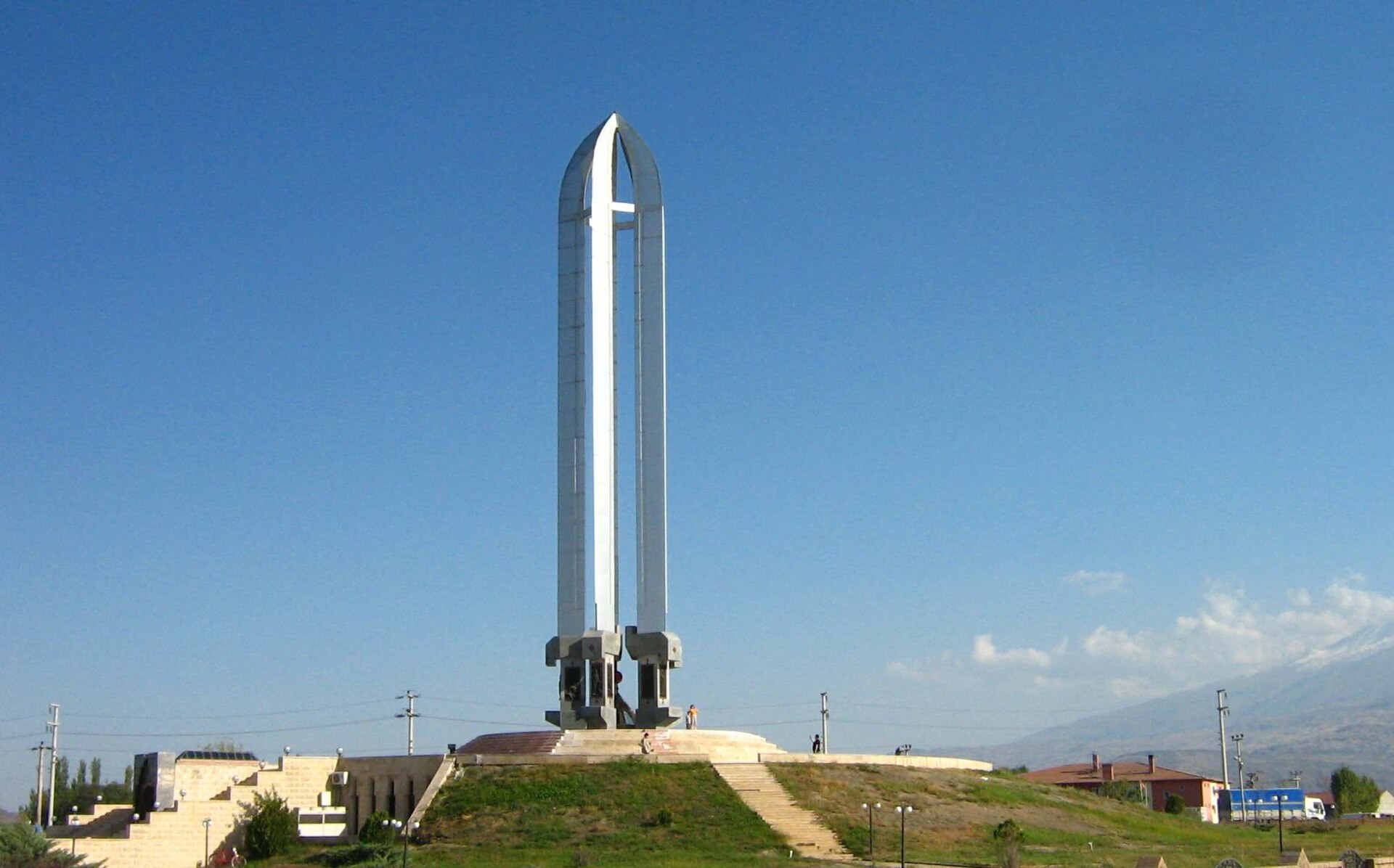 Photograph of the Iğdır Genocide Memorial and Museum in Turkey The Iğdır Genocide Memorial and Museum's promotion of the view that Armenians committed genocide against Turks, rather than vice versa, has received international condemnation for falsifying the history surrounding those Armenians killed.[89] Main article: Armenian genocide denial Turkish laws such as Article 301, that state "a person who publicly insults Turkishness, or the Republic or [the] Turkish Grand National Assembly of Turkey, shall be punishable by imprisonment", were used to criminally charge the writer Orhan Pamuk with disrespecting Turkey, for saying that "Thirty thousand Kurds, and a million Armenians, were killed in these lands, and nobody, but me, dares to talk about it".[90] The controversy occurred as Turkey was first vying for membership in the European Union (EU) where the suppression of dissenters is looked down upon.[91] Article 301 originally was part of penal-law reforms meant to modernize Turkey to European Union standards, as part of negotiating Turkey's accession to the EU.[92] In 2006, the charges were dropped due to pressure from the European Union and United States on the Turkish government.[91] On 7 February 2006, five journalists were tried for insulting the judicial institutions of the State, and for aiming to prejudice a court case (per Article 288 of the Turkish penal code).[93] The reporters were on trial for criticizing the court-ordered closing of a conference in Istanbul regarding the Armenian genocide during the time of the Ottoman Empire. The conference continued elsewhere, transferring locations from a state to a private university. The trial continued until 11 April 2006, when four of the reporters were acquitted. The case against the fifth journalist, Murat Belge, proceeded until 8 June 2006, when he was also acquitted. The purpose of the conference was to critically analyse the official Turkish view of the Armenian genocide in 1915; a taboo subject in Turkey.[94] The trial proved to be a test case between Turkey and the European Union; the EU insisted that Turkey should allow increased freedom of expression rights, as a condition to membership.[95][96] |
トルコとアルメニア人虐殺 トルコのイグディル虐殺記念館・博物館の写真 イグディル虐殺記念館・博物館が、アルメニア人がトルコ人に対して虐殺を行ったという見解を推進していること(その逆ではない)は、殺害されたアルメニア人を取り巻く歴史を歪曲しているとして、国際的な非難を受けている。[89] 本記事:アルメニア人虐殺の否定 「トルコ人としてのアイデンティティ、共和国、または [トルコ]大国民議会を公然と侮辱した者は、懲役刑に処する」と規定する第301条などのトルコ法は、作家オルハン・パムクが「この地で3万人のクルド人 と100万人のアルメニア人が殺害されたが、私以外には誰もそれを語る勇気はない」と述べたことを理由に、トルコへの不敬罪で刑事告発するために利用され た。[90] この論争は、異論を唱える者への弾圧が忌避される欧州連合(EU)への加盟をトルコが初めて目指していた時期に発生した。[91] 第301条はもともと、トルコのEU加盟交渉の一環として、トルコをEUの基準に合わせて近代化することを目的とした刑法改正の一部であった。[92] 2006年、欧州連合(EU)および米国からのトルコ政府への圧力により、起訴は取り下げられた。[91] 2006年2月7日、5人のジャーナリストが、国家の司法機関への侮辱および裁判への妨害意図(トルコ刑法第288条)の罪で裁判にかけられた。[93] 記者らは、オスマン帝国時代のアルメニア人虐殺に関するイスタンブールでの会議が裁判所の命令により中止されたことを批判したとして起訴されていた。会議 は会場を国立大学から私立大学へと移し、別の場所で継続された。裁判は2006年4月11日まで続き、記者4名は無罪となった。5人目のジャーナリスト、 ムラト・ベルゲに対する裁判は2006年6月8日まで続き、彼もまた無罪となった。この会議の目的は、1915年のアルメニア人虐殺に関するトルコの公式 見解を批判的に分析することにあった。これはトルコにおいてタブー視されているテーマである。[94] この裁判は、トルコと欧州連合(EU)との間の試金石となった。EUは、加盟の条件として、トルコが表現の自由の権利を拡大すべきだと主張した。[95] [96] |
| South Korean war crimes in Vietnam Further information: South Korea in the Vietnam War § War crimes and atrocities At the request of the United States, South Korea under Park Chung Hee sent approximately 320,000 South Korean troops to fight alongside the United States and South Vietnam during the Vietnam War. Various civilian groups have accused the South Korean military of many "My Lai-style massacres",[97] while the Korean Ministry of Defense has denied all such accusations.[98][99] Korean forces are alleged to have perpetrated the Binh Tai, Bình An/Tây Vinh, Bình Hòa, and Hà My massacres and several other massacres across Vietnam,[100] killing as many as 9000 Vietnamese civilians.[101] In 2023, a South Korean court ruled in favour of a Vietnamese victim of South Korean atrocities during the war and ordered that the South Korean government compensate the surviving victim. In response, the South Korean government repeated its earlier denials of the atrocities, and later announced its appeal of the decision. This strained relations with Vietnam, as a spokesperson for Vietnam's fording ministry called the decision "extremely regrettable".[102] |
ベトナムにおける韓国の戦争犯罪 詳細情報:ベトナム戦争における韓国 § 戦争犯罪と残虐行為 米国の要請を受け、朴正煕政権下の韓国は、ベトナム戦争中に米国および南ベトナムと共闘するため、約32万人の韓国軍兵士を派遣した。様々な民間団体が、 韓国軍による数多くの「マイ・ライ式虐殺」を非難している[97]が、韓国国防省はそうした非難をすべて否定している[98][99]。韓国軍は、ビンタ イ、ビンアン/タイヴィン、ビンホア、ハミでの虐殺をはじめ、ベトナム各地で発生したその他の数多くの虐殺に関与したとされ[100]、最大で9,000 人のベトナム人民間人を殺害したとされる。[101] 2023年、韓国の裁判所は、戦争中の韓国軍による残虐行為のベトナム人被害者の訴えを認め、韓国政府に対し生存している被害者への賠償を命じた。これに 対し、韓国政府は以前と同様に残虐行為を否定し、後に判決への控訴を発表した。これによりベトナムとの関係は緊張し、ベトナム外務省の報道官はこの判決を 「極めて遺憾」だと述べた。[102] |
| Iran The Islamic Republic of Iran uses historical negationism against religious minorities in order to maintain legitimacy and relevancy of the regime. One example is the regime's approach to the Baháʼí community. In 2008, an erroneous and misleading biography of Báb was presented to all primary school children.[103] In his official 2013 Nowruz address, Supreme Leader of Iran Grand Ayatollah Ali Khamenei questioned the veracity of the Holocaust, remarking that "The Holocaust is an event whose reality is uncertain and if it has happened, it's uncertain how it has happened."[104][105] This was consistent with Khamenei's previous comments regarding the Holocaust.[106] |
イラン イラン・イスラム共和国は、政権の正当性と存在意義を維持するために、宗教的少数派に対して歴史の否定主義を用いている。その一例が、バハーイー教徒に対する政権の対応である。2008年には、バブに関する誤りや誤解を招く伝記が、すべての小学生に配布された。[103] 2013年のノウルーズ(イランの新年)における公式演説で、イランの最高指導者アリ・ハメネイ大アヤトラはホロコーストの真実性を疑問視し、「ホロコー ストは、その実在が定かではない出来事であり、仮に起きたとしても、どのように起きたのかは定かではない」と述べた。[104][105] これは、ホロコーストに関するハメネイのこれまでの発言と一貫していた。[106] |
| Soviet and Russian history See also: Historiography in the Soviet Union, Soviet war crimes, and Holodomor denial In his book, The Stalin School of Falsification, Leon Trotsky cited a range of historical documents such as private letters, telegrams, party speeches, meeting minutes, and suppressed texts such as Lenin's Testament,[108] to argue that the Stalinist faction routinely distorted political events, forged a theoretical basis for irreconcilable concepts such as the notion of "Socialism in One Country" and misrepresented the views of opponents. He also argued that the Stalinist regime employed an array of professional historians as well as economists to justify policy manoeuvering and safeguarding its own set of material interests.[108] During the existence of the Russian Soviet Federative Socialist Republic (1917–1991) and the Soviet Union (1922–1991), the Communist Party of the Soviet Union (CPSU) attempted to ideologically and politically control the writing of both academic and popular history. These attempts were most successful in the 1934–1952 period. According to Klaus Mehnert, writing in 1952, the Soviet government attempted to control academic historiography (the writing of history by academic historians) to promote ideological and ethno-racial imperialism by Russians.[11][better source needed] During the 1928–1956 period, modern and contemporary history was generally composed according to the wishes of the CPSU, not the requirements of accepted historiographic method.[11] During and after the rule of Nikita Khrushchev (1956–1964), Soviet historiographic practice was more complicated. In this period, Soviet historiography was characterized by complex competition between Stalinist and anti-Stalinist Marxist historians.[12] To avoid the professional hazard of politicized history, some historians chose pre-modern, medieval history or classical history, where ideological demands were relatively relaxed and conversation with other historians in the field could be fostered.[109] Prescribed ideology could still introduce biases in historians' work, but not all of Soviet historiography was affected.[12] Control over party history and the legal status of individual ex-party members played a large role in dictating the ideological diversity and thus the faction in power within the CPSU. The official History of the Communist Party of the Soviet Union (Bolsheviks) was revised to delete references to leaders purged from the party, especially during the rule of Joseph Stalin (1922–1953).[note 1] In the historiography of the Cold War, a controversy over negationist historical revisionism exists, where numerous revisionist scholars in the West have been accused of whitewashing the crimes of Stalinism, overlooking the Katyn massacre in Poland, disregarding the validity of the Venona Project messages with regards to Soviet espionage in the United States,[110][111][112] as well as the denial of the Holodomor of 1932–1933. In 2009, Russia established the Presidential Commission of the Russian Federation to Counter Attempts to Falsify History to the Detriment of Russia's Interests to "defend Russia against falsifiers of history". Some critics, like Heorhiy Kasyanov from the National Academy of Sciences of Ukraine, said the Kremlin was trying to whitewash Soviet history in order to justify its denial of human rights: "It's part of the Russian Federation's policy to create an ideological foundation for what is happening in Russia right now."[113] Historian and author Orlando Figes, a professor at the University of London, who views the new commission is part of a clampdown on historical scholarship, stated: "They're idiots if they think they can change the discussion of Soviet history internationally, but they can make it hard for Russian historians to teach and publish. It's like we're back to the old days."[114] The commission was disestablished in 2012.[citation needed] |
ソ連およびロシアの歴史 関連項目:ソ連における歴史学、ソ連の戦争犯罪、ホロドモールの否定 レオン・トロツキーは著書『スターリンの捏造学校』において、私信、電報、党内演説、会議議事録、さらには『レーニンの遺言』[108]のような隠蔽され た文書など、幅広い歴史的資料を引用し、スターリン派が日常的に政治的出来事を歪曲し、「一国社会主義」といった相容れない概念の理論的根拠を捏造し、反 対派の見解を歪めて伝えたと論じた。また彼は、スターリン主義体制が、政策上の駆け引きを正当化し、自らの物質的利益を守るために、多くの専門の歴史家や 経済学者を動員していたと論じた。[108] ロシア・ソビエト連邦社会主義共和国(1917–1991)およびソビエト連邦(1922–1991)の存続期間中、ソビエト連邦共産党(CPSU)は、 学術史および大衆史の記述をイデオロギー的・政治的に統制しようとした。こうした試みは、1934年から1952年の期間に最も成功を収めた。1952年 に執筆したクラウス・メナートによれば、ソビエト政府は、ロシア人によるイデオロギー的および民族・人種的帝国主義を推進するために、学術的歴史学(学術 歴史家による歴史記述)を統制しようとした。[11][より信頼できる出典が必要] 1928年から1956年の期間、近代史および現代史は、一般的に、確立された歴史学の方法の要件ではなく、ソ連共産党の意向に従って記述された。 [11] ニキータ・フルシチョフの統治期間中およびその後(1956–1964年)、ソビエトの歴史記述の実践はより複雑なものとなった。この時期、ソ連の歴史学 は、スターリン主義派と反スターリン主義派のマルクス主義歴史家たちとの間の複雑な競争によって特徴づけられた。[12] 政治化された歴史研究に伴う職業上のリスクを避けるため、一部の歴史家は、イデオロギー的な要求が比較的緩やかで、同分野の他の歴史家との対話が育まれる 可能性のある、前近代史、中世史、あるいは古典史を選択した。[109] 規定されたイデオロギーは依然として歴史家の研究に偏見をもたらす可能性があったが、ソ連の歴史学のすべてが影響を受けたわけではなかった。[12] 党の歴史に対する統制と、個々の元党員の法的地位は、イデオロギー的多様性、ひいてはソ連共産党(CPSU)内の権力派閥を決定づける上で大きな役割を果 たした。公式の『ソビエト連邦共産党(ボリシェヴィキ)の歴史』は改訂され、特にヨシフ・スターリンの統治期(1922–1953年)に党から追放された 指導者たちへの言及が削除された。[注1] 冷戦史学においては、否定主義的歴史修正主義をめぐる論争が存在する。そこでは、西側の多くの修正主義的学者が、スターリン主義の犯罪を美化したり、ポー ランドでのカティンの虐殺を見過ごしたり、米国におけるソ連のスパイ活動に関するヴェノナ・プロジェクトのメッセージの信憑性を無視したりしていると非難 されている[110] [111][112]、さらには1932–1933年のホロドモールの否定も含まれる。 2009年、ロシアは「歴史の改竄者からロシアを守る」ため、「ロシアの利益を損なう歴史改竄の試みに対抗するロシア連邦大統領委員会」を設立した。ウク ライナ国立科学アカデミーのゲオルギー・カシャノフのような一部の批評家は、クレムリンが人権侵害の正当化を図るためにソ連の歴史を美化しようとしている と指摘した。「これは、現在ロシアで起きていることに対するイデオロギー的基盤を築くための、ロシア連邦の政策の一環だ。」[113] ロンドン大学教授で歴史家・著者のオーランド・フィゲスは、この新委員会を歴史研究への弾圧の一環と見なし、次のように述べた。「国際的なソ連史の議論を 変えられると考えるなら彼らは愚か者だが、ロシアの歴史家たちが教えたり出版したりすることを困難にすることはできる。まるで昔に戻ったようだ。」 [114] この委員会は2012年に廃止された。[出典必要] |
| Azerbaijan Main article: Falsification of history in Azerbaijan In relation to Armenia See also: Anti-Armenian sentiment in Azerbaijan, Armenian cemetery in Julfa, and Azerbaijan National Academy of Sciences § Statements on Armenia and Armenians Many scholars, among them Victor Schnirelmann,[115][116] Willem Floor,[117] Robert Hewsen,[118] George Bournoutian[119][120] and others state that in Soviet and post-Soviet Azerbaijan since the 1960s there is a practice of revising primary sources on the South Caucasus in which any mention about Armenians is removed. In the revised texts, Armenian is either simply removed or is replaced by Albanian; there are many other examples of such falsifications, all of which have the purpose of creating an impression that historically Armenians were not present in this territory. Willem M. Floor and Hasan Javadi in the English edition of "The Heavenly Rose-Garden: A History of Shirvan & Daghestan" by Abbasgulu Bakikhanov specifically point out to the instances of distortions and falsifications made by Ziya Bunyadov in his Russian translation of this book.[117] According to Bournoutian and Hewsen these distortions are widespread in these works; they thus advise the readers in general to avoid the books produced in Azerbaijan in Soviet and post-Soviet times if these books do not contain the facsimile copy of original sources.[118][120] Shnirelman thinks that this practice is being realized in Azerbaijan according to state order.[115] Philip L. Kohl brings an example of a theory advanced by Azerbaijani archaeologist Akhundov about Albanian origin of Khachkars as an example of patently false cultural origin myths.[121] The Armenian cemetery in Julfa, a cemetery near the town of Julfa, in the Nakhchivan exclave of Azerbaijan originally housed around 10,000 funerary monuments. The tombstones consisted mainly of thousands of khachkars, uniquely decorated cross-stones characteristic of medieval Christian Armenian art. The cemetery was still standing in the late 1990s, when the government of Azerbaijan began a systematic campaign to destroy the monuments.[122] After studying and comparing satellite photos of Julfa taken in 2003 and 2009, the American Association for the Advancement of Science came to the conclusion in December 2010 that the cemetery was demolished and levelled.[123] After the director of the Hermitage Museum Mikhail Piotrovsky expressed his protest about the destruction of Armenian khachkars in Julfa, he was accused by Azerbaijanis of supporting the "total falsification of the history and culture of Azerbaijan".[124] Several appeals were filed by both Armenian and international organizations, condemning the Azerbaijani government and calling on it to desist from such activity. In 2006, Azerbaijan barred European Parliament members from investigating the claims, charging them with a "biased and hysterical approach" to the issue and stating that it would only accept a delegation if it visited Armenian-occupied territory as well.[125] In the spring of 2006, a journalist from the Institute for War and Peace Reporting who visited the area reported that no visible traces of the cemetery remained.[126] In the same year, photographs taken from Iran showed that the cemetery site had been turned into a military shooting range.[127] The destruction of the cemetery has been widely described by Armenian sources, and some non-Armenian sources, as an act of "cultural genocide."[128][129][130] In Azerbaijan, the Armenian genocide is officially denied and is considered a hoax. According to the state ideology of Azerbaijan, a genocide of Azerbaijanis, carried out by Armenians and Russians, took place starting from 1813. Mahmudov has claimed that Armenians first appeared in Karabakh in 1828.[131] Azerbaijani academics and politicians have claimed that foreign historians falsify the history of Azerbaijan and criticism was directed towards a Russian documentary about the regions of Karabakh and Nakhchivan and the historical Armenian presence in these areas.[132][133][134] According to the institute director of the Azerbaijan National Academy of Sciences Yagub Mahmudov, prior to 1918 "there was never an Armenian state in the South Caucasus".[135] According to Mahmudov, Ilham Aliyev's statement in which he said that "Irevan is our [Azerbaijan's] historic land, and we, Azerbaijanis must return to these historic lands", was based "historical facts" and "historical reality".[135] Mahmudov also stated that the claim that Armenians are the most ancient people in the region is based on propaganda, and said that Armenians are non-natives of the region, having only arrived in the area after Russian victories over Iran and the Ottoman Empire in the first half of the 19th century.[135] The institute director also said: "The Azerbaijani soldier should know that the land under the feet of provocative Armenians is Azerbaijani land. The enemy can never defeat Azerbaijanis on Azerbaijani soil. Those who rule the Armenian state today must fundamentally change their political course. The Armenians cannot defeat us by sitting in our historic city of Irevan."[135] In relation to Iran See also: Azerbaijan naming controversy, Campaign on granting Nizami the status of the national poet of Azerbaijan, and Anti-Iranian sentiment in Azerbaijan Historic falsifications in Azerbaijan, in relation to Iran and its history, are "backed by state and state backed non-governmental organizational bodies", ranging "from elementary school all the way to the highest level of universities".[136] As a result of the two Russo-Iranian Wars of the 19th century, the border between what is present-day Iran and the Republic of Azerbaijan was formed.[137] Although there had not been a historical Azerbaijani state to speak of in history, the demarcation, set at the Aras river, left significant numbers of what were later coined "Azerbaijanis" to the north of the Aras river.[137][138] During the existence of the Azerbaijan SSR, as a result of Soviet-era historical revionism and myth-building, the notion of a "northern" and "southern" Azerbaijan was formulated and spread throughout the Soviet Union.[137][139] During the Soviet nation building campaign, any event, both past and present, that had ever occurred in what is the present-day Azerbaijan Republic and Iranian Azerbaijan were rebranded as phenomenons of "Azerbaijani culture".[140] Any Iranian ruler or poet that had lived in the area was assigned to the newly rebranded identity of the Transcaucasian Turkophones, in other words "Azerbaijanis".[141] According to Michael P. Croissant: "It was charged that the "two Azerbaijans", once united, were separated artificially by a conspiracy between imperial Russia and Iran".[137] This notion based on illegitimate historic revisionism suited Soviet political purposes well (based on "anti-imperialism"), and became the basis for irredentism among Azerbaijani nationalists in the last years of the Soviet Union, shortly prior to the establishment of the Azerbaijan Republic in 1991.[137] In Azerbaijan, periods and aspects of Iranian history are usually claimed as being an "Azerbaijani" product in a distortion of history, and historic Iranian figures, such as the Persian poet Nizami Ganjavi are called "Azerbaijanis", contrary to universally acknowledged fact.[142][143] In the Azerbaijan SSR, forgeries such as an alleged "Turkish divan" and falsified verses were published in order to "Turkify" Nizami Ganjavi.[143] Although this type of irredentism was initially the result of the nation building policy of the Soviets, it became an instrument for "biased, pseudo-academic approaches and political speculations" in the nationalistic aspirations of the young Azerbaijan Republic.[142] In the modern Azerbaijan Republic, historiography is written with the aim of retroactively Turkifying many of the peoples and kingdoms that existed prior to the arrival of Turks in the region, including the Iranian Medes.[144] According to professor of history George Bournoutian:[145] As noted, in order to construct an Azerbaijani national history and identity based on the territorial definition of a nation, as well as to reduce the influence of Islam and Iran, the Azeri nationalists, prompted by Moscow devised an "Azeri" alphabet, which replaced the Arabo-Persian script. In the 1930s a number of Soviet historians, including the prominent Russian Orientalist, Ilya Petrushevskii, were instructed by the Kremlin to accept the totally unsubstantiated notion that the territory of the former Iranian khanates (except Yerevan, which had become Soviet Armenia) was part of an Azerbaijani nation. Petrushevskii's two important studies dealing with the South Caucasus, therefore, use the term Azerbaijan and Azerbaijani in his works on the history of the region from the sixteenth to the nineteenth centuries. Other Russian academics went even further and claimed that an Azeri nation had existed from ancient times and had continued to the present. Since all the Russian surveys and almost all nineteenth-century Russian primary sources referred to the Muslims who resided in the South Caucasus as "Tatars" and not "Azerbaijanis", Soviet historians simply substituted Azerbaijani for Tatars. Azeri historians and writers, starting in 1937, followed suit and began to view the three-thousand-year history of the region as that of Azerbaijan. The pre-Iranian, Iranian, and Arab eras were expunged. Anyone who lived in the territory of Soviet Azerbaijan was classified as Azeri; hence the great Iranian poet Nezami, who had written only in Persian, became the national poet of Azerbaijan. Bournoutian adds:[146] Although after Stalin's death arguments rose between Azerbaijani historians and Soviet Iranologists dealing with the history of the region in ancient times (specifically the era of the Medes), no Soviet historian dared to question the use of the term Azerbaijan or Azerbaijani in modern times. As late as 1991, the Institute of History of the Academy of Sciences of the USSR, published a book by an Azeri historian, in which it not only equated the "Tatars" with the present-day Azeris, but the author, discussing the population numbers in 1842, also included Nakhichevan and Ordubad in "Azerbaijan". The author, just like Petrushevskii, totally ignored the fact that between 1828 and 1921, Nakhichivan and Ordubad were first part of the Armenian Province and then part of the Yerevan guberniia and had only become part of Soviet Azerbaijan, some eight decades later ... Although the overwhelming number of nineteenth-century Russian and Iranian, as well as present-day European historians view the Iranian province of Azarbayjan and the present-day Republic of Azerbaijan as two separate geographical and political entities, modern Azeri historians and geographers view it as a single state that has been separated into "northern" and "southern" sectors and which will be united in the future. ... Since the collapse of the Soviet Union the current Azeri historians have not only continued to use the terms "northern" and "southern" Azerbaijan, but also assert that the present-day Armenian Republic was a part of northern Azerbaijan. In their fury over what they view as the "Armenian occupation" of Nagorno-Karabakh [which incidentally was an autonomous Armenian region within Soviet Azerbaijan], Azeri politicians and historians deny any historic Armenian presence in the South Caucasus and add that all Armenian architectural monuments located in the present-day Republic of Azerbaijan are not Armenian but [Caucasian] Albanian. |
アゼルバイジャン 本記事:アゼルバイジャンにおける歴史の改竄 アルメニアとの関係 関連項目:アゼルバイジャンにおける反アルメニア感情、ジュルファのアルメニア人墓地、アゼルバイジャン科学アカデミー § アルメニアおよびアルメニア人に関する声明 ヴィクトル・シュニレルマン[115][116]、ウィレム・フロア[117]、ロバート・ヒューセン[118]、ジョージ・ボルヌティアン[119] [120]ら多くの学者は、1960年代以降のソ連およびポストソ連のアゼルバイジャンにおいて、南コーカサスに関する一次資料を改竄し、アルメニア人に 関する言及をすべて削除する慣行が存在すると述べている。改訂されたテキストでは、アルメニア語は単に削除されるか、アルバニア語に置き換えられる。この ような改竄の例は他にも数多くあり、そのすべてが、歴史的にこの地域にアルメニア人は存在しなかったという印象を作り出すことを目的としている。ウィレ ム・M・フロアとハサン・ジャヴァディは、アッバスグル・バキハノフ著『天国のバラ園:シルヴァンとダゲスタンの歴史』の英語版において、同書のロシア語 訳においてジヤ・ブニャドフが行った歪曲や改ざんの事例を具体的に指摘している。[117] ブルヌティアンとヒューセンによれば、こうした歪曲はこれらの著作に広く見られる。したがって彼らは、原典の複製が含まれていない限り、ソ連時代およびポ ストソ連時代にアゼルバイジャンで出版された書籍は避けるよう、読者に一般に助言している。[118][120] シュニレルマンは、この慣行がアゼルバイジャンにおいて国家の指示に従って行われていると考えている。[115] フィリップ・L・コールは、ハチカルのアルメニア起源に関するアゼルバイジャンの考古学者アフンドフの提唱した理論を、明らかに虚偽の文化的起源神話の例 として挙げている。[121] アゼルバイジャンのナヒチェヴァン飛地にあるジュルファの町近郊のアルメニア人墓地には、もともと約1万基の葬祭記念碑が建っていた。墓石は主に数千基の ハチカルで構成されており、これらは中世キリスト教アルメニア美術に特徴的な、独特な装飾が施された十字石である。1990年代後半、この墓地はまだ残っ ていたが、アゼルバイジャン政府が記念碑を破壊する組織的なキャンペーンを開始した。[122] 2003年と2009年に撮影されたジュルファの衛星写真を調査・比較した結果、米国科学振興協会は2010年12月、墓地が破壊され、平らにされたとの 結論に達した。[123] エルミタージュ美術館の館長ミハイル・ピオトロフスキーが、ジュルファにおけるアルメニアのハチカル破壊に抗議を表明すると、彼はアゼルバイジャン人らか ら「アゼルバイジャンの歴史と文化の完全な捏造」を支持していると非難された。[124] アルメニアおよび国際的な組織から、アゼルバイジャン政府を非難し、そのような行為を中止するよう求める複数の申し立てがなされた。2006年、アゼルバ イジャンは欧州議会議員による調査を拒否し、同問題に対する「偏ったヒステリックな姿勢」を非難するとともに、代表団がアルメニア占領地域も訪問する場合 にのみ受け入れると表明した。[125] 2006年春、現地を訪れた「戦争と平和報道研究所」のジャーナリストは、墓地の目に見える痕跡は一切残っていないと報告した。[126] 同年、イラン側から撮影された写真により、墓地跡が軍事射撃場へと変貌していたことが明らかになった。[127] この墓地の破壊は、アルメニア側の情報源や一部の非アルメニア系情報源によって、「文化的ジェノサイド」の行為であると広く評されている。[128] [129][130] アゼルバイジャンでは、アルメニア人虐殺は公式に否定されており、でっち上げと見なされている。アゼルバイジャンの国家イデオロギーによれば、1813年 からアルメニア人とロシア人によって行われたアゼルバイジャン人に対する虐殺があったとされる。マフムドフは、アルメニア人がカラバフに初めて現れたのは 1828年だと主張している。[131] アゼルバイジャンの学者や政治家は、外国の歴史家たちがアゼルバイジャンの歴史を改竄していると主張しており、カラバフとナヒチェヴァン地域およびこれら の地域におけるアルメニア人の歴史的な存在について扱ったロシアのドキュメンタリーに対して批判が向けられた。[132][133][134] アゼルバイジャン国立科学アカデミーの研究所長ヤグブ・マフムドフによれば、1918年以前、「南コーカサスにアルメニア国家が存在したことは一度もな かった」という。[135] マフムドフによれば、イルハム・アリエフが「エレバンは我々(アゼルバイジャン)の歴史的な土地であり、我々アゼルバイジャン人はこれらの歴史的な土地に 戻らなければならない」と述べた発言は、「歴史的事実」と「歴史的現実」に基づいていたという。[135] マフムドフはまた、アルメニア人がこの地域で最も古い民族であるという主張はプロパガンダに基づいていると述べ、アルメニア人はこの地域の先住民ではな く、19世紀前半にロシアがイランおよびオスマン帝国に勝利した後にこの地域に到来したに過ぎないと語った。[135] 同研究所長はまた次のように述べた。「アゼルバイジャンの兵士は、挑発的なアルメニア人の足元の土地がアゼルバイジャンの土地であることを知るべきだ。敵 はアゼルバイジャンの土壌において、決してアゼルバイジャン人を打ち負かすことはできない。今日アルメニア国家を統治する者たちは、その政治路線を根本的 に変えなければならない。アルメニア人は、我々の歴史的な都市エレバンに居座っているだけでは、我々を打ち負かすことはできない。」[135] イランに関して 参照:アゼルバイジャンの名称をめぐる論争、ニザミをアゼルバイジャンの国民的詩人とする運動、およびアゼルバイジャンにおける反イラン感情 アゼルバイジャンにおけるイランとその歴史に関する歴史的改竄は、「国家および国家が支援する非政府組織によって後押しされており」、その範囲は「小学校 から大学最高レベルに至るまで」に及んでいる。[136] 19世紀の2度の露イラン戦争の結果、現在のイランとアゼルバイジャン共和国の間の国境が形成された。[137] 歴史上、言及すべきアゼルバイジャン国家は存在しなかったものの、アラス川を境界とするこの画定により、後に「アゼルバイジャン人」と呼ばれるようになっ た人々の相当数が、アラス川の北側に残された。[137][138] アゼルバイジャン・ソビエト社会主義共和国(アゼルバイジャンSSR)が存在していた間、ソ連時代の歴史修正主義と神話構築の結果として、「北」アゼルバ イジャンと「南」アゼルバイジャンという概念が形成され、ソビエト連邦全土に広まった。[137][139] ソ連の国家建設キャンペーンにおいて、現在のアゼルバイジャン共和国およびイラン・アゼルバイジャンで過去に起きた、あるいは現在起きているあらゆる出来 事は、「アゼルバイジャン文化」の現象として再定義された。[140] この地域に暮らしたイランの支配者や詩人は、新たに再定義された「南コーカサス・トルコ語話者」、言い換えれば「アゼルバイジャン人」というアイデンティ ティを割り当てられた。[141] マイケル・P・クロワッサンによれば、「かつては一つだった『二つのアゼルバイジャン』が、帝政ロシアとイランの陰謀によって人為的に分断された」と非難 された。[137] この不当な歴史修正主義に基づく観念は、ソ連の政治的目的(「反帝国主義」に基づく)に合致し、1991年のアゼルバイジャン共和国樹立直前のソ連末期に おいて、アゼルバイジャンナショナリストたちの領土回復主義の基盤となった。[137] アゼルバイジャンでは、歴史の歪曲により、イランの歴史上の時代や側面が通常「アゼルバイジャン」の産物であると主張されており、ペルシャの詩人ニザミ・ ガンジャヴィのような歴史上のイラン人人物も、世界的に認められた事実とは裏腹に「アゼルバイジャン人」と呼ばれている。[142] [143] アゼルバイジャン・ソビエト社会主義共和国では、ニザミ・ガンジャヴィを「トルコ化」させるために、いわゆる「トルコ語のディヴァン」や捏造された詩句と いった偽作が出版された。[143] このような領土回復主義は、当初はソ連の国家建設政策の結果であったが、若いアゼルバイジャン共和国のナショナリストの願望において、「偏った疑似学術的 アプローチや政治的憶測」の手段となった。[142] 現代のアゼルバイジャン共和国において、歴史学は、イランのメデス人を含め、トルコ人がこの地域に到来する前に存在していた多くの民族や王国を、遡及的に トルコ化することを目的として記述されている。[144] 歴史学者のジョージ・ボルヌティアン教授によれば: [145] 前述の通り、国家の領土的定義に基づくアゼルバイジャンの国民史とアイデンティティを構築し、イスラム教やイランの影響力を弱めるため、モスクワの指示を 受けたアゼルバイジャンナショナリストたちは、アラビア・ペルシア文字に代わる「アゼルバイジャン」文字を考案した。1930年代、著名なロシアのオリエ ンタリスト、イリヤ・ペトルシェフスキーを含む多くのソ連の歴史家たちは、クレムリンから、かつてのイラン系ハン国(ソビエト・アルメニアとなったエレバ ンを除く)の領土がアゼルバイジャン国民の一部であるという、全く根拠のない説を受け入れるよう指示された。したがって、南コーカサスに関するペトゥシェ フスキーの2つの重要な研究では、16世紀から19世紀にかけての同地域の歴史を論じる際、「アゼルバイジャン」および「アゼルバイジャン人」という用語 が使用されている。他のロシア人学者たちはさらに踏み込み、アゼルバイジャン国民が古代から存在し、現在まで続いていると主張した。ロシアの調査報告書や 19世紀のロシア一次資料のほぼすべてが、南コーカサスに居住するイスラム教徒を「アゼルバイジャン人」ではなく「タタール人」と呼んでいたため、ソ連の 歴史家たちは単に「タタール人」を「アゼルバイジャン人」に置き換えたに過ぎない。アゼルバイジャンの歴史家や作家たちは、1937年を境にこれに追随 し、この地域の3000年にわたる歴史をアゼルバイジャンの歴史として捉え始めた。イラン以前の時代、イラン時代、アラブ時代は抹消された。ソビエト・ア ゼルバイジャンの領土に住んでいた者は誰でもアゼルバイジャン人と分類された。そのため、ペルシア語のみで作品を残した偉大なイランの詩人ネザーミーが、 アゼルバイジャンの国民的詩人となったのである。 ブルヌティアンは次のように付け加えている[146] スターリンの死後、古代(特にメディア時代)の地域史を扱うアゼルバイジャン人歴史家とソ連のイラン学者との間で論争が起きたものの、近現代において「ア ゼルバイジャン」や「アゼルバイジャン人」という用語の使用に異議を唱えるソ連の歴史家は一人もいなかった。1991年という遅い時期になってもなお、ソ 連科学アカデミー歴史研究所は、あるアゼルバイジャン人歴史家の著書を出版した。その書物では、「タタール人」を現代のアゼルバイジャン人と同一視しただ けでなく、著者は1842年の人口について論じる際、ナヒチェヴァンとオルドゥバドをも「アゼルバイジャン」に含めていた。この著者は、ペトルシェフス キーと同様に、1828年から1921年にかけてナヒチェヴァンとオルドゥバドが当初はアルメニア州の一部であり、その後エレバン県の一部となり、ソビエ ト・アゼルバイジャンの一部となったのはそれから約80年後のことであるという事実を完全に無視していた…… 19世紀のロシアやイランの歴史家、そして現代のヨーロッパの歴史家の圧倒的多数は、イランのアザルバイジャン州と現在のアゼルバイジャン共和国を、地理 的・政治的に別個の二つの実体と見なしているが、現代のアゼルバイジャン人歴史家や地理学者は、これを「北部」と「南部」に分断された単一の国家と見な し、将来的に再統一されると考えている。……ソビエト連邦の崩壊以来、現代のアゼルバイジャン人歴史家たちは「北部」および「南部」アゼルバイジャンとい う用語を使い続けているだけでなく、現在のアルメニア共和国が北部アゼルバイジャンの一部であったと主張している。ナゴルノ・カラバフ(ちなみにこれはソ ビエト・アゼルバイジャン内のアルメニア人自治地域であった)に対する、彼らが「アルメニアによる占領」とみなす事態への怒りから、アゼルバイジャンの政 治家や歴史家たちは、南コーカサスにおけるアルメニア人の歴史的な存在を一切否定し、さらに、現在のアゼルバイジャン共和国にあるすべてのアルメニア建築 遺跡はアルメニアのものではなく、(コーカサス)アルメニア人のものであると付け加えている。 |
| North Korea and the Korean War Since the start of the Korean War (1950–1953), the government of North Korea has consistently denied that the Democratic People's Republic of Korea (DPRK) launched the attack with which it began the war for the Communist unification of Korea. The historiography of the DPRK maintains that the war was provoked by South Korea, at the instigation of the United States: "On June 17, Juche 39 [1950] the then U.S. President [Harry S.] Truman sent [John Foster] Dulles as his special envoy to South Korea to examine the anti-North war scenario and give an order to start the attack. On June 18, Dulles inspected the 38th parallel and the war preparations of the 'ROK Army' units. That day he told Syngman Rhee to start the attack on North Korea with the counter-propaganda that North Korea first 'invaded' the south."[147] Further North Korean pronouncements included the claim that the U.S. needed the peninsula of Korea as "a bridgehead, for invading the Asian continent, and as a strategic base, from which to fight against national-liberation movements and socialism, and, ultimately, to attain world supremacy."[148] Likewise, the DPRK denied the war crimes committed by the Korean People's Army in the course of the war; nonetheless, in the 1951–1952 period, the Workers' Party of Korea (WPK) privately admitted to the "excesses" of their earlier campaign against North Korean citizens who had collaborated with the enemy – either actually or allegedly – during the US–South Korean occupation of North Korea. Later, the WPK blamed every wartime atrocity upon the U.S. Armed Forces, e.g. the Sinchon Massacre (17 October – 7 December 1950) occurred during the retreat of the DPRK government from Hwanghae Province, in the south-west of North Korea. The campaign against "collaborators" was attributed to political and ideological manipulations by the U.S.; the high-ranking leader Pak Chang-ok said that the American enemy had "started to use a new method, namely, it donned a leftist garb, which considerably influenced the inexperienced cadres of the Party and government organs."[149] Kathryn Weathersby's Soviet Aims in Korea and the Origins of the Korean War, 1945–1950: New Evidence from Russian Archives (1993) confirmed that the Korean War was launched by order of Kim Il Sung (1912–1994); and also refuted the DPRK's allegations of biological warfare in the Korean War. The Korean Central News Agency dismissed the historical record of Soviet documents as "sheer forgery".[150] |
北朝鮮と朝鮮戦争 朝鮮戦争(1950年~1953年)の勃発以来、北朝鮮政府は、朝鮮民主主義人民共和国(DPRK)が朝鮮の共産主義統一を目指して戦争を開始する攻撃を 仕掛けたという事実を一貫して否定してきた。北朝鮮の歴史観によれば、この戦争は米国の扇動により韓国によって引き起こされたものである。「主体39年 (1950年)6月17日、当時の米国大統領[ハリー・S・]トルーマンは、対北朝鮮戦争のシナリオを検討し、攻撃開始の命令を下すため、[ジョン・フォ スター]ダレスを特使として韓国に派遣した。6月18日、ダレスは38度線と『韓国軍』部隊の戦備を視察した。その日、彼は李承晩に対し、北朝鮮が先に南 部を『侵略』したという反宣伝を掲げて、北朝鮮への攻撃を開始するよう命じた。」[147] さらに北朝鮮側の声明には、米国が朝鮮半島を「アジア大陸への侵攻のための橋頭堡として、また民族解放運動や社会主義と戦うための戦略的拠点として、そし て最終的には世界覇権を掌握するために必要としている」との主張が含まれていた。[148] 同様に、北朝鮮は戦争中に朝鮮人民軍が犯した戦争犯罪を否定した。それにもかかわらず、1951年から1952年にかけて、朝鮮労働党(WPK)は、米韓 による北朝鮮占領期間中に敵と協力した(実際に協力したか、あるいは協力したと疑われた)北朝鮮市民に対する以前の弾圧キャンペーンにおける「行き過ぎ」 を、非公式に認めた。その後、朝鮮労働党は、あらゆる戦時中の残虐行為を米軍に責任転嫁した。例えば、新川虐殺(1950年10月17日~12月7日) は、北朝鮮政府が北朝鮮南西部の黄海道から撤退する際に発生したものである。 「協力者」に対する弾圧は、米国の政治的・イデオロギー的な操作によるものとされた。高位の指導者パク・チャンオクは、米国の敵が「新たな手法を使い始め た。すなわち、左翼の衣をまとい、党や政府機関の経験の浅い幹部たちに多大な影響を与えた」と述べた。[149] キャサリン・ウェザースビーの著書『ソ連の朝鮮における目的と朝鮮戦争の起源、1945–1950:ロシア公文書館からの新証拠』(1993年)は、朝鮮 戦争が金日成(1912–1994)の命令によって開始されたことを裏付けた。また、朝鮮戦争における生物兵器使用に関する北朝鮮の主張を反駁した。朝鮮 中央通信は、ソ連文書の歴史的記録を「完全な捏造」として一蹴した。[150] |
| Holocaust denial Main articles: Criticism of Holocaust denial and Holocaust denial Holocaust deniers usually reject the term Holocaust denier as an inaccurate description of their historical point of view, instead preferring the term Holocaust revisionist;[151] nonetheless, scholars prefer "Holocaust denier" to differentiate deniers from legitimate historical revisionists, whose goal is to accurately analyse historical evidence with established methods.[note 2] Historian Alan Berger reports that Holocaust deniers argue in support of a preconceived theory – that the Holocaust either did not occur or was mostly a hoax – by ignoring extensive historical evidence to the contrary.[152] When the author David Irving[note 3] lost his English libel case against Deborah Lipstadt, and her publisher, Penguin Books, and thus was publicly discredited and identified as a Holocaust denier,[153] the trial judge, Justice Charles Gray, concluded that "Irving has, for his own ideological reasons, persistently and deliberately misrepresented and manipulated historical evidence; that, for the same reasons, he has portrayed Hitler in an unwarrantedly favorable light, principally in relation to his attitude towards, and responsibility for, the treatment of the Jews; that he is an active Holocaust denier; that he is anti-semitic and racist, and that he associates with right-wing extremists who promote neo-Nazism."[154] On 20 February 2006, Irving was found guilty, and sentenced to three years imprisonment for Holocaust denial, under Austria's 1947 law banning Nazi revivalism and criminalizing the "public denial, belittling or justification of National Socialist crimes".[155] Besides Austria, eleven other countries[156] – including Belgium, France, Germany, Lithuania, Poland, and Switzerland – have criminalized Holocaust denial as punishable with imprisonment.[note 4] |
ホロコースト否定論 主な記事:ホロコースト否定論への批判、ホロコースト否定論 ホロコースト否定論者は通常、「ホロコースト否定論者」という用語を、自らの歴史的見解を不正確に表現するものとして拒否し、代わりに「ホロコースト修正 主義者」という用語を好む[151]。それにもかかわらず、学者たちは、確立された方法を用いて歴史的証拠を正確に分析することを目的とする正当な歴史修 正主義者と、否定論者を区別するために、「ホロコースト否定論者」という用語を用いることを好む。[注2] 歴史家のアラン・バーガーは、ホロコースト否定論者が、ホロコーストは発生しなかったか、あるいは大部分が捏造であったという先入観に基づく理論を支持す るために、それに反する広範な歴史的証拠を無視していると報告している。[152] 著者のデビッド・アーヴィング[注3]が、デボラ・リップシュタットおよび彼女の出版社であるペンギン・ブックスを相手取った英国での名誉毀損訴訟に敗訴 し、その結果、公に信用を失いホロコースト否定論者として特定された際[153]、裁判官のチャールズ・グレイ判事は次のように結論付けた。「アーヴィン グは、自身のイデオロギー的な理由から、執拗かつ意図的に歴史的証拠を歪曲し、操作してきた。また、同様の理由から、主にユダヤ人への処遇に対するヒト ラーの態度および責任に関して、ヒトラーを不当に好意的に描いてきた。彼は積極的なホロコースト否定論者であり、反ユダヤ主義者かつ人種差別主義者であ り、ネオナチズムを推進する極右過激派と結託している」と結論付けた。[154] 2006年2月20日、アーヴィングは有罪判決を受け、ナチスの復活を禁止し、「国家社会主義の犯罪の公的な否認、軽視、または正当化」を犯罪とするオー ストリアの1947年法に基づき、ホロコースト否認の罪で懲役3年の判決を受けた。[155] オーストリアのほか、ベルギー、フランス、ドイツ、リトアニア、ポーランド、スイスを含む11カ国[156]が、ホロコースト否定を懲役刑の対象となる犯 罪として規定している。[注4] |
| North Macedonia See also: Historiography in North Macedonia Further information: Antiquization According to Eugene N. Borza, the Macedonians are in search of their past to legitimize their unsure present, in the disorder of the Balkan politics.[157] Ivaylo Dichev claims that the Macedonian historiography has the impossible task of filling the huge gaps between the ancient kingdom of Macedon, that collapsed in 2nd century BC, the 10th–11th century state of the Cometopuls, and the Yugoslav Macedonia established in the middle of the 20th century.[158] According to Ulf Brunnbauer, modern Macedonian historiography is highly politicized, because the Macedonian nation-building process is still in development.[159] The recent nation-building project imposes the idea of a "Macedonian nation" with unbroken continuity from the antiquity (Ancient Macedonians) to the modern times,[160] which has been criticized by some domestic and foreign scholars[161] for ahistorically projecting modern ethnic distinctions into the past.[162] In this way generations of students were educated in pseudohistory.[163] |
北マケドニア 関連項目:北マケドニアの歴史学 詳細情報:古代化 ユージン・N・ボルザによれば、マケドニア人は、バルカン半島の政治的混乱の中で、不確かな現在を正当化するために、自らの過去を探求しているという。 [157] イヴァイロ・ディチェフは、マケドニアの歴史学には、紀元前2世紀に崩壊した古代マケドニア王国、10~11世紀のコメトプルス朝、そして20世紀半ばに 樹立されたユーゴスラビア・マケドニアの間の巨大な空白を埋めるという不可能な課題があると主張している。[158] ウルフ・ブルンバウアーによれば、マケドニアの国民形成プロセスは依然として進行中であるため、現代のマケドニア史学は高度に政治化されている。 [159] 近年の国家形成プロジェクトは、古代(古代マケドニア人)から現代に至るまで途切れることのない連続性を持つ「マケドニア国民」という概念を押し付けてい る[160]が、これは現代の民族的区別を過去に非歴史的に投影しているとして、国内外の一部の学者から批判されている[161][162]。このように して、何世代もの学生が偽りの歴史で教育されてきたのである[163]。 |
| Historiography in Africa During the Rwandan genocide, over five-thousand people seeking refuge in the then Ntarama church were killed by grenade, machete, rifle, or burnt alive. Rwandan genocide denial has proliferated in multiple contexts despite the fact that the mass killings took place amidst widespread news coverage and additionally later received detailed study during the International Criminal Tribunal for Rwanda (ICTR). Perpetrators of violent attacks against civilians in Rwanda, known as the "génocidaires", have been an element of this controversy. Concentrated details involving the planning, financing, and progress of war crimes have gotten unearthed, yet campaigns of denial endure given the influences of extremist ideologies surrounding ethnicity and race.[164] In May 2020, the Los Angeles Review of Books interviewed legal advocate and writer Linda Melvern on the topic, with her having assisted with ICTR related prosecutions. She concluded that the "pernicious influence" of the Hutu Power faction that enacted the widespread murders "lives on in rumor, stereotype, lies, and propaganda." She also remarked that said "movement's campaign of genocide denial has confused many, recruited some, and shielded others" such that with "the use of seemingly sound research methods, the génocidaires pose a threat, especially to those who might not be aware of the historical facts."[164] In terms of the 21st Century, increased international debate and discussion have partially failed to prevent efforts obfuscating the facts surrounding the Sudanese genocide. In March 2010, Omer Ismail and John Prendergast wrote for the Christian Science Monitor warning of multiple distortions of reality with lasting implications given the actions of the then Khartoum-based government. Specifically, they alleged that the state had "systematically denied access to the United Nations/African Union observer mission [personnel] to investigate attacks on civilians, so many of these attacks go unreported and the culpability remains mysterious."[165] Historical negationism within the territories of multiple African nations constitutes a crime from a de jure legal perspective. For example, denying the Rwandan genocide has led to prosecutions in that country. However, the negative social affects from disinformation and misinformation have expanded in some cases using modern media. |
アフリカにおける歴史学 ルワンダ大虐殺の際、当時のンタラマ教会に避難していた5,000人以上の人々が、手榴弾、マチェテ、ライフルによって殺害されたり、生きたまま焼かれたりした。 ルワンダ大虐殺の否定論は、大量殺戮が広範な報道の中で行われたにもかかわらず、また後にルワンダ国際刑事裁判所(ICTR)において詳細な調査が行われ たにもかかわらず、様々な文脈で広まっている。ルワンダにおける民間人への暴力攻撃の加害者、いわゆる「ジェノシダール」は、この論争の一因となってい る。戦争犯罪の計画、資金調達、進行に関する詳細な情報が次々と明らかになっているにもかかわらず、民族や人種をめぐる過激なイデオロギーの影響により、 否定キャンペーンは依然として続いている。[164] 2020年5月、『ロサンゼルス・レビュー・オブ・ブックス』は、ICTR関連の起訴を支援した法学者兼作家のリンダ・メルヴァンにこのテーマについてイ ンタビューを行った。彼女は、大規模な殺戮を実行したフツ・パワー派の「有害な影響」が「噂、固定観念、嘘、そしてプロパガンダの中に生き続けている」と 結論付けた。また彼女は、同「運動によるジェノサイド否定キャンペーンが、多くの人々を混乱させ、一部を勧誘し、他者を庇護してきた」と指摘し、「一見妥 当な研究手法を用いることで、ジェノサイド実行者たちは、特に歴史的事実を認識していない人々に対して脅威となっている」と述べた。[164] 21世紀において、国際的な議論や討論が活発化したにもかかわらず、スーダンにおけるジェノサイドをめぐる事実を曖昧にしようとする動きを阻止するには 至っていない。2010年3月、オマー・イスマイルとジョン・プレンダーガストは『クリスチャン・サイエンス・モニター』紙に寄稿し、当時のハルツーム政 権の行動を踏まえると、現実に対する複数の歪曲が生じており、それが長期的な影響を及ぼす恐れがあると警告した。具体的には、彼らは、同国政府が「民間人 への攻撃を調査するための国連・アフリカ連合監視団(要員)の立ち入りを組織的に拒否したため、こうした攻撃の多くが報告されず、その責任の所在は謎のま まである」と主張した。[165] 複数のアフリカ諸国の領土内における歴史的否定主義は、法的な観点からは犯罪を構成する。例えば、ルワンダ大虐殺を否定することは、同国において起訴につながっている。しかし、偽情報や誤情報による社会的悪影響は、現代のメディアを通じて拡大しているケースもある。 |
| In textbooks Japan Main article: Japanese history textbook controversies 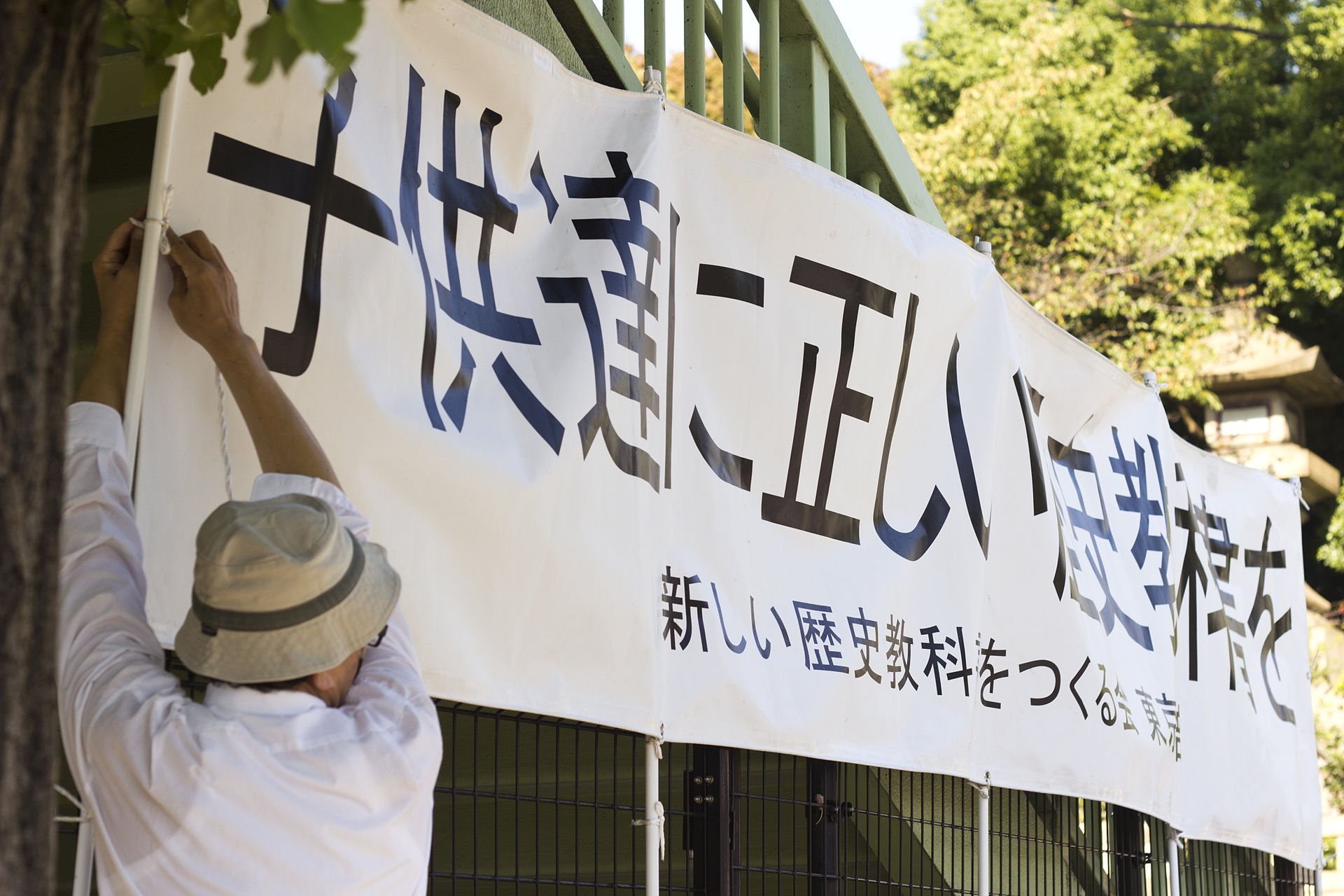 A member of the revisionist group “Japanese Society for History Textbook Reform” erects a banner reading "[Give] the Children Correct History Textbooks". The history textbook controversy centres upon the secondary school history textbook Atarashii Rekishi Kyōkasho ("New History Textbook") said to minimize the nature of Japanese militarism in the First Sino-Japanese War (1894–1895), in annexing Korea in 1910, in the Second Sino-Japanese War (1937–1945), and in the Pacific Theater of World War II (1941–1945). The conservative Japanese Society for History Textbook Reform commissioned the Atarashii Rekishi Kyōkasho textbook with the purpose of traditional national and international view of that Japanese historical period. The Ministry of Education vets all history textbooks, especially those containing references to imperialist atrocities due to a special provision in the textbook examination rules to avoid inflaming controversy with neighbouring countries; however, the Atarashii Rekishi Kyōkasho de-emphasizes aggressive Japanese Imperial wartime behaviour and the matter of Chinese and Korean comfort women. When it comes to the Nanking massacre, the textbook only refers to it as the Nanking Incident, mentioning there were civilian casualties without delving into specifics, and mentioning it again in relation to the Tokyo tribunal, stating that there are multiple opinions about the topic with controversies continuing to this day (see Nanking massacre denial).[166] In 2007, the Ministry of Education attempted to revise textbooks regarding the Battle of Okinawa, lessening the involvement of the Imperial Japanese Army in Okinawan civilian mass suicides.[167][168] |
教科書において 日本 本記事:日本の歴史教科書をめぐる論争 修正主義団体「日本歴史教科書改革協会」のメンバーが、「子供たちに正しい歴史教科書を」と書かれた横断幕を掲げている。 歴史教科書をめぐる論争は、中等学校の歴史教科書『新しい歴史教科書』を中心に展開している。同書は、日清戦争(1894年~1895年)、1910年の 朝鮮併合、日中戦争 (1937–1945年)、および第二次世界大戦(1941–1945年)の太平洋戦線における日本軍国主義の性質を過小評価しているとされる。保守派の 「歴史教科書改革協会」は、当該の日本史時代に対する伝統的な国家的・国際的見解を提示することを目的として、『新しい歴史教科書』の制作を委託した。文 部科学省は、近隣諸国との論争を煽らないよう教科書審査規則に特別条項を設けているため、すべての歴史教科書、特に帝国主義による残虐行為に言及している ものを審査している。しかし、『新しい歴史教科書』は、日本帝国軍の戦時中の侵略的行為や、中国・朝鮮の慰安婦問題について、その重要性を軽視している。 南京大虐殺に関しては、同教科書はこれを「南京事件」としか呼称せず、具体的な詳細には触れずに民間人の犠牲者が出たことに言及しているに留まり、東京裁 判に関連して再び言及する際には、この問題については複数の意見があり、今日に至るまで論争が続いていると述べている(南京大虐殺否定論を参照)。 [166] 2007年、文部科学省は沖縄戦の記述を改訂しようとし、沖縄の民間人集団自殺における日本陸軍の関与を軽視する方向で修正を図った。[167] [168] |
| Pakistan Further information: Pakistani textbooks controversy Allegations of historical revisionism have been made regarding Pakistani textbooks in that they are laced with Indophobic, Hindu-hating and Islamist bias. Pakistan's use of officially published textbooks has been criticized for using schools to more subtly foster religious extremism, whitewashing Muslim conquests on the Indian subcontinent and promoting "expansive pan-Islamic imaginings" that "detect the beginnings of Pakistan in the birth of Islam on the Arabian peninsula".[169] Since 2001, the Pakistani government has stated that curriculum reforms have been underway by the Ministry of Education.[170][171][172] South Korea 12 October 2015, South Korea's government has announced controversial plans to control the history textbooks used in secondary schools despite oppositional concerns of people and academics that the decision is made to glorify the history of those who served the Imperial Japanese government (Chinilpa). Section and the authoritarian dictatorships in South Korea during 1960s–1980s.The Ministry of Education announced that it would put the secondary-school history textbook under state control; "This was an inevitable choice in order to straighten out historical errors and end the social dispute caused by ideological bias in the textbooks," Hwang Woo-yea, education minister said on 12 October 2015.[173] According to the government's plan, the current history textbooks of South Korea will be replaced by a single textbook written by a panel of government-appointed historians and the new series of publications would be issued under the title The Correct Textbook of History and are to be issued to the public and private primary and secondary schools in 2017 onwards. The move has sparked fierce criticism from academics who argue that the system can be used to distort the history and glorify the history of those who served the Imperial Japanese government (Chinilpa) and of the authoritarian dictatorships. Moreover, 466 organizations including Korean Teachers and Education Workers Union formed History Act Network in solidarity and have staged protests: "The government's decision allows the state too much control and power and, therefore, it is against political neutrality that is certainly the fundamental principle of education." Many South Korean historians condemned Kyohaksa for their text glorifying those who served the Imperial Japanese government (Chinilpa) and the authoritarian dictatorship with a far-right political perspective. On the other hand, New Right supporters welcomed the textbook, saying that "the new textbook finally describes historical truths contrary to the history textbooks published by left-wing publishers", and the textbook issue became intensified as a case of ideological conflict. In Korean history, the history textbook was once put under state control during the authoritarian regime under Park Chung Hee (1963–1979), who is a father of Park Geun-hye, former President of South Korea, and was used as a means to keep the Yushin Regime, also known as the Yushin Dictatorship; however, there had been continuous criticisms about the system especially from the 1980s when Korea experienced a dramatic democratic development. In 2003, reformation of textbook began when the textbooks on Korean modern and contemporary history were published though the Textbook Screening System, which allows textbooks to be published not by a single government body but by many different companies, for the first time. Turkey Main article: Turkish textbook controversies Education in Turkey is centralized, and its policy, administration, and content are each determined by the Turkish government. Textbooks taught in schools are either prepared directly by the Ministry of National Education (MEB) or must be approved by its Instruction and Education Board. In practice, this means that the Turkish government is directly responsible for what textbooks are taught in schools across Turkey.[174] In 2014, Taner Akçam, writing for the Armenian Weekly, discussed 2014–2015 Turkish elementary and middle school textbooks that the MEB had made available on the internet. He found that Turkish history textbooks describe Armenians as people "who are incited by foreigners, who aim to break apart the state and the country, and who murdered Turks and Muslims." The Armenian genocide is referred to as the "Armenian matter", and is described as a lie perpetrated to further the perceived hidden agenda of Armenians. Recognition of the Armenian genocide is defined as the "biggest threat to Turkish national security".[174] Akçam summarized one textbook that claims the Armenians had sided with the Russians during the war. The 1909 Adana massacre, in which as many as 20,000–30,000 Armenians were massacred, is identified as "The Rebellion of Armenians of Adana". According to the book, the Armenian Hnchak and Dashnak organizations instituted rebellions in many parts of Anatolia, and "didn't hesitate to kill Armenians who would not join them," issuing instructions that "if you want to survive you have to kill your neighbor first." Claims highlighted by Akçam: "[The Armenians murdered] many people living in villages, even children, by attacking Turkish villages, which had become defenseless because all the Turkish men were fighting on the war fronts. ... They stabbed the Ottoman forces in the back. They created obstacles for the operations of the Ottoman units by cutting off their supply routes and destroying bridges and roads. ... They spied for Russia and by rebelling in the cities where they were located, they eased the way for the Russian invasion. ... Since the Armenians who engaged in massacres in collaboration with the Russians created a dangerous situation, this law required the migration of [Armenian people] from the towns they were living in to Syria, a safe Ottoman territory. ... Despite being in the midst of war, the Ottoman state took precautions and measures when it came to the Armenians who were migrating. Their tax payments were postponed, they were permitted to take any personal property they wished, government officials were assigned to ensure that they were protected from attacks during the journey and that their needs were met, police stations were established to ensure that their lives and properties were secure."[174] Similar revisionist claims found in other textbooks by Akçam included that Armenian "back-stabbing" was the reason the Ottomans lost the Russo-Turkish War of 1877–78 (similar to the post-War German stab-in-the-back myth), that the Hamidian massacres never happened, that the Armenians were armed by the Russians during late World War I to fight the Ottomans (in reality they had already been nearly annihilated from the area by this point), that Armenians killed 600,000 Turks during said war, that the deportation were to save Armenians from other violent Armenian gangs, and that deported Armenians were later allowed to retrieve their possessions and return to Turkey unharmed.[174] As of 2015, Turkish textbooks continue to refer to Armenians as "traitors," deny the genocide, and assert that the Ottoman Turks "took necessary measures to counter Armenian separatism".[175] Students are taught that Armenians were forcibly relocated to defend Turkish nationals from attacks, and Armenians are described as "dishonorable and treacherous".[176] |
パキスタン 詳細情報:パキスタンの教科書をめぐる論争 パキスタンの教科書については、インド嫌悪やヒンドゥー教徒への憎悪、イスラム主義的な偏見が散りばめられているとして、歴史改竄の疑いが持たれている。 パキスタンにおける公的に発行された教科書の使用は、学校を利用して宗教的過激主義をより巧妙に助長し、インド亜大陸におけるイスラム教徒の征服を美化 し、「アラビア半島におけるイスラム教の誕生にパキスタンの起源を見出す」ような「拡大的な汎イスラム主義的想像」を助長しているとして批判されてきた。 [169] 2001年以降、パキスタン政府は教育省によるカリキュラム改革が進められていると表明している。[170][171][172] 韓国 2015年10月12日、韓国政府は、中等学校で使用される歴史教科書を統制するという物議を醸す計画を発表した。これに対し、一般市民や学界からは、こ の決定が日本帝国政府(親日派)に仕えた者たちの歴史を美化するためのものであるとの懸念が示されている。セクションおよび1960年代から1980年代 にかけての韓国における権威主義的独裁政権。教育省は、中等学校の歴史教科書を国家の管理下に置くことを発表した。「これは、歴史上の誤りを正し、教科書 におけるイデオロギー的偏向によって引き起こされた社会的紛争を終わらせるために、避けられない選択であった」と、黄祐亜(ファン・ウヤ)教育相は 2015年10月12日に述べた。[173] 政府の計画によれば、韓国の現行の歴史教科書は、政府が任命した歴史家による委員会が作成した単一の教科書に置き換えられ、新シリーズは『正しい歴史教科 書』というタイトルで発行され、2017年以降、公立および私立の小中学校に配布される予定である。 この動きに対し、この制度が歴史を歪曲し、日本帝国政府(親日派)や権威主義的独裁政権に仕えた者たちの歴史を美化するのに利用される恐れがあると主張す る学者たちから激しい批判が巻き起こっている。さらに、韓国教職員労働組合を含む466の団体が連帯して「歴史法ネットワーク」を結成し、抗議活動を行っ ている: 「政府の決定は国家に過度な統制と権力を与え、したがって教育の基本原則である政治的中立性に反するものである。」多くの韓国人歴史家は、極右的な政治的 視点から日本帝国政府(親日派)や権威主義的独裁政権に仕えた者たちを美化する同社の教科書に対し、非難を浴びせた。一方、新右派の支持者たちは、「新し い教科書は、左派出版社が発行した歴史教科書とは対照的に、ついに歴史の真実を描いている」としてこの教科書を歓迎し、教科書問題はイデオロギー対立の一 例として激化した。韓国の歴史において、歴史教科書はかつて、韓国元大統領パク・クネの父であるパク・チョンヒ(1963–1979)による権威主義体制 下で国家の管理下に置かれ、維新体制(維新独裁とも呼ばれる)を維持する手段として利用された。しかし、特に1980年代に韓国が劇的な民主化の進展を遂 げて以降、この制度に対する批判が絶えなかった。2003年、韓国近代・現代史の教科書が「教科書審査制度」を通じて初めて出版されたことを契機に、教科 書の改革が始まった。この制度により、教科書は単一の政府機関ではなく、多くの異なる企業によって出版されるようになった。 トルコ 本記事:トルコの教科書をめぐる論争 トルコの教育は中央集権化されており、その政策、運営、および内容はすべてトルコ政府によって決定される。学校で使用される教科書は、国民教育省 (MEB)が直接作成するか、同省の教育指導委員会による承認を得なければならない。実際には、これはトルコ政府がトルコ全土の学校で使用される教科書の 選定に直接責任を負っていることを意味する。[174] 2014年、『アルメニアン・ウィークリー』に寄稿したタネル・アクチャムは、MEBがインターネット上で公開した2014~2015年度版のトルコの 小・中学校の教科書について論じた。彼は、トルコの歴史教科書がアルメニア人を「外国人に扇動され、国家と国土を分裂させようとし、トルコ人やイスラム教 徒を殺害した人々」と描写していることを指摘した。アルメニア人虐殺は「アルメニア問題」と呼ばれ、アルメニア人の隠された意図を推進するために仕組まれ た嘘であると記述されている。アルメニア人虐殺の認定は、「トルコの国家安全保障に対する最大の脅威」と定義されている。[174] アクチャムは、戦争中にアルメニア人がロシア側についたと主張するある教科書の要約を行った。2万から3万人のアルメニア人が虐殺されたとされる1909 年のアダナ虐殺は、「アダナのアルメニア人反乱」と位置づけられている。同書によれば、アルメニアのフンチャク派およびダシュナク派組織はアナトリア各地 で反乱を起こし、「彼らに加わらないアルメニア人を殺すことを躊躇しなかった」上、「生き残りたいなら、まず隣人を殺さなければならない」という指令を出 したという。アクチャムが強調する主張:「[アルメニア人は] トルコ人男性が戦線に出征していたため無防備となっていたトルコ人の村を襲撃し、村に住む多くの人々、子供さえも殺害した。……彼らはオスマン軍を裏切っ た。補給路を断ち、橋や道路を破壊することで、オスマン軍部隊の作戦に支障をきたした。……彼らはロシアのためにスパイ活動を行い、居住する都市で反乱を 起こすことで、ロシアの侵攻を容易にした。……ロシアと共謀して虐殺を行ったアルメニア人たちが危険な状況を作り出したため、この法律は、彼らが居住して いた町から、安全なオスマン領であるシリアへの移住を義務付けた。... 戦争の最中にもかかわらず、オスマン帝国は移住するアルメニア人に対して予防措置と対策を講じた。彼らの納税は延期され、希望する個人的な私物を持ち出す ことが許可された。旅の途中の襲撃から彼らを守り、必要が満たされるよう政府職員が配置され、生命と財産の安全を確保するために警察署が設置された。」 [174] アクチャムの他の教科書に見られる同様の修正主義的主張には、1877年から78年の露土戦争でオスマン帝国が敗北したのはアルメニア人の「背後からの裏 切り」が原因であった(戦後のドイツにおける「背後からの一撃」神話に類似する)、ハミディ朝時代の虐殺は決して起こらなかった、第一次世界大戦末期にア ルメニア人はオスマン帝国と戦うためにロシアから武装させられた (実際には、この時点で彼らはすでにその地域からほぼ全滅させられていた)、同戦争中にアルメニア人が60万人のトルコ人を殺害したこと、追放は他の暴力 的なアルメニア人集団からアルメニア人を救うためであったこと、そして追放されたアルメニア人は後に所有物を取り戻し、無傷でトルコへ戻ることが許された ことなどが挙げられる。[174] 2015年現在も、トルコの教科書はアルメニア人を「裏切り者」と呼び続け、ジェノサイドを否定し、オスマン・トルコが「アルメニアの分離主 義に対抗するために必要な措置を講じた」と主張している。[175] 生徒たちは、トルコ国民を攻撃から守るためにアルメニア人が強制移住させられたと教えられており、アルメニア人は「不名誉で裏切り者」と描写されている。 [176] |
| Yugoslavia Throughout the post war era, though Tito denounced nationalist sentiments in historiography, those trends continued with Croat and Serbian academics at times accusing each other of misrepresenting each other's histories, especially in relation to the Croat-Nazi alliance.[177] Communist historiography was challenged in the 1980s and a rehabilitation of Serbian nationalism by Serbian historians began.[178][179] Historians and other members of the intelligentsia belonging to the Serbian Academy of Sciences and Arts (SANU) and the Writers Association played a significant role in the explanation of the new historical narrative.[180][181][182] The process of writing a "new Serbian history" paralleled alongside the emerging ethno-nationalist mobilization of Serbs with the objective of reorganizing the Yugoslav federation.[179] Using ideas and concepts from Holocaust historiography, Serbian historians alongside church leaders applied it to World War Two Yugoslavia and equated the Serbs with Jews and Croats with Nazi Germans.[183] Chetniks along with the Ustashe were vilified by Tito era historiography within Yugoslavia.[184] In the 1980s, Serbian historians initiated the process of re-examining the narrative of how World War Two was told in Yugoslavia which was accompanied by the rehabilitation of Četnik leader Draža Mihailović.[185][186] Monographs relating to Mihailović and the Četnik movement were produced by some younger historians who were ideologically close to it towards the end of the 1990s.[187] Being preoccupied with the era, Serbian historians have looked to vindicate the history of the Chetniks by portraying them as righteous freedom fighters battling the Nazis while removing from history books the ambiguous alliances with the Italians and Germans.[188][184][189][190] Whereas the crimes committed by Chetniks against Croats and Muslims in Serbian historiography are overall "cloaked in silence".[191] During the Milošević era, Serbian history was falsified to obscure the role Serbian collaborators Milan Nedić and Dimitrije Ljotić played in cleansing Serbia's Jewish community, killing them in the country or deporting them to Eastern European concentration camps.[67] In the 1990s following a massive Western media coverage of the Yugoslav Wars, there was a rise of the publications considering the matter on historical revisionism of former Yugoslavia. One of the most prominent authors on the field of historical revisionism in the 1990s considering the newly emerged republics is Noel Malcolm and his works Bosnia: A Short History (1994) and Kosovo: A Short History (1998), that have seen a robust debate among historians following their release; following the release of the latter, the merits of the book were the subject of an extended debate in Foreign Affairs. Critics said that the book was "marred by his sympathies for its ethnic Albanian separatists, anti-Serbian bias, and illusions about the Balkans".[192] In late 1999, Thomas Emmert of the history faculty of Gustavus Adolphus College in Minnesota reviewed the book in Journal of Southern Europe and the Balkans Online and while praising aspects of the book also asserted that it was "shaped by the author's overriding determination to challenge Serbian myths", that Malcolm was "partisan", and also complained that the book made a "transparent attempt to prove that the main Serbian myths are false".[193] In 2006, a study by Frederick Anscombe looked at issues surrounding scholarship on Kosovo such as Noel Malcolm's work Kosovo: A Short History.[194] Anscombe noted that Malcolm offered a "detailed critique of the competing versions of Kosovo's history" and that his work marked a "remarkable reversal" of previous acceptance by Western historians of the "Serbian account" regarding the migration of the Serbs (1690) from Kosovo.[194] Malcolm has been criticized for being "anti-Serbian" and selective like the Serbs with the sources, while other more restrained critics note that "his arguments are unconvincing".[195] Anscombe noted that Malcolm, like Serbian and Yugoslav historians who have ignored his conclusions, sidelines and is unwilling to consider indigenous evidence such as that from the Ottoman archive when composing national history.[195] |
ユーゴスラビア 戦後を通じて、ティトーは歴史学におけるナショナリズム的傾向を非難したものの、そうした傾向は続き、特にクロアチアとナチスの同盟をめぐっては、クロア チアとセルビアの学者たちが互いの歴史を歪曲していると非難し合うことがあった。[177] 1980年代には共産主義的な歴史観が疑問視され、セルビアの歴史家たちによるセルビア・ナショナリズムの再評価が始まった。[178][179] セルビア科学芸術アカデミー(SANU)や作家協会に所属する歴史家やその他の知識人たちは、この新たな歴史的物語の説明において重要な役割を果たした。 [180][181][182] 「新しいセルビアの歴史」を記述するプロセスは、ユーゴスラビア連邦の再編を目的とした、セルビア人の新たなナショナリスト的動員と並行して進められた。 [179] ホロコースト史学の思想や概念を用い、セルビアの歴史家たちは教会指導者らと共に、これを第二次世界大戦下のユーゴスラビアに適用し、セルビア人をユダヤ 人に、クロアチア人をナチス・ドイツ人に例えた。[183] チェトニクはウスタシャと共に、ユーゴスラビア国内のティトー時代の歴史学によって非難された。[184] 1980年代、セルビアの歴史家たちは、ユーゴスラビアにおける第二次世界大戦の語り方を再検討するプロセスを開始し、それに伴いチェトニクの指導者ドラ ジャ・ミハイロヴィッチの名誉回復が進められた。[185] [186] 1990年代末には、ミハイロヴィッチやチェトニク運動にイデオロギー的に近しい一部の若手歴史家によって、彼らに関する専門書が執筆された。[187] この時代に没頭するセルビアの歴史家たちは、チェトニクをナチスと戦う正義の自由戦士として描き、イタリアやドイツとの曖昧な同盟関係を歴史書から排除す ることで、チェトニクの歴史を正当化しようとしてきた。[188][184][189][190] 一方で、チェトニクがクロアチア人やイスラム教徒に対して犯した犯罪については、セルビアの歴史記述において概して「沈黙に包まれている」[191]。ミ ロシェヴィッチ時代、セルビアの歴史は改竄され、セルビアのユダヤ人コミュニティの粛清において、セルビア人協力者ミラン・ネディッチとディミトリェ・ リョティッチが果たした役割――国内での殺害や東欧の強制収容所への送還――が隠蔽された。[67] 1990年代、ユーゴスラビア戦争に関する西側メディアの大規模な報道を受けて、旧ユーゴスラビアの歴史修正主義を論じる出版物が急増した。1990年 代、新たに誕生した共和国を扱った歴史修正主義の分野で最も著名な著者の一人がノエル・マルコムであり、その著作『ボスニア:短史』(1994年)と『コ ソボ:短史』(1998年)は、出版後に歴史家の間で激しい議論を呼んだ。後者の出版後、同書の評価については『フォーリン・アフェアーズ』誌で長期間に わたる論争が繰り広げられた。批評家たちは、同書が「アルバニア系分離主義者への同情、反セルビア的偏見、そしてバルカン半島に対する幻想によって損なわ れている」と指摘した。[192] 1999年後半、ミネソタ州のグスタフス・アドルフス大学歴史学部のトーマス・エマートは、『Journal of Southern Europe and the Balkans Online』誌で本書を評し、その一部を称賛しつつも、本書は「セルビアの神話に異議を唱えようとする著者の圧倒的な決意によって形作られている」と主 張し、マルコムは「党派的」であると指摘した。また、本書が「主要なセルビアの神話が虚偽であることを証明しようとする露骨な試み」であるとも批判した。 [193] 2006年、フレデリック・アンスコムによる研究は、ノエル・マルコムの著書『コソボ:短い歴史』など、コソボに関する学術研究を取り巻く諸問題を検討し た。[194] アンスコムは、マルコムが「コソボの歴史に関する対立する諸説に対する詳細な批判」を提示しており、その著作が、コソボからのセルビア人の移住(1690 年)に関する「セルビア側の説」を西欧の歴史家たちが従来受け入れてきた状況に「著しい転換」をもたらしたと指摘した。[194] マルコムは「反セルビア的」であり、セルビア人と同様に資料を恣意的に選別していると批判されてきたが、より抑制的な批評家たちは「彼の主張は説得力に欠 ける」と指摘している。[195] アンスコムは、マルコムが、自身の結論を無視してきたセルビアやユーゴスラビアの歴史家たちと同様に、国家史を構築する際にオスマン帝国公文書館などの現 地資料を脇に追いやり、検討しようとしない点に言及した。[195] |
| French law recognizing colonialism's positive value Main article: French law on colonialism On 23 February 2005, the Union for a Popular Movement conservative majority at the French National Assembly voted a law compelling history textbooks and teachers to "acknowledge and recognize in particular the positive role of the French presence abroad, especially in North Africa".[196] It was criticized by historians and teachers, among them Pierre Vidal-Naquet, who refused to recognize the French Parliament's right to influence the way history is written (despite the French Holocaust denial laws, see Loi Gayssot). That law was also challenged by left-wing parties and the former French colonies; critics argued that the law was tantamount to refusing to acknowledge the racism inherent to French colonialism, and that the law proper is a form of historical revisionism.[note 5][197][198] Marcos martial law negationism in the Philippines Main article: Historical distortion regarding Ferdinand Marcos See also: Ferdinand Marcos' cult of personality In the Philippines, the biggest examples of historical negationism are linked to the Marcos family dynasty, usually Imelda Marcos, Bongbong Marcos, and Imee Marcos specifically.[199][200][201] They have been accused of denying or trivializing the human rights violations during martial law and the plunder of the Philippines' coffers while Ferdinand Marcos was president.[202][203][204] Denial of the Muslim conquest of the Iberian peninsula See also: Umayyad conquest of Hispania A spin-off of the vision of history espoused by the "inclusive Spanish nationalism" built in opposition to the National-Catholic brand of Spanish nationalism, it was first coined by Ignacio Olagüe (a dilettante historian connected to the early Spanish fascism) particularly in the former's 1974 work La revolución islámica en Occidente ("The Islamic revolution in the West").[205] Olagüe argued that it was impossible for Arabs to have invaded Hispania in 711 since they had not yet established their dominance over the neighbouring part of North Africa. Instead, Olagüe held that the events of 711 could be explained as skirmishes involving allied North African troops within the context of a civil war pitting Catholic Goths led by Roderic against Goths adhering to some form of Arianism and a largely-nontrinitarian Spanish population, including Nestorians, Gnostics and Manichaeans. The negationist postulates of Olagüe were later adopted by certain sectors within Andalusian nationalism.[205] These ideas were resurrected in the early 21st century by the Arabist Emilio González Ferrín.[205][206] Australia Main article: Australian history wars See also: Australian frontier wars and Stolen Generations The Indigenous Australian population plummeted in the Australian frontier wars. The aboriginal people were regarded as lacking any concept of property or land rights: consequently, Australia was considered terra nullius.[207] Massacres and mass poisonings were carried out against indigenous people.[208] Indigenous children were removed from their families in what is known as the Stolen Generations.[209][210] Several critics like Andrew Bolt and Keith Windschuttle have rejected the scholarly evidence pointing to the genocide against Indigenous Australians and have accused historians like Henry Reynolds and Lyndall Ryan of deliberately fabricating Australian history to suit a political agenda.[211][212][213] Nakba Main article: Nakba denial Nakba denial is a form of historical denialism[214] pertaining to the 1948 Palestinian expulsion and flight and its accompanying effects, which Palestinians refer to collectively as the "Nakba" (lit. 'catastrophe').[215] Underlying assumptions of Nakba denial cited by scholars can include the denial of historically documented violence against Palestinians, the idea that Palestine was barren land, and the notion that Palestinian dispossession were part of mutual transfers between Arabs and Jews justified by war.[216][217][218] |
植民地主義の肯定的価値を認めるフランス法 本記事:植民地主義に関するフランス法 2005年2月23日、フランス国民議会における保守派多数派「国民運動連合」は、歴史教科書および教師に対し、「特に北アフリカにおけるフランスの海外 進出の肯定的役割を認め、評価すること」を義務付ける法律を可決した。[196] この法律は歴史家や教師らから批判を受けた。その中にはピエール・ヴィダル=ナケも含まれており、彼は(フランスのホロコースト否定禁止法(ゲイソ法参 照)があるにもかかわらず)フランス議会が歴史の記述方法に影響を与える権利を認めようとしなかった。この法律は左派政党や旧フランス植民地からも異議を 唱えられた。批判者らは、この法律はフランス植民地主義に内在する人種主義を認めないことに等しく、法律そのものが歴史修正主義の一形態であると主張し た。[注5][197][198] フィリピンにおけるマルコス政権の戒厳令否定主義 本記事:フェルディナンド・マルコスに関する歴史の歪曲 関連項目:フェルディナンド・マルコスの個人崇拝 フィリピンにおいて、歴史否定主義の最も顕著な例はマルコス家の一族、特にイメルダ・マルコス、ボンボン・マルコス、イミー・マルコスに関連している。 [199][200][201] 彼らは、フェルディナンド・マルコス大統領在任中の戒厳令下における人権侵害や、フィリピン国庫の略奪を否定したり軽視したりしていると非難されている。 [202][203] [204] イベリア半島におけるイスラム教徒による征服の否定 関連項目:ウマイヤ朝によるヒスパニア征服 「国民カトリック派」のスペインナショナリズムに対抗して構築された「包摂的スペインナショナリズム」が提唱する歴史観から派生した概念であり、特にイグ ナシオ・オラグエ(初期のスペイン・ファシズムと関わりのあったアマチュア歴史家)が1974年の著作『La revolución islámica en Occidente』(『西洋におけるイスラム革命』)において初めてこの用語を用いた。[205] オラグエは、アラブ人が711年にヒスパニアに侵攻したというのはあり得ないと主張した。なぜなら、彼らは当時、隣接する北アフリカ地域において支配を確 立していなかったからである。その代わりに、オラグエは、711年の出来事は、ロデリク率いるカトリック系ゴート族と、ある種のアリウス主義を信奉する ゴート族、およびネストリウス派、グノーシス派、マニ教徒を含む主に非三位一体論的なスペイン人住民との間で繰り広げられた内戦の文脈において、北アフリ カの同盟軍が関与した小競り合いとして説明できると主張した。オラグエの否定論的仮説は、後にアンダルシアナショナリズムの一部勢力によって採用された。 [205] これらの考えは、21世紀初頭にアラビストのエミリオ・ゴンサレス・フェリンによって再浮上した。[205] [206] オーストラリア 本記事:オーストラリアの歴史戦争 関連項目:オーストラリアの開拓戦争および「盗まれた世代」 オーストラリアの開拓戦争において、先住民の人口は激減した。アボリジニは財産や土地権の概念を全く持たないと見なされていた。その結果、オーストラリア は「テラ・ヌリウス(無主地)」とみなされた。[207] 先住民に対しては虐殺や集団毒殺が行われた。[208] 先住民の子供たちは、「盗まれた世代」として知られる政策の下で家族から引き離された。[209][210] アンドルー・ボルトやキース・ウィンドシャトルといった一部の批評家は、オーストラリア先住民に対するジェノサイドを示唆する学術的証拠を否定し、ヘン リー・レイノルズやリンドール・ライアンのような歴史家に対し、政治的意図に合わせてオーストラリアの歴史を意図的に捏造していると非難している。 [211][212] [213] ナクバ 本記事:ナクバ否定論 ナクバ否定論とは、1948年のパレスチナ人の追放と避難、およびそれに伴う影響に関する歴史否定主義の一形態[214]であり、パレスチナ人はこれらを 総称して「ナクバ」(直訳:大惨事)と呼んでいる。[215] 学者らが指摘するナクバ否認の根底にある前提には、パレスチナ人に対する歴史的に記録された暴力の否定、パレスチナが不毛の地であったという考え、そして パレスチナ人の土地剥奪は、戦争によって正当化されたアラブ人とユダヤ人の間の相互移住の一部であったという主張が含まれる。[216][217] [218] |
| In fiction See also: Fahrenheit 451 and Alternate history In the novel Nineteen Eighty-Four (1949) by George Orwell, the government of Oceania continually revises historical records to concord with the contemporary political explanations of The Party. When Oceania is at war with Eurasia, the public records (newspapers, cinema, television) indicate that Oceania has been always at war with Eurasia; yet, when Eurasia and Oceania are no longer fighting each other, the historical records are subjected to negationism; thus, the populace are brainwashed to believe that Oceania and Eurasia always have been allies against Eastasia. The protagonist of the story, Winston Smith, is an editor in the Ministry of Truth, responsible for effecting the continual historical revisionism that will negate the contradictions of the past upon the contemporary world of Oceania.[240][241] To cope with the psychological stresses of life during wartime, Smith begins a diary, in which he observes that "He who controls the present, controls the past. He who controls the past, controls the future", and so illustrates the principal, ideological purpose of historical negationism.[242] Franz Kurowski was an extremely prolific right-wing German writer who dedicated his entire career to the production of Nazi military propaganda, followed by post-war military pulp fiction and revisionist histories of World War II, claiming the humane behaviour and innocence of war crimes of the Wehrmacht, glorifying war as a desirable state, while fabricating eyewitness reports of atrocities allegedly committed by the Allies, especially Bomber Command and the air raids on Cologne and Dresden as a planned genocide of the civilian population.[243] |
フィクションにおいて 関連項目:『華氏451度』および「代替歴史」 ジョージ・オーウェルの小説『1984年』(1949 年)において、オセアニア政府は、党による当時の政治的解釈と整合させるため、歴史的記録を絶えず改竄している。オセアニアがユーラシアと戦争中であると きは、公的な記録(新聞、映画、テレビ)は、オセアニアが常にユーラシアと戦争状態にあったことを示している。しかし、ユーラシアとオセアニアがもはや互 いに戦っていないときは、歴史的記録は否定主義の対象となる。こうして、大衆は、オセアニアとユーラシアが常に東アジアに対抗する同盟国であったと信じる よう洗脳されるのだ。物語の主人公ウィンストン・スミスは、真理省の編集者であり、オセアニアの現代世界において過去の矛盾を否定するための、絶え間ない 歴史修正主義を実行する責任を負っている。[240][241] 戦時下の生活による心理的ストレスに対処するため、スミスは日記をつけ始める。その中で彼は、「現在を支配する者は、過去を支配する。過去を支配する者 は、未来を支配する」と記し、歴史否定主義の主要なイデオロギー的意図を浮き彫りにしている。[242] フランツ・クロフスキは、極めて多作なドイツの右派作家であり、そのキャリアのすべてをナチスの軍事プロパガンダの制作に捧げた。戦後は、軍事を題材とし た大衆小説や第二次世界大戦の修正主義的な歴史書を執筆し、ドイツ国防軍(ヴェルマハト)の非人道的な行為や戦争犯罪の無実を主張し、戦争を望ましい状態 として美化すると同時に、連合国によって行われたとされる残虐行為の目撃証言を捏造した。とりわけ爆撃機司令部によるケルンやドレスデンの空襲を、民間人 に対する計画的なジェノサイドであるかのように描いていた。[243] |
| Academic integrity Alternative facts Ash heap of history Big lie Black legend Cognitive dissonance Damnatio memoriae Doublethink Dunning School (United States) History wars (Australia) History wars (Canada) Hindutva pseudohistory Information warfare Memory hole National memory Selective omission – biases to taboo some elements of a collective memory Cases of denialism 1776 Commission Denial of atrocities against indigenous peoples Denial of the Holodomor Genocide denial – lists a number of particular cases Negationism of the military dictatorship of Chile Temple denial The 1619 Project White Legend World War II-related Anti-Katyn Austria victim theory HIAG Waffen-SS revisionism Holocaust denial Italiani brava gente Myth of the clean Wehrmacht |
学術的誠実性 代替事実 歴史の灰燼 大嘘 黒い伝説 認知的不協和 ダムナティオ・メモリアエ ダブルシンク ダニング・スクール(アメリカ合衆国) 歴史戦争(オーストラリア) 歴史戦争(カナダ) ヒンドゥトヴァの疑似歴史 情報戦争 記憶の穴 国民的記憶 選択的省略 – 集団的記憶の特定の要素をタブー視する偏向 否認主義の事例 1776委員会 先住民に対する残虐行為の否認 ホロドモールの否認 ジェノサイドの否認 – 具体的な事例を列挙 チリ軍事独裁政権の否定主義 テンプル否定論 「1619プロジェクト」 ホワイト・レジェンド 第二次世界大戦関連 反カティン オーストリア被害者論 HIAG(ドイツ・オーストリア・イスラエル友好協会)による武装親衛隊修正主義 ホロコースト否定 「イタリア人は善良な人々」 「清廉なドイツ国防軍」神話 |
| References 01 The term negationism derives from the French neologism négationnisme, denoting Holocaust denial.(Kornberg, Jacques. The Future of a Negation: Reflections on the Question of Genocide.(Review) (book review) Archived 22 December 2017 at the Wayback Machine, Shofar, January 2001). It is now also sometimes used for more general political historical revisionism as (PDF) UNESCO against racism world conference 31 August – 7 September 2001. "Given the ignorance with which it is treated, the slave trade comprises one of the most radical forms of historical negationism." Pascale Bloch has written in International law: Response to Professor Fronza's The punishment of Negationism (Accessed ProQuest Database, 12 October 2011) that revisionists are understood as negationists in order to differentiate them from historical revisionists, since their goal is either to prove that the Holocaust did not exist or to introduce confusion regarding the victims and German executioners regardless of historical and scientific methodology and evidence. For those reasons, the term revisionism is often considered confusing, since it conceals misleading ideologies that purport to avoid disapproval by presenting revisions of the past based on pseudo-scientific methods, while they are in fact a part of negationism. Kriss Ravetto (2001). The Unmaking of Fascist Aesthetics, University of Minnesota Press ISBN 0-8166-3743-1. p. 33 Watts, Philip (2009). "Rewriting history: Céline and Kurt Vonnegut". Kurt Vonnegut's Slaughterhouse-five. Infobase Publishing. ISBN 978-1-4381-2874-0. Pohl, Dieter (2020). "Holocaust Studies in Our Societies". S:I.M.O.N. Shoah: Intervention. Methods. Documentation. 7 (1): 133–141. ISSN 2408-9192. In addition, Holocaust research can support the fight against the falsification of history, not only Nazi negationism, but also lighter forms of historical propaganda. H. Foxman, Abraham (27 January 2014). "Inappropriate Comparisons Trivialize the Holocaust". Anti Defamation League. Retrieved 18 July 2025. Addressing Anti-Semitism through Education: Addressing Holocaust Denial, Distortion and Trivialization (Teaching Aid 6 ed.). Europe: Organization for Security and Co-operation in Europe. 4 December 2019. pp. 2–3. "The two leading critical exposés of Holocaust denial in the United States were written by historians Deborah Lipstadt (1993) and Michael Shermer and Alex Grobman (2000). These scholars make a distinction between historical revisionism and denial. Revisionism, in their view, entails a refinement of existing knowledge about an historical event, not a denial of the event itself, that comes through the examination of new empirical evidence or a re-examination or reinterpretation of existing evidence. Legitimate historical revisionism acknowledges a 'certain body of irrefutable evidence' or a 'convergence of evidence' that suggest that an event – like the black plague, American slavery, or the Holocaust – did in fact occur (Lipstadt 1993:21; Shermer & Grobman 200:34). Denial, on the other hand, rejects the entire foundation of historical evidence. ... " Ronald J. Berger. Fathoming the Holocaust: A Social Problems Approach, Aldine Transaction, 2002, ISBN 0-202-30670-4, p. 154. Lying About Hitler: History, Holocaust, and the David Irving Trial, by Richard J. Evans, 2001, ISBN 0-465-02153-0. p. 145. The author is a professor of Modern History, at the University of Cambridge, and was a major expert-witness in the Irving v. Lipstadt trial; the book presents his perspective of the trial, and the expert-witness report, including his research about the Dresden death count. Trafzer, Clifford E.; Lorimer, Michelle (5 August 2013). "Silencing California Indian Genocide in Social Studies Texts". American Behavioral Scientist. 58 (1): 64–82. doi:10.1177/0002764213495032. S2CID 144356070. Fenelon, James V.; Trafzer, Clifford E. (4 December 2013). "From Colonialism to Denial of California Genocide to Misrepresentations: Special Issue on Indigenous Struggles in the Americas". American Behavioral Scientist. 58 (1): 3–29. doi:10.1177/0002764213495045. S2CID 145377834. Klaus Mehnert, Stalin Versus Marx: the Stalinist historical doctrine (Translation of Weltrevolution durch Weltgeschichte) Port Washington NY: Kennikat Press 1972 (1952), on the illegitimate use of history in the 1934–1952 period. Roger D. Markwick, Rewriting history in Soviet Russia : the politics of revisionist historiography, 1956–1974 New York; Basingstoke: Palgrave, 2001, on legitimate Soviet historiography particularly in the post 1956 period. "Nakba of 1948 and Today Are Not Separate Events, but Ongoing Process of Palestinian Displacement, Replacement, Speakers Tell Panel, Urging Immediate Ceasefire in Gaza | Meetings Coverage and Press Releases". press.un.org. Retrieved 22 November 2024. Nations, United. "Social media feeds Holocaust denial and distortion, finds UN report". United Nations. Retrieved 22 November 2024. Finkielkraut, Alain (1998). The Future of a Negation: Reflections on the Question of Genocide. Lincoln: University of Nebraska Press. p. 125. ISBN 978-0-8032-2000-3. "Truth or Denial". The Washington Post. Retrieved 3 June 2025. Taisia Osipova, "Peasant rebellions: Origin, Scope, Design and Consequences", in Vladimir N. Brovkin (ed.), The Bolsheviks in Russian Society: The Revolution and the Civil Wars, Yale University Press, 1997, ISBN 0-300-06706-2. pp. 154–76. Roger D. Markwick, Donald J. Raleigh, Rewriting History in Soviet Russia: The Politics of Revisionist Historiography, Palgrave Macmillan, 2001, ISBN 0-333-79209-2, pp. 4–5. Tennent H. Bagley, Spy Wars¸ Yale University Press, 2007. ISBN 978-0-300-12198-8, p. 105. Dionne, E.J. Jr. Cold War Scholars Fault Stalin: Soviet Historians Lean to U.S. View. The Washington Post. 26 July 1990. LexisNexis Database (Retrieved 12 October 2011). First Section, p. A3. Nagorski, Andrew. Russia's New Normal: The Cold War may be over, but that doesn't mean the threat from the Kremlin has entirely disappeared. Newsweek; World Affairs. 17 March 2008. LexisNexis Database(. Retrieved 12 October 2011)Vol. 151 No 11. ISSN 0163-7053 Richard J. Evans. David Irving, Hitler and Holocaust Denial: Electronic Edition, 6. General Conclusion Archived 24 September 2015 at the Wayback Machine Paragraphs 6.20,6.21 Jon Silverman How 'Holocaust denier' fought and lost on the BBC web-site 18 November 2005 Malte Herwig "The Swastika Wielding Provocateur" in Der Spiegel 16 January 2006 Barry Loberfeld, "Denying the Other Holocausts": Professor Lipstadt's Own Assault on Truth and Memory, Liberty, May 2002 Linehan, Hugh. "Sinn Féin not allowing facts derail good 'Irish slaves' yarn". The Irish Times. Retrieved 30 March 2021. Kennedy, Liam (2015). Unhappy the Land: The Most Oppressed People Ever, the Irish?. Dublin: Irish Academic Press. p. 19. ISBN 9781785370472. Cf. Gouvea, Jornada (Coimbra, 1606);Geddes,"History of the Malabar Church", London, 1694 Fadhil, Muna (26 February 2015). "Isis destroys thousands of books and manuscripts in Mosul libraries". The Guardian. Retrieved 17 July 2015. Shiji Chapter 6. "The Basic Annals of the First Emperor of Qin" thirty-fourth year: "所不去者,醫藥卜筮種樹之書。" Hebert, Olivia (23 May 2025). "National parks ordered to police 'negative' history under Trump directive". SFGate. Retrieved 22 May 2025. Joselow, Maxine (22 July 2025). "Trump Told Park Workers to Report Displays That 'Disparage' Americans. Here's What They Flagged". The New York Times. Retrieved 22 July 2025. David Barton (December 2008). "Confronting Civil War Revisionism: Why the South Went to War". Wall Builders. Archived from the original on 31 December 2013. Retrieved 30 December 2013. Barrett Brown (27 December 2010). "Neoconfederate civil war revisionism: Those who commemorate the South's fallen heroes are entitled to do so, but not to deny that slavery was the war's prime cause". TheGuardian.com. Retrieved 30 December 2013. "Howard Swint: Confederate revisionism warps U.S. history". Charleston Daily Mail. 15 June 2011. Archived from the original on 31 December 2013. Retrieved 30 December 2013. "Arizona State Professor Brooks D. Simpson Discusses Neo-Confederate Movement". Intelligence Report. Southern Poverty Law Center. 15 September 2000. Blight, David W. Race and Reunion: The Civil War in American Memory. (2001) p. 289 [ISBN missing] Blight, David W. Race and Reunion: The Civil War in American Memory. (2001) p. 290 Madley, Benjamin (2016). "Understanding Genocide in California under United States Rule, 1846–1873". The Western Historical Quarterly. 47 (4): 449–461. doi:10.1093/whq/whw176. Madley, Benjamin (1 August 2008). "California's Yuki Indians: Defining Genocide in Native American History". The Western Historical Quarterly. 39 (3): 303–332. doi:10.1093/whq/39.3.303. Madley, Benjamin (2004). "Patterns of frontier genocide 1803–1910: the aboriginal Tasmanians, the Yuki of California, and the Herero of Namibia". Journal of Genocide Research. 6 (2): 167–192. doi:10.1080/1462352042000225930. S2CID 145079658. Sousa, Ashley Riley (2004). ""They will be hunted down like wild beasts and destroyed!": a comparative study of genocide in California and Tasmania". Journal of Genocide Research. 6 (2): 193–209. doi:10.1080/1462352042000225949. S2CID 109131060. Madley, Benjamin (2016). An American Genocide: The United States and the California Indian Catastrophe, 1846–1873. New Haven: Yale University Press. ISBN 978-0300181364. Adhikari, Mohamed (2022). Destroying to Replace: Settler Genocides of Indigenous Peoples. Indianapolis: Hackett Publishing Company. pp. 72–115. ISBN 978-1647920548. Lindsay, Brendan C. (March 2015). Murder State: California's Native American Genocide, 1846–1873. University of Nebraska Press. ISBN 978-0-8032-6966-8. "Forgiving the culprits: Japanese historical revisionism in a post-cold war context" Archived 5 August 2009 at the Wayback Machine published in the International Journal of Peace Studies "Now Tojo is a Hero" The Daily Telegraph. Sydney, Australia. 12 May 1998. LexisNexis Database. Retrieved 23 November 2011. (subscription required) "No government coercion in war's sex slavery : Abe", Japan Times, 2 March 2007 "Japan's Revisionist History". Los Angeles Times. 11 April 2005. Kim, Youmi; Ives, Mike (26 February 2021). "A Harvard Professor Called Wartime Sex Slaves 'Prostitutes.' One Pushed Back". The New York Times. ISSN 0362-4331. Retrieved 24 February 2026. "Revenge of the Doves". Newsweek. 6 February 2006. Archived from the original on 6 February 2006. "Japan's Atomic Bomb Victims Complain that Their Government Still Neglects Them & Refuses to Take Responsibility". History News Network. 8 December 2005. Sledge, Eugene (2002). China Marine. University of Alabama Press. p. 160. ISBN 978-0-8173-1161-2. Hill, Joshua; Koshiro, Yukiko (15 December 1997). "Remembering the Atomic Bomb". Fresh Writing. Archived from the original on 5 February 2008. Drago Hedl (10 November 2005). "Croatia's Willingness To Tolerate Fascist Legacy Worries Many". BCR Issue 73. IWPR. Retrieved 30 November 2010. Sadkovich, James J. (13 October 2004). "Father of His Country? Franjo Tudjman and the Creation of Contemporary Croatia". Wilson Center. Sindbaek, Tia (2012). Usable History?: Representations of Yugoslavia's Difficult Past from 1945 to 2002. ISD LLC. pp. 178–179. ISBN 978-8-77124-107-5. Milekic, Sven (31 January 2018). "Croatia's Jasenovac Death Toll: A Political Numbers Game". Balkan Insight. BIRN. "Croatia probes why Hitler image was on sugar packets". Reuters. 20 February 2007. Archived from the original on 24 September 2015. Retrieved 12 October 2012. Milekic, Sven (24 January 2017). "Croatia Ex-President Shown Downplaying WWII Crimes". Balkan Insight. BIRN. "Mesić na snimci iz devedesetih: 'Jasenovac nije bio logor smrti. Tko je stigao tamo, bio je spašen'". Novi list. 23 January 2017. Vladisavljevic, Anja (7 January 2019). "Book Event Questioning WWII Crimes Planned for Zagreb Church". Balkan Insight. BIRN. "Simon Wiesenthal Centre urges Croatia to ban Jasenovac revisionist works". hr.n1info.com. N1 Zagreb. 9 January 2019. Archived from the original on 9 October 2020. Retrieved 21 April 2020. "Jewish rights group urges Croatia to ban pro-Nazi book". Associated Press. 9 January 2019. Milekic, Sven (21 April 2017). "Dishonour for Zagreb Over 'Alternative Facts' About Holocaust". BalkanInsight. Retrieved 5 September 2019. Hr, Telegram (18 April 2016). "Jakov Sedlar bi zbog filma 'Jasenovac – istina' mogao u zatvor" (in Croatian). Telegram. Perica 2002, p. 151. Ramet, Sabrina (2007). "The denial syndrome and its consequences: Serbian political culture since 2000". Communist and Post-Communist Studies. 40: 41–58. doi:10.1016/j.postcomstud.2006.12.004. Retrieved 17 April 2020. Ridgeway, James; Udovickii, Jasminka (2000). Burn This House: The Making and Unmaking of Yugoslavia. Duke University Press. p. 133. Cohen 1996, pp. 76–81. Cohen 1996, p. 113. "Rehabilitacija Milana Nedića". BBC Serbian. 7 July 2008. Retrieved 28 January 2017. "How Serbia Changed its Mind about World War II History". Balkan Insight. 6 February 2020. "Brief Record". US Library of Congress. Retrieved 22 April 2009. Gordana Katana (a correspondent with Voice of America in Banja Luka). Regional Report: Bosnian Serbs Play Down Srebrenica, website of the Institute for War & Peace Reporting. Retrieved 25 October 2009 Judgement against Miroslav Deronjic ICTY "Radio Free Europe/Radio Liberty: Newsline, 02-09-03". 3 September 2005. Archived from the original on 5 June 2011. Retrieved 3 July 2009. Daria Sito-Sucic (6 June 2017). "Serb president bans teaching about Sarajevo siege, Srebrenica genocide". Reuters. Retrieved 19 May 2020. Peled, Daniella (3 October 2019). "Why Are Israel's Top Holocaust Scholars So Willing to Deny This Genocide?". Haaretz. Ilyushin, p. 15 Portnov, Andrii (2013). "Ukraińskie interpretacje rzezi wołyńskiej". Więź (in Polish). LVI (652): 158–166. ISSN 0511-9405. "WW2 massacre of Poles by Ukrainians must be called genocide, says head of Polish church". 7 July 2023. Zurbuchen, Mary S. (July/August 2002). "History, Memory, and the '1965 Incident' in Indonesia". Asian Survey Vol. 42, No. 4, pp. 564–581. Friend (2003), p. 115; Chris Hilton (writer and director) (2001). Shadowplay. Vagabond Films and Hilton Cordell Productions (Television documentary).; Vickers (1995). Schwarz (1994), p. 21; Cribb (1990), pp. 2–3; Indonesian academics fight burning of books on 1965 coup Archived 26 October 2012 at the Wayback Machine, The Sydney Morning Herald, 9 August 2007. Allard, Tom (12 June 2009). "Indonesia unwilling to tackle legacy of massacres". The Sydney Morning Herald. Retrieved 27 April 2023. Teaching and Remembering Inside Indonesia History Textbooks Suharto Era Transitional Justice Archived 27 July 2011 at the Wayback Machine. People.uncw.edu. Retrieved 25 December 2010. Jacobson, Philip (22 October 2013). "Book Review: Indonesia and the World Circa 1965". tempo.co. Retrieved 9 June 2014. Marchand, Laure; Perrier, Guillaume (2015). Turkey and the Armenian Ghost: On the Trail of the Genocide. McGill-Queen's Press. pp. 111–112. ISBN 9780773597204. The Iğdır genocide monument is the ultimate caricature of the Turkish government's policy of denying the 1915 genocide by rewriting history and transforming victims into guilty parties. Sarah Rainsford Author's trial set to test Turkey BBC 14 December 2005. Madeleine Brand speaks with Hugh Pope Charges Against Turkish Writer Pamuk Dropped NPR 25 January 2005. "Turkey's new penal code touches raw nerves" EurActiv 2 June 2005, updated 14 November 2005. Writer Hrant Dink acquitted; trials against other journalists continue IFEX 9 February 2006. Sarah Rainsford Turkey bans 'genocide' conference BBC News 22 September 2005. Benjamin Harvey Fight halts Turkish journalists' trial Archived 30 September 2007 at the Wayback Machine in The Independent 8 February 2006. Associated Press Case Against 4 Turkish Journalists Dropped in The Guardian 11 April 2006. Griffiths, James. "The 'forgotten' My Lai: South Korea's Vietnam War massacres". CNN. Retrieved 27 May 2018. "The Forgotten History of South Korean Massacres in Vietnam". thediplomat.com. Archived from the original on 11 September 2020. "South Korean defense minister denies Vietnam War massacres". AP News. 17 February 2023. "Apocalypse Then". Newsweek. 9 April 2000. Archived from the original on 12 June 2018. "It's Time for South Korea to Acknowledge Its Atrocities in Vietnam". Foreign Policy. 30 December 2022. "South Korea appeals court ruling to compensate Vietnam war victim". Reuters. 9 March 2023. Retrieved 1 June 2023. Moinipour, Shabnam (2021). "The Islamic Republic of Iran and children's right to education: acceptability and adaptability". Human Rights Education Review. 4 (2): 26–48. doi:10.7577/hrer.3930. ISSN 2535-5406. S2CID 236595174. "Khamenei.ir". Twitter. "In Iran new year's address, Khamenei questions Holocaust". al-monitor.com. Archived from the original on 24 March 2014. Retrieved 23 March 2014. "What does Iran's Supreme Leader really think about the Holocaust?". News – Telegraph Blogs. Archived from the original on 2 October 2013. "Newseum: The Commissar Vanishes". Archived from the original on 11 June 2008. Retrieved 19 July 2008. Trotsky, Leon (2019). The Stalin School of Falsification. Pickle Partners Publishing. pp. vii–89. ISBN 978-1-78912-348-7. The Historian (journal) Encounters with Soviet Historians in The Historian (journal) November 1957. Vol 20. No 1. pp. 80–95 John Earl Haynes and Harvey Klehr. In Denial: Historians, Communism, and Espionage. Encounter Books, 2003. ISBN 1-893554-72-4 pp. 15–17 John Keep. Recent Writing on Stalin's Gulag: An Overview. 1997 Rosefielde, Steven (2009). Red Holocaust. Routledge. pp. 173–213. ISBN 978-0-415-77757-5. "Russia panel to 'protect history'". BBC News. 19 May 2009. Retrieved 24 May 2009. Osborn, Andrew (20 May 2009). "Medvedev Creates History Commission". The Wall Street Journal. Retrieved 24 May 2009. Victor Schnirelmann: The Value of the Past: Myths, Identity and Politics in Transcaucasia. Senri Ethnological Studies. pp. 160, 196–97: "The republication of classical and medieval sources with omissions, with the replacement of the term "Armenian state" by "Albanian state" and with other distortions of the original manuscripts was another way to play down the Armenian role in early and medieval Transcaucasia. ... The Azeri scholars did all of this by order of the Soviet and Party authorities of Azerbaijan, rather than through free will." Victor Schnirelmann: Why to attribute the dominant views in Azerbaijan to the "world science"? // REGNUM, 12 February 2013 (Translation) Willem M. Floor, Hasan Javadi. "Abbas-Kuli-aga Bakikhanov. The Heavenly Rose-Garden: A History of Shirvan & Daghestan". Mage Publishers, 2008. p. xvi: "This is in particular disturbing because he suppresses, for example, the mention of territory inhabited by Armenians, thus not only falsifying history, but also not respecting Bakikhanov's dictum that a historian should write without prejudice, whether religious, ethnic, political or otherwise" Robert Hewsen. Armenia: A Historical Atlas. University of Chicago Press, 2001. p. 291: "Scholars should be on guard when using Soviet and post-Soviet Azeri editions of Azeri, Persian, and even Russian and Western European sources printed in Baku. These have been edited to remove references to Armenians and have been distributed in large numbers in recent years. When utilizing such sources, the researchers should seek out pre-Soviet editions wherever possible." George Bournoutian. A brief history of the Aghuankʻ region. Mazda Publishers, 2009. pp. 8–14: "Therefore, in order to substantiate their political claims, Bunyatov and his fellow academics chose to set aside all scholarly integrity and print large numbers of re-edited versions of these not easily accessible primary sources on Karabagh, while deleting or altering references to the Armenians" George Bournoutian. Rewriting History: Recent Azeri Alterations of Primary Sources Dealing with Karabakh // Research note from Volume 6 of the "Journal of the Society for Armenian Studies" (1992, 1993) Philip L. Kohl, Clare P. Fawcett. Nationalism, politics, and the practice of archaeology. Cambridge University Press, 1995. p. 154: "Thus, minimally, two points must be made. Patently false cultural origin myths are not always harmless. The political context within which such myths are articulated is critical, and this context continually changes: given the events of the last nine years, assertion that today's Azerbaijan was the original homeland of Turkic-speaking peoples is charged with political significance" Pickman, Sarah (30 June 2006). "Tragedy on the Araxes". Archaeology. Archaeological Institute of America. "High-Resolution Satellite Imagery and the Destruction of Cultural Artifacts in Nakhchivan, Azerbaijan". American Association for the Advancement of Science. 8 December 2010. Алиев В. "Кампанией вокруг хачкаров армяне хотят отвлечь внимание мира от агрессии Армении против Азербайджана"/В. Алиев // Наш век, 2006.-5-11 мая, N N18.-С.6 Castle, Stephen (23 October 2011). "Azerbaijan 'flattened' sacred Armenian site". The Independent. Abbasov, Idrak; Rzayev, Shahin; Mamedov, Jasur; Muradian, Seda; Avetian, Narine; Ter-Sahakian, Karine (27 April 2006). "Azerbaijan: Famous Medieval Cemetery Vanishes". Institute for War and Peace Reporting. Maghakyan, Simon (November 2007). "Sacred Stones Silenced in Azerbaijan". History Today. 57 (11): 4–5. Antonyan, Yulia; Siekierski, Konrad (2014). "A neopagan movement in Armenia: the children of Ara". In Aitamurto, Kaarina; Simpson, Scott (eds.). Modern Pagan and Native Faith Movements in Central and Eastern Europe. Routledge. p. 280. By analogy, other tragic events or threatening processes are designated today by Armenians as "cultural genocide" (for example, the destruction by Azerbaijanis of the Armenian cemetery in Julfa)... Ghazinyan, Aris (13 January 2006). "Cultural War: Systematic destruction of Old Julfa khachkars raises international attention". ArmeniaNow. Archived from the original on 25 November 2015. Retrieved 22 November 2020. ...another "cultural genocide being perpetrated by Azerbaijan." Uğur Ümit Üngör (2015). "Cultural genocide: Destruction of material and non-material human culture". In Carmichael, Cathie; Maguire, Richard C. (eds.). The Routledge History of Genocide. Routledge. p. 250. ISBN 9781317514848. Махмудов Я.М. Самый опасный вымысел в истории: (Ложь о "Великой Армении" – "идеология" террора, геноцида и захвата чужих земель) // Бакинский рабочий. – 2009:27 января. – N 16. – С. 2–3. (copy) Day.Az. 02 Мая 2007 [18:13]. Как реагировать на затягивание Россией ответов на ноты протеста? (copy) Керимов Р. Молчание Кремля: РФ рассматривает ноту протеста Азербайджана, в МИД АР ждут извинений и исправлений ошибок, а НАНА готова помочь соседу документами/Р. Керимов // Эхо, 2007.-3 мая, N N 77.-С.1.3 "Посол России был вызван в МИД Азербайджана". 24 April 2007. "Studies prove that before 1918, there was no Armenian state in S.Caucasus". Azernews. 13 February 2018. Retrieved 27 August 2019. Lornejad, Siavash; Doostzadeh, Ali (2012). Arakelova, Victoria; Asatrian, Garnik (eds.). On the modern politicization of the Persian poet Nezami Ganjavi (PDF). Caucasian Centre for Iranian Studies. p. 85 (note 277). Archived from the original (PDF) on 14 September 2022. Retrieved 27 December 2020. Croissant, Michael P. (1998). The Armenia-Azerbaijan Conflict: Causes and Implications. Praeger Publishers. p. 61. Lornejad, Siavash; Doostzadeh, Ali (2012). Arakelova, Victoria; Asatrian, Garnik (eds.). On the modern politicization of the Persian poet Nezami Ganjavi (PDF). Caucasian Centre for Iranian Studies. pp. 9–10 (note 26). Archived from the original (PDF) on 14 September 2022. Retrieved 27 December 2020. Ahmadi, Hamid (2017). "The Clash of Nationalisms: Iranian response to Baku's irredentism". In Kamrava, Mehran (ed.). The Great Game in West Asia: Iran, Turkey and the South Caucasus. Oxford University Press. pp. 109–110. ISBN 978-0190869663. Lornejad, Siavash; Doostzadeh, Ali (2012). Arakelova, Victoria; Asatrian, Garnik (eds.). On the modern politicization of the Persian poet Nezami Ganjavi. Caucasian Centre for Iranian Studies. p. 17. Lornejad, Siavash; Doostzadeh, Ali (2012). Arakelova, Victoria; Asatrian, Garnik (eds.). On the modern politicization of the Persian poet Nezami Ganjavi (PDF). Caucasian Centre for Iranian Studies. p. 17. Archived from the original (PDF) on 14 September 2022. Retrieved 27 December 2020. Lornejad, Siavash; Doostzadeh, Ali (2012). Arakelova, Victoria; Asatrian, Garnik (eds.). On the modern politicization of the Persian poet Nezami Ganjavi. Caucasian Centre for Iranian Studies. pp. i, 91–92. Talattof, Kamran (2012). "Reviewed Work: Ali Doostzadeh, On the Modern Politicization of the Persian Poet Nezami Ganjavi (Yerevan Series for Oriental Studies – 1) by Siavash Lornejad". Iran & the Caucasus. 16 (3): 380–383. doi:10.1163/1573384X-20120025. Lornejad, Siavash; Doostzadeh, Ali (2012). Arakelova, Victoria; Asatrian, Garnik (eds.). On the modern politicization of the Persian poet Nezami Ganjavi. Caucasian Centre for Iranian Studies. pp. 18, 85 (note 277). Bournoutian, George (2016). The 1820 Russian Survey of the Khanate of Shirvan: A Primary Source on the Demography and Economy of an Iranian Province prior to its Annexation by Russia. Gibb Memorial Trust. p. xvi. Bournoutian, George (2016). The 1820 Russian Survey of the Khanate of Shirvan: A Primary Source on the Demography and Economy of an Iranian Province prior to its Annexation by Russia. Gibb Memorial Trust. pp. xvii, xv, xviii. "U.S. Order to Start Korean War", Korean Central News Agency, 12 June 2000. Ho Jong Ho, Kang Sok Hui, and Pak Thae Ho, US Imperialists Started the Korean War (Pyongyang: Foreign Languages Publishing House, 1993), p. 11. Balázs Szalontai. "Captives of the Past: The Questions of Responsibility and Reconciliation in North Korea's Narratives of the Korean War", Inherited Responsibility and Historical Reconciliation in East Asian Context, Jun-Hyeok Kwak and Melissa Nobles, eds., London: Routledge, 2013, pp. 165–82. Korean Central News Agency, 19 January 1998. "Holocaust deniers often refer to themselves as 'revisionists', in an attempt to claim legitimacy for their activities". (The nature of Holocaust denial: What is Holocaust denial? Archived 12 March 2012 at the Wayback Machine, JPR report No. 3, 2000. Retrieved 16 May 2007) Alan L. Berger, "Holocaust Denial: Tempest in a Teapot, or Storm on the Horizon?", In Peace, in Deed: Essays in Honor of Harry James Cargas, Eds. Zev Garber and Richard Libowitz: Atlanta: Scholars Press, 1998, p. 154. "Denying the Holocaust: The Growing Assault on Truth and Memory" by Deborah E. Lipstadt. ISBN 0-452-27274-2 David Pallister Author fights Holocaust denier judgment in The Guardian 21 June 2001 Oliver Duff David Irving: An anti-Semitic racist who has suffered financial ruin Archived 22 April 2007 at the Wayback Machine 21 February 2006 Holocaust denier Irving to appeal BBC 21 February 2006. "Austria is one of 11 countries with laws against denying the Holocaust." Eugene N. Borza, Macedonia Redux in The Eye Expanded: Life and the Arts in Greco-Roman Antiquity with Frances B. Titchener, and Richard F. Moorton as ed. University of California Press, 1999, ISBN 0520210298, p. 259. Dichev, Ivaylo, Eros Identiteta, In: Dušan Bjelić, Obrad Savić (eds.), Balkan kao metafora: između globalizacije i fragmentacije. Beograd: Beogradski krug, 2003, pp. 269–284. Ulf Brunnbauer, "Serving the Nation: Historiography in the Republic of Macedonia (FYROM) after Socialism", Historien, Vol. 4 (2003–04), pp. 174-175. Klaus Roth, Asker Kartarı as authors and ed., Cultures of Crisis in Southeast Europe, Volume 2, LIT Verlag Münster, 2017, ISBN 3643907915, p. 169. Sinisa Jakov Marusic, New Statue Awakens Past Quarrels in Macedonia. BalkanInsight, 13 July 2012, cited in War in the Balkans: Conflict and Diplomacy before World War I by James Pettifer, I.B. Tauris, 2015, ISBN 0857739689. Kyril Drezov, Macedonian identity: an overview of the major claims in The New Macedonian Question with J. Pettifer as ed., Springer, 1999, ISBN 0230535798, p. 55. The past was systematically falsified to conceal the fact that many prominent 'Macedonians' had supposed themselves to be Bulgarian, and generations of students were taught the "pseudo-history" of the 'Macedonian nation." For more see: Michael L. Benson, Yugoslavia: A Concise History, 2nd ed., Springer, 2003, ISBN 1403997209, p. 89. Evans, Brad (4 May 2020). "Histories of Violence: The Violence of Denial — Rwanda and the Lived Memory of Genocide". Los Angeles Review of Books. Retrieved 25 June 2023. Ismail, Omer; Prendergast, John (1 March 2010). "Genocide in Darfur: How Sudan covers it up". Christian Science Monitor. Retrieved 26 June 2023. Shinta, Ichiro (2001). "「つくる会」の歴史教科書を読む (Reading Thukuru-kai's History Textbook)". Zenchokyo Osaka (National Association for Education and Research of Korean Residents in Japan, Osaka). Okinawa slams history text rewrite, The Japan Times, 23 June 2007. Gheddo, Piero. "Okinawa against Tokyo's attempts to rewrite history". Asianews.it. Retrieved 4 December 2013. Curriculum of hatred, Dawn, 20 May 2009 Jamil, Baela Raza. "Curriculum Reforms in Pakistan – A Glass Half Full or Half Empty?" (PDF). Idara-e-Taleem-o-Aagahi. Retrieved 10 April 2011. Jalal, Ayesha. "Conjuring Pakistan: History as Official Imagining" (PDF). International Journal of Middle East Studies, 27, (1995), 73–89. Retrieved 10 April 2011. The threat of Pakistan's revisionist texts, The Guardian, 18 May 2009 Herald, The Korea (12 October 2015). "Ministry unveils plan for history textbook publication system". Retrieved 17 October 2016. Akcam: Textbooks and the Armenian Genocide in Turkey: Heading Towards 2015, Armenian Weekly Arango, Tim (16 April 2015). "A Century After Armenian Genocide, Turkey's Denial Only Deepens". The New York Times. Retrieved 22 February 2022. Kafanov, Lucy (24 April 2015). "Turkey, Armenians battle over genocide 100 years later". USA Today. Retrieved 22 February 2022. Kolander, Patricia (1999). ""Malevolent Partnership of Blatant Opportunism?" Croat-German Relations, 1919–1941". In Bullivant, Keith; Giles, Geoffrey J.; Pape, Walter (eds.). Germany and Eastern Europe: Cultural identities and cultural differences. Rodopi. p. 267. ISBN 9789042006782. Brunnbauer, Ulf (2011). "Historical Writing in the Balkans". In Woolf, Daniel; Schneider, Axel (eds.). The Oxford History of Historical Writing: Volume 5: Historical Writing Since 1945. Oxford University Press. p. 364. ISBN 9780199225996. Perica 2002, p. 147. Bieber, Florian; Galijaš, Armina (2016). Debating the End of Yugoslavia. Routledge. p. 117. ISBN 9781317154242. Ramet, Sabrina Petra (2002). Balkan Babel: The Disintegration of Yugoslavia From The Death of Tito to the Fall of Milošević. Westview Press. p. 19. ISBN 9780813339054. Serbian historians debates. Ramet, Sabrina P. (2006). The three Yugoslavias: State-building and legitimation, 1918–2005. Indiana University Press. p. 322. ISBN 9780253346568. Perica 2002, p. 150. Ramet, Sabrina P. (2005). Serbia since 1989: Politics and Society under Milopevic and After. University of Washington Press. p. 129. ISBN 9780295802077. Emmert, Thomas; Ingrao, Charles (2013). Conflict in Southeastern Europe at the End of the Twentieth Century: A" Scholars' Initiative" Assesses Some of the Controversies. Routledge. p. 42. ISBN 9781317970163. Drapac, Vesna (2014). "Catholic resistance and collaboration in the Second World War: From Master Narrative to Practical Application". In Rutar, Sabine (ed.). Beyond the Balkans: Towards an Inclusive History of Southeastern Europe. LIT Verlag. p. 282. ISBN 9783643106582. Stojanović, Dubravka (2011). Ramet, Sabrina; Listhaug, Ole (eds.). Serbia and the Serbs in World War Two. Springer. p. 249. ISBN 9780230347816. MacDonald, David Bruce (2003). Balkan Holocausts?: Serbian and Croatian victim centred propaganda and the war in Yugoslavia. Manchester University Press. p. 138. ISBN 9780719064678. Subotic, Jelena (2015). "The Mythologizing of Communist Violence". In Stan, Lavinia; Nedelsky, Nadya (eds.). Post-communist Transitional Justice: Lessons from Twenty-five Years of Experience. Cambridge University Press. p. 201. ISBN 9781107065567. Finney, Patrick (2010). "Land of Ghosts: Memories of War in the Balkans". In Buckley, John; Kassimeris, George (eds.). The Ashgate research companion to modern warfare. Routledge. p. 353. ISBN 9781409499534. Bećirević 2014, p. 46 Djilas 1998. Emmert 1999. Anscombe 2006, p. 770. "Noel Malcolm, who offers a detailed critique of the competing versions of Kosovo's history... Here is a remarkable reversal, as Malcolm, like other Western historians, had previously accepted the Serbian account." Anscombe 2006, pp. 770–71. "Malcolm is criticized for being anti-Serbian, and for using his sources as selectively as the Serbs, though the more restrained of his critics only suggest that his arguments are unconvincing. Most of the documents he relies on were written by enemies of the Ottoman Empire, or by officials with limited experience of the Ottoman Balkans... Malcolm, like the historians of Serbia and Yugoslavia who ignore his findings, overlooks the most valuable indigenous evidence. Unwillingness to consider Ottoman evidence when constructing national history is exemplified by the Serbian historians..." "Loi n° 2005-158 du 23 février 2005 portant reconnaissance de la Nation et contribution nationale en faveur des Français rapatriés (1). - Légifrance". "Les principales prises de position". L'Obs (in French). 26 January 2006. Retrieved 2 August 2018. * "French Revisionism: Case of Positive Role of French Colonisation". The Cameroun Post. 18 December 2005. "France under pressure to defend its colonial past". Agence France-Presse. 8 December 2005. Archived from the original on 22 June 2006. Retrieved 13 February 2006. "EDSA People Power: Inadequate Challenge to Marcos Revisionism | CMFR". 10 March 2016. "UP faculty vows to fight historical revisionism". Archived from the original on 24 September 2018. Retrieved 16 November 2018. "Why has Marcos' propaganda lived on?". Report of an Amnesty International Mission to The Republic of the Philippines: 22 November ~ 5 December 1975 Archived 10 October 2017 at the Wayback Machine amnesty.org Ayee Macaraig (26 August 2015). "Marcos on dad's regime: What am I to apologize for?". Rappler. "PCGG welcomes Singapore court decision on Marcos' Swiss funds". 4 January 2014. García Sanjuán, Alejandro (2018). "La creciente difusión de un fraude historiográfico: la negación de la conquista musulmana de la península ibérica" (PDF). Vínculos de Historia (7). Huelva: Universidad de Huelva: 173–193. doi:10.18239/vdh_2018.07.10 (inactive 1 July 2025). hdl:10272/16207. ISSN 2254-6901. Blanco, Patricia R. (9 April 2018). "El "fraude" que intenta tergiversar la historia de Al Andalus". El País. "Terra nullius". Australian Museum. 15 February 2024. "Mapping the massacres of Australia's colonial frontier". www.newcastle.edu.au. University of Newcastle. 5 July 2017. Retrieved 13 September 2017. Marten, J.A. (2002) Children and War, NYU Press, New York, p. 229 ISBN 0-8147-5667-0 "Indigenous Australia: Family Life". Australian Museum. 2004. Archived from the original on 5 February 2008. Retrieved 28 March 2008. Whitewash : on Keith Windschuttle's Fabrication of Aboriginal history. Internet Archive. Melbourne, Vic. : Black Inc. Agenda. 2003. ISBN 978-0-9750769-0-3. Attwood, Bain (2001). "The Stolen Generations and genocide: Robert Manne's". Aboriginal History. 25. ANU Press: 163–172. ISSN 0314-8769. JSTOR 45135477. Retrieved 10 November 2024. Manne, Robert (9 September 2006). "The cruelty of denial". The Age. Retrieved 20 May 2025. Ben Salem, Lobna (2021). "Humanizing the Enemy: Transcending Victimhood Narratives in Mahmoud Darwish'S and Yehuda Amichai'S Poetry". Postcolonial Text. 16 (1): 1–18. Retrieved 31 January 2024 – via Docslib.org. "Abbas signs decree criminalizing 'Nakba' denial". The Times of Israel. 30 May 2023. Fischbach, Michael R. (2021). "Nakba Denial: Israeli Resistance to Palestinian Refugee Reparations". In Bhabha, Jacqueline; Matache, Margareta; Elkins, Caroline (eds.). Time for Reparations: A Global Perspective. Pennsylvania Studies in Human Rights. University of Pennsylvania Press. pp. 183–200. doi:10.9783/9780812299915-014. ISBN 978-0-8122-9991-5. Nassar, Maha (2023). "Exodus, Nakba Denialism, and the Mobilization of Anti-Arab Racism". Critical Sociology. 49 (6): 1037–1051. doi:10.1177/08969205221132878. S2CID 253134415. Mori, Mariko (July 2009). "Zionism and the Nakba: The Mainstream Narrative, the Oppressed Narratives, and the Israeli Collective Memory" (PDF). Kyoto Bulletin of Islamic Area Studies. 3 (1): 89–107 [95–97]. ISSN 1881-8323. Frequently asked questions and answers Council of Europe Convention on cyber-crime Archived 9 February 2006 at the Wayback Machine by the United States Department of Justice Protocol to the Convention on cybercrime, concerning the criminalisation of acts of a racist and xenophobic nature committed through computer systems on the Council of Europe web site "Additional Protocol to the Convention on cybercrime, concerning the criminalisation of acts of a racist and xenophobic nature committed through computer systems (Chart of signatures and ratifications) Status as of: 30/11/2011". Council of Europe website. Retrieved 30 November 2011. "Liste complète". Archived from the original on 27 September 2011. Retrieved 17 October 2016. APCoc Treaty open for signature by the States which have signed the Treaty ETS 185. on the Council of Europe web site 148. Bundesverfassungsgesetz: Verbotsgesetz-Novelle 1992, Austrian federal law gazette, 19 March 1992, (in German) "2017 Country Reports on Human Rights Practices: Belgium". U. S. Department of State. 20 April 2017. Retrieved 16 May 2019. "2017 Country Reports on Human Rights Practices: Czech Republic". U. S. Department of State. 20 April 2018. Retrieved 16 May 2019. Text of §130(3) of the German penal code (in German). "2017 Country Reports on Human Rights Practices: Hungary". U. S. Department of State. 20 April 2018. Retrieved 16 May 2019. "Denial of Holocaust -Prohibition- Law- 5746-1986-". Israel Ministry of Foreign Affairs. 8 July 1986. Retrieved 16 May 2019. "2017 Country Reports on Human Rights Practices: Lithuania". U. S. Department of State. 20 April 2018. Retrieved 16 May 2019. "2017 Country Reports on Human Rights Practices: Luxembourg". U. S. Department of State. 20 April 2018. Retrieved 16 May 2019. "The Act on the Institute of National Remembrance". Institute of National Remembrance. 16 June 2016. Archived from the original on 30 August 2019. Retrieved 16 May 2019. "Comparative study on legislation sanctioning hate speech and discrimination in the member states of the European Union" (PDF). Comparative Study on Legislation Sanctioning Hate Speech and Discrimination in the Member States of the European Union: 46, 47, 48. October 2014. "Comparative study on legislation sanctioning hate speech and discrimination in the member states of the European Union" (PDF). Comparative Study on Legislation Sanctioning Hate Speech and Discrimination in the Member States of the European Union: 57, 58, 59, 60. October 2014. "Comparative study on legislation sanctioning hate speech and discrimination in the member states of the European Union" (PDF). Comparative Study on Legislation Sanctioning Hate Speech and Discrimination in the Member States of the European Union: 48, 49, 50, 51. October 2014. Gorton, Sean (2015). "THE UNCERTAIN FUTURE OF GENOCIDE DENIAL LAWS IN THE EUROPEAN UNION". George Washington International Law Review. 47 (2): 421–445. The Laws Banning Holocaust Denial Archived 27 October 2011 at the Wayback Machine Genocide Prevention Now. Retrieved 28 November 2011. pp. 1–9 "2007 Country Reports on Human Rights Practices: Czech Republic". 11 March 2008. Retrieved 17 October 2016. Holodomor and Holocaust denial to be a criminal offense, The Day "SparkNotes: 1984: Themes, Motifs & Symbols". Retrieved 17 October 2016. Orwell, George Nineteen Eighty-four New American Library 1961 ISBN 978-0-451-52493-5 Orwell, George. 1984, New American Library, 1961 ISBN 978-0-451-52493-5, p. 37. 243. *Literature by and about Franz Kurowski in the German National Library catalogue |
参考文献 01 「ネガシオニズム」という用語は、ホロコーストの否定を意味するフランス語の新造語「négationnisme」に由来する。(Kornberg, Jacques. 『否定の未来:ジェノサイド問題に関する考察』(書評)(2017年12月22日ウェイバックマシンにアーカイブ)、『ショファール』、2001年1月 号)。現在では、より一般的な政治的歴史修正主義を指す場合にも用いられることがある。(PDF)ユネスコ反人種主義世界会議 2001年8月31日~9月7日。「 「これほど無知に扱われていることを考えれば、奴隷貿易は歴史的ネガショニズムの最も過激な形態の一つを成している。」パスカル・ブロックは『国際法:フ ロンザ教授の「ネガショニズムの処罰」への応答』(ProQuestデータベースより2011年10月12日にアクセス)の中で、修正主義者たちは、歴史 的修正主義者たちと区別するためにネガショニストとして理解されていると記している。彼らの目的は、歴史的・科学的な方法論や証拠を無視して、ホロコース トが存在しなかったことを証明するか、あるいは犠牲者とドイツ人加害者に関する混乱を招くことにあるからだ。こうした理由から、「修正主義」という用語は しばしば紛らわしいと見なされる。なぜなら、それは疑似科学的な方法に基づいて過去を修正することで非難を回避しようとする、誤解を招くイデオロギーを隠 蔽している一方で、実際には否定主義の一部であるからだ。 クリス・ラヴェット(2001)。『ファシスト美学の解体』、ミネソタ大学出版局 ISBN 0-8166-3743-1。p. 33 ワッツ、フィリップ(2009)。「歴史の書き換え:セリーヌとカート・ヴォネガット」。『カート・ヴォネガットの「スローターハウス5」』。インフォベース・パブリッシング。ISBN 978-1-4381-2874-0. ポール、ディーター(2020)。「我々の社会におけるホロコースト研究」。『S:I.M.O.N. Shoah: Intervention. Methods. Documentation. 7 (1): 133–141. ISSN 2408-9192. さらに、ホロコースト研究は、ナチスの否定主義だけでなく、より軽微な形態の歴史的プロパガンダに対しても、歴史の改竄との闘いを支えることができる。 H. フォックスマン、アブラハム(2014年1月27日)。「不適切な比較はホロコーストを軽視させる」。反誹謗同盟。2025年7月18日閲覧。 教育を通じた反ユダヤ主義への対処:ホロコーストの否定、歪曲、軽視への対処(教育補助資料 第6版)。欧州:欧州安全保障協力機構。2019年12月4日。pp. 2–3。 「米国におけるホロコースト否定論に対する主要な批判的暴露書2冊は、歴史家のデボラ・リップシュタット (1993年)とマイケル・シャーマーおよびアレックス・グロブマン(2000年)によって執筆された。これらの学者は、歴史修正主義と否定論を区別して いる。彼らの見解では、修正主義とは、新たな実証的証拠の検証、あるいは既存の証拠の再検討や再解釈を通じて、歴史的出来事に関する既存の知識を精緻化す ることを意味し、出来事そのものの否定ではない。正当な歴史修正主義は、黒死病、アメリカの奴隷制、あるいはホロコーストといった出来事が実際に起こった ことを示唆する「反駁不可能な証拠の一定量」や「証拠の一致」を認めている(リップスタット 1993:21; シャーマー&グロブマン 200:34) 。一方、否定論は、歴史的証拠の基盤そのものを拒絶する。...」ロナルド・J・バーガー『ホロコーストの解明:社会問題アプローチ』(Aldine Transaction、2002年、ISBN 0-202-30670-4、p. 154)。 リチャード・J・エヴァンス著『ヒトラーについての嘘:歴史、ホロコースト、そしてデヴィッド・アーヴィング裁判』(2001年、 ISBN 0-465-02153-0、145ページ。著者はケンブリッジ大学現代史教授であり、アーヴィング対リップシュタット裁判における主要な専門家証人で あった。本書は、同裁判に対する著者の見解と、ドレスデンの死者数に関する研究を含む専門家証人報告書を提示している。 トラフザー、クリフォード・E.;ロリマー、ミシェル(2013年8月5日)。「社会科学教科書におけるカリフォルニア先住民虐殺の黙殺」。 『American Behavioral Scientist』. 58 (1): 64–82. doi:10.1177/0002764213495032. S2CID 144356070. フェネロン、ジェームズ・V.; トラフザー、クリフォード・E. (2013年12月4日). 「植民地主義からカリフォルニア・ジェノサイドの否定、そして虚偽の描写へ:アメリカ大陸における先住民の闘争に関する特集号」. 『アメリカン・ビヘイビア・サイエンティスト』. 58 (1): 3–29. doi:10.1177/0002764213495045. S2CID 145377834. クラウス・メナート、『スターリン対マルクス:スターリン主義の歴史教義』(『世界史による世界革命』の翻訳) ニューヨーク州ポート・ワシントン:ケニカット・プレス 1972年(1952年)、1934年から1952年にかけての歴史の不正な利用について。 ロジャー・D・マークウィック、『ソビエトロシアにおける歴史の書き換え:修正主義的歴史学の政治学、1956–1974年』ニューヨーク;ベージングストーク:パルグレイブ、2001年。特に1956年以降の正当なソビエト歴史学について論じている。 " 「1948年のナクバと今日という日は別個の出来事ではなく、パレスチナ人の追放と置換が継続する過程である――パネリストらが指摘、ガザでの即時停戦を要請 | 会議報道およびプレスリリース」。press.un.org。2024年11月22日閲覧。 国連。「ソーシャルメディアがホロコーストの否定と歪曲を助長していると国連報告書が指摘」。国連。2024年11月22日閲覧。 フィンキエルクラウト、アラン(1998)。『否定の未来:ジェノサイド問題に関する考察』。リンカーン:ネブラスカ大学出版局。p. 125。ISBN 978-0-8032-2000-3。 「真実か否認か」。『ワシントン・ポスト』。2025年6月3日閲覧。 タイシア・オシポワ、「農民反乱:起源、規模、計画、および結果」、ウラジーミル・N・ブロフキン編、『ロシア社会におけるボルシェビキ:革命と内戦』、イェール大学出版局、1997年、 ISBN 0-300-06706-2。pp. 154–76。 ロジャー・D・マークウィック、ドナルド・J・ローリー、『ソビエトロシアにおける歴史の書き換え:修正主義歴史学の政治学』、パルグレイブ・マクミラン、2001年、ISBN 0-333-79209-2、 pp. 4–5. テネット・H・バグリー、『スパイ・ウォーズ』、イェール大学出版局、2007年。ISBN 978-0-300-12198-8、p. 105。 ディオンヌ、E.J. Jr. 『冷戦学者たちがスターリンを非難:ソ連の歴史家たちは米国の見解に傾く』。ワシントン・ポスト。1990年7月26日。LexisNexisデータベース(2011年10月12日取得)。第1部、p. A3。 ナゴルスキー、アンドルー。「ロシアのニューノーマル:冷戦は終わったかもしれないが、それはクレムリンからの脅威が完全に消えたことを意味しない」。 ニューズウィーク;ワールド・アフェアーズ。2008年3月17日。LexisNexisデータベース(2011年10月12日取得)。第151巻第11 号。ISSN 0163-7053 リチャード・J・エヴァンス。デヴィッド・アーヴィング、ヒトラー、そしてホロコースト否定論:電子版、6. 総括 2015年9月24日ウェイバックマシンにアーカイブ 6.20、6.21項 ジョン・シルバーマン「『ホロコースト否定論者』がBBCのウェブサイトでいかに戦い、敗れたか」2005年11月18日 マルテ・ヘルヴィヒ「卍の印を掲げる挑発者」『デア・シュピーゲル』2006年1月16日 バリー・ローバーフェルド「『他のホロコースト』の否定」:リップシュタット教授による真実と記憶への攻撃、『リバティ』2002年5月 リネハン、ヒュー。「シン・フェイン党、事実によって『善良なアイルランド人奴隷』の物語が台無しになるのを許さない」。『アイリッシュ・タイムズ』。2021年3月30日閲覧。 ケネディ、リアム(2015)。『不幸な大地:史上最も抑圧された民族、アイルランド人か?』。ダブリン:アイリッシュ・アカデミック・プレス。p. 19。ISBN 9781785370472。 参照:Gou ベア、『ホルナダ』(コインブラ、1606年);ゲデス、「マラバル教会の歴史」、ロンドン、1694年 ファディル、ムナ(2015年2月26日)。「ISIS、モスル図書館で数千冊の書籍と写本を破壊」。『ガーディアン』。2015年7月17日閲覧。 『史記』第6章。「秦の始皇帝の基本年表」第34年:「所不去者,醫藥卜筮種樹之書。」 ヘバート、オリビア(2025年5月23日)。「トランプ大統領の指令により、国立公園に『否定的な』歴史の監視が命じられる」。SFGate。2025年5月22日閲覧。 ジョセロウ、マキシン(2025年7月22日)。「トランプ大統領、公園職員にアメリカ人を『貶める』展示を報告するよう指示。彼らが報告した内容はこれだ」。ニューヨーク・タイムズ。2025年7月22日閲覧。 デビッド・バートン(2008年12月)。「南北戦争修正主義への対峙:なぜ南部は戦争に踏み切ったのか」。Wall Builders。2013年12月31日にオリジナルからアーカイブされた。2013年12月30日閲覧。 バレット・ブラウン(2010年12月27日)。「新南部連合派による南北戦争修正主義:南部の戦没英雄を称える権利はあるが、奴隷制が戦争の主因であったことを否定する権利はない」。TheGuardian.com。2013年12月30日閲覧。 「ハワード・スウィント:南部連合派の修正主義は米国史を歪める」 . チャールストン・デイリー・メール。2011年6月15日。2013年12月31日にオリジナルからアーカイブされた。2013年12月30日閲覧。 「アリゾナ州立大学のブルックス・D・シンプソン教授がネオ・コンフェデレート運動について論じる」。インテリジェンス・レポート。サザン・ポヴァティ・ロー・センター。2000年9月15日。 ブライト、デビッド・W. 『人種と再統合:アメリカの記憶における南北戦争』。(2001) p. 289 [ISBN欠落] ブライト、デビッド・W. 『人種と再統合:アメリカの記憶における南北戦争』. (2001) p. 290 マドリー、ベンジャミン (2016). 「米国統治下のカリフォルニアにおけるジェノサイドの理解、1846–1873年」. 『ウェスタン・ヒストリカル・クォータリー』. 47 (4): 449–461. doi:10.1093/whq/whw176. マドリー、ベンジャミン(2008年8月1日)。「カリフォルニアのユキ族インディアン:ネイティブ・アメリカン史におけるジェノサイドの定義」。『ウェ スタン・ヒストリカル・クォータリー』。39 (3): 303–332. doi:10.1093/whq/39.3. 303. マドリー、ベンジャミン(2004年)。「1803–1910年のフロンティアにおけるジェノサイドの様相:タスマニア先住民、カリフォルニアのユキ族、 ナミビアのヘレロ族」。『ジェノサイド研究ジャーナル』。6 (2): 167–192. doi:10.1080/1462352042000225930. S2CID 145079658. スーザ、アシュリー・ライリー(2004)。「『彼らは野獣のように追い詰められ、滅ぼされるだろう!』:カリフォルニアとタスマニアにおけるジェノサイ ドの比較研究」。『ジェノサイド研究ジャーナル』。6 (2): 193–209. doi:10.1080/1462352042000225949. S2CID 109131060. マドリー、ベンジャミン(2016)。『アメリカのジェノサイド:合衆国とカリフォルニア・インディアン大惨事、1846–1873』。ニューヘイブン:イェール大学出版局。ISBN 978-0300181364。 アドヒカリ、モハメド(2022)。『破壊して置き換える:先住民に対する入植者によるジェノサイド』。インディアナポリス:ハケット出版。72–115頁。ISBN 978-1647920548。 リンジー、ブレンダン・C.(2015年3月)。『殺戮国家:カリフォルニアにおけるネイティブ・アメリカン虐殺、1846–1873年』。ネブラスカ大学出版局。ISBN 978-0-8032-6966-8。 「加害者を許す:冷戦後の文脈における日本の歴史修正主義」2009年8月5日ウェイバックマシンにアーカイブ。International Journal of Peace Studiesに掲載 「今や東条は英雄だ」The Daily Telegraph。オーストラリア、シドニー。1998年5月12日。LexisNexisデータベース。2011年11月23日閲覧。(購読が必要) 「戦争中の性奴隷に政府の強制はなかった:安倍」『ジャパン・タイムズ』、2007年3月2日 「日本の歴史修正主義」。『ロサンゼルス・タイムズ』。2005年4月11日。 キム・ユミ、アイブス・マイク(2021年2月26日)。「ハーバード大学の教授が戦時中の性奴隷を『売春婦』と呼んだ。ある人物が反論した」。ニューヨーク・タイムズ。ISSN 0362-4331。2026年2月24日閲覧。 「鳩派の逆襲」。ニューズウィーク。2006年2月6日。2006年2月6日にオリジナルからアーカイブ。 「日本の原爆被害者、政府が依然として自分たちを顧みず責任を取ることを拒否していると訴える」。ヒストリー・ニュース・ネットワーク。2005年12月8日。 スレッジ、ユージーン(2002)。『チャイナ・マリン』。アラバマ大学出版局。160頁。ISBN 978-0-8173-1161-2。 ヒル、ジョシュア;コシロ、ユキコ(1997年12月15日)。「原爆を記憶する」。フレッシュ・ライティング。2008年2月5日にオリジナルからアーカイブされた。 ドラゴ・ヘドル(2005年11月10日)。「ファシズムの遺産を容認するクロアチアの姿勢に多くの人が懸念」。BCR第73号。IWPR。2010年11月30日に閲覧。 サドコビッチ、ジェームズ・J.(2004年10月13日)。「祖国の父? フランヨ・トゥジマンと現代クロアチアの形成」。ウィルソン・センター。 シンベック、ティア(2012年)。『活用可能な歴史か?:1945年から2002年までのユーゴスラビアの困難な過去の表象』。ISD LLC。178–179頁。ISBN 978-8-77124-107-5。 ミレキッチ、スヴェン(2018年1月31日)。「クロアチアのヤセノヴァツ犠牲者数:政治的な数字の駆け引き」。バルカン・インサイト。BIRN。 「クロアチア、砂糖の袋にヒトラーの肖像が印刷されていた理由を調査」。ロイター。2007年2月20日。2015年9月24日にオリジナルからアーカイブ。2012年10月12日に閲覧。 ミレキッチ、スヴェン(2017年1月24日)。「クロアチア元大統領、第二次世界大戦の犯罪を軽視する姿勢が明らかになる」。バルカン・インサイト。BIRN。 「90年代の映像に映るメシッチ:『ヤセノヴァツは死の収容所ではなかった。「そこにたどり着いた者は、救われたのだ」」。ノヴィ・リスト。2017年1月23日。 ヴラディサヴリェヴィッチ、アンヤ(2019年1月7日)。「第二次世界大戦の犯罪に疑問を呈する書籍のイベント、ザグレブの教会で計画」。バルカン・インサイト。BIRN。 「サイモン・ヴィーゼンタール・センター、クロアチアに対しヤセノヴァツに関する修正主義的な著作の禁止を要請」。hr.n1info.com。N1ザグレブ。2019年1月9日。2020年10月9日にオリジナルからアーカイブ。2020年4月21日閲覧。 「ユダヤ人権利団体、クロアチアに親ナチス書籍の禁止を要請」。AP通信。2019年1月9日。 ミレキッチ、スヴェン(2017年4月21日)。「ホロコーストに関する『代替事実』をめぐりザグレブに不名誉」。BalkanInsight。2019年9月5日に閲覧。 Hr, Telegram(2016年4月18日)。「ヤコフ・セドラー、映画『ヤセノヴァツ――真実』により収監される可能性」(クロアチア語)。Telegram。 ペリカ 2002, p. 151. ラメット, サブリナ (2007). 「否認症候群とその帰結:2000年以降のセルビアの政治文化」. 『Communist and Post-Communist Studies』. 40: 41–58. doi:10.1016/j.postcomstud.2006.12.004. 2020年4月17日閲覧。 リッジウェイ、ジェームズ;ウドヴィッキ、ヤスミンカ(2000)。『この家を燃やせ:ユーゴスラビアの形成と崩壊』。デューク大学出版局。p. 133。 コーエン 1996, pp. 76–81。 Cohen 1996, p. 113. 「ミラノ・ネディッチの復権」。BBCセルビア語版。2008年7月7日。2017年1月28日閲覧。 「セルビアが第二次世界大戦の歴史に対する見方をどう変えたか」。Balkan Insight。2020年2月6日。 「概要」。米国議会図書館。2009年4月22日閲覧。 ゴルダナ・カタナ(バニャ・ルカのボイス・オブ・アメリカ特派員)。地域レポート:ボスニア・セルビア人がスレブレニツァを軽視、戦争・平和報道研究所のウェブサイト。2009年10月25日閲覧 ミロスラフ・デロニッチに対する判決 ICTY 「ラジオ・フリー・ヨーロッパ/ラジオ・リバティ:ニュースライン、2003年9月2日」。2005年9月3日。2011年6月5日にオリジナルからアーカイブ。2009年7月3日閲覧。 ダリア・シト=スチッチ(2017年6月6日)。「セルビア大統領、サラエボ包囲戦とスレブレニツァ虐殺に関する教育を禁止」 。ロイター。2020年5月19日閲覧。 ペレド、ダニエラ(2019年10月3日)。「なぜイスラエルのホロコースト研究の第一人者たちは、このジェノサイドを否定することにそれほど熱心なのか?」。ハアレツ。 イリュシン、p. 15 ポートノフ、アンドリー(2013年)。「ヴォリニの虐殺に関するウクライナの解釈」。『ヴィェズ』(ポーランド語)。LVI (652): 158–166. ISSN 0511-9405. 「第二次世界大戦中のウクライナ人によるポーランド人虐殺はジェノサイドと呼ぶべきだ、とポーランド教会のトップが語る」。2023年7月7日。 ズールブチェン、メアリー・S.(2002年7月/8月) 。「インドネシアにおける歴史、記憶、そして『1965年の事件』」。『Asian Survey』第42巻第4号、564–581頁。 フレンド(2003年)、115頁;クリス・ヒルトン(脚本・監督)(2001年)。『Shadowplay』。Vagabond FilmsおよびHilton Cordell Productions(テレビドキュメンタリー)。;ヴィッカーズ (1995年)。 シュワルツ(1994年)、21頁;クリブ(1990年)、2–3頁;『インドネシアの学者ら、1965年クーデターに関する書籍の焼却に反対』2012年10月26日ウェイバックマシンにアーカイブ、シドニー・モーニング・ヘラルド、2007年8月9日。 アラード、トム(2009年6月12日)。「インドネシア、虐殺の遺産と向き合うことを拒む」。『シドニー・モーニング・ヘラルド』。2023年4月27日閲覧。 インドネシア国内における教育と記憶 スハルト時代の歴史教科書 移行期正義 2011年7月27日ウェイバックマシンにアーカイブ。People.uncw.edu。2010年12月25日閲覧。 ジェイコブソン、フィリップ(2013年10月22日)。「書評:1965年頃のインドネシアと世界」。tempo.co。2014年6月9日閲覧。 マルシャン、ローレ;ペリエ、ギヨーム(2015年)。『トルコとアルメニアの亡霊:ジェノサイドの足跡』。マギル・クイーンズ・プレス。pp. 111–112. ISBN 9780773597204. イグディルのジェノサイド記念碑は、歴史を書き換え、犠牲者を加害者に変えることで1915年のジェノサイドを否定するトルコ政府の政策の究極の滑稽な象 徴である。 サラ・レインズフォード 作家の裁判がトルコを試す BBC 2005年12月14日。 マドレーヌ・ブランドがヒュー・ポープと対談 トルコ人作家パムクの起訴取り下げ NPR 2005年1月25日。 「トルコの新しい刑法は神経を逆なでする」 EurActiv 2005年6月2日、2005年11月14日更新。 作家フラント・ディンクは無罪判決、他のジャーナリストに対する裁判は続く IFEX 2006年2月9日。 サラ・レインズフォード トルコ、「ジェノサイド」会議を禁止 BBCニュース 2005年9月22日。 ベンジャミン・ハーヴェイ「闘争によりトルコ人ジャーナリストの裁判が中断」2007年9月30日ウェイバックマシンにアーカイブ、The Independent 2006年2月8日。 AP通信「トルコ人ジャーナリスト4人に対する訴追が取り下げられる」The Guardian 2006年4月11日。 グリフィス、ジェームズ。「 『忘れられた』マイ・ライ:韓国によるベトナム戦争時の虐殺」。CNN。2018年5月27日閲覧。 「ベトナムにおける韓国軍による虐殺の忘れられた歴史」。thediplomat.com。2020年9月11日にオリジナルからアーカイブ。 「韓国国防相、ベトナム戦争時の虐殺を否定」。AP通信。2023年2月17日。 「当時の黙示録」。ニューズウィーク。2000年4月9日。2018年6月12日にオリジナルからアーカイブ。 「韓国はベトナムでの残虐行為を認めるべき時だ」。Foreign Policy。2022年12月30日。 「韓国、ベトナム戦争の被害者への補償を命じた控訴審判決を不服として上告」。Reuters。2023年3月9日。2023年6月1日取得。 モイニプール、シャブナム(2021年)。「イラン・イスラム共和国と子どもの教育を受ける権利:受容性と適応性」。『ヒューマン・ライツ・エデュケー ション・レビュー』。4巻2号:26–48頁。doi:10.7577/hrer.3930。ISSN 2535-5406。S2CID 236595174。 「Khamenei.ir」。Twitter。 「イランの新年演説で、ハメネイ師がホロコーストに疑問を呈する」。al-monitor.com。2014年3月24日にオリジナルからアーカイブ。2014年3月23日閲覧。 「イランの最高指導者はホロコーストについて本当にどう考えているのか?」。ニュース – テレグラフ・ブログ。2013年10月2日にオリジナルからアーカイブ。 「ニューズーム:コミッサールの消失」。2008年6月11日にオリジナルからアーカイブされた。2008年7月19日に閲覧。 トロツキー、 レオン(2019年)。『スターリン流の改竄』。ピックル・パートナーズ・パブリッシング。vii–89頁。ISBN 978-1-78912-348-7。 『ヒストリアン』(学術誌)『ソ連の歴史家たちとの出会い』、『ヒストリアン』(学術誌)1957年11月号。第20巻第1号。pp. 80–95 ジョン・アール・ヘインズ、ハーヴェイ・クレア。In Denial: Historians, Communism, and Espionage。エンカウンター・ブックス、2003年。ISBN 1-893554-72-4 pp. 15–17 ジョン・キープ。Recent Writing on Stalin's Gulag: An Overview。1997年 ローズフィールド、スティーブン(2009年)。『レッド・ホロコースト』。ラウトリッジ。pp. 173–213。ISBN 978-0-415-77757-5. 「ロシア、『歴史を守る』ための委員会を設置」。BBCニュース。2009年5月19日。2009年5月24日閲覧。 オズボーン、アンドルー(2009年5月20日)。「メドベージェフ、歴史委員会を設立」。ウォール・ストリート・ジャーナル。2009年5月24日閲覧。 ヴィクター・シュニレルマン:『過去の価値:南コーカサスにおける神話、アイデンティティ、そして政治』。千里民族学研究。pp. 160, 196–97:「古典および中世の資料を、省略を加え、 『アルメニア国家』という用語を『アルメニア国家』に置き換え、その他の原典の歪曲を行う形で再刊されたことは、初期および中世のトランスコーカシアにお けるアルメニアの役割を軽視するためのもう一つの手段であった。……アゼルバイジャンの学者たちは、これらすべてを自らの意思ではなく、アゼルバイジャン のソ連および党当局の命令によって行ったのである。」 ヴィクトル・シュニレルマン:なぜアゼルバイジャンにおける支配的な見解を「世界科学」に帰するのだか? // REGNUM、2013年2月12日(翻訳) ウィレム・M・フロア、ハサン・ジャヴァディ。「アッバス・クリ・アガ・バキハノフ。『天上のバラ園:シルヴァンとダゲスタンの歴史』」。Mage Publishers、2008年。p. xvi:「これは特に憂慮すべきことである。なぜなら、彼は例えばアルメニア人が居住する地域への言及を意図的に排除しており、それによって歴史を改竄す るだけでなく、歴史家は宗教的、民族的、政治的、その他のいかなる偏見をも持たずに書くべきだというバキハノフの格言をも尊重していないからである」 ロバート・ヒューセン。『アルメニア:歴史地図集』。シカゴ大学出版局、2001年。p. 291:「研究者は、バクーで印刷されたアゼルバイジャン語、ペルシア語、さらにはロシア語や西ヨーロッパの資料の、ソ連およびポストソ連のアゼルバイ ジャン語版を利用する際には警戒すべきである。これらはアルメニア人に関する言及を削除するよう編集されており、近年大量に流通している。こうした資料を 利用する際、研究者は可能な限りソ連以前の版を探すべきである。」 ジョージ・ボルヌティアン。『アグアンク地域の簡史』。マズダ出版社、2009年。pp. 8–14: 「したがって、自らの政治的主張を裏付けるため、ブニャトフとその仲間の学者たちは、学術的誠実さをすべて捨て去り、カラバフに関する入手困難な一次資料 の改訂版を大量に印刷することを選んだ。その際、アルメニア人に関する言及を削除または改変したのである」 ジョージ・ボルヌティアン。『歴史の書き換え: カラバフに関する一次資料へのアゼルバイジャン側の最近の改変 // 『アルメニア研究学会誌』第6巻(1992年、1993年)からの研究ノート フィリップ・L・コール、クレア・P・フォーセット。『ナショナリズム、政治、そして考古学の実践』。ケンブリッジ大学出版局、1995年。p. 154:「したがって、少なくとも2つの点を指摘しなければならない。明らかに虚偽の文化的起源神話は、必ずしも無害ではない。そのような神話が語られる 政治的文脈は極めて重要であり、この文脈は絶えず変化している。過去9年間の出来事を踏まえると、今日のアゼルバイジャンがトルコ語系民族の本来の故郷で あったという主張は、政治的な意味合いを帯びている」 ピックマン、サラ(2006年6月30日)。「アラクス川での悲劇」。『Archaeology』。アメリカ考古学協会。 「高解像度衛星画像とアゼルバイジャン・ナヒチェヴァンにおける文化遺産の破壊」。アメリカ科学振興協会。2010年12月8日。 アリエフ・V. 「ハチャカルをめぐるキャンペーンは、アルメニアによるアゼルバイジャンへの侵略から世界の注目をそらそうとするアルメニア人の策略だ」/V. アリエフ // 『ナシュ・ヴェク』、2006年5月11日、第18号、6ページ キャッスル、スティーブン(2011年10月23日)。「アゼルバイジャン、アルメニアの聖地を『平らにした』」。『インディペンデント』。 アッバソフ、イドラク;ルザエフ、シャヒン;マメドフ、ジャスール;ムラディアン、セダ;アヴェティアン、ナリン;テル=サハキアン、カリン(2006年4月27日)。「アゼルバイジャン:有名な中世の墓地が消滅」。戦争と平和報道研究所。 マガキアン、サイモン(2007年11月)。「アゼルバイジャンで沈黙した聖なる石」。『ヒストリー・トゥデイ』。57巻(11号):4–5頁。 アントニアン、ユリア;シエキエルスキ、コンラッド(2014年)。「アルメニアにおける新異教運動:アラの子ら」。アイタムルト、カアリーナ;シンプソ ン、スコット(編)。『中東欧における現代異教および先住民信仰運動』. ラウトリッジ. p. 280. 類推により、他の悲劇的な出来事や脅威となる過程は、今日アルメニア人によって「文化的ジェノサイド」と指定されている(例えば、アゼルバイジャン人によ るジュルファのアルメニア人墓地の破壊など)... ガジニャン、アリス(2006年1月13日)。「文化戦争:旧ジュルファのハチカルに対する組織的な破壊が国際的な注目を集める」。 ArmeniaNow。2015年11月25日にオリジナルからアーカイブ。2020年11月22日閲覧。……「アゼルバイジャンによって行われているも う一つの『文化的ジェノサイド』」。 ウグル・ウミット・ウンゴル(2015年)。「文化的ジェノサイド:有形・無形の人類文化の破壊」。カーマイケル、キャシー;マグワイア、リチャード・ C.(編)。『The Routledge History of Genocide』。Routledge。250頁。ISBN 9781317514848。 マフムドフ・ヤ・M. 歴史上最も危険な虚構:(「大アルメニア」に関する嘘――テロ、ジェノサイド、他国領土の占領という「イデオロギー」) // バキン・ラボチイ。– 2009年1月27日。– 第16号。– 2–3頁。(コピー) Day.Az. 2007年5月2日 [18:13]。ロシアによる抗議書簡への回答の先延ばしにどう対応すべきか? (コピー) ケリモフ・R. クレムリンの沈黙:ロシア連邦はアゼルバイジャンの抗議書簡を検討中、アゼルバイジャン外務省は謝罪と誤りの是正を待ち、NANAは隣国に文書で協力する用意がある/R. ケリモフ // エコー、2007年5月3日、第77号、1・3ページ 「ロシア大使がアゼルバイジャン外務省に召喚された」。2007年4月24日。 「研究により、1918年以前には南コーカサスにアルメニア国家は存在しなかったことが証明された」。Azernews。2018年2月13日。2019年8月27日閲覧。 ロルネジャド、シアヴァシュ;ドゥストザデ、アリ(2012年)。アラケロヴァ、ヴィクトリア;アサトリアン、ガルニク(編)。ペルシャの詩人ネザミ・ガ ンジャヴィの現代における政治化について (PDF)。コーカサス・イラン研究センター。p. 85 (注277)。2022年9月14日にオリジナル (PDF) からアーカイブされた。2020年12月27日閲覧。 クロワッサン、マイケル・P. (1998) . 『アルメニア・アゼルバイジャン紛争:原因と影響』. プレーガー・パブリッシャーズ. p. 61. ロルネジャド, シアヴァシュ; ドゥストザデ, アリ (2012). アラケロヴァ, ヴィクトリア; アサトリアン, ガルニク (編). ペルシャの詩人ネザーミ・ガンジャヴィの現代における政治化について (PDF). コーカサス・イラン研究センター. pp. 9–10(注26)。2022年9月14日にオリジナル(PDF)からアーカイブされた。2020年12月27日閲覧。 アフマディ、ハミド(2017年)。「 『ナショナリズムの衝突:バクーの領土回復主義に対するイランの反応』」。カムラヴァ、メハラン(編)。『西アジアにおけるグレート・ゲーム:イラン、ト ルコ、南コーカサス』。オックスフォード大学出版局。pp. 109–110。ISBN 978-0190869663。 ロルネジャド、シアヴァシュ;ドゥストザデ、アリ(2012) . アラケロヴァ、ヴィクトリア;アサトリアン、ガルニク(編)。『ペルシャの詩人ネザーミ・ガンジャヴィの現代的政略化について』。コーカサス・イラン研究センター。p. 17. ロルネジャド、シアヴァシュ;ドゥストザデ、 アリ(2012年)。アラケロヴァ、ヴィクトリア;アサトリアン、ガルニク(編)。ペルシャの詩人ネザーミ・ガンジャヴィの現代における政治化について (PDF)。コーカサス・イラン研究センター。p. 17。2022年9月14日にオリジナル(PDF)からアーカイブされた。2020年12月27日閲覧。 ロルネジャド、シアヴァシュ; ドゥストザデ、アリ(2012年)。アラケロヴァ、ヴィクトリア;アサトリアン、ガルニク(編)。『ペルシアの詩人ネザーミ・ガンジャヴィの現代的政略化について』。コーカサス・イラン研究センター。i、91–92頁。 タラトフ、カムラン(2012年)。「書評:Ali Doostzadeh著『ペルシャの詩人ネザーミ・ガンジャヴィの現代的政略化について』(Yerevan Series for Oriental Studies – 1)Siavash Lornejad評」。『Iran & the Caucasus』。16 (3): 380–383. doi:10.1163/1573384X-20120025. ロルネジャド、シアヴァシュ;ドゥストザデ、アリ(2012)。アラケロヴァ、ヴィクトリア;アサトリアン、ガルニク(編)。『ペルシャの詩人ネザーミ・ガンジャヴィの近代的政治化について』。コーカサス・イラン研究センター。pp. 18, 85(注277)。 ボルヌティアン、ジョージ (2016). 『1820年のシルヴァン・ハン国に関するロシアの調査:ロシアによる併合前のイランの州の人口統計と経済に関する一次資料』。ギブ記念トラスト。p. xvi. ボウルヌティアン、ジョージ (2016). 『1820年のシルヴァン・ハン国に関するロシアの調査:ロシアによる併合前のイランの州の人口統計と経済に関する一次資料』。ギブ記念トラスト。xvii、xv、xviii頁。 「朝鮮戦争開始の米国命令」、朝鮮中央通信、2000年6月12日。 ホ・ジョンホ、カン・ソクヒ、パク・テホ、 『米帝国主義者による朝鮮戦争の勃発』(平壌:外国語出版社、1993年)、p. 11。 バラズ・サロントイ。「過去の囚人:北朝鮮の朝鮮戦争叙述における責任と和解の問題」、『東アジアの文脈における継承された責任と歴史的和解』、クァク・ジュンヒョクおよびメリッサ・ノーブルズ編。、ロンドン:ラウトリッジ、2013年、165–82頁。 朝鮮中央通信、1998年1月19日。 「ホロコースト否定論者は、自らの活動の正当性を主張しようと、しばしば自らを『修正主義者』と呼ぶ」。(ホロコースト否定の性質:ホロコースト否定とは 何か?2012年3月12日ウェイバックマシンにアーカイブ、JPRレポート第3号、2000年。2007年5月16日取得) アラン・L・バーガー、「ホロコースト否定論:茶碗の中の嵐か、それとも地平線上の嵐か?」、『Peace, in Deed: Essays in Honor of Harry James Cargas』所収、ゼヴ・ガーバーおよびリチャード・リボウィッツ編:アトランタ: Scholars Press、1998年、154頁。 デボラ・E・リップシュタット著『ホロコーストの否定:真実と記憶への高まる攻撃』。ISBN 0-452-27274-2 デイヴィッド・パリスター著『著者がホロコースト否定論者に対する判決に異議を唱える』ガーディアン紙 2001年6月21日 オリバー・ダフ『デビッド・アーヴィング:経済的苦悩を招いた反ユダヤ主義者かつ人種差別主義者』2007年4月22日ウェイバックマシンにアーカイブ 2006年2月21日 ホロコースト否定論者アーヴィング、BBCを提訴へ 2006年2月21日。「オーストリアは、ホロコースト否定を禁じる法律を持つ11カ国のうちの1つである。」 ユージン・N・ボルザ、『マケドニア・リダックス』、『The Eye Expanded: Life and the Arts in Greco-Roman Antiquity』(フランシス・B・ティッチナー、リチャード・F・ムーアトン編)。カリフォルニア大学出版局、1999年、ISBN 0520210298、259ページ。 ディチェフ、イヴァイロ、 『エロス・アイデンティテタ』、ドゥシャン・ビェリッチ、オブラド・サヴィッチ(編)、『バルカンとしてのメタファー:グローバル化と断片化の間』所収。ベオグラード:ベオグラードスキ・クルグ、2003年、269–284頁。 ウルフ・ブルンバウアー、「国民への奉仕:社会主義後のマケドニア共和国(FYROM)における歴史学」、『ヒストリアン』第4巻(2003–04年)、174–175頁。 クラウス・ロス、アスケル・カルタリ(著・編)、『南東ヨーロッパの危機文化』、 第2巻、LIT Verlag Münster、2017年、ISBN 3643907915、p. 169。 シニシャ・ヤコフ・マルシッチ、「マケドニアで新たな像が過去の争いを呼び覚ます」。BalkanInsight、2012年7月13日、ジェームズ・ペ ティファー著『バルカン半島の戦争:第一次世界大戦前の紛争と外交』(I.B. Tauris刊、2015年、ISBN 0857739689。 キリル・ドレゾフ、「マケドニアのアイデンティティ:主要な主張の概観」、『新たなマケドニア問題』(J. ペティファー編)、 Springer、1999年、ISBN 0230535798、55ページ。 多くの著名な「マケドニア人」が自らをブルガリア人だと考えていたという事実を隠蔽するため、過去は体系的に改竄され、何世代にもわたる学生たちに「マケ ドニア国民」の「偽りの歴史」が教え込まれた。詳細は以下を参照:マイケル・L・ベンソン、『ユーゴスラビア:簡明史』第2版、 スプリンガー、2003年、ISBN 1403997209、89ページ。 エヴァンス、ブラッド(2020年5月4日)。「暴力の歴史:否認の暴力――ルワンダとジェノサイドの生きた記憶」。『ロサンゼルス・レビュー・オブ・ブックス』。2023年6月25日閲覧。 イスマイル、オメル; プレンダーガスト、ジョン(2010年3月1日)。「ダルフールにおけるジェノサイド:スーダンがそれを隠蔽する方法」。『クリスチャン・サイエンス・モニター』。2023年6月26日閲覧。 新田一郎(2001)。「『つくる会』の歴史教科書を読む」 。全教組大阪(在日韓国人教育研究全国協会、大阪)。 沖縄、歴史教科書の書き換えを非難、『ジャパン・タイムズ』、2007年6月23日。 ゲド、ピエロ。「歴史の書き換えを図る東京に対し、沖縄が反対」。Asianews.it。2013年12月4日閲覧。 憎悪のカリキュラム、ドーン紙、2009年5月20日 ジャミル、バエラ・ラサ。「パキスタンのカリキュラム改革――コップは半分空か、半分満か?」(PDF)。Idara-e-Taleem-o-Aagahi。2011年4月10日閲覧。 ジャラル、アイシャ。「パキスタンの構築:公式な想像としての歴史」(PDF)。『International Journal of Middle East Studies』、27号(1995年)、73–89頁。2011年4月10日閲覧。 パキスタンの修正主義的テキストの脅威、『ガーディアン』、2009年5月18日 ヘラルド、韓国(2015年10月12日)。「教育省、歴史教科書出版システムの計画を発表」。2016年10月17日閲覧。 アクカム:トルコにおける教科書とアルメニア人虐殺:2015年へ向けて、アルメニアン・ウィークリー アランゴ、ティム(2015年4月16日)。「 アルメニア人虐殺から1世紀、トルコの否定は深まるばかり」。『ニューヨーク・タイムズ』。2022年2月22日閲覧。 カファノフ、ルーシー(2015年4月24日)。「トルコとアルメニア人、虐殺をめぐり100年後に激突」。『USAトゥデイ』。2022年2月22日閲覧。 コランダー、パトリシア(1999年)。「『露骨な日和見主義による悪意ある提携?』クロアチアとドイツの関係、1919–1941年」。ブリヴァント、 キース;ジャイルズ、ジェフリー・J.;パペ、ウォルター(編)。『ドイツと東欧:文化的アイデンティティと文化的差異』。ロドピ。p. 267。ISBN 9789042006782. ブルンバウアー、ウルフ(2011年)。「バルカン半島における歴史記述」。ウールフ、ダニエル;シュナイダー、アクセル(編)。『オックスフォード歴史 叙述史:第5巻:1945年以降の歴史叙述』. オックスフォード大学出版局. p. 364. ISBN 9780199225996. ペリカ 2002, p. 147. ビーバー、フロリアン;ガリヤシュ、アルミナ(2016)。『ユーゴスラビアの終焉をめぐる論争』。ラウトリッジ。p. 117。ISBN 9781317154242。 ラメット、サブリナ・ペトラ(2002) . 『バルカン・バベル:ティトーの死からミロシェヴィッチの失脚まで――ユーゴスラビアの解体』. ウェストビュー・プレス. p. 19. ISBN 9780813339054. セルビアの歴史家たちの論争。 ラメット、サブリナ・P. (2006). 『三つのユーゴスラビア:国家建設と正当化、1918–2005』. インディアナ大学出版局。322頁。ISBN 9780253346568。 ペリカ 2002, 150頁。 ラメット、サブリナ・P. (2005). 『1989年以降のセルビア:ミロシェヴィッチ政権下およびその後の政治と社会』。ワシントン大学出版局。p. 129. ISBN 9780295802077. エマート, トーマス; イングラオ, チャールズ (2013). 『20世紀末の南東ヨーロッパにおける紛争:「学者イニシアチブ」が論争のいくつかを検証する』. ラウトリッジ. p. 42. ISBN 9781317970163. ドラパック、ヴェスナ(2014年)。「第二次世界大戦におけるカトリックの抵抗と協力:大叙事から実践的応用へ」。ルター、サビーネ(編)。『バルカン 半島を超えて:南東ヨーロッパの包括的な歴史に向けて』。LIT Verlag。p. 282. ISBN 9783643106582. ストヤノヴィッチ、ドゥブラフカ(2011)。ラメット、サブリナ;リストハウグ、オーレ(編)。『第二次世界大戦におけるセルビアとセルビア人』。Springer。p. 249。ISBN 9780230347816。 マクドナルド、デビッド・ブルース(2003)。『バルカンのホロコースト?:セルビアとクロアチアの被害者中心のプロパガンダとユーゴスラビア戦争』。マンチェスター大学出版局。p. 138。ISBN 9780719064678。 スボティッチ、イェレナ (2015年)。「共産主義的暴力の神話化」。スタン、ラヴィニア;ネデルスキー、ナディア(編)。『ポスト共産主義の移行期正義:25年の経験から得た教訓』。ケンブリッジ大学出版局。201頁。ISBN 9781107065567。 フィニー、パトリック(2010年)。「幽霊の国:バルカン半島の戦争の記憶」 。バックリー、ジョン;カシメリス、ジョージ(編)。『アッシュゲート現代戦争研究コンパニオン』。ラウトリッジ。353頁。ISBN 9781409499534。 ベチレヴィッチ 2014, p. 46 ジラス 1998. エマート 1999. アンスコム 2006, p. 770. 「コソボの歴史をめぐる対立する説について詳細な批判を展開するノエル・マルコム……ここには驚くべき転換が見られる。マルコムは、他の西洋の歴史家と同様、以前はセルビア側の説を受け入れていたからだ。」 アンスコム 2006, pp. 770–71. 「マルコムは反セルビア的であるとか、セルビア人と同様に資料を恣意的に利用しているといった批判を受けているが、批判の中でも控えめな者たちは、単に彼 の主張が説得力に欠けると指摘するにとどまっている。彼が依拠する文書のほとんどは、オスマン帝国の敵対者、あるいはオスマン帝国のバルカン地域での経験 が限られた役人によって書かれたものである。。マルコムは、自身の調査結果を無視するセルビアやユーゴスラビアの歴史家たちと同様、最も価値ある現地の証 拠を見落としている。国家史を構築する際にオスマン帝国の証拠を考慮しようとしない姿勢は、セルビアの歴史家たちによって典型的に示されている……」 「2005年2月23日法律第2005-158号:フランス人帰還者に対する国家の承認および国家的支援に関する法律 (1) . - Légifrance」。 「主な立場」。L'Obs(フランス語)。2006年1月26日。2018年8月2日閲覧。 * 「フランスの修正主義:フランス植民地化の肯定的役割をめぐる事例」。The Cameroun Post。2005年12月18日。 「植民地時代の過去を擁護するよう圧力を受けるフランス」。AFP通信。2005年12月8日。2006年6月22日にオリジナルからアーカイブ。2006年2月13日閲覧。 「EDSA人民革命:マルコス修正主義への不十分な挑戦 | CMFR」。2016年3月10日。 「UP教員、歴史修正主義と戦うことを誓う」。2018年9月24日にオリジナルからアーカイブされた。2018年11月16日に閲覧。 「なぜマルコスのプロパガンダは生き残ったのか?」。 アムネスティ・インターナショナルによるフィリピン共和国訪問団報告書:1975年11月22日~12月5日 2017年10月10日にウェイバックマシンでアーカイブ amnesty.org Ayee Macaraig(2015年8月26日)。「マルコス、父の政権について:何に対して謝罪すべきなのか?」。Rappler。 「PCGG、マルコスのスイス資金に関するシンガポール裁判所の判決を歓迎」。2014年1月4日。 ガルシア・サンフアン、アレハンドロ(2018年)。「歴史学上の虚偽の広まり:イベリア半島におけるイスラム征服の否定」(PDF)。 『Vínculos de Historia』第7号。ウエルバ:ウエルバ大学:173–193頁。doi:10.18239/vdh_2018.07.10 (2025年7月1日現在、リンク切れ)。hdl:10272/16207。ISSN 2254-6901。 ブランコ、パトリシア・R.(2018年4月9日)。「アル・アンダルスの歴史を歪めようとする『詐欺』」。エル・パイス。 「テラ・ヌリウス」。オーストラリア博物館。2024年2月15日。 「オーストラリア植民地フロンティアにおける虐殺の地図化」。www.newcastle.edu.au。ニューカッスル大学。2017年7月5日。2017年9月13日閲覧。 マーテン、J.A. (2002) 『Children and War』, NYU Press, ニューヨーク, p. 229 ISBN 0-8147-5667-0 「先住民のオーストラリア:家族生活」。オーストラリア博物館。2004年。2008年2月5日にオリジナルからアーカイブ。2008年3月28日閲覧。 『ホワイトウォッシュ:キース・ウィンドシャトルによるアボリジニ史の捏造について』。インターネットアーカイブ。メルボルン、ビクトリア州:ブラック・インク。アジェンダ。2003年。ISBN 978-0-9750769-0-3。 アットウッド、ベイン(2001)。「『盗まれた世代』とジェノサイド:ロバート・マンの」。『アボリジニ・ヒストリー』。25号。ANUプレス: 163–172. ISSN 0314-8769. JSTOR 45135477. 2024年11月10日閲覧。 マン、ロバート(2006年9月9日)。「否定の残酷さ」。『ザ・エイジ』。2025年5月20日閲覧。 ベン・サレム、ロブナ(2021年)。「敵の人間化:マフムード・ダルウィッシュとイェフダ・アミハイの詩における被害者叙事の超越」。『ポストコロニアル・テキスト』。16 (1): 1–18. 2024年1月31日閲覧 – Docslib.org経由。 「アッバス、『ナクバ』否定を犯罪化する法令に署名」。『ザ・タイムズ・オブ・イスラエル』。2023年5月30日。 フィッシュバック、マイケル・R.(2021年)。「ナクバ否定:パレスチナ難民への賠償に対するイスラエルの抵抗」。ジャクリーン・ババ、マルガレー タ・マタチェ編; エルキンス、キャロライン(編)。『賠償の時:グローバルな視点』。ペンシルベニア人権研究。ペンシルベニア大学出版局。pp. 183–200。doi:10.9783/9780812299915-014。ISBN 978-0-8122-9991-5。 ナッサー、マハ(2023)。「エクソダス、ナクバ否定主義、そして反アラブ人種主義の動員」。『クリティカル・ソシオロジー』。49巻6号: 1037–1051. doi:10.1177/08969205221132878. S2CID 253134415. 森真理子(2009年7月).「シオニズムとナクバ:主流のナラティブ、抑圧されたナラティブ、そしてイスラエルの集合的記憶」 (PDF) . 京都イスラム地域研究. 3 (1): 89–107 [95–97]. ISSN 1881-8323. よくある質問と回答 欧州評議会サイバー犯罪条約 2006年2月9日ウェイバックマシンにアーカイブ 米国司法省 欧州評議会ウェブサイト上の「コンピュータシステムを通じて行われる人種差別的および外国人排斥的な行為の犯罪化に関するサイバー犯罪条約追加議定書」 「コンピュータシステムを通じて行われる人種差別的および外国人排斥的な行為の犯罪化に関するサイバー犯罪条約追加議定書(署名・批准一覧)2011年11月30日時点の状況」。欧州評議会ウェブサイト。2011年11月30日に取得。 「完全なリスト」。2011年9月27日にオリジナルからアーカイブされた。2016年10月17日に取得。 APCoc条約は、条約ETS 185に署名した国々による署名のために開放されている。欧州評議会のウェブサイトにて 148. 連邦憲法法:1992年禁止法改正、オーストリア連邦官報、1992年3月19日、(ドイツ語) 「2017年人権実態国別報告書:ベルギー」。米国務省。2017年4月20日。2019年5月16日閲覧。 「2017年人権実態国別報告書:チェコ共和国」。米国国務省。2018年4月20日。2019年5月16日閲覧。 ドイツ刑法第130条第3項の条文(ドイツ語)。 「2017年人権実態国別報告書:ハンガリー」。米国務省。2018年4月20日。2019年5月16日閲覧。 「ホロコースト否定禁止法(5746-1986)」。イスラエル外務省。1986年7月8日。2019年5月16日閲覧。 「2017年人権実態国別報告書:リトアニア」。米国務省。2018年4月20日。2019年5月16日閲覧。 「2017年人権実態国別報告書:ルクセンブルク」。米国務省。2018年4月20日。2019年5月16日閲覧。 「国家記憶研究所法」。国家記憶研究所。2016年6月16日。2019年8月30日にオリジナルからアーカイブされた。2019年5月16日閲覧。 「欧州連合加盟国におけるヘイトスピーチおよび差別を制裁する立法に関する比較研究」 (PDF)。『欧州連合加盟国におけるヘイトスピーチおよび差別を制裁する立法に関する比較研究』:46、47、48。2014年10月。 「欧州連合加盟国におけるヘイトスピーチおよび差別を制裁する立法に関する比較研究」 (PDF)。『欧州連合加盟国におけるヘイトスピーチおよび差別を制裁する立法に関する比較研究』:57、 58、59、60。2014年10月。 「欧州連合加盟国におけるヘイトスピーチおよび差別を制裁する立法に関する比較研究」(PDF)。欧州連合加盟国におけるヘイトスピーチおよび差別を制裁する立法に関する比較研究:48、49、50、51。2014年10月。 ゴートン、ショーン(2015)。「 『欧州連合におけるジェノサイド否定法の不確かな未来』」。ジョージ・ワシントン国際法レビュー。47 (2): 421–445。 ホロコースト否定を禁止する法律 2011年10月27日ウェイバックマシンにアーカイブ。ジェノサイド・プリベンション・ナウ。2011年11月28日閲覧。pp. 1–9 「2007年人権実態国別報告書:チェコ共和国」。2008年3月11日。2016年10月17日閲覧。 ホロドモールとホロコーストの否定を犯罪とする、『ザ・デイ』 「SparkNotes:1984:テーマ、モチーフ、シンボル」。2016年10月17日閲覧。 オーウェル、ジョージ 『1984年』 New American Library 1961年 ISBN 978-0-451-52493-5 オーウェル、ジョージ。『1984年』、ニュー・アメリカン・ライブラリー、1961年 ISBN 978-0-451-52493-5、p. 37。 243. *ドイツ国立図書館目録におけるフランツ・クロフスキの著作および彼に関する文献 |
| Sources Anscombe, Frederick (2006). "The Ottoman Empire in Recent International Politics – II: The Case of Kosovo" (PDF). The International History Review. 28 (4): 758–793. doi:10.1080/07075332.2006.9641103. JSTOR 40109813. S2CID 154724667. Archived from the original (PDF) on 24 September 2019. Retrieved 24 September 2019. Bećirević, Edina (2014). Genocide on the Drina River. Yale University Press. ISBN 9780300192582 – via Google Books. Cohen, Philip J. (1996). Serbia's Secret War: Propaganda and the Deceit of History. College Station, Texas: Texas A&M University Press. ISBN 0-89096-760-1. Djilas, Aleksa (September–October 1998). "Imagining Kosovo: A Biased New Account Fans Western Confusion". Foreign Affairs. 77 (5): 124–131. doi:10.2307/20049055. JSTOR 20049055. Emmert, Thomas (1999). "Challenging myth in a short history of Kosovo". Journal of Southern Europe and the Balkans Online. 1 (2): 217–221. doi:10.1080/14613199908414002. Howe, K (2003). The Quest for Origins – Who First Discovered and Settled New Zealand and the Pacific Islands?. Penguin Books Press. ISBN 9780143008453. Perica, Vjekoslav (2002). Balkan idols: Religion and nationalism in Yugoslav states. Oxford University Press. ISBN 9780195174298. |
出典 アンスコム、フレデリック (2006). 「近年の国際政治におけるオスマン帝国 ― II:コソボの事例」 (PDF). 『インターナショナル・ヒストリー・レビュー』. 28 (4): 758–793. doi:10.1080/07075332.2006.9641103. JSTOR 40109813. S2CID 154724667. 2019年9月24日にオリジナル (PDF) からアーカイブされた。2019年9月24日閲覧。 ベチレヴィッチ、エディナ(2014)。『ドリナ川でのジェノサイド』。イェール大学出版局。ISBN 9780300192582 – Google Books経由。 コーエン、フィリップ・J. (1996). 『セルビアの秘密戦争:プロパガンダと歴史の欺瞞』. テキサス州カレッジステーション:テキサスA&M大学出版局. ISBN 0-89096-760-1. ジラス、アレクサ(1998年9月–10月)。「コソボの想像:偏った新たな記述が西側の混乱を煽る」。『フォーリン・アフェアーズ』。77 (5): 124–131. doi:10.2307/20049055. JSTOR 20049055. エマート、トーマス(1999年)。「コソボの短史における神話への挑戦」。『Journal of Southern Europe and the Balkans Online』。1 (2): 217–221. doi:10.1080/14613199908414002. ハウ、K(2003年)。『起源の探求――ニュージーランドと太平洋諸島を最初に発見し定住したのは誰か?』. ペンギン・ブックス・プレス. ISBN 9780143008453. ペリカ、ヴィエコスラヴ (2002). 『バルカンの偶像:ユーゴスラビア諸国における宗教とナショナリズム』. オックスフォード大学出版局. ISBN 9780195174298. |
| Further reading Elst, Koenraad (1992). Negationism in India: Concealing the Record of Islam. Voice of India. Shourie, Arun. 2014. Eminent historians: their technology, their line, their fraud. HarperCollins. ISBN 9789351365921. Arun Shourie, Sita Ram Goel, Harsh Narain, J. Dubashi & Ram Swarup. Hindu Temples – What Happened to Them Vol. I, (A Preliminary Survey) (1990) ISBN 81-85990-49-2. Sisson, Jonathan (2010) “A Conceptual Framework for Dealing with the Past.” Politorbis Nr. 50 - 3 / 2010. |
追加文献(さらに読む) エルスト、コエンラード(1992)。『インドにおける否定主義:イスラムの記録の隠蔽』。ボイス・オブ・インディア。 ショーリー、アルン(2014)。『著名な歴史家たち:その手法、その主張、その欺瞞』。ハーパーコリンズ。ISBN 9789351365921。 アルン・ショーリー、シタ・ラム・ゴエル、ハルシュ・ナレイン、J・ドゥバシ、ラム・スワループ。『ヒンドゥー寺院――その行方』第1巻(予備調査)(1990年)ISBN 81-85990-49-2。 シッソン、ジョナサン(2010)『過去と向き合うための概念的枠組み』Politorbis 第50号 - 3 / 2010。 |
| https://en.wikipedia.org/wiki/Historical_negationism |
リ ンク
文 献
そ の他の情報
CC
Copyleft,
CC, Mitzub'ixi Quq Chi'j, 1996-2099