Pardox of Catch 22 (twenty two)
キャッチ22のパラドックス
Pardox of Catch 22 (twenty two)
解説:池田光穂
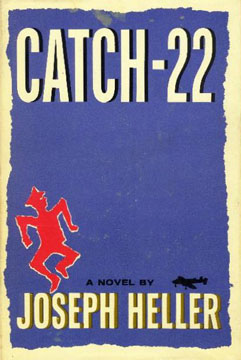
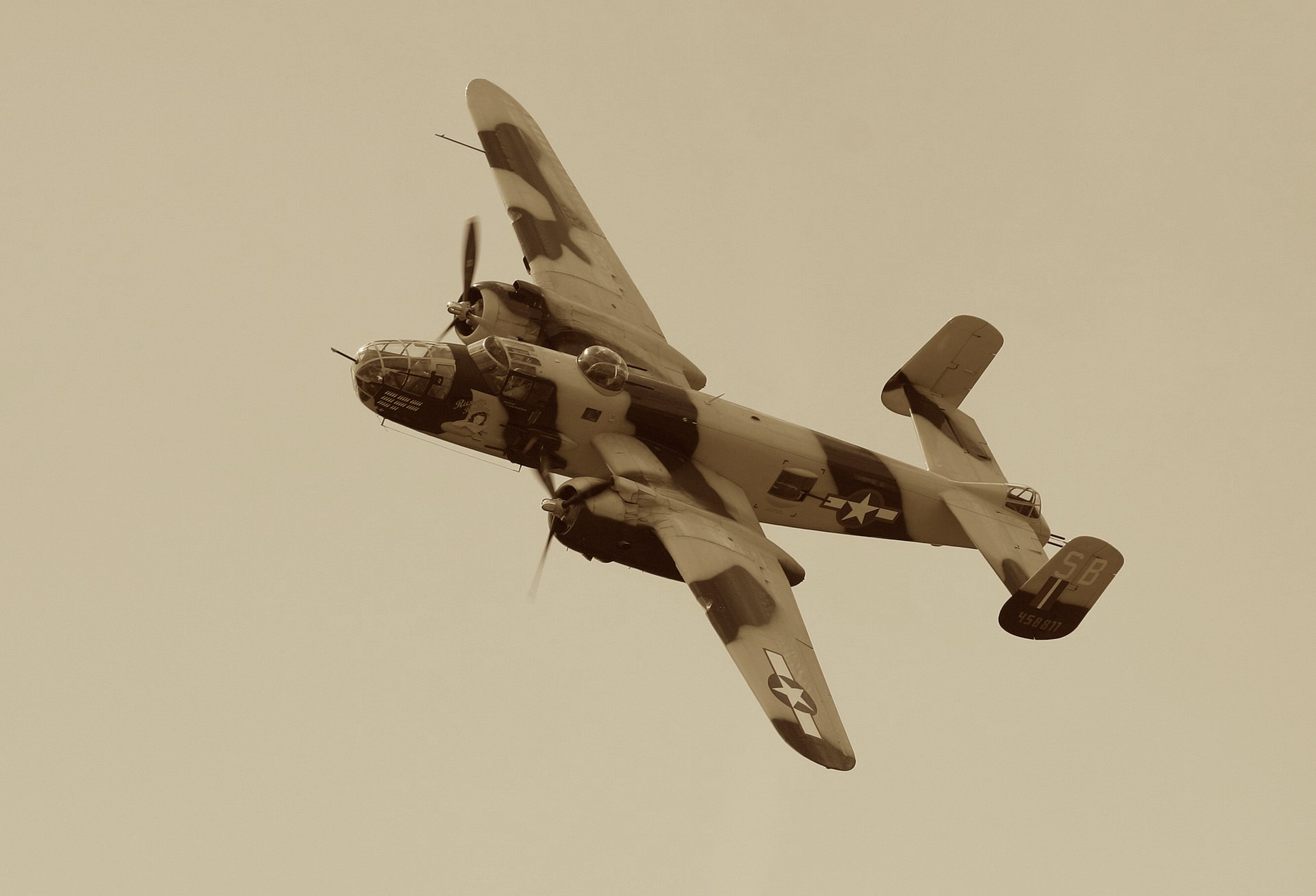
『キャッチ22』は、アメリカの現代小説 家ジョセフ・ヘラー(Joseph Heller, 1923-1999)の1961年の作品。キャッチとは、落とし穴や罠のことで、22は小説の中にでてく る奇妙な軍規(military rule)のことである。小説の舞台は、第二次大戦中の地中海のイタリアの島ピアノサ。そこにはアメリカ空軍のB-25爆 撃機(North American Aviation会社製)の256大隊の基地での、戦 争にまつわる人間の非理性や醜さ、奇妙さを巧妙に描いたもので、現在ではアメリカ文化の古典になっている。
この中で、主人公のジョン・ヨッサリアン (John Joseph Yossarian)は、自分が精神障害(=狂気)であることを理由に除隊を申し入れるが、上官は自分が精神障害だと言えるのは、まだ精神障害ではない証 拠とされて、除隊は永遠にできないことになる。
このことから、絶対に自分の主張が通らな い論理や、ダブルバインド(=2つの相反する要求のもとで、意思決定をする人が2つの論理に宙づりにさ れること)状態のことを、キャッチ22と呼ばれるようになった。
A Catch-22 is a paradoxical
situation from which an individual cannot escape because of
contradictory rules or limitations #Wiki.
There was only one catch and that was Catch-22, which specified that a concern for one's safety in the face of dangers that were real and immediate was the process of a rational mind. Orr was crazy and could be grounded. All he had to do was ask; and as soon as he did, he would no longer be crazy and would have to fly more missions. Orr would be crazy to fly more missions and sane if he didn't, but if he were sane he had to fly them. If he flew them he was crazy and didn't have to; but if he didn't want to he was sane and had to. Yossarian was moved very deeply by the absolute simplicity of this clause of Catch-22 and let out a respectful whistle. (p. 56, ch. 5)
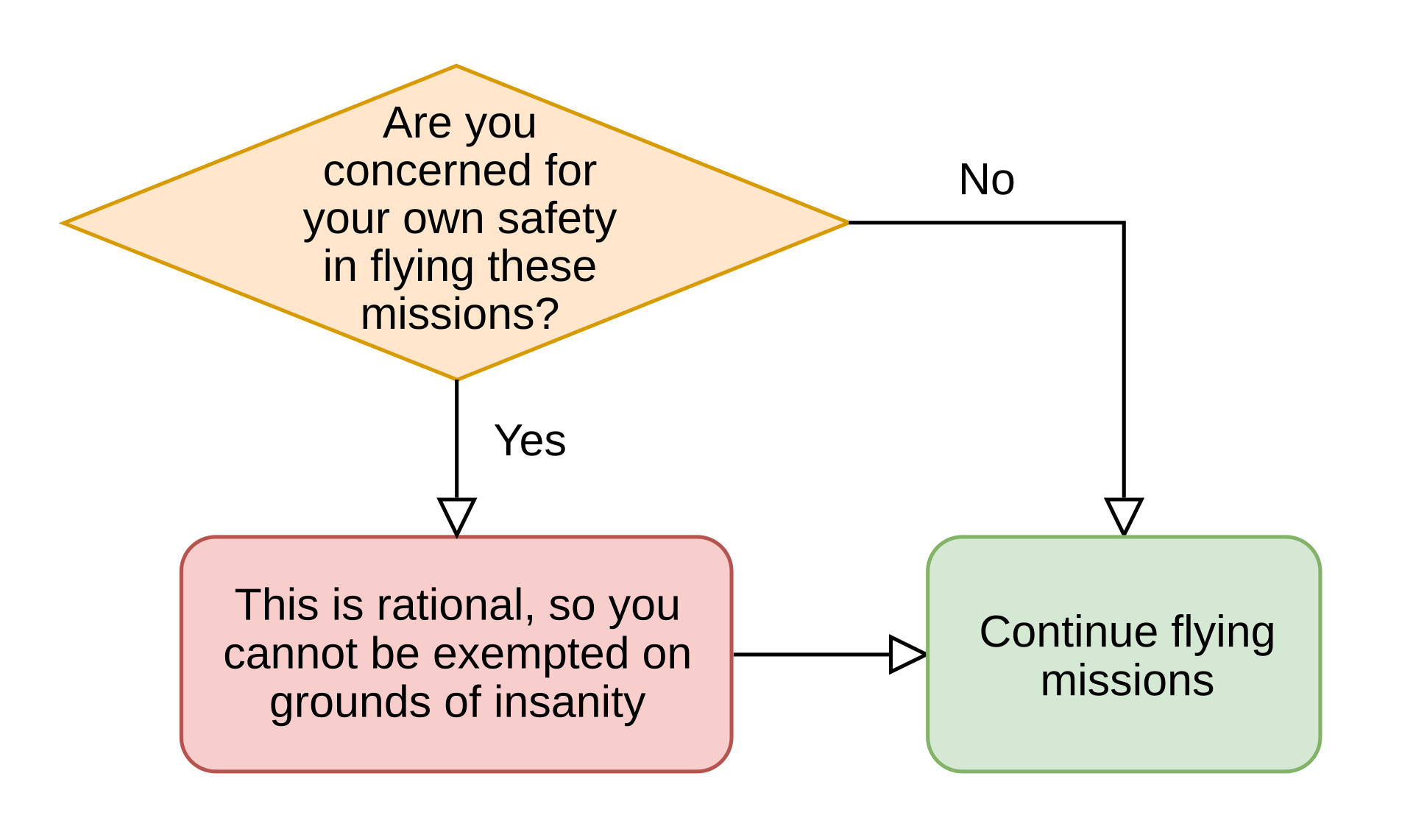
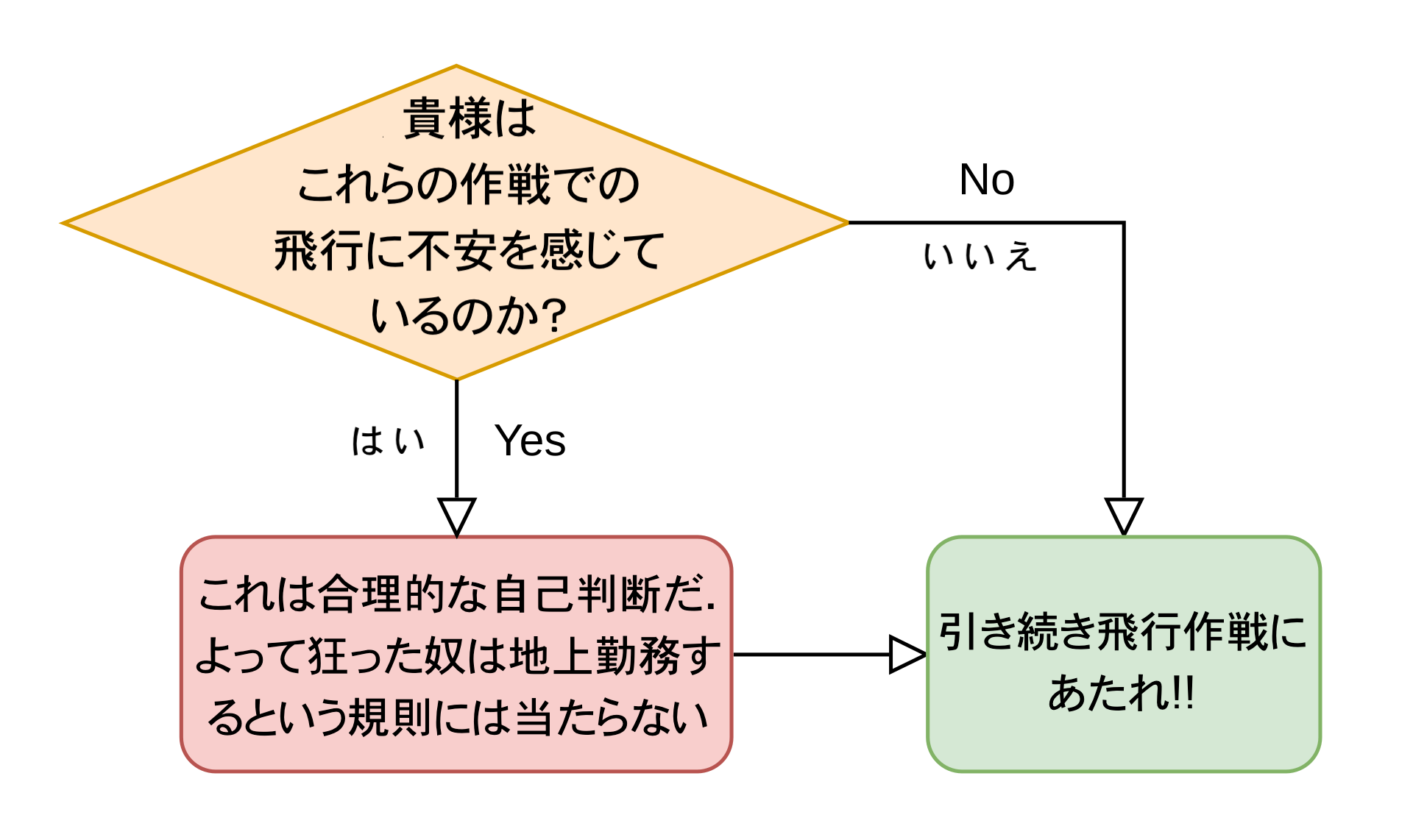
A flowchart showing Joseph Heller's original Catch-22
| A catch-22 is a
paradoxical situation from which an individual cannot escape because of
contradictory rules or limitations.[1] The term was first used by
Joseph Heller in his 1961 novel Catch-22. Catch-22s often result from rules, regulations, or procedures that an individual is subject to, but has no control over, because to fight the rule is to accept it. Another example is a situation in which someone is in need of something that can only be had by not being in need of it (e.g., the only way to qualify for a loan is to prove to the bank that you do not need a loan). One connotation of the term is that the creators of the "catch-22" situation have created arbitrary rules in order to justify and conceal their own abuse of power. |
キャッチ・トゥエンティトゥーとは、矛盾した規則や制約のために個人が
抜け出せない逆説的な状況のことである。[1]
この用語は、ジョセフ・ヘラーが1961年に発表した小説『キャッチ・トゥエンティトゥー』で初めて使用された。 キャッチ・トゥエンティトゥーは、個人が従わなければならないが、その規則に異議を唱えることはすなわちそれを受け入れることになるため、個人がコント ロールできない規則、規制、または手続きから生じることが多い。別の例としては、あるものを必要としている人が、それを手に入れるためには、そのものを必 要としていないことを証明しなければならないという状況が挙げられる(例:融資の審査に通る唯一の方法は、銀行に対して融資を必要としていないことを証明 することである)。この用語には、「キャッチ・22」という状況を仕組んだ者たちが、自らの権力乱用を正当化し、隠蔽するために恣意的な規則を作り出した という含意もある。 |
| Origin and meaning Joseph Heller coined the term in his 1961 novel Catch-22, which describes absurd bureaucratic constraints on soldiers in World War II. The term is introduced by the character Doc Daneeka, an army surgeon who invokes "Catch-22" to explain why any pilot requesting mental evaluation for insanity—hoping to be found not sane enough to fly and thereby escape dangerous missions—demonstrates his own sanity in creating the request and thus cannot be declared insane. This phrase also means a dilemma or difficult circumstance from which there is no escape because of mutually conflicting or dependent conditions.[2] "You mean there's a catch?" "Sure there's a catch," Doc Daneeka replied. "Catch-22. Anyone who wants to get out of combat duty isn't really crazy." There was only one catch and that was Catch-22, which specified that a concern for one's own safety in the face of dangers that were real and immediate was the process of a rational mind. Orr was crazy and could be grounded. All he had to do was ask; and as soon as he did, he would no longer be crazy and would have to fly more missions. Orr would be crazy to fly more missions and sane if he didn't, but if he was sane, he had to fly them. If he flew them, he was crazy and didn't have to; but if he didn't want to, he was sane and had to. Yossarian was moved very deeply by the absolute simplicity of this clause of Catch-22 and let out a respectful whistle. Different formulations of "Catch-22" appear in the novel. The term is applied to loopholes and quirks of the military system, always with the implication that rules are inaccessible to and slanted against those lower in the hierarchy. In chapter 6, Yossarian (the protagonist) is told that Catch-22 requires him to do anything his commanding officer tells him to do, regardless of whether these orders contradict orders from the officer's superiors.[3] In a final episode, Catch-22 is described to Yossarian by an old woman recounting an act of violence by soldiers, "Catch-22 says they have a right to do anything we can't stop them from doing." "What the hell are you talking about?" Yossarian shouted at her in bewildered, furious protest. "How did you know it was Catch-22? Who the hell told you it was Catch-22?" "The soldiers with the hard white hats and clubs. The girls were crying. 'Did we do anything wrong?' they said. The men said no and pushed them away out the door with the ends of their clubs. 'Then why are you chasing us out?' the girls said. 'Catch-22,' the men said. All they kept saying was 'Catch-22, Catch-22.' What does it mean, Catch-22? What is Catch-22?" "Didn't they show it to you?" Yossarian demanded, stamping about in anger and distress. "Didn't you even make them read it?" "They don't have to show us Catch-22," the old woman answered. "The law says they don't have to." "What law says they don't have to?" "Catch-22."[4][5] According to literature professor Ian Gregson, the old woman's narrative defines "Catch-22" more directly as the "brutal operation of power", stripping away the "bogus sophistication" of the earlier scenarios.[6] |
由来と意味 ジョセフ・ヘラーは、第二次世界大戦の兵士たちに対する不条理な官僚的制約を描いた1961年の小説『キャッチ・22』の中で、この用語を造語した。この 用語は、軍医のドク・ダニカという登場人物によって導入された。彼は、精神鑑定を申請するパイロットについて、「キャッチ-22」を用いて次のように説明 する。つまり、飛行に適さないほど正気ではないと判定され、それによって危険な任務から逃れたいと願うパイロットは、その申請を行うという行為そのものが 正気であることを示しており、したがって正気ではないと宣言することはできないのだ。このフレーズはまた、互いに矛盾したり依存し合ったりする条件のため に、逃げ道のないジレンマや困難な状況を意味する。[2] 「つまり、落とし穴があるってことか?」 「もちろんだ」とドク・ダニカは答えた。「キャッチ-22だ。戦闘任務から逃れたいと思う者は、実際には正気なのだ。」 落とし穴はただ一つ、それがキャッチ-22だった。それは、現実的かつ差し迫った危険に直面して自身の安全を気遣う行為こそが、理性的な精神の表れである と規定していた。オアは狂っており、飛行停止処分にできる。彼に求められるのはただ申し出るだけだった。しかし、申し出た途端、彼はもはや狂人ではなくな り、さらなる任務を遂行しなければならなくなる。さらなる任務を遂行すればオアは狂人となり、遂行しなければ正気となる。だが、正気であれば任務を遂行し なければならない。任務を遂行すれば、彼は狂人であり、遂行する必要はない。しかし、遂行したくないのであれば、彼は正気であり、遂行しなければならな い。ヨサリアンは、『キャッチ-22』のこの条項の絶対的な単純さに深く心を動かされ、敬意を表して口笛を吹いた。 小説の中では、異なる表現の「キャッチ-22」が登場する。この用語は、軍隊制度の抜け穴や奇妙な点に用いられ、常に、規則が階層の下位にいる者には理解 不能であり、彼らに不利に働くという含意を伴っている。第6章で、ヨサリアン(主人公)は、キャッチ-22によって、たとえその命令が上官の上司からの命 令と矛盾していても、指揮官が命じることは何でもしなければならないと告げられる。[3] 最終話で、兵士たちによる暴力行為を語る老婆が、ヨサリアンにキャッチ-22についてこう説明する。 「キャッチ-22ってやつは、俺たちが止められないことなら、奴らには何でもする権利があるって言うのよ」 「一体何の話だ?」ヨサリアンは困惑と怒りを込めて彼女に叫んだ。「どうしてそれがキャッチ-22だと分かったんだ? 一体誰がそう言ったんだ?」 「白い硬い帽子と警棒を持った兵士たちよ。女の子たちは泣いていた。『私たち、何か悪いことした?』と彼女たちは言った。男たちは『いいや』と言い、警棒 の先で彼女たちをドアの外へ押し出した。『じゃあ、なんで追い出すの?』と少女たちは言った。『キャッチ・22だ』と男たちは言った。彼らが口にしたのは 『キャッチ・22、キャッチ・22』だけだった。キャッチ・22って何の意味? キャッチ・22って何?」 「見せてくれなかったのか?」ヨサリアンは怒りと苦悩に身を震わせながら詰め寄った。「せめて読ませるようにはしなかったのか?」 「『キャッチ・22』を見せてくれる義務なんてないのよ」老婆は答えた。「法律でそう定められているから」 「どの法律が、見せる必要はないと言っているんだ?」 「キャッチ・22よ。」[4][5] 文学教授のイアン・グレグソンによれば、老女の語り口は「キャッチ・22」を、以前のシナリオに見られた「見せかけの洗練さ」を剥ぎ取り、「権力の残酷な行使」としてより直接的に定義づけているという。[6] |
| Other appearances in the novel Besides referring to an unsolvable logical dilemma, Catch-22 is invoked to explain or justify the military bureaucracy. In the first chapter, it requires Yossarian to sign his name to letters he censors while he is confined to a hospital bed. One clause mentioned in chapter 10 closes a loophole in promotions, which one private had been exploiting to re-attain the attractive rank of private first class after any promotion. Through courts-martial for going AWOL, he would be busted back to private but Catch-22 limited the number of times he could do this before being sent to the stockade. At another point in the book, a prostitute explains to Yossarian that she cannot marry him because he is crazy, and she will never marry a crazy man. She considers any man crazy who would marry a woman who is not a virgin. This closed logic loop clearly illustrated Catch-22 because by her logic, all men who refuse to marry her are sane and thus she would consider marriage; but as soon as a man agrees to marry her, he becomes crazy for wanting to marry a non-virgin, and is instantly rejected. Captain Black attempts to press Milo into depriving Major Major of food as a consequence of not signing a loyalty oath that Major Major was never given an opportunity to sign in the first place. Captain Black asks Milo, "You're not against Catch-22, are you?" In chapter 40, Catch-22 forces Colonels Korn and Cathcart to promote Yossarian to Major and ground him rather than simply sending him home. They fear that if they do not, others will refuse to fly, just as Yossarian did. |
小説におけるその他の登場 『キャッチ・22』は、解決不可能な論理的ジレンマを指すだけでなく、軍隊の官僚機構を説明したり正当化したりするためにも用いられている。第1章では、 病院のベッドに寝たきりのヨサリアンに対し、自身が検閲した手紙に署名するよう要求する場面がある。第10章で言及されるある条項は、昇進に関する抜け穴 を塞ぐものであり、ある二等兵はこれを利用して、昇進するたびに魅力的な一等兵の階級を取り戻していた。無断欠勤による軍法会議を経て、彼は二等兵に降格 されることになるが、「キャッチ-22」により、拘置所に送られるまでの間にこの行為を繰り返せる回数が制限されていた。 また、別の場面では、ある娼婦がヨサリアンに対し、彼は頭がおかしいから結婚できない、そして自分は頭のおかしい男とは決して結婚しないと説明する。彼女 は、処女ではない女性と結婚しようとする男は皆、頭がおかしいと考えているのだ。この閉じた論理のループは、まさに『キャッチ・22』を如実に示してい た。彼女の論理によれば、彼女との結婚を拒む男は皆正気であり、したがって彼女は結婚を真剣に考えることになる。しかし、男が結婚に同意した途端、処女で はない女性と結婚しようとする彼は狂人となり、即座に拒絶されるのだ。 ブラック大尉は、そもそも署名する機会さえ与えられていなかった忠誠宣誓書に署名しなかったという理由で、マイナー・メジャー少佐の食糧を剥奪するよう、 マイロに強要しようとする。ブラック大尉はマイロにこう問いかける。「お前は『キャッチ-22』に反対なんじゃないだろうな?」 第40章で、『キャッチ-22』はコーン大佐とキャスカート大佐に、ヨサリアンを少佐に昇進させ、単に帰国させるのではなく飛行禁止処分にするよう強いる。彼らは、そうしなければ、ヨサリアンがそうしたように、他の者たちも飛行を拒否するのではないかと恐れているのだ。 |
| Significance of the number 22 Main articles: Catch-22 § Title, and Catch-22 Heller originally wanted to call the phrase (and hence, the book) by other numbers, but he and his publishers eventually settled on 22. The number has no particular significance; it was chosen more or less for euphony. The title was originally Catch-18, but Heller changed it after the popular Mila 18 was published a short time beforehand.[7][8] |
数字の22の意義 主な記事:『キャッチ・22』 § タイトル、および『キャッチ・22』 ヘラーは当初、このフレーズ(ひいては本書)に別の数字をタイトルとして付けようと考えていたが、彼と出版社は最終的に22に落ち着いた。この数字に特別 な意味はない。ほぼ響きの良さだけで選ばれたものだ。タイトルは当初『キャッチ-18』だったが、人気作『ミラ18』が直前に出版されたため、ヘラーは変 更した。[7][8] |
| Usage The term "catch-22" has filtered into common usage in the English language. In a 1975 interview, Heller said the term would not translate well into other languages.[8] James E. Combs and Dan D. Nimmo suggest that the idea of a "catch-22" has gained popular currency because so many people in modern society are exposed to frustrating bureaucratic logic. They write of the rules of high school and colleges that: This bogus democracy that can be overruled by arbitrary fiat is perhaps a citizen's first encounter with organizations that may profess 'open' and libertarian values, but in fact are closed and hierarchical systems. Catch-22 is an organizational assumption, an unwritten law of informal power that exempts the organization from responsibility and accountability, and puts the individual in the absurd position of being excepted for the convenience or unknown purposes of the organization.[5] Along with George Orwell's "doublethink", "catch-22" has become one of the best-recognized ways to describe the predicament of being trapped by contradictory rules.[9] A significant type of definition of alternative medicine has been termed a catch-22. In a 1998 editorial co-authored by Marcia Angell, a former editor of the New England Journal of Medicine, argued that: It is time for the scientific community to stop giving alternative medicine a free ride. There cannot be two kinds of medicine—conventional and alternative. There is only medicine that has been adequately tested and medicine that has not, medicine that works and medicine that may or may not work. Once a treatment has been tested rigorously, it no longer matters whether it was considered alternative at the outset. If it is found to be reasonably safe and effective, it will be accepted. But assertions, speculation, and testimonials do not substitute for evidence. Alternative treatments should be subjected to scientific testing no less rigorous than that required for conventional treatments.[10] This definition has been described by Robert L. Park as a logical catch-22 which ensures that any complementary and alternative medicine (CAM) method which is proven to work "would no longer be CAM, it would simply be medicine."[11] U.S. Circuit Judge Don Willett referred to qualified immunity, which requires a violation of constitutional rights to have been previously established in order for a victim to claim damages, as a catch-22: "Section 1983 meets Catch-22. Important constitutional questions go unanswered precisely because those questions are yet unanswered. Courts then rely on that judicial silence to conclude there's no equivalent case on the books. No precedent = no clearly established law = no liability. An Escherian Stairwell. Heads government wins, tails plaintiff loses."[12][13] |
用法 「キャッチ・22」という用語は、英語の一般的な用法として定着している。1975年のインタビューで、ヘラーはこの用語は他の言語にはうまく翻訳できないと述べた。[8] ジェームズ・E・コムとダン・D・ニモは、「キャッチ-22」という概念が広く普及したのは、現代社会において多くの人々が苛立たしい官僚的論理にさらされているからだと指摘している。彼らは高校や大学の規則について次のように書いている。 恣意的な決定によって覆されることのあるこの偽りの民主主義は、おそらく市民が初めて直面する組織のあり方である。そうした組織は『開放的』で自由主義的 な価値観を標榜しているが、実際には閉鎖的で階層的なシステムなのである。「キャッチ-22」とは、組織の前提条件であり、組織を責任や説明責任から免除 し、個人の都合や組織の不明確な目的のために個人を例外扱いするという、非公式な権力の不文律である。[5] ジョージ・オーウェルの「ダブルシンク」と並んで、「キャッチ-22」は、矛盾した規則に囚われた苦境を表す最もよく知られた表現の一つとなっている。[9] 代替医療の定義における重要な類型の一つが、キャッチ-22と呼ばれている。『ニューイングランド・ジャーナル・オブ・メディシン』の元編集長であるマーシア・アンジェルが共同執筆した1998年の論説では、次のように主張された: 科学界は、代替医療を甘やかすのをやめるべき時が来ている。医療に「従来型」と「代替」という二種類があるはずがない。あるのは、十分に検証された医療と そうでない医療、効果がある医療と効果があるかどうかわからない医療だけである。治療法が厳格に検証されれば、当初それが代替医療と見なされていたかどう かはもはや問題ではない。それが合理的に安全かつ有効であると判明すれば、受け入れられることになる。しかし、主張や推測、体験談は証拠の代わりにはなら ない。代替療法は、従来の治療法に求められるものと同等かそれ以上の厳格さをもって科学的検証を受けるべきである。[10] この定義について、ロバート・L・パークは、効果が証明されたあらゆる補完・代替医療(CAM)の手法が「もはやCAMではなく、単なる医療となる」ことを保証する論理的なキャッチ22であると述べている。[11] 米連邦巡回裁判所のドン・ウィレット判事は、被害者が損害賠償を請求するためには、憲法上の権利の侵害が事前に立証されている必要があるとする「限定的免 責」を、キャッチ22に例えて言及した: 「第1983条は『キャッチ22』に直面している。重要な憲法上の疑問が未解決のままであるのは、まさにそれらの疑問が未だ解明されていないからに他なら ない。裁判所は、その司法上の沈黙を根拠に、判例法上、同等の事例が存在しないと結論付ける。判例なし=明確に確立された法なし=責任なし。エッシャー的 な階段だ。表なら政府が勝ち、裏なら原告が負ける。」[12][13] |
| Logic The archetypal catch-22, as formulated by Joseph Heller, involves the case of John Yossarian, a U.S. Army Air Forces bombardier, who wishes to be grounded from combat flight. This will only happen if he is evaluated by the squadron's flight surgeon and found "unfit to fly". "Unfit" would be any pilot who is willing to fly such dangerous missions, as one would have to be mad to volunteer for possible death. To be evaluated, he must request the evaluation, an act that is considered sufficient proof for being declared sane. These conditions make it impossible to be declared "unfit". The "Catch-22" is that "anyone who wants to get out of combat duty isn't really crazy".[14] Pilots who request a mental fitness evaluation are sane, and therefore must fly in combat. At the same time, if an evaluation is not requested by the pilot, he will never receive one and thus can never be found insane, meaning he must also fly in combat. Catch-22 ensures that no pilot can ever be grounded for being insane even if he is. A logical formulation of this situation is: 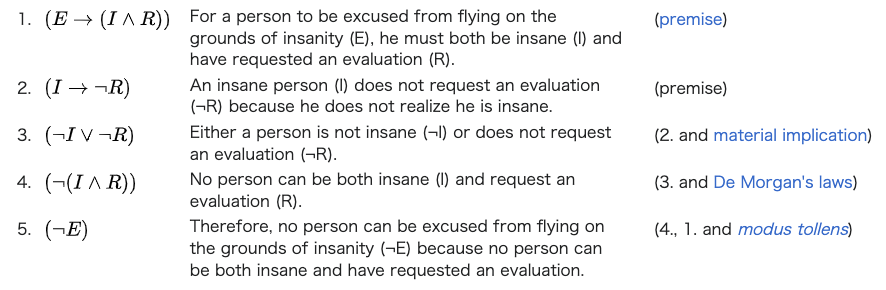 Therefore, no person can be excused from flying on the grounds of insanity (¬E) because no person can be both insane and have requested an evaluation. (4., 1. and modus tollens) The philosopher Laurence Goldstein argues that the "airman's dilemma" is logically not even a condition that is true under no circumstances; it is a "vacuous biconditional" that is ultimately meaningless. Goldstein writes:[15] The catch is this: what looks like a statement of the conditions under which an airman can be excused flying dangerous missions reduces not to the statement (i) 'An airman can be excused flying dangerous missions if and only if Cont' (where 'Cont' is a contradiction) (which could be a mean way of disguising an unpleasant truth), but to the worthlessly empty announcement (ii) 'An airman can be excused flying dangerous missions if and only if it is not the case that an airman can be excused flying dangerous missions' If the catch were (i), that would not be so bad—an airman would at least be able to discover that under no circumstances could he avoid combat duty. But Catch-22 is worse—a welter of words that amounts to nothing; it is without content, it conveys no information at all. |
論理 ジョセフ・ヘラーが描いた典型的な「キャッチ・22」とは、米陸軍航空軍の爆撃手ジョン・ヨサリアンが、戦闘飛行から外れることを望んでいるという事例で ある。彼が戦闘飛行から外れるには、飛行隊の軍医による診断を受け、「飛行不適格」と判定される必要がある。「飛行不適格」とは、そのような危険な任務に 志願するパイロットのことだ。死の危険を冒してまで志願する者は、正気ではないとみなされるからだ。しかし、評価を受けるには本人が評価を申請しなければ ならない。その行為自体が、正気であることの十分な証拠とみなされるのだ。こうした条件により、「飛行不適格」と認定されることは不可能となる。 「キャッチ・22」とは、「戦闘任務から抜け出したいと願う者は、実際には正気である」ということだ。[14] 精神適性検査を申請するパイロットは正気であり、したがって戦闘任務に就かなければならない。同時に、パイロットが検査を申請しなければ、検査を受けるこ とは決してなく、したがって正気でないとは判定されず、つまり彼もまた戦闘任務に就かなければならない。キャッチ-22は、たとえ正気でなかったとして も、パイロットが正気でないことを理由に飛行停止処分を受けることが決してないことを保証している。 この状況の論理的定式化は以下の通りである: 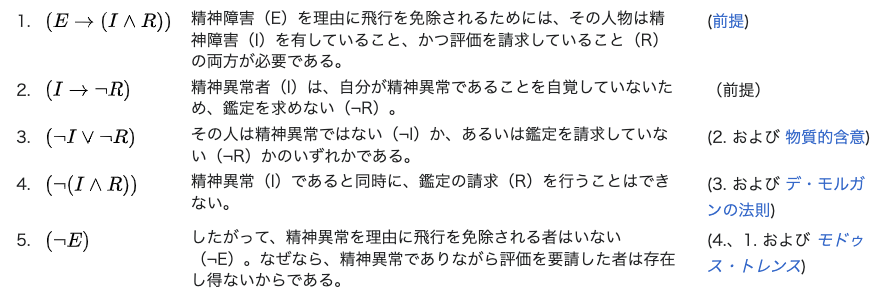 したがって、精神異常でありながら評価を請求した人格は存在し得ないため、精神異常を理由に飛行を免除される人格はいない(¬E)。 (4.、1. およびモダス・トレンス) 哲学者ローレンス・ゴールドスタインは、「飛行士のジレンマ」は論理的にはいかなる状況下でも真となる条件ですらないと論じている。それは究極的には無意味な「空虚な双条件」である。ゴールドスタインは次のように書いている[15] 肝心な点はここだ。飛行士が危険な任務の飛行を免除される条件を述べたように見えるこの文は、次の文に還元される (i) 「空軍兵が危険な任務の飛行を免除されるのは、かつ、かつ、Cont(ここで『Cont』は矛盾である)の場合に限る」 (これは不快な真実を巧妙に隠す手段となり得る)という命題ではなく、無価値で空虚な宣言 (ii) 「空軍兵が危険な任務の飛行を免除されるのは、かつ、かつ、空軍兵が危険な任務の飛行を免除されることがあり得ない場合に限る」 もしその落とし穴が(i)であれば、それほど悪くはなかっただろう――飛行士は少なくとも、いかなる状況下でも戦闘任務を回避できないことを知ることがで きただろう。しかし『キャッチ22』はそれよりも悪い――何の意味もなさない言葉の羅列であり、内容がなく、情報を全く伝えていないのだ。 |
| Begging the question Circular reasoning Cornelian dilemma Deadlock Double bind False dilemma Feedback loop Godel's incompleteness theorem Hobson's choice – taking what is offered or taking nothing Ironic process theory Kobayashi Maru – a choice presented in Star Trek "The Lady, or the Tiger?" – a no-win situation List of paradoxes Morton's fork Mu Ninety–ninety rule No-win situation Pyrrhic victory Self-reference Social trap Strange loop Vicious circle Wicked problem Zugzwang |
循環論法 同語反復 コルネリアンのジレンマ デッドロック ダブルバインド 偽の二者択一 フィードバックループ ゲーデルの不完全性定理 ホブソンの選択 ― 提示されたものを受け入れるか、何も受け入れないか アイロニック・プロセス理論 コバヤシ・マル ― 『スタートレック』に登場する選択 「女か、虎か?」――八方塞がりの状況 パラドックスの一覧 モートンの二択 ム 90-90の法則 八方塞がりの状況 ピルリクスの勝利 自己言及 社会的罠 ストレンジ・ループ 悪循環 難解な問題 ツークツヴァング |
| References 01. Largest Idioms Dictionary, The Idioms. "Catch 22 meaning". Theidioms.com. Retrieved 12 May 2020. Beidler, Philip D. (1995). Scriptures for a Generation: What We Were Reading in the '60s. University of Georgia Press. p. 162. ISBN 978-0820317878. It is Catch-22: Dr. Daneeka explains how anybody who is crazy has a right to ask to be removed from combat status but how anybody who asks is revealing a rational concern for his own safety that makes him not crazy; Margot A. Henriksen, Dr. Strangelove's America: Society and Culture in the Atomic Age; University of California Press, 1997; ISBN 0-520-08310-5; p. 250. "Joseph Heller", Gale Encyclopedia of Biography, accessed via Answers.com, 16 August 2013. James E. Combs & Dan D. Nimmo, The Comedy of Democracy; Westport, CT: Praeger (Greenwood Publishing Group), 1996; ISBN 0-275-94979-6; p. 152. Ian Gregson, Character and Satire in Post War Fiction; London: Continuum, 2006; ISBN 978-1441130006; p. 38. Aldridge, John W. (1986-10-26). "The Loony Horror of it All – 'Catch-22' Turns 25". The New York Times. p. Section 7, Page 3, Column 1. Retrieved 2011-01-09. "A classic by any other name", The Telegraph, 18 November 2007. Richard King, "22 Going on 50: Half a century later, the world is full of Catch-22s"; The Smart Set, 20 July 2011. 10. Angell, M.; et al. (1998). "Alternative medicine – The risks of untested and unregulated remedies". New England Journal of Medicine. 339 (12): 839–841. CiteSeerX 10.1.1.694.9581. doi:10.1056/NEJM199809173391210. PMID 9738094. Park, Robert L., Alternative Medicine: The Clinton Commission's Catch-22. Archived 2016-03-04 at the Wayback Machine Ford, Matt (September 12, 2018). "Should Cops Be Immune From Lawsuits?". The New Republic. Archived from the original on November 26, 2019. Retrieved November 25, 2019. Zadeh v. Robinson, 902 F.3d 483 (5th Cir. 2018). Heller, Joseph (1999). Catch-22: A Novel. Simon and Schuster. p. 52. ISBN 978-0-684-86513-3. Retrieved 2011-01-09. 15. Goldstein, Laurence (2004). "The Barber, Russell's paradox, catch-22, God, contradiction and more: A defence of a Wittgensteinian conception of contradiction". In Priest, Graham; Beall, J. C.; Armour-Garb, Bradley (eds.). The law of non-contradiction: new philosophical essays. Oxford University Press. Retrieved June 25, 2023. |
参考文献 01. 『The Largest Idioms Dictionary』, The Idioms. 「Catch 22の意味」. Theidioms.com. 2020年5月12日閲覧。 Beidler, Philip D. (1995). 『Scriptures for a Generation: What We Were Reading in the '60s』. ジョージア大学出版局. p. 162. ISBN 978-0820317878。それは『キャッチ22』だ。ダニーカ博士は、狂っている者は誰でも戦闘任務からの除外を求める権利がある一方で、それを求 める者は自身の安全に対する合理的な懸念を示しており、それゆえに狂っていないのだと説明する。 マーゴット・A・ヘンリクセン、『ドクター・ストレンジラヴのアメリカ:原子時代の社会と文化』;カリフォルニア大学出版局、1997年;ISBN 0-520-08310-5;p. 250。 「ジョセフ・ヘラー」、『ゲイル人物事典』、Answers.com経由でアクセス、2013年8月16日。 ジェームズ・E・コムズ&ダン・D・ニモ、『民主主義の喜劇』;コネチカット州ウェストポート:プレージャー(グリーンウッド・パブリッシング・グループ)、1996年;ISBN 0-275-94979-6;p. 152。 イアン・グレグソン、『戦後小説における人物像と風刺』;ロンドン:コンティニュアム、2006年;ISBN 978-1441130006;38ページ。 オルドリッジ、ジョン・W. (1986年10月26日)。「そのすべてがもたらす狂気的な恐怖――『キャッチ-22』25周年」。『ニューヨーク・タイムズ』。p. 第7セクション、3ページ、1列目。2011年1月9日取得。 「他のどんな名前であれ、それは古典だ」、『テレグラフ』、2007年11月18日。 リチャード・キング、「22歳から50歳へ:半世紀が経ち、世界は『キャッチ・22』だらけだ」;『ザ・スマート・セット』、2011年7月20日。 10. アンジェル, M. 他 (1998). 「代替医療――未検証かつ規制されていない治療法のリスク」. 『ニューイングランド・ジャーナル・オブ・メディシン』. 339 (12): 839–841. CiteSeerX 10.1.1.694.9581. doi:10.1056/NEJM199809173391210. PMID 9738094. Park, Robert L., 『代替医療:クリントン委員会のキャッチ-22』. 2016年3月4日、Wayback Machineにてアーカイブ Ford, Matt (2018年9月12日). 「警察官は訴訟免責であるべきか?」。The New Republic。2019年11月26日にオリジナルからアーカイブされた。2019年11月25日に閲覧。 Zadeh v. Robinson, 902 F.3d 483 (第5巡回区控訴裁判所 2018年)。 ヘラー、ジョセフ(1999年)。『キャッチ・22:小説』。サイモン・アンド・シュスター。52頁。ISBN 978-0-684-86513-3。2011年1月9日に閲覧。 15. ゴールドスタイン、ローレンス(2004年)。「理髪師、ラッセルのパラドックス、キャッチ-22、神、矛盾、そしてその他:ウィトゲンシュタイン的矛盾 概念の擁護」。Priest, Graham; Beall, J. C.; Armour-Garb, Bradley (編). 『矛盾律:新しい哲学的エッセイ』. オックスフォード大学出版局。2023年6月25日閲覧。 |
| https://en.wikipedia.org/wiki/Catch-22_(logic) |
リンク
文献
その他の情報
Copyleft, CC, Mitzub'ixi Quq Chi'j, 1996-2099
Copyleft,
CC, Mitzub'ixi Quq Chi'j, 1996-2099