

哲学としてのバイオセキュリティ
Biosecurity as
Philosophy
A
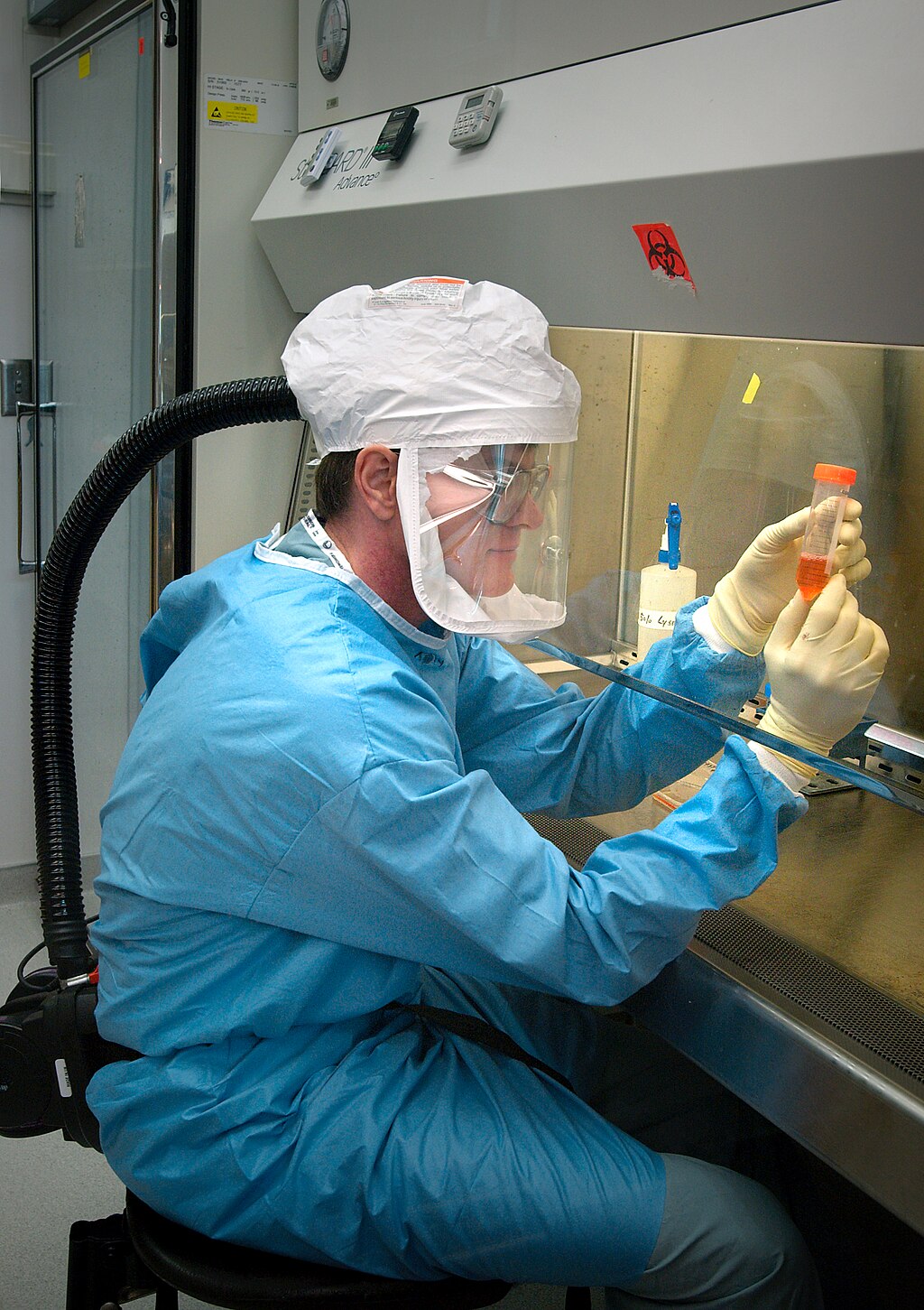
microbiologist working on the reconstructed virus of the 1918 Spanish
Flu, using a fume hood for biocontainment.
☆バイオセキュリティ[Biosecurity]とは、有害な生物(ウイルス、細菌、植物、動物など)が、意図的または意図せず、その原産地以外の地域や新たな環境へ持ち込まれることや拡散することを防ぐための措置を指す。 農業分野では、これらの措置は、食糧作物や家畜を、害虫、外来種、および人類の福祉に資さないその他の生物から保護することを目的としている。この用語に は、パンデミックやバイオテロリズムによるものを含む、人間に対する生物学的脅威も含まれる。定義は時に他の概念まで含めるよう拡大され、文脈によって異 なる目的で使用される。 COVID-19のパンデミックは、世界中のすべての国でバイオセキュリティ対策が必要とされた脅威の最近の例である。
★哲学としてのバイオセキュリティ[biosecurity as philosophy]とは、バイオポリティクスの一領域としてのバイオセキュリティがもつイデオロギー的効果について考え、バイオセキュリティ下状態[under the condition of bioseculity]における人間主体のあり方の変化について考察する学問分野のことである。
「バイオセキュリティ体制において民主主義的な政治パラダイムがいかに深刻な変容を被ったか……。ブルジョア民主主義においては、すべての市民は「健康 権」をもっていました。この権利がいまや、人々の気づかぬうちに、いかなる対価を払っても果たすべき、健康への法的義務へと傾斜しています」(アガンベン 2021:142)
| Biosecurity refers
to measures aimed at preventing the introduction or spread of harmful
organisms (e.g. viruses, bacteria, plants, animals etc.) intentionally
or unintentionally outside their native range or within new
environments. In agriculture, these measures are aimed at protecting
food crops and livestock from pests, invasive species, and other
organisms not conducive to the welfare of the human population. The
term includes biological threats to people, including those from
pandemic diseases and bioterrorism. The definition has sometimes been
broadened to embrace other concepts, and it is used for different
purposes in different contexts. The COVID-19 pandemic is a recent example of a threat for which biosecurity measures have been needed in all countries of the world. |
バイオセキュリティとは、有害な生物(ウイルス、細菌、植物、動物な
ど)が、意図的または意図せず、その原産地以外の地域や新たな環境へ持ち込まれることや拡散することを防ぐための措置を指す。農業分野では、これらの措置
は、食糧作物や家畜を、害虫、外来種、および人類の福祉に資さないその他の生物から保護することを目的としている。この用語には、パンデミックやバイオテ
ロリズムによるものを含む、人間に対する生物学的脅威も含まれる。定義は時に他の概念まで含めるよう拡大され、文脈によって異なる目的で使用される。 COVID-19のパンデミックは、世界中のすべての国でバイオセキュリティ対策が必要とされた脅威の最近の例である。 |
| Background and terminology The term "biosecurity" has been defined differently by various disciplines. The term was first used by the agricultural and environmental communities to describe preventative measures against threats from naturally occurring diseases and pests, later expanded to introduced species. Australia and New Zealand, among other countries, had incorporated this definition within their legislation by 2010.[2] New Zealand was the earliest adopter of a comprehensive approach with its Biosecurity Act 1993. In 2001, the US National Association of State Departments of Agriculture (NASDA) defined biosecurity as "the sum of risk management practices in defense against biological threats", and its main goal as "protect[ing] against the risk posed by disease and organisms".[3] In 2010, the World Health Organization (WHO) provided an information note describing biosecurity as a strategic and integrated approach to analysing and managing relevant risks to human, animal and plant life and health and associated risks for the environment.[4] In another document, it describes the aim of biosecurity being "to enhance the ability to protect human health, agricultural production systems, and the people and industries that depend on them", with the overarching goal being "to prevent, control and/or manage risks to life and health as appropriate to the particular biosecurity sector".[5] Measures taken to counter biosecurity risks typically include compulsory terms of quarantine, and are put in place to minimise the risk of invasive pests or diseases arriving at a specific location that could damage crops and livestock as well as the wider environment.[6] In general, the term is today taken to include managing biological threats to people, industries or environment. These may be from foreign or endemic[clarification needed] organisms, but they can also extend to pandemic diseases and the threat of bioterrorism, both of which pose threats to public health.[6] |
背景と用語 「バイオセキュリティ」という用語は、分野によって異なる定義を持っている。この用語は当初、農業や環境分野において、自然発生する病気や害虫による脅威 に対する予防措置を表すために用いられたが、後に外来種への対策にも拡大された。オーストラリアやニュージーランドをはじめとする各国は、2010年まで にこの定義を国内法に盛り込んでいた。[2] ニュージーランドは、1993年の『バイオセキュリティ法』により、包括的なアプローチをいち早く採用した。2001年、米国州農業局協会(NASDA) は、バイオセキュリティを「生物学的脅威に対する防御のためのリスク管理手法の総体」と定義し、その主な目的を「疾病や生物がもたらすリスクからの保護」 とした。[3] 2010年、世界保健機関(WHO)は、バイオセキュリティを「人間、動物、植物の生命と健康、および環境に対する関連リスクを分析・管理するための戦略 的かつ統合的なアプローチ」と説明する情報ノートを発行した。[4] 別の文書では、バイオセキュリティの目的を「人間の健康、農業生産システム、およびそれらに依存する人々や産業を保護する能力を強化すること」とし、包括 的な目標を「特定のバイオセキュリティ分野に応じて、生命と健康に対するリスクを予防、抑制、および/または管理すること」としている。[5] バイオセキュリティ上のリスクに対抗するために講じられる措置には、通常、強制的な検疫条件が含まれ、作物や家畜、さらにはより広範な環境に損害を与える可能性のある侵入害虫や病気が特定の場所に到達するリスクを最小限に抑えるために実施される。[6] 一般に、今日この用語は、人、産業、または環境に対する生物学的脅威の管理を含むものと解釈されている。これらは外来または在来[説明が必要]の生物によるものだが、公衆衛生への脅威となるパンデミック疾患やバイオテロリズムの脅威にも及ぶことがある。[6] |
| Laboratory biosafety and intentional harm Main articles: Bioterrorism, Laboratory biosafety, and Biological weapons The definition has sometimes been broadened to embrace other concepts, and it is used for different purposes in different contexts. It can be defined as the "successful minimising of the risks that the biological sciences will be deliberately or accidentally misused in a way which causes harm for humans, animals, plants or the environment, including through awareness and understanding of the risks".[7] From the late 1990s, in response to the threat of biological terrorism, the term started to include the prevention of the theft of biological materials from research laboratories, called "laboratory biosecurity" by WHO.[2] The term laboratory biosafety refers to the measures taken "to reduce the risk of accidental release of or exposure to infectious disease agents", whereas laboratory biosecurity is usually taken to mean "a set of systems and practices employed in legitimate bioscience facilities to reduce the risk that dangerous biological agents will be stolen and used maliciously".[8] Joseph Kanabrocki (2017) source elaborates: "Biosafety focuses on protection of the researcher, their contacts and the environment via accidental release of a pathogen from containment, whether by direct release into the environment or by a laboratory-acquired infection. Conversely, biosecurity focuses on controlling access to pathogens of consequence and on the reliability of the scientists granted this access (thereby reducing the threat of an intentional release of a pathogen) and/or access to sensitive information related to a pathogen's virulence, host-range, transmissibility, resistance to medical countermeasures, and environmental stability, among other things".[9][10] In the US, the National Science Advisory Board on Biosecurity was created in 2004 to provide biosecurity oversight of "dual-use research", defined as "biological research with legitimate scientific purpose that may be misused to pose a biological threat to public health and/or national security". In 2006, the National Academy of Sciences defined biosecurity as "security against the inadvertent, inappropriate, or intentional malicious or malevolent use of potentially dangerous biological agents or biotechnology, including the development, production, stockpiling, or use of biological weapons as well as outbreaks of newly emergent and epidemic disease".[2] A number of nations have developed biological weapons for military use, and many civilian research projects in medicine have the potential to be used in military applications (dual-use research), so biosecurity protocols are used to prevent dangerous biological materials from falling into the hands of malevolent parties.[2] Laboratory program Components of a laboratory biosecurity program include:[8] Physical security Personnel security Material control and accountability Transport security Information security Program management Biological Security |
実験室のバイオセーフティと意図的な危害 主な記事:バイオテロリズム、実験室のバイオセーフティ、生物兵器 この定義は、他の概念も包含するように拡大されることがあり、文脈によって異なる目的で使用される。それは、「リスクに対する認識と理解を含め、生物科学 が意図的または偶発的に悪用され、人間、動物、植物、あるいは環境に危害を及ぼすリスクを効果的に最小限に抑えること」と定義できる。[7] 1990年代後半以降、生物テロの脅威に対応するため、この用語には研究施設からの生物試料の盗難防止も含まれるようになり、WHOはこれを「実験室バイ オセキュリティ」と呼んでいる。[2] 「実験室バイオセーフティ」という用語は、「感染症病原体の偶発的な放出や曝露のリスクを低減するための措置」を指すのに対し、「実験室バイオセキュリ ティ」は通常、「危険な生物剤が盗まれ悪用されるリスクを低減するために、正規の生物科学施設で採用される一連のシステムおよび慣行」を意味すると解釈さ れる。[8] ジョセフ・カナブロッキ(2017年)は次のように詳述している。「バイオセーフティは、封じ込め施設からの病原体の偶発的な放出(環境への直接放出であ れ、実験室内での感染であれ)を通じて、研究者、その接触者、および環境を保護することに焦点を当てている。これに対し、バイオセキュリティは、重大な影 響を及ぼす病原体へのアクセスを管理すること、およびそのアクセスを許可された科学者の信頼性を確保すること(それによって病原体の意図的な放出の脅威を 低減すること)、ならびに病原体の病原性、宿主範囲、伝播性、医療対策に対する耐性、環境安定性などに関連する機密情報へのアクセスを管理することに焦点 を当てている」。[9][10] 米国では、2004年に「デュアルユース研究」に対するバイオセキュリティの監督を行うため、国立バイオセキュリティ科学諮問委員会が設立された。「デュ アルユース研究」とは、「正当な科学的目的に基づく生物学的研究でありながら、公衆衛生および/または国家安全保障に対する生物学的脅威をもたらすために 悪用される可能性があるもの」と定義されている。2006年、米国科学アカデミーは、バイオセキュリティを「潜在的に危険な生物剤やバイオテクノロジー の、不注意、不適切、あるいは意図的な悪意ある使用に対する安全対策」と定義した。これには、生物兵器の開発、生産、備蓄、使用、ならびに新興感染症や流 行性疾患の発生が含まれる。[2] 多くの国が軍事利用を目的として生物兵器を開発しており、医学分野の多くの民間研究プロジェクトも軍事用途に転用される可能性がある(デュアルユース研 究)ため、危険な生物学的物質が悪意ある者の手に渡るのを防ぐために、バイオセキュリティプロトコルが用いられている。[2] 実験室プログラム 実験室バイオセキュリティプログラムの構成要素には以下が含まれる:[8] 物理的セキュリティ 人員セキュリティ 資材管理と責任追跡 輸送セキュリティ 情報セキュリティ プログラム管理 生物セキュリティ |
Animals and plants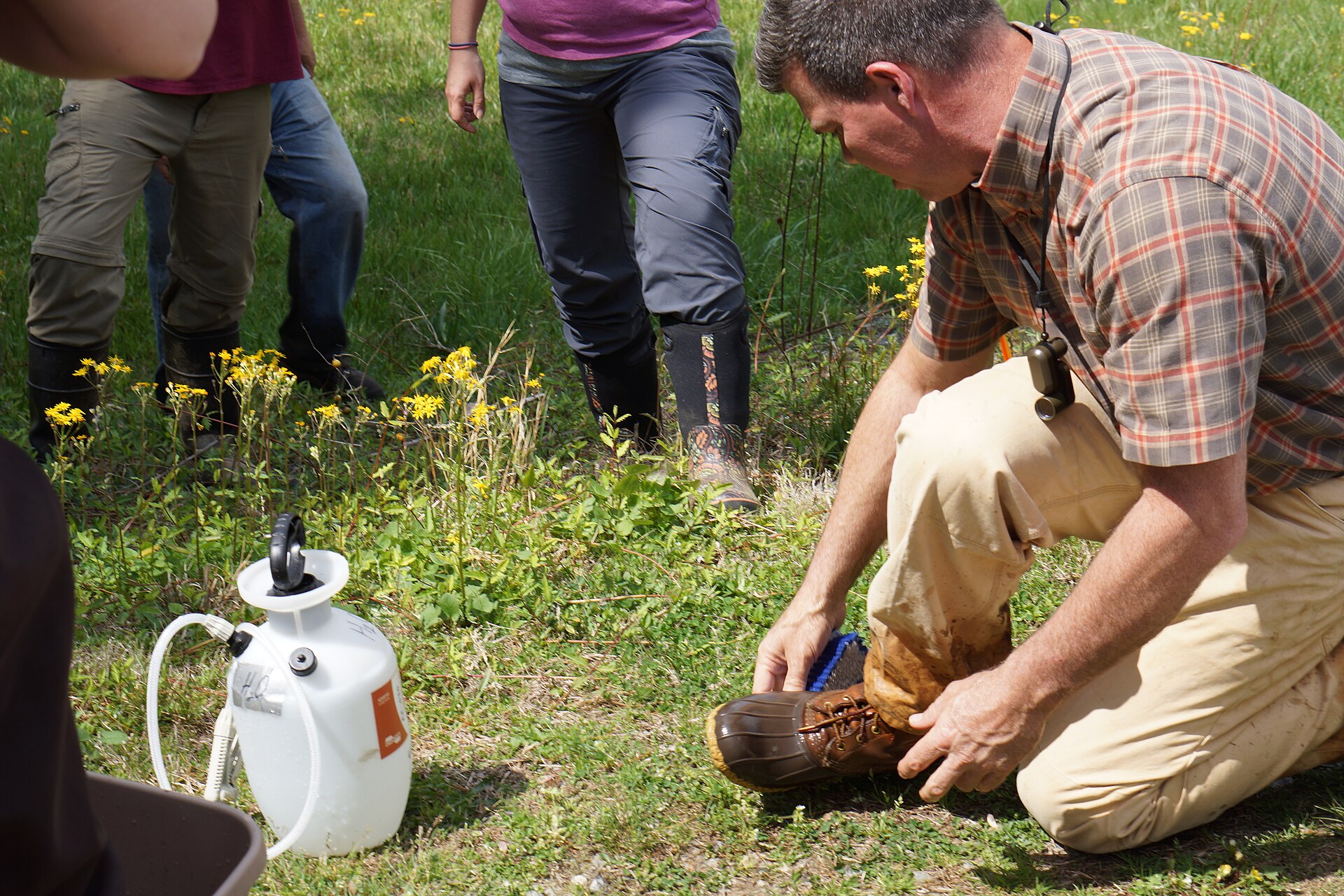 A biologist washing his boots to avoid contaminating a site with invasive species Threats to animals and plants, in particular food crops, which may in turn threaten human health, are typically overseen by a government department of agriculture.[11][12] Animal biosecurity encompasses different means of prevention and containment of disease agents in a specific area. A critical element in animal biosecurity is biocontainment – the control of disease agents already present in a particular area and work to prevent transmission.[13] Animal biosecurity may protect organisms from infectious agents or noninfectious agents such as toxins or pollutants, and can be executed in areas as large as a nation or as small as a local farm.[14] Animal biosecurity takes into account the epidemiological triad for disease occurrence: the individual host, the disease, and the environment in contributing to disease susceptibility. It aims to improve nonspecific immunity of the host to resist the introduction of an agent, or limit the risk that an agent will be sustained in an environment at adequate levels. Biocontainment works to improve specific immunity towards already present pathogens.[15] The aquaculture industry is also vulnerable to pathogenic organisms, including fungal, bacterial, or viral infections which can affect fish at different stages of their life cycle.[16] |
動植物 外来種による汚染を防ぐため、ブーツを洗う生物学者 動植物、特に食用作物に対する脅威は、ひいては人間の健康を脅かす可能性があり、通常は政府の農林水産省が管轄している。[11][12] 動物のバイオセキュリティとは、特定の地域における病原体の予防および封じ込めを行う異なる手段を指す。動物のバイオセキュリティにおける重要な要素の一 つがバイオコンテインメントであり、これは特定の地域にすでに存在する病原体を制御し、その伝播を防ぐための取り組みである。[13] 動物のバイオセキュリティは、生物を病原体や、毒素や汚染物質などの非病原性因子から保護するものであり、国家規模の広大な地域から、地元の農場のような 小規模な地域まで、あらゆる規模で実施される。[14] 動物バイオセキュリティは、疾病発生における疫学的三要素、すなわち個体の宿主、疾病、および環境が疾病感受性に及ぼす影響を考慮に入れる。その目的は、 病原体の侵入に抵抗するための宿主の非特異的免疫力を向上させること、あるいは病原体が環境内で一定レベル以上維持されるリスクを低減することにある。バ イオコンテインメントは、すでに存在する病原体に対する特異的免疫力を向上させる働きをする。[15] 水産養殖産業もまた、魚類のライフサイクルの異なる段階に影響を及ぼし得る真菌、細菌、またはウイルス感染を含む病原性生物に対して脆弱である。[16] |
| Human health Direct threats to human health may come in the form of epidemics or pandemics, such as the 1918 Spanish flu pandemic and other influenza epidemics, MERS, SARS, or the COVID-19 pandemic, or they may be deliberate attacks (bioterrorism). The country/federal and/or state health departments are usually responsible for managing the control of outbreaks and transmission and the supply of information to the public.[17][18][19] Medical countermeasures Medical countermeasures (MCMs) are products such as biologics and pharmaceutical drugs that can protect from or treat the effects of a chemical, biological, radiological, or nuclear (CBRN) attack or in the case of public health emergencies. MCMs can also be used for prevention and diagnosis of symptoms associated with CBRN attacks or threats.[20] In the US, the Food and Drug Administration (FDA) runs a program called the "FDA Medical Countermeasures Initiative" (MCMi), with programs funded by the federal government. It helps support "partner" agencies and organisations prepare for public health emergencies that could require MCMs.[20][21] |
人間の健康 人間の健康に対する直接的な脅威は、1918年のスペイン風邪のパンデミックやその他のインフルエンザの流行、MERS、SARS、あるいはCOVID- 19のパンデミックといった形をとる場合もあるし、意図的な攻撃(バイオテロリズム)である場合もある。通常、感染の拡大や伝播の抑制、および一般市民へ の情報提供は、国・連邦および/または州の保健当局が担当する。[17][18][19] 医療対策 医療対策(MCM)とは、化学・生物・放射線・核(CBRN)攻撃や公衆衛生上の緊急事態において、その影響から身を守ったり、治療したりできる生物製剤や医薬品などの製品を指す。MCMは、CBRN攻撃や脅威に伴う症状の予防や診断にも使用される。[20] 米国では、食品医薬品局(FDA)が「FDA医療対策イニシアチブ」(MCMi)と呼ばれるプログラムを運営しており、その活動は連邦政府の資金提供を受 けている。これは、MCMが必要となる可能性のある公衆衛生上の緊急事態に備えるため、「パートナー」機関や組織を支援するものである。[20][21] |
| International agreements and guidelines Agricultural biosecurity and human health  Biosecurity sign for use on a farm or agricultural area experiencing swine fever (Dutch example) Various international organisations, international bodies and legal instruments and agreements make up a worldwide governance framework for biosecurity.[5] Standard-setting organisations include the Codex Alimentarius Commission (CAC), the World Organisation for Animal Health (OIE) and the Commission on Phytosanitary Measures (CPM) develop standards pertinent to their focuses, which then become international reference points through the World Trade Organization (WTO)'s Agreement on the Application of Sanitary and Phytosanitary Measures (SPS Agreement), created in 1995.[5] This agreement requires all members of the WTO to consider all import requests concerning agricultural products from other countries.[22] Broadly, the measures covered by the agreement are those aimed at the protection of human, animal or plant life or health from certain risks.[23] Other important global and regional agreements include the International Health Regulations (IHR, 2005), the International Plant Protection Convention (IPPC), the Cartagena Protocol on Biosafety, the Codex Alimentarius, the Convention on Biological Diversity (CBD) and the General Agreement on Tariffs and Trade (GATT, 1947).[5][24][25] The UN Food and Agriculture Organization (FAO), the International Maritime Organization (IMO), the Organisation for Economic Co-operation and Development (OECD) and WHO are the most important organisations associated with biosecurity.[5] The IHR is a legally binding agreement on 196 nations, including all member states of WHO. Its purpose and scope is "to prevent, protect against, control, and provide a public health response to the international spread of disease in ways that are commensurate with and restricted to public health risks and that avoid unnecessary interference with international traffic and trade", "to help the international community prevent and respond to acute public health risks that have the potential to cross borders and threaten people worldwide".[26] |
国際協定およびガイドライン 農業バイオセキュリティと人間の健康 豚熱が発生している農場や農業地域で使用されるバイオセキュリティ標識(オランダの例) 様々な国際機関、国際組織、法的文書および協定が、バイオセキュリティに関する世界的なガバナンスの枠組みを構成している。[5] 基準設定機関には、コーデックス委員会(CAC)、国際獣疫事務局(OIE)、植物検疫措置委員会(CPM)などがあり、それぞれの専門分野に関連する基 準を策定している。これらの基準は、1995年に制定された世界貿易機関(WTO)の「衛生植物検疫措置の適用に関する協定(SPS協定)」を通じて、国 際的な基準となる。[5] この協定は、WTOの全加盟国に対し、他国からの農産物に関するすべての輸入要請を検討することを義務付けている。[22] 概して、同協定の対象となる措置とは、特定のリスクから人間、動物、または植物の生命や健康を保護することを目的としたものである。[23] その他の重要な国際的・地域的協定には、国際保健規則(IHR、2005年)、国際植物保護条約(IPPC)、カルタヘナ生物安全議定書、コーデックス委 員会、生物多様性条約(CBD)、関税および貿易に関する一般協定(GATT、1947年)などがある。[5][24][25] 国連食糧農業機関(FAO)、国際海事機関(IMO)、経済協力開発機構(OECD)、およびWHOは、バイオセキュリティに関連する最も重要な組織である。[5] IHRは、WHOの全加盟国を含む196カ国に対して法的拘束力を持つ協定である。その目的と範囲は、「公衆衛生上のリスクに見合った範囲に限定し、かつ 国際的な交通や貿易への不必要な干渉を回避する方法で、疾病の国際的な蔓延を予防、防止、抑制し、公衆衛生上の対応を行うこと」、「国境を越えて世界中の 人々を脅かす可能性のある急性の公衆衛生上のリスクに対し、国際社会が予防および対応できるよう支援すること」である。[26] |
| Biological weapons The Biological Weapons Convention was the first multilateral disarmament treaty banning the production of an entire category of weapons, being biological weapons.[27][28] UN Resolution 1540 (2004) "affirms that the proliferation of nuclear, chemical and biological weapons and their means of delivery constitutes a threat to international peace and security. The resolution obliges States, inter alia, to refrain from supporting by any means non-State actors from developing, acquiring, manufacturing, possessing, transporting, transferring or using nuclear, chemical or biological weapons and their means of delivery". Resolution 2325, reaffirming 1540, was adopted unanimously on 15 December 2016.[29] Laboratory safety OECD Best Practice Guidelines for Biological Resource Centres, a consensus report created in 2001 after experts from OECD countries came together, calling upon "national governments to undertake actions to bring the BRC concept into being in concert with the international scientific community". BRCs are "repositories and providers of high-quality biological materials and information".[30] |
生物兵器 生物兵器禁止条約は、生物兵器という兵器のカテゴリー全体を禁止した最初の多国間軍縮条約である。[27][28] 国連決議第1540号(2004年)は、「核兵器、化学兵器、生物兵器およびそれらの運搬手段の拡散が、国際の平和と安全に対する脅威を構成することを確 認する。同決議は、各国に対し、とりわけ、非国家主体による核兵器、化学兵器、生物兵器およびその運搬手段の開発、取得、製造、保有、輸送、移転、または 使用を、いかなる手段によっても支援しないことを義務付けている」。決議第1540号を再確認する決議第2325号は、2016年12月15日に全会一致 で採択された。[29] 実験室の安全 「生物資源センター(BRC)に関するOECDベストプラクティス・ガイドライン」は、OECD加盟国の専門家が集まり2001年に作成された合意報告書 であり、「各国政府に対し、国際科学界と連携してBRCの概念を実現するための措置を講じるよう」求めている。BRCは「高品質な生物試料および情報の保 管・提供機関」である。[30] |
| As international security issue For a long time, health security or biosecurity issues were not considered as an international security issue, especially in the traditional view of international relations. However, some changes in trend have contributed to the inclusion of biosecurity (health security) in discussions of security. As time progressed, there was a movement towards securitisation. Non-traditional security issues such as climate change, organised crime, terrorism, and landmines came to be included in the definition of international security. There was a general realisation that the actors in the international system not only involved nation-states but also included international organisations, institutions, and individuals, which ensured the security of various actors within each nation became an important agenda. Biosecurity is one of the issues to be securitised under this trend. On 10 January 2000, the UN Security Council convened to discuss HIV/AIDS as a security issue in Africa and designated it a threat in the following month. The UNDP Millennium Development Goals also recognise health issues as international security issue.[2][31] Several instances of epidemics such as SARS increased awareness of health security (biosecurity). Several factors have rendered biosecurity issues more severe: there is a continuing advancement of biotechnology, which increases the possibility for malevolent use, evolution of infectious diseases, and globalising force which is making the world more interdependent and more susceptible to spread of epidemics.[2] Controversial experiments in synthetic biology, including the synthesis of poliovirus from its genetic sequence, and the modification of flu type H5N1 for airborne transmission in mammals, led to calls for tighter controls on the materials and information used to perform similar feats.[32] Ideas include better enforcement by national governments and private entities concerning shipments and downloads of such materials, and registration or background check requirements for anyone handling such materials.[33] |
国際安全保障問題として 長い間、健康安全保障やバイオセキュリティの問題は、特に伝統的な国際関係論の観点からは、国際安全保障問題とは見なされていなかった。しかし、いくつか の潮流の変化が、バイオセキュリティ(健康安全保障)を安全保障の議論に組み込む一因となった。時が経つにつれ、セキュリティ化への動きが見られた。気候 変動、組織犯罪、テロリズム、地雷といった非伝統的な安全保障上の課題が、国際安全保障の定義に含まれるようになった。国際システムの主体には国家だけで なく、国際機関、組織、個人も含まれるという認識が広まり、各国内の様々な主体の安全保障を確保することが重要な課題となった。バイオセキュリティは、こ の傾向の下で「安全保障化」される課題の一つである。2000年1月10日、国連安全保障理事会はアフリカにおけるHIV/エイズを安全保障上の問題とし て議論するため会合を開き、翌月にはこれを脅威と指定した。国連開発計画(UNDP)のミレニアム開発目標も、健康問題を国際安全保障上の問題として認識 している。[2][31] SARSなどのいくつかの感染症の流行は、健康安全保障(バイオセキュリティ)に対する認識を高めた。いくつかの要因がバイオセキュリティ問題をより深刻 なものにしている。バイオテクノロジーの継続的な進歩により悪意ある利用の可能性が高まっていること、感染症の進化、そして世界をより相互依存的なものに し、感染症の蔓延を受けやすくしているグローバル化の勢いである。[2] ポリオウイルスの遺伝子配列からの合成や、哺乳類への空気感染を可能にするH5N1型インフルエンザウイルスの改変など、合成生物学における物議を醸す実 験を受け、同様の研究を行う際に使用される材料や情報に対する規制強化を求める声が上がった。[32] 具体的な案としては、こうした材料の輸送やダウンロードに関する各国政府および民間団体による監視体制の強化、また、こうした材料を取り扱う者に対する登 録や身元調査の義務化などが挙げられている。[33] |
| Challenges Diseases caused by emerging viruses are a major threat to global public health.[34] The proliferation of high biosafety level laboratories around the world has resulted in concern about the availability of targets for those that might be interested in stealing dangerous pathogens. The growth in containment laboratories is often in response to emerging diseases, and many new containment labs' main focus is to find ways to control these diseases. By strengthening national disease surveillance, prevention, control and response systems, the labs have improved international public health.[35] One of the major challenges of biosecurity is that harmful technology has become more available and accessible.[36][37] Biomedical advances and the globalisation of scientific and technical expertise have made it possible to greatly improve public health; however, there is also the risk that these advances can make it easier for terrorists to produce biological weapons.[38] Communication between the citizen and law enforcement officials is important. Indicators of agro-terrorism at a food processing plant may include persons taking notes or photos of a business, theft of employee uniforms, employees changing working hours, or persons attempting to gain information about security measures and personnel. Unusual activity is best handled if reported to law enforcement personnel promptly.[39][40] Communication between policymakers and life sciences scientists is also important.[41] The MENA (Middle East and North Africa) region, with its socio-political unrest, diverse cultures and societies, and recent biological weapons programs, faces particular challenges.[42] |
課題 新興ウイルスによる疾病は、世界の公衆衛生にとって重大な脅威となっている。[34] 世界中で高レベルのバイオセーフティを備えた実験室が増加した結果、危険な病原体を盗み出そうとする者にとっての標的が容易に入手可能になるのではないか という懸念が生じている。封じ込め実験室の増加は、多くの場合、新興感染症への対応として行われており、多くの新しい封じ込め実験室の主な焦点は、これら の疾病を制御する方法を見つけることにある。各国の疾病監視、予防、制御、および対応システムを強化することで、これらの実験室は国際的な公衆衛生を向上 させてきた。[35] バイオセキュリティの主要な課題の一つは、有害な技術が入手しやすくなり、アクセスしやすくなっている点である。[36][37] 生物医学の進歩と科学・技術的専門知識のグローバル化により、公衆衛生を大幅に改善することが可能になった。しかし、これらの進歩が、テロリストによる生 物兵器の製造を容易にするリスクもはらんでいる。[38] 市民と法執行官との間のコミュニケーションは重要である。食品加工工場における農業テロの兆候としては、事業所のメモや写真を撮影する人物、従業員の制服 の盗難、従業員の勤務時間の変更、あるいは警備措置や人員に関する情報を入手しようとする人物などが挙げられる。不審な活動については、速やかに法執行官 に通報することが最善の対処法である。[39][40] 政策立案者と生命科学者との間のコミュニケーションもまた重要である。[41] 社会政治的な混乱、多様な文化や社会、そして近年の生物兵器開発計画を抱えるMENA(中東・北アフリカ)地域は、特に大きな課題に直面している。[42] |
| Future See also: Pandemic prevention § Biosafety technologies and biotechnology regulation Biosecurity requires the cooperation of scientists, technicians, policy makers, security engineers, and law enforcement officials.[8][37] The emerging nature of newer biosecurity threats means that small-scale risks can blow up rapidly, which makes the development of an effective policy challenging owing to the limitations on time and resources available for analysing threats and estimating the likelihood of their occurrence.[43][44] It is likely that further synergies with other disciplines, such as virology or the detection of chemical contaminants, will develop over time.[5] Some uncertainties about the policy implementation for biosecurity remain for future. In order to carefully plan out preventive policies, policy makers need to be able to somewhat predict the probability and assess the risks; however, as the uncertain nature of the biosecurity issue goes it is largely difficult to predict and also involves a complex process as it requires a multidisciplinary approach. The policy choices they make to address an immediate threat could pose another threat in the future, facing an unintended trade-off.[2] Philosopher Toby Ord, in his 2020 book The Precipice: Existential Risk and the Future of Humanity, puts into question whether the current international conventions regarding biotechnology research and development regulation, and self-regulation by biotechnology companies and the scientific community are adequate.[32][45] American scientists have proposed various policy-based measures to reduce the large risks from life sciences research – such as pandemics through accident or misapplication. Risk management measures may include novel international guidelines, effective oversight, improvement of US policies to influence policies globally, and identification of gaps in biosecurity policies along with potential approaches to address them.[46][47] Researchers have also warned in 2024 of potential risks from mirror life, a hypothetical form of life whose molecular building blocks have inverted chirality. If mirror bacteria were synthesized, they may be able to evade immune systems and spread in the environment without natural predators. They noted that the technology to create mirror bacteria was still probably more than a decade away, but called for a ban on research aiming to create them.[48] |
将来 参照:パンデミック予防 § バイオセーフティ技術とバイオテクノロジー規制 バイオセキュリティには、科学者、技術者、政策立案者、セキュリティエンジニア、法執行官の協力が必要である。[8][37] 新たなバイオセキュリティ上の脅威は突発的な性質を持つため、小規模なリスクが急速に拡大する可能性がある。そのため、脅威を分析し、その発生確率を推定 するために利用できる時間や資源には限界があり、効果的な政策の策定は困難である。[43][44] ウイルス学や化学汚染物質の検出といった他の分野とのさらなる連携が、今後発展していく可能性が高い。[5] バイオセキュリティに関する政策実施については、将来に向けて依然として不確実性が残されている。予防策を慎重に策定するためには、政策立案者がその発生 確率をある程度予測し、リスクを評価できる必要がある。しかし、バイオセキュリティ問題の不確実な性質上、予測は概して困難であり、また学際的なアプロー チを必要とするため複雑なプロセスを伴う。差し迫った脅威に対処するために下された政策選択が、将来的に別の脅威となり、意図せぬトレードオフに直面する 可能性がある。[2] 哲学者トビー・オードは、2020年の著書『The Precipice: Existential Risk and the Future of Humanity』において、バイオテクノロジーの研究開発規制に関する現行の国際条約や、バイオテクノロジー企業および科学界による自主規制が適切であ るかどうかを疑問視している。[32] [45] 米国の科学者たちは、事故や誤用によるパンデミックなど、ライフサイエンス研究に伴う重大なリスクを軽減するため、様々な政策ベースの措置を提案してい る。リスク管理措置には、新たな国際ガイドライン、効果的な監督、世界的な政策に影響を与えるための米国政策の改善、そしてバイオセキュリティ政策の欠陥 の特定と、それらに対処するための潜在的なアプローチが含まれる可能性がある。[46] [47] 研究者らは2024年、分子構成要素のキラル性が反転した架空の生命体である「ミラーライフ」から生じる潜在的なリスクについても警告した。もしミラー細 菌が合成されれば、免疫系を回避し、天敵のいない環境下で拡散する可能性がある。彼らは、ミラー細菌を作成する技術の実現にはおそらくまだ10年以上かか るだろうと指摘しつつも、その作成を目的とした研究の禁止を求めた。[48] |
| Role of education The advance of the life sciences and biotechnology has the potential to bring great benefits to humankind through responding to societal challenges. However, it is also possible that such advances could be exploited for hostile purposes, something evidenced in a small number of incidents of bioterrorism, particularly by the series of large-scale offensive biological warfare programs carried out by major states in the last century. Dealing with this challenge, which has been labelled the "dual-use dilemma", requires a number of different activities. However, one way of ensuring that the life sciences continue to generate significant benefits and do not become subject to misuse for hostile purposes is a process of engagement between scientists and the security community, and the development of strong ethical and normative frameworks to complement legal and regulatory measures that are developed by states.[7][49] |
教育の役割 生命科学とバイオテクノロジーの進歩は、社会的課題への対応を通じて人類に多大な恩恵をもたらす可能性を秘めている。しかし、こうした進歩が悪意ある目的 に悪用される可能性もあり、これは、特に前世紀に主要国によって実施された一連の大規模な攻撃的生物兵器計画をはじめ、少数のバイオテロ事件によって裏付 けられている。「デュアルユースのジレンマ」と称されるこの課題に対処するには、異なる取り組みが必要となる。しかし、生命科学が引き続き大きな利益を生 み出し、敵対的な目的のために悪用されることのないようにするための方法の一つは、科学者と安全保障コミュニティとの連携プロセスであり、国家によって策 定される法的・規制的措置を補完する、強固な倫理的・規範的枠組みの構築である。[7][49] |
| Biodefence Biological Weapons Convention Biorisk Biosecurity in Australia Biosecurity in New Zealand Biosecurity in the United States Biowar Cyberbiosecurity Food safety Global health Global Health Security Initiative (GHSI) Good Agricultural Practices Human security International Health Regulations Interplanetary contamination Public health Quarantine Select agent |
生物防衛 生物兵器禁止条約 バイオリスク オーストラリアのバイオセキュリティ ニュージーランドのバイオセキュリティ 米国のバイオセキュリティ 生物戦争 サイバーバイオセキュリティ 食品安全 グローバル健康 グローバル・ヘルス・セキュリティ・イニシアティブ(GHSI) 適正農業規範 人間の安全保障 国際保健規則 惑星間汚染 公衆衛生 検疫 指定病原体 |
| References 01. "Reconstruction of the 1918 Influenza Pandemic Virus". archive.cdc.gov. 13 September 2023. Retrieved 14 December 2024. Koblentz, Gregory D. (2010). "Biosecurity Reconsidered: Calibrating Biological Threats and Responses". International Security. 34 (4): 96–132. doi:10.1162/isec.2010.34.4.96. S2CID 57560210. Full text Meyerson, Laura A.; Reaser, Jamie K. (July 2002). "Biosecurity: Moving toward a Comprehensive Approach: A comprehensive approach to biosecurity is necessary to minimize the risk of harm caused by non-native organisms to agriculture, the economy, the environment, and human health". BioScience. 52 (7): 593–600. doi:10.1641/0006-3568(2002)052[0593:BMTACA]2.0.CO;2. "Biosecurity: An integrated approach to manage risk to human, animal and plant life and health" (PDF). WHO.int. 3 March 2010. Retrieved 13 April 2020. International Food Safety Authorities Network (INFOSAN) (3 March 2010). "Biosecurity: An integrated approach to manage risk to human, animal and plant life and health" (PDF). INFOSAN Information Note No. 1/2010 - Biosecurity. World Health Organization & Food and Agriculture Organization of the United Nations. Retrieved 23 May 2020. Fitt, Gary (15 November 2013). "Explainer: why Australia needs biosecurity". The Conversation. Retrieved 21 May 2020. Novossiolova, Tatyana (January 2016). Biological Security Education Handbook: The Power of Team-Based Learning (PDF). Bradford Disarmament Research Centre. ISBN 978-1-85143-278-3. Retrieved 22 May 2020. Salerno, Reynolds M.; Gaudioso, Jennifer; Brodsky, Benjamin H. (2007). "Preface". Laboratory Biosecurity Handbook (Illustrated ed.). CRC Press. p. xi. ISBN 9781420006209. Retrieved 23 May 2020. Kanabrocki, Joseph (20 January 2017). "Biosafety and Biosecurity in the Realm of Dual-Use Research of Concern" (PDF). p. 2. Retrieved 23 May 2020. 10. National Academies of Sciences, Engineering, and Medicine (14 September 2017). "3. Managing Dual Use Research of Concern". Dual Use Research of Concern in the Life Sciences: Current Issues and Controversies. Washington DC: National Academies Press. doi:10.17226/24761. ISBN 978-0-309-45888-7. PMID 29001489. Retrieved 23 May 2020 – via NCBI Bookshelf. PDF "Controlling disease in farm animals". GOV.UK. 18 September 2012. Retrieved 22 May 2020. "Biosecurity". Department of Agriculture. Retrieved 22 May 2020. 1. Thomson, J. Biosecurity: preventing and controlling diseases in the beef herd. Livestock Conservation Institute; 1991; 49-51. 5. Anderson, F. Biosecurity - a new term for an old concept: how to apply it. Bovine Practitioner; 1998; 32:61-70. 8. Thomson, J. Biosecurity: preventing and controlling diseases in the beef herd. Livestock Conservation Institute; 1991; 49-51. "Biosecurity in Aquaculture: Fighting Disease Transmission". Syndel. 30 October 2019. Retrieved 12 August 2020. "Coronavirus (COVID-19) health alert". Australian Government Department of Health. 6 February 2020. Retrieved 22 May 2020. "HSE news". Coronavirus: latest information and advice. 21 May 2020. Archived from the original on 22 May 2020. Retrieved 22 May 2020. "Australian Health Management Plan for Pandemic Influenza (AHMPPI)". Department of Health. 5 September 2014. Retrieved 22 May 2020. 20. "What are Medical Countermeasures?". FDA: Emergency Preparedness and Response. Food and Drug Administration. Archived from the original on 20 February 2015. Retrieved 15 June 2016. "Alliance for Biosecurity applauds subcommittee efforts to sustain medical countermeasure funding". Homeland Preparedness News. Washington, D.C. 8 June 2016. Retrieved 15 June 2016. "Chapter 5: Biosecurity and food safety". Inquiry into Australia's food processing sector. Published online 14 April 2013. Select Committee on Australia's Food Processing Sector. 16 August 2012. ISBN 978-1-74229-657-9. Retrieved 23 May 2020. Peter Van den Bossche and Werner Zdouc, The Law and Policy of the World Trade Organization: Text, Cases and Materials (Cambridge University Press, 2013) 834. "Australia's international biosecurity obligations". Department of Agriculture. Retrieved 23 May 2020. "Protecting Australia's Health Through Human Biosecurity". Department of Health. 27 September 2017. Retrieved 23 May 2020. "What are the International Health Regulations and Emergency Committees?". WHO. 19 December 2019. Retrieved 23 May 2020. "Biological Weapons:The Biological Weapons Convention". United Nations. 10 April 1972. Retrieved 23 May 2020. "The Biological Weapons Convention (BWC) At A Glance". Arms Control Association. 28 January 2004. Retrieved 23 May 2020. "1540 Committee (Security Council Committee established pursuant to resolution 1540 (2004)): 1540 Fact Sheet". United Nations. 28 April 2004. Retrieved 23 May 2020. 30. "OECD Best Practice Guidelines for Biological Resource Centres". OECD. Retrieved 23 May 2020. pdf The Millennium Development Goals Report: 2006 (PDF). United Nations. 2006. Retrieved 22 May 2020. Ord, Toby (6 March 2020). "Why we need worst-case thinking to prevent pandemics". The Guardian. ISSN 0261-3077. Retrieved 11 April 2020. This is an edited extract from The Precipice: Existential Risk and the Future of Humanity Dankosky, John; Oye, Kenneth; Garrett, Laurie; Carr, Peter (8 November 2013). "Biosecurity for the Age of Redesigned Life" (Audio & transcript). NPR.org. Retrieved 22 May 2020. Artika, I. Made; Ma'roef, Chairin Nisa (May 2017). "Laboratory biosafety for handling emerging viruses". Asian Pacific Journal of Tropical Biomedicine. 7 (5): 483–491. doi:10.1016/j.apjtb.2017.01.020. PMC 7103938. PMID 32289025. Gaudioso, Jennifer (28 March 2008). "Biosecurity and Biosafety—A Growing Concern". Sandia Corporation. Retrieved 23 May 2020. McClellan, Paul (27 March 2009). "Designer Plague". EDA Graffiti. Archived from the original on 12 May 2010. Retrieved 23 April 2009. Piper, Kelsey (5 April 2022). "Why experts are terrified of a human-made pandemic — and what we can do to stop it". Vox. Retrieved 8 April 2022. Institute of Medicine (31 January 2006). Globalization, Biosecurity, and the Future of the Life Sciences. National Academies Press. doi:10.17226/11567. ISBN 978-0-309-10032-8. Criminal Investigation Handbook for Agroterrorism|2008|U.S. Government Printing Office|Washington, D.C.|pages=34-36 40 The Bipartisan WMD Terrorism Research Center (October 2011). "Bio-Response Report Card" (PDF). Archived from the original (PDF) on 25 December 2011. Retrieved 22 November 2011. Benson, David; Kjelgren, Roger K. (13 January 2014). "Tacit Diplomacy in Life Sciences A Foundation for Science Diplomacy". Science & Diplomacy. 3 (1). Archived from the original on 5 December 2023. Nasim, Anwar; et al. (26 November 2013). "Paths to Biosafety and Biosecurity Sustainability". Science & Diplomacy. 2 (4). Archived from the original on 28 January 2023. Del Rio Vilas, Alberto; Voller, Fay; Montibeller, Gilberto; et al. (1 February 2013). "An integrated process and management tools for ranking multiple emerging threats to animal health". Preventive Veterinary Medicine. 108 (2–3): 94–102. doi:10.1016/j.prevetmed.2012.08.007. PMID 22954461. S2CID 23937402. Archived from the original on 6 November 2023. Jaspersen, Johannes G.; Montibeller, Gilberto (1 July 2015). "Probability Elicitation Under Severe Time Pressure: A Rank-Based Method". Risk Analysis. 35 (7): 1317–1335. Bibcode:2015RiskA..35.1317J. doi:10.1111/risa.12357. ISSN 1539-6924. PMID 25850859. S2CID 30118666. Ord, Toby (23 March 2021). "Covid-19 has shown humanity how close we are to the edge". The Guardian. ISSN 0261-3077. Retrieved 26 March 2021. "Forschung an Krankheitserregern soll sicherer werden". Science Media Center Germany. 2022. Retrieved 17 January 2023. Pannu, Jaspreet; Palmer, Megan J.; Cicero, Anita; Relman, David A.; Lipsitch, Marc; Inglesby, Tom (16 December 2022). "Strengthen oversight of risky research on pathogens" (PDF). Science. 378 (6625): 1170–1172. Bibcode:2022Sci...378.1170P. doi:10.1126/science.adf6020. ISSN 0036-8075. PMID 36480598. S2CID 254998228. Archived from the original (PDF) on 23 May 2023. University press release: Chasnoff, Ari (8 December 2022). "Stanford Researchers Recommend Stronger Oversight of Risky Research on Pathogens". Stanford University Freeman Spogli Institute for International Studies. Retrieved 17 January 2023. Adamala, Katarzyna P.; Agashe, Deepa; Belkaid, Yasmine; Bittencourt, Daniela Matias de C.; Cai, Yizhi; Chang, Matthew W.; Chen, Irene A.; Church, George M.; Cooper, Vaughn S.; Davis, Mark M.; Devaraj, Neal K.; Endy, Drew; Esvelt, Kevin M.; Glass, John I.; Hand, Timothy W. (12 December 2024). "Confronting risks of mirror life". Science. 386 (6728): 1351–1353. Bibcode:2024Sci...386.1351A. doi:10.1126/science.ads9158. PMID 39666824. 49. Whitby, Simon; Novossiolova, Tatyana; Walther, Gerald; Dando, Malcolm, eds. (December 2015). "Preventing Biological Threats: What You Can Do" (PDF). Bradford Disarmament Research Centre. Retrieved 22 May 2020. |
参考文献 01. 「1918年インフルエンザパンデミックウイルスの再構築」。archive.cdc.gov。2023年9月13日。2024年12月14日閲覧。 Koblentz, Gregory D. (2010). 「バイオセキュリティの再考:生物学的脅威と対応の評価」. International Security. 34 (4): 96–132. doi:10.1162/isec.2010.34.4.96. S2CID 57560210. 全文 Meyerson, Laura A.; Reaser, Jamie K. (2002年7月). 「バイオセキュリティ:包括的アプローチへの移行:農業、経済、環境、および人間の健康に対する外来生物による被害リスクを最小限に抑えるためには、バイ オセキュリティに対する包括的アプローチが必要である」。『BioScience』. 52 (7): 593–600. doi:10.1641/0006-3568(2002)052[0593:BMTACA]2.0.CO;2. 「バイオセキュリティ:人間、動物、植物の生命と健康に対するリスクを管理するための統合的アプローチ」 (PDF). WHO.int. 2010年3月3日。2020年4月13日閲覧。 国際食品安全当局ネットワーク(INFOSAN)(2010年3月3日)。「バイオセキュリティ:人間、動物、植物の生命と健康に対するリスクを管理する ための統合的アプローチ」(PDF)。INFOSAN情報ノート No. 1/2010 - バイオセキュリティ。世界保健機関および国連食糧農業機関。2020年5月23日閲覧。 フィット、ゲイリー(2013年11月15日)。「解説:オーストラリアにバイオセキュリティが必要な理由」。The Conversation。2020年5月21日閲覧。 ノヴォシオロワ、タチアナ(2016年1月)。『生物セキュリティ教育ハンドブック:チームベース学習の力』(PDF)。ブラッドフォード軍縮研究センター。ISBN 978-1-85143-278-3。2020年5月22日閲覧。 サレルノ、レイノルズ・M.;ガウディオソ、ジェニファー;ブロドスキー、ベンジャミン・H.(2007年)。「序文」。『実験室バイオセキュリティ・ハンドブック』(図解版)。CRCプレス。xi頁。ISBN 9781420006209。2020年5月23日閲覧。 カナブロッキ、ジョセフ(2017年1月20日)。「懸念されるデュアルユース研究の領域におけるバイオセーフティとバイオセキュリティ」(PDF)。p. 2。2020年5月23日閲覧。 10. 国立科学・工学・医学アカデミー(2017年9月14日)。「3. 懸念されるデュアルユース研究の管理」。『生命科学における懸念されるデュアルユース研究:現在の課題と論争』。ワシントンDC:ナショナル・アカデ ミー・プレス。doi:10.17226/24761。ISBN 978-0-309-45888-7。PMID 29001489。2020年5月23日閲覧 – NCBI Bookshelf経由。PDF 「家畜の疾病管理」。GOV.UK。2012年9月18日。2020年5月22日閲覧。 「バイオセキュリティ」。農務省。2020年5月22日閲覧。 1. Thomson, J. バイオセキュリティ:群畜における疾病の予防と制御。家畜保全研究所;1991;49-51。 5. Anderson, F. バイオセキュリティ - 古い概念を表す新しい用語:その適用方法。Bovine Practitioner;1998;32:61-70。 8. トムソン, J. バイオセキュリティ:群畜における疾病の予防と管理。家畜保全研究所;1991;49-51。 「水産養殖におけるバイオセキュリティ:疾病伝播との戦い」。シンデル。2019年10月30日。2020年8月12日閲覧。 「コロナウイルス(COVID-19)健康警報」。オーストラリア政府保健省。2020年2月6日。2020年5月22日閲覧。 「HSEニュース」。コロナウイルス:最新情報とアドバイス。2020年5月21日。2020年5月22日にオリジナルからアーカイブ。2020年5月22日閲覧。 「パンデミックインフルエンザに対するオーストラリア健康管理計画(AHMPPI)」。保健省。2014年9月5日。2020年5月22日閲覧。 20. 「医療対策とは何か?」。FDA:緊急事態への備えと対応。食品医薬品局。2015年2月20日にオリジナルからアーカイブされた。2016年6月15日閲覧。 「バイオセキュリティ同盟、医療対策資金の維持に向けた小委員会の取り組みを称賛」。Homeland Preparedness News。ワシントンD.C. 2016年6月8日。2016年6月15日閲覧。 「第5章:バイオセキュリティと食品安全」。オーストラリアの食品加工部門に関する調査。2013年4月14日オンライン公開。オーストラリア食品加工部門特別委員会。2012年8月16日。ISBN 978-1-74229-657-9。2020年5月23日閲覧。 ピーター・ヴァン・デン・ボッシュおよびヴェルナー・ズドゥーク、『世界貿易機関の法と政策:テキスト、判例、資料』(ケンブリッジ大学出版局、2013年)834頁。 「オーストラリアの国際的なバイオセキュリティ義務」。農業省。2020年5月23日閲覧。 「ヒトのバイオセキュリティを通じたオーストラリアの健康の保護」。保健省。2017年9月27日。2020年5月23日閲覧。 「国際保健規則と緊急委員会とは何か?」。WHO。2019年12月19日。2020年5月23日閲覧。 「生物兵器:生物兵器禁止条約」。国連。1972年4月10日。2020年5月23日閲覧。 「生物兵器禁止条約(BWC)の概要」。軍備管理協会。2004年1月28日。2020年5月23日閲覧。 「1540委員会(決議1540(2004)に基づき設立された安全保障理事会委員会):1540ファクトシート」。国連。2004年4月28日。2020年5月23日閲覧。 30. 「生物資源センターのためのOECDベストプラクティス・ガイドライン」。OECD。2020年5月23日閲覧。pdf 『ミレニアム開発目標報告書:2006年』(PDF)。国連。2006年。2020年5月22日閲覧。 オード、トビー(2020年3月6日)。「パンデミックを防ぐために最悪のシナリオを考える必要がある理由」。ガーディアン。ISSN 0261-3077。2020年4月11日閲覧。これは『The Precipice: Existential Risk and the Future of Humanity』からの編集抜粋である ダンコスキー、ジョン;オイエ、ケネス;ギャレット、ローリー;カー、ピーター(2013年11月8日)。「生命の再設計の時代におけるバイオセキュリティ」(音声および文字起こし)。NPR.org。2020年5月22日閲覧。 アーティカ, I. メイド; マロエフ, チャイリン・ニサ (2017年5月). 「新興ウイルスの取り扱いにおける実験室バイオセーフティ」. 『アジア太平洋熱帯生物医学ジャーナル』. 7 (5): 483–491. doi:10.1016/j.apjtb.2017.01.020. PMC 7103938. PMID 32289025. ガウディオソ、ジェニファー(2008年3月28日)。「バイオセキュリティとバイオセーフティ――高まる懸念」。サンディア・コーポレーション。2020年5月23日閲覧。 マクレラン、ポール(2009年3月27日)。「デザイナー・ペスト」。EDA Graffiti。2010年5月12日にオリジナルからアーカイブされた。2009年4月23日閲覧。 パイパー、ケルシー(2022年4月5日)。「専門家が人為的なパンデミックを恐れる理由――そしてそれを防ぐために私たちにできること」。Vox。2022年4月8日閲覧。 医学研究所(2006年1月31日)。『グローバル化、バイオセキュリティ、そして生命科学の未来』。ナショナル・アカデミー・プレス。doi:10.17226/11567。ISBN 978-0-309-10032-8。 『農業テロリズム捜査ハンドブック』|2008|米国政府印刷局|ワシントンD.C.|34-36ページ 40 超党派大量破壊兵器テロリズム研究センター(2011年10月)。「バイオ・レスポンス・レポートカード」(PDF)。2011年12月25日にオリジナル(PDF)からアーカイブされた。2011年11月22日に取得。 ベンソン、デビッド;ケルグレン、ロジャー・K.(2014年1月13日)。「生命科学における暗黙の外交:科学外交の基盤」。『Science & Diplomacy』。3 (1)。2023年12月5日にオリジナルからアーカイブされた。 ナシム、アンワル;他(2013年11月26日)。「バイオセーフティとバイオセキュリティの持続可能性への道」。『Science & Diplomacy』。2 (4)。2023年1月28日にオリジナルからアーカイブされた。 デル・リオ・ヴィラス、アルベルト;ヴォラー、フェイ;モンティベラー、ジルベルト;他(2013年2月1日)。「動物の健康に対する複数の新興脅威をラ ンク付けするための統合プロセスと管理ツール」。Preventive Veterinary Medicine. 108 (2–3): 94–102. doi:10.1016/j.prevetmed.2012.08.007. PMID 22954461. S2CID 23937402. 2023年11月6日にオリジナルからアーカイブされた。 Jaspersen, Johannes G.; Montibeller, Gilberto (2015年7月1日). 「厳しい時間的制約下における確率の抽出:順位に基づく手法」. 『Risk Analysis』. 35 (7): 1317–1335. Bibcode:2015RiskA..35.1317J. doi:10.1111/risa.12357. ISSN 1539-6924. PMID 25850859. S2CID 30118666. オード、トビー(2021年3月23日)。「新型コロナウイルスは、人類がいかに崖っぷちに立っているかを示した」。『ガーディアン』。ISSN 0261-3077。2021年3月26日閲覧。 「病原体研究の安全性を高める」。サイエンス・メディア・センター・ドイツ。2022年。2023年1月17日閲覧。 パンヌ、ジャスプリート;パーマー、メーガン・J.;シセロ、アニタ;レルマン、デビッド・A.;リプシッチ、マーク;イングルズビー、トム(2022年 12月16日)。「病原体に関するリスクの高い研究の監視を強化せよ」(PDF)。『サイエンス』。378 (6625): 1170–1172。Bibcode:2022Sci...378.1170P. doi:10.1126/science.adf6020. ISSN 0036-8075. PMID 36480598. S2CID 254998228. 2023年5月23日にオリジナル (PDF) からアーカイブされた。 大学プレスリリース:Chasnoff, Ari (2022年12月8日). 「スタンフォード大学の研究者ら、病原体に関するリスクの高い研究へのより強力な監督を提言」. スタンフォード大学フリーマン・スポグリ国際研究所. 2023年1月17日閲覧。 アダムアラ、カタジナ・P.;アガシェ、ディーパ;ベルカイド、ヤスミン;ビッテンコート、ダニエラ・マティアス・デ・C.;カイ、イージ;チャン、マ シュー・W.;チェン、アイリーン・A.;チャーチ、ジョージ・M.;クーパー、ヴォーン・S.;デイビス、マーク・M.;デバラジ、ニール・K.;エン ディ、ドリュー;エスベルト、ケビン・M.; グラス, ジョン・I.; ハンド, ティモシー・W. (2024年12月12日). 「ミラーライフのリスクへの対処」. Science. 386 (6728): 1351–1353. Bibcode:2024Sci...386.1351A. doi:10.1126/science.ads9158. PMID 39666824. 49. ウィットビー、サイモン;ノヴォシオロヴァ、タチアナ;ウォルター、ジェラルド;ダンドー、マルコム(編)(2015年12月)。「生物学的脅威の防止:あなたにできること」(PDF)。ブラッドフォード軍縮研究センター。2020年5月22日閲覧。 |
| Further reading General Biosecurity Commons, a Wiki Database Global Biosecurity, University of New South Wales, ISSN 2652-0036 – A peer-reviewed, open access electronic journal for cross-disciplinary research in all aspects of human or animal epidemics, pandemics, biosecurity, bioterrorism and CBRN, including prevention, governance, detection, mitigation and response. Articles and books Chen, Lincoln, Jennifer Leaning, and Vasant Narasimhan, eds. (2003). Global Health Challenges for Human Security Harvard University Press. Falk, Ian; Wallace, Ruth; Ndoen, Marthen L., eds. (2011). Managing Biosecurity Across Borders (Illustrated ed.). Springer Science & Business Media. ISBN 9789400714120. High-level Panel on Threats, Challenges and Change (2004). A More Secure World: Our Shared Responsibility: Report of the Secretary-General's High-level Panel on Threats, Challenges and Change (PDF). United Nations. p. 41. Hoyt, Kendall and Brooks, Stephen G. (2003). "A Double-Edged Sword: Globalization and Biosecurity". International Affairs, Vol. 23, No. 3. Koblentz, Gregory D. (2012). "From biodefence to biosecurity: the Obama administration's strategy for countering biological threats". International Affairs, Vol. 88, Issue 1. Lakoff, Andrew, and Sorensen, Georg. (October 2008). Biosecurity Interventions: Global Health and Security in Question, Columbia University Press, ISBN 9780231146067. (Details here.) Paris, Roland. (2001). "Human Security: Paradigm Shift or Hot Air?". International Affairs, Vol. 26, No. 2. Tadjbakhsh, Shahrbanou. and Chenoy, Anuradha. (2007). Human Security: Concepts and Implications. New York, Routledge. ISBN 978-0415473385 p. 42. (Also 2005 article here) |
追加文献(さらに読む) 一般 Biosecurity Commons(ウィキデータベース) Global Biosecurity(ニューサウスウェールズ大学、ISSN 2652-0036)――ヒトや動物の流行病、パンデミック、バイオセキュリティ、バイオテロリズム、CBRN(化学・生物・放射性物質・核)のあらゆる 側面に関する学際的研究を対象とした、査読付きオープンアクセス電子ジャーナル。予防、ガバナンス、検知、軽減、対応などを含む。 論文および書籍 Chen, Lincoln, Jennifer Leaning, and Vasant Narasimhan, eds. (2003). 『人間の安全保障におけるグローバルな健康課題』ハーバード大学出版局。 Falk, Ian; Wallace, Ruth; Ndoen, Marthen L., eds. (2011). 『国境を越えたバイオセキュリティの管理』(図版入り版)。Springer Science & Business Media。ISBN 9789400714120. 脅威、課題、変化に関するハイレベル・パネル(2004年)。『より安全な世界:我々の共有責任:脅威、課題、変化に関する事務総長ハイレベル・パネルの報告書』(PDF)。国連。p. 41。 ホイト、ケンドール、およびブルックス、スティーブン・G.(2003年)。「両刃の剣:グローバル化とバイオセキュリティ」。『International Affairs』第23巻第3号。 コブレンツ、グレゴリー・D.(2012年)。「生物防衛からバイオセキュリティへ:生物学的脅威に対抗するオバマ政権の戦略」。『International Affairs』第88巻第1号。 レイコフ、アンドリュー、およびソレンセン、ゲオルグ。(2008年10月)。『バイオセキュリティ介入:問われるグローバル・健康とセキュリティ』、コロンビア大学出版局、ISBN 9780231146067。(詳細はこちら。) パリ、ローランド。(2001年)。「人間の安全保障:パラダイムシフトか、それとも空論か?」。『International Affairs』第26巻第2号。 タジバクシュ、シャールバノウ、およびチェノイ、アヌラダ。(2007年)。『人間の安全保障:概念と含意』。ニューヨーク、ラウトリッジ。ISBN 978-0415473385 p. 42。(2005年の論文はこちら) |
| https://en.wikipedia.org/wiki/Biosecurity |
★バイオセキュリティ体制下における健康権(health rights under the condition of bioseculity)
「バ
イオセキュリティ体制において民主主義的な政治パラダイムがいかに深刻な変容を被ったか……。ブルジョア民主主義においては、すべての市民は「健康権」を
もっていました。この権利がいまや、人々の気づかぬうちに、いかなる対価を払っても果たすべき、健康への法的義務へと傾斜しています」(アガンベン
2021:142)
リ ンク
文 献
そ の他の情報
CC
Copyleft,
CC, Mitzub'ixi Quq Chi'j, 1996-2099