行動依存・行動嗜癖
Behavioral addiction
☆
行動依存症(Behavioral
addiction)、
プロセス依存症[1]、または非物質関連障害[2]
は、その人物の身体的、精神的、社会的、または経済的な幸福に悪影響があるにもかかわらず、物質とは関係のない、報酬となる行動(自然報酬[3][4]
と呼ばれることもある)に執着する依存症の一種である。[5]
脳の報酬系において、ΔFosBと呼ばれる遺伝子転写因子が、行動依存症と薬物依存症の両方に共通して関与する必須の要因として同定されており、これらの
依存症は同じ神経適応のセットと関連している。[3][4][6]
依存症は本来、薬物乱用を指す言葉だけど、1990年代以降、その意味は、報酬につながる行動(ギャンブル、過食、買い物など)にも拡大されている
[7]。それでも、行動依存症を診断・分類する枠組みは、精神病理学の分野では依然として議論の的となっている[8][9]。
| Behavioral
addiction, process addiction,[1] or non-substance-related
disorder[2]
is a form of addiction that involves a compulsion to engage in a
rewarding non-substance-related behavior – sometimes called a natural
reward[3][4] – despite any negative consequences to the person's
physical, mental, social or financial well-being.[5] In the brain's
reward system, a gene transcription factor known as ΔFosB has been
identified as a necessary common factor involved in both behavioral and
drug addictions, which are associated with the same set of neural
adaptations.[3][4][6] Addiction canonically refers to substance abuse; however, the term's connotation has been expanded to include behaviors that may lead to a reward (such as gambling, eating, or shopping)[7] since the 1990s. Still, the framework to diagnose and categorize behavioral addiction is a controversial topic in the psychopathology field.[8][9] |
行動依存症、プロセス依存症[1]、または非物質関連障害[2]
は、その人物の身体的、精神的、社会的、または経済的な幸福に悪影響があるにもかかわらず、物質とは関係のない、報酬となる行動(自然報酬[3][4]
と呼ばれることもある)に執着する依存症の一種である。[5]
脳の報酬系において、ΔFosBと呼ばれる遺伝子転写因子が、行動依存症と薬物依存症の両方に共通して関与する必須の要因として同定されており、これらの
依存症は同じ神経適応のセットと関連している。[3][4][6] 依存症は本来、薬物乱用を指す言葉だけど、1990年代以降、その意味は、報酬につながる行動(ギャンブル、過食、買い物など)にも拡大されている [7]。それでも、行動依存症を診断・分類する枠組みは、精神病理学の分野では依然として議論の的となっている[8][9]。 |
| Psychiatric and medical
classifications Diagnostic and Statistical Manual of Mental Disorders (DSM) recognized behavioral addictions for the first time in DSM-5 with gambling disorder, formerly pathological gambling, as the only non-substance-related disorder classified under the chapter of "Substance-Related and Addictive Disorders".[10] Internet gaming addiction was included in the appendix as a condition for further study.[11] Although "addiction" is commonly used to describe repetitive harmful behavior in nonmedical settings,[12] DSM-5 recommended the neutral term "disorder" instead of "addiction" under the clinical settings to avoid uncertain definition and potentially negative connotation.[13] Similar to the changes in DSM-5, the eleventh revision of the International Classification of Diseases (ICD-11) introduced the category "Disorders due to substance use or addictive behaviours," based on the diagnostic framework of impaired control, repetitive harmful behavior, and continuation or escalation despite negative consequences.[14] The new sub-category "Disorders due to addictive behaviours" included gambling disorder (formerly under the habit and impulse disorders), gaming disorder (a new diagnosis), and two residual categories (other specified and unspecified) to raise attention among clinicians and the public and to facilitate further research.[14][15] In 2019, the American Society of Addiction Medicine (ASAM) revised its definition of addiction including substance use and compulsive behaviors, stating: "addiction is a treatable, chronic medical disease involving complex interactions among brain circuits, genetics, the environment, and an individual’s life experiences."[16] Other addictive behaviors which have received research attention but with insufficient or inconclusive evidence include pornography use disorder, compulsive buying disorder, social network use disorder, work addiction, exercise addiction, compulsive sexual behavior disorder, and food addiction.[13][17][18][19] |
精神医学的および医学的分類 精神障害の診断と統計マニュアル(DSM)は、DSM-5 で初めて行動依存症を認識し、以前は病的賭博と呼ばれていた賭博障害を、「物質関連および依存性障害」の章に分類された唯一の非物質関連障害として認定し た。[10] インターネットゲーム依存症は、追加の研究対象として付録に収録された。[11] 「依存症」という用語は、医療以外の文脈で反復的な有害な行動を説明する際に一般的に使用されるが、[12] DSM-5は、臨床的文脈において「依存症」という用語の曖昧な定義や潜在的な否定的な連想を避けるため、中立的な用語「障害」を使用することを推奨し た。[13] DSM-5 の変更と同様に、国際疾病分類の第 11 版(ICD-11)では、制御の障害、反復的な有害な行動、および悪影響にもかかわらず継続またはエスカレートするという診断の枠組みに基づいて、「物質 使用または依存性行動による障害」というカテゴリーが導入された。[14] 新しいサブカテゴリー「依存行動による障害」には、ギャンブル障害(以前は習慣と衝動の障害に分類されていた)、ゲーム障害(新たな診断)、および2つの 残余カテゴリー(特定されたその他の障害と未特定)が含まれ、臨床医と一般市民の注意を喚起し、さらなる研究を促進することを目的としている。[14] [15] 2019年、米国依存症医学協会(ASAM)は、物質使用および強迫行動を含む依存症の定義を改訂し、「依存症は、脳回路、遺伝、環境、および個人の人生 経験の複雑な相互作用を伴う、治療可能な慢性疾患である」と述べた。[16] 研究の対象となっているが、証拠が不十分または不十分な他の依存症行動には、ポルノ使用障害、強迫性購買障害、ソーシャルネットワーク使用障害、仕事依存 症、運動依存症、強迫性性行動障害、および食依存症が含まれる。[13][17][18][19] |
| Types Exercise addiction Main article: Exercise addiction Exercise addiction is a state characterized by a compulsive engagement in any form of physical exercise, despite negative consequences. While regular exercise is generally a healthy activity, exercise addiction generally involves performing excessive amounts of exercise to the detriment of physical health, spending too much time exercising to the detriment of personal and professional life, and exercising regardless of physical injury.[20][21][22] It may also involve a state of dependence upon regular exercise which involves the occurrence of severe withdrawal symptoms when the individual is unable to exercise.[20] Differentiating between addictive and healthy exercise behaviors is difficult but there are key factors in determining which category a person may fall into.[23] Exercise addiction shows a high comorbidity with eating disorders.[21] Exercise addiction is not listed as a disorder in the fourth revision of the Diagnostic and Statistical Manual of Mental Disorders (DSM-IV). This type of addiction can be classified under a behavioral addiction in which a person's behavior becomes obsessive, compulsive, and/or causes dysfunction in a person's life.[24] |
種類 運動依存症 主な記事:運動依存症 運動依存症とは、悪影響があるにもかかわらず、あらゆる形態の身体運動に強迫的に従事する状態のことです。定期的な運動は一般的に健康的な活動ですが、運 動依存症は、一般的に、身体の健康を損なうほどの過度の運動、私生活や仕事に悪影響を及ぼすほどの運動に過大な時間を費やす、身体的な怪我にもかかわらず 運動を続ける、といった特徴があります。[20][21][22] また、定期的な運動に依存し、運動ができないと重度の離脱症状が現れる状態も含まれる。[20] 中毒的な運動行動と健康的な運動行動を区別することは困難ですが、その人がどちらのカテゴリーに該当するかを判断するための重要な要素があります。 [23] 運動依存症は、摂食障害との併発率が高い傾向があります。[21] 運動依存症は、精神障害の診断と統計マニュアル(DSM-IV)の第 4 版では障害として記載されていない。このタイプの依存症は、人の行動が強迫的、強迫的になり、人の生活に機能障害を引き起こす行動依存症に分類することが できる。[24] |
| Gambling addiction Main article: Problem gambling Problem gambling, ludopathy[26] or ludomania is repetitive gambling behavior despite harm and negative consequences. Problem gambling may be diagnosed as a mental disorder according to DSM-5 if certain diagnostic criteria are met. Pathological gambling is a common disorder associated with social and family costs. The DSM-5 has re-classified the condition as an addictive disorder, with those affected exhibiting many similarities to those with substance addictions. The term gambling addiction has long been used in the recovery movement.[27] Pathological gambling was long considered by the American Psychiatric Association to be an impulse-control disorder rather than an addiction.[28] However, data suggests a closer relationship between pathological gambling and substance use disorders than exists between PG and obsessive–compulsive disorder, mainly because the behaviors in problem gambling and most primary substance use disorders (i.e., those not resulting from a desire to "self-medicate" for another condition such as depression) seek to activate the brain's reward mechanisms, while the behaviors characterizing obsessive-compulsive disorder are prompted by overactive and misplaced signals from the brain's fear mechanisms.[29] Problem gambling is an addictive behavior with a high comorbidity with alcohol problems.[30] A common tendency shared by people who have a gambling addiction is impulsivity. |
ギャンブル依存症 主な記事:問題ギャンブル(PG) 問題ギャンブル、ルーダパシー[26]、またはルーダマニアとは、害や悪影響があるにもかかわらず、ギャンブルを繰り返し行う行動のことです。問題ギャン ブルは、特定の診断基準を満たした場合、DSM-5 により精神障害と診断されることがあります。病的ギャンブルは、社会や家族に多大な負担をもたらす一般的な障害です。 DSM-5では、この状態は依存症として再分類され、影響を受けた人は物質依存症の人と多くの類似点を示します。「ギャンブル依存症」という用語は、回復 運動において長年使用されてきた[27]。病的なギャンブルは、アメリカ精神医学会によって長年、依存症ではなく衝動制御障害とみなされてきた[28]。 しかし、データは、病的なギャンブルと物質使用障害との間の関係が、PGと強迫性障害との間よりも密接であることを示唆している。これは主に、問題ギャン ブルとほとんどの主要な物質使用障害(例えば、 うつ病などの他の疾患を「自己治療」するためのものではないもの)は、脳の報酬メカニズムを活性化させることを目的としているのに対し、強迫性障害を特徴 付ける行動は、脳の恐怖メカニズムからの過剰で誤った信号によって引き起こされるからです。[29] 問題ギャンブルは、アルコール依存症との併発率が高い依存性行動です。[30] ギャンブル依存症の人々に共通する傾向は、衝動性です。 |
| Internet addiction This section is an excerpt from Internet addiction disorder.[edit] Internet addiction disorder (IAD), also known as problematic internet use, or pathological internet use, is a problematic compulsive use of the internet, particularly on social media, that impairs an individual's function over a prolonged period of time. Young people are at particular risk of developing internet addiction disorder,[31] with case studies highlighting students whose academic performance declines as they spend more time online.[32] Some experience health consequences from loss of sleep[33] as they stay up to continue scrolling, chatting, and gaming.[34] 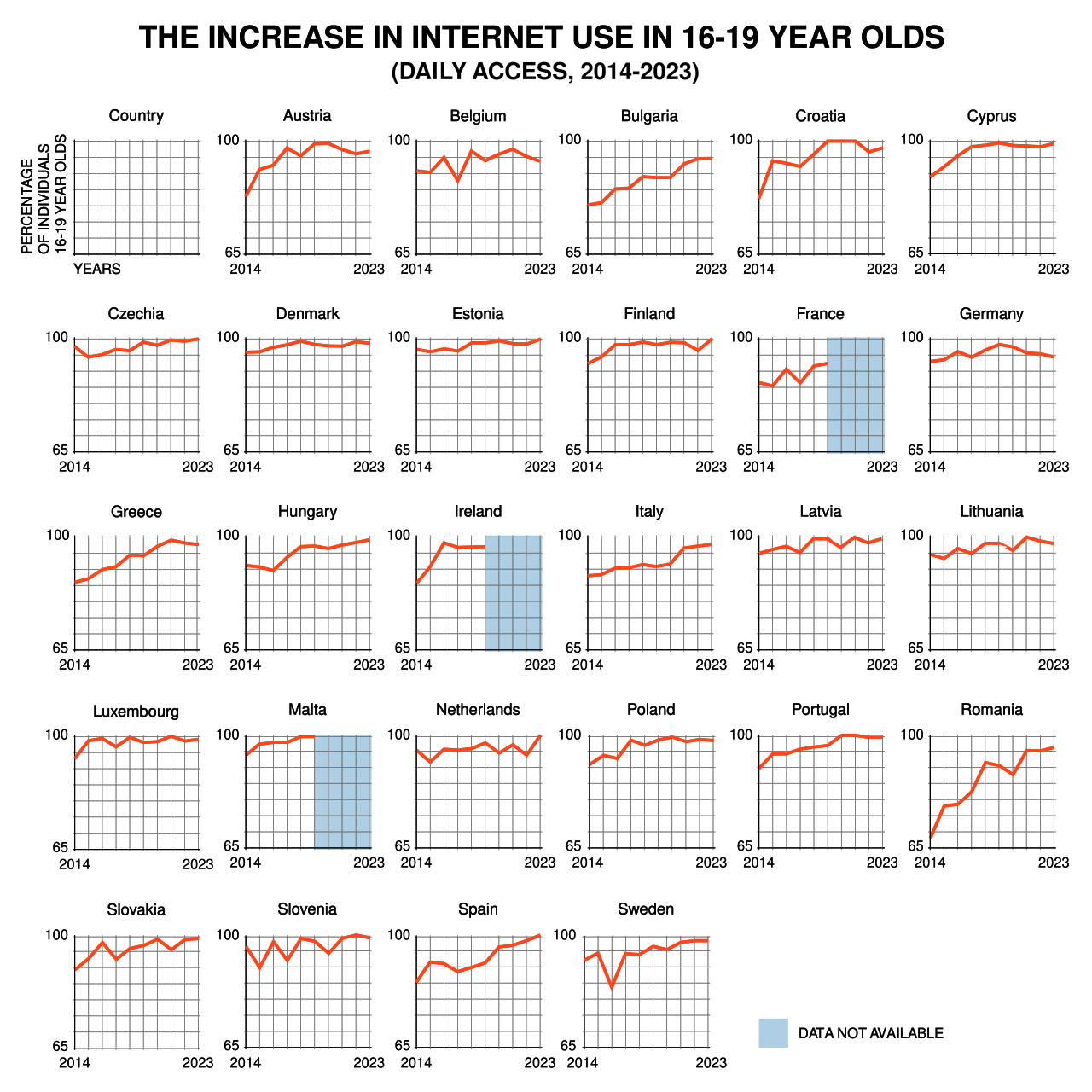 The increase in Internet access in 16-19 year olds living in EU countries Excessive Internet use is not recognized as a disorder by the American Psychiatric Association's DSM-5 or the World Health Organization's ICD-11.[35] However, gaming disorder appears in the ICD-11.[36] Controversy around the diagnosis includes whether the disorder is a separate clinical entity, or a manifestation of underlying psychiatric disorders. Definitions are not standardized or agreed upon, complicating the development of evidence-based recommendations. Many different theoretical models have been developed and employed for many years in order to better explain predisposing factors to this disorder. Models such as the cognitive-behavioral model of pathological Internet have been used to explain IAD for more than 20 years. Newer models, such as the Interaction of Person-Affect-Cognition-Execution model, have been developed more recently and are starting to be applied in more clinical studies.[37] In 2011 the term "Facebook addiction disorder" (FAD) emerged.[38] FAD is characterized by compulsive use of Facebook. A 2017 study investigated a correlation between excessive use and narcissism, reporting "FAD was significantly positively related to the personality trait narcissism and to negative mental health variables (depression, anxiety, and stress symptoms)".[39][40] In 2020, the documentary The Social Dilemma, reported concerns of mental health experts and former employees of social media companies over social media's pursuit of addictive use. For example, when a user has not visited Facebook for some time, the platform varies its notifications, attempting to lure them back. It also raises concerns about the correlation between social media use and child and teen suicidality.[41] Additionally in 2020, studies have shown that there has been an increase in the prevalence of IAD since the COVID-19 pandemic.[42] Studies highlighting the possible relationship between COVID-19 and IAD have looked at how forced isolation and its associated stress may have led to higher usage levels of the Internet.[42] Turning off social media notifications may help reduce social media use.[43] For some users, changes in web browsing can be helpful in compensating for self-regulatory problems. For instance, a study involving 157 online learners on massive open online courses examined the impact of such an intervention. The study reported that providing support in self-regulation was associated with a reduction in time spent online, particularly on entertainment.[44] |
インターネット依存症 このセクションは、インターネット依存症から抜粋したものです。 インターネット依存症(IAD)は、問題のあるインターネット利用、または病的なインターネット利用とも呼ばれ、特にソーシャルメディアにおいて、長期間 にわたって個人の機能を損なう問題のある強迫的なインターネット利用です。若者はインターネット依存症を発症するリスクが特に高く[31]、オンラインで の時間が長くなるにつれて学業成績が低下する学生を事例として取り上げた研究もあります。[32] スクロール、チャット、ゲームに没頭して夜更かしをするため、睡眠不足による健康への影響も生じている[33]。[34] EU 諸国に住む 16~19 歳のインターネット利用の増加 過度なインターネット利用は、米国精神医学会の DSM-5 や世界保健機関(WHO)の ICD-11 では障害として認識されていません。[35] ただし、ゲーム障害はICD-11に収録されている。[36] 診断に関する議論には、この障害が独立した臨床的実体であるか、または潜在的な精神疾患の症状であるかが含まれる。定義は標準化されておらず、合意も得ら れていないため、根拠に基づく推奨事項の開発が困難になっている。 この障害の素因をよりよく説明するために、長年にわたり、さまざまな理論モデルが開発され、採用されてきた。病的なインターネットの認知行動モデルなどの モデルは、20 年以上にわたり IAD の説明に使用されてきた。最近では、人格・感情・認知・実行の相互作用モデルなどの新しいモデルが開発され、より多くの臨床研究に適用され始めている。 [37] 2011年には、「Facebook依存症(FAD)」という用語が登場した。[38] FADは、Facebookの強制的な使用を特徴とする。2017年の研究では、過度な使用とナルシシズムとの相関関係を調査し、「FADは、人格特性で あるナルシシズムおよび負の精神的健康変数(うつ病、不安、ストレス症状)と有意な正の相関関係がある」と報告している。[39][40] 2020年、ドキュメンタリー映画『The Social Dilemma』は、ソーシャルメディアの依存性追求について、メンタルヘルスの専門家やソーシャルメディア企業の元従業員たちの懸念を報告した。例え ば、ユーザーがしばらくFacebookにアクセスしていない場合、プラットフォームは通知の内容を変えて、ユーザーを再び引き戻そうとする。また、ソー シャルメディアの利用と子供や青少年の自殺傾向との相関関係についても懸念が指摘されている。[41] さらに2020年には、COVID-19のパンデミック以降、IADの有病率が上昇していることが研究で明らかになった。[42] COVID-19とIADの関連性を指摘する研究では、強制的な隔離とそのに伴うストレスが、インターネットの利用レベルの増加につながった可能性につい て考察している。[42] ソーシャルメディアの通知をオフにすると、ソーシャルメディアの利用を減らすことができるかもしれない。[43] 一部のユーザーにとっては、ウェブの閲覧方法を変えることが、自己規制の問題を補うのに役立つ場合がある。例えば、大規模公開オンライン講座(MOOC) の 157 人のオンライン学習者を対象とした研究では、このような介入の影響が調査された。この研究では、自己規制のサポートを提供すると、オンライン、特に娯楽に 費やす時間が減少することが報告されている。[44] |
| Pornography addiction This section is an excerpt from Pornography addiction.[edit] Pornography addiction is the scientifically controversial[45] application of an addiction model to the use of pornography.[46] Pornography use may be part of compulsive behavior, with negative consequences to one's physical, mental, social, or financial well-being. While the World Health Organization's ICD-11 (2022) has recognized compulsive sexual behaviour disorder (CSBD) as an impulse-control disorder,[47] CSBD is not an addiction,[48][49] and the American Psychiatric Association's DSM-5 and the DSM-5-TR do not classify compulsive pornography consumption as a mental disorder or a behavioral addiction.[48][50][51] Problematic Internet pornography viewing is the viewing of Internet pornography that is problematic for an individual due to personal or social reasons, including the excessive time spent viewing pornography instead of interacting with others and the facilitation of procrastination. Individuals may report depression, social isolation, career loss, decreased productivity, or financial consequences as a result of their excessive Internet pornography viewing impeding their social lives.[52] |
ポルノ依存症 このセクションは、ポルノ依存症からの抜粋です。[編集] ポルノ依存症は、ポルノの使用に依存症モデルを適用した、科学的に議論の分かれる[45] 概念です。[46] ポルノの使用は、身体的、精神的、社会的、または経済的な健康に悪影響を及ぼす強迫的な行動の一部である可能性があります。世界保健機関(WHO)の ICD-11 (2022) は、強迫性性行動障害(CSBD)を衝動制御障害として認識しているが[47]、CSBD は依存症ではない[48][49]、また、米国精神医学会の DSM-5 および DSM-5-TR は、強迫的なポルノ消費を精神障害や行動依存症として分類していない。[48][50][51] 問題のあるインターネットポルノの閲覧とは、他人と交流する代わりにポルノの閲覧に過大な時間を費やす、先延ばし癖を助長するなどの、個人的または社会的 な理由により、個人にとって問題となるインターネットポルノの閲覧のことです。個人は、過度なインターネットポルノの閲覧が社会生活を阻害した結果、うつ 病、社会的孤立、キャリアの喪失、生産性の低下、経済的な影響などを報告する場合があります。[52] |
| Sexual addiction This section is an excerpt from Sexual addiction.[edit] Sexual addiction is a state characterized by compulsive participation or engagement in sexual activity, particularly sexual intercourse, despite negative consequences.[53] The concept is contentious;[54][55][56] as of 2023, sexual addiction is not a clinical diagnosis in either the DSM or ICD medical classifications of diseases and medical disorders, the latter of which instead classifying such behaviors as a part of compulsive sexual behaviour disorder (CSBD).[citation needed] There is considerable debate among psychiatrists, psychologists, sexologists, and other specialists whether compulsive sexual behavior constitutes an addiction – in this instance a behavioral addiction – and therefore its classification and possible diagnosis. Animal research has established that compulsive sexual behavior arises from the same transcriptional and epigenetic mechanisms that mediate drug addiction in laboratory animals. Some argue that applying such concepts to normal behaviors such as sex can be problematic, and suggest that applying medical models such as addiction to human sexuality can serve to pathologise normal behavior and cause harm.[57] |
性的依存症 このセクションは、性的依存症から抜粋したものです。[編集] 性的依存症とは、悪影響があるにもかかわらず、性的活動、特に性交に強迫的に参加または従事する状態を指します。[53] この概念は議論の的となっている[54][55][56]。2023年現在、性依存症はDSM(精神障害の診断と統計マニュアル)やICD(国際疾病分 類)の疾病および医療障害の分類において臨床診断として認められていない。後者では、このような行動は強迫性性行動障害(CSBD)の一部として分類され ている[出典必要]。 精神科医、心理学者、性科学者、その他の専門家は、強迫的な性行為が依存症(この場合、行動依存症)に該当するかどうか、したがってその分類と診断の可能 性について、激しい議論を交わしている。動物研究では、強迫性性行動が、実験動物における薬物依存を仲介する同じ転写とエピジェネティックなメカニズムか ら生じることが示されている。一部では、このような概念を性行為のような正常な行動に適用することは問題があると主張し、依存症のような医学的モデルを人 間の性行動に適用することは、正常な行動を病理化して害を及ぼす可能性があるとしている。[57] |
| Shopping addiction This section is an excerpt from Shopping addiction.[edit] Shopping addiction is characterized by an eagerness to purchase unnecessary or superfluous things and a lack of impulse control when it comes to shopping. It is a concept similar to compulsive buying disorder (oniomania), but usually has a more psychosocial perspective,[58] or is viewed as a drug-free addiction like addiction to gambling, Internet, or video games.[59] However, there is "still debate on whether other less recognized forms of impulsive behaviors, such as compulsive buying [...] can be conceptualized as addictions."[60] |
買い物依存症 このセクションは、買い物依存症からの抜粋です。[編集] 買い物依存症は、不必要または過剰なものを購入したいという衝動と、買い物に関する衝動制御の欠如を特徴とする。これは強迫性購買障害(オニオマニア)と 類似した概念ですが、通常はより心理社会的視点から捉えられます[58]、またはギャンブル、インターネット、ビデオゲームへの依存症と同様の薬物依存症 ではない依存症として見なされます[59]。ただし、「強迫性購買など、他の認識されていない衝動的行動が依存症として概念化できるかどうかについては、 まだ議論がある」とされています[60]。 |
| Video game addiction This section is an excerpt from Video game addiction.[edit] Video game addiction (VGA), also known as gaming disorder or internet gaming disorder, is generally defined as a behavioural addiction involving problematic, compulsive use of video games that results in significant impairment to an individual's ability to function in various life domains over a prolonged period of time. This and associated concepts have been the subject of considerable research, debate, and discussion among experts in several disciplines and has generated controversy within the medical, scientific, and gaming communities. Such disorders can be diagnosed when an individual engages in gaming activities at the cost of fulfilling daily responsibilities or pursuing other interests without regard for the negative consequences. As defined by the ICD-11, the main criterion for this disorder is a lack of self control over gaming.[61][62] The World Health Organization (WHO) included gaming disorder in the 11th revision of its International Classification of Diseases (ICD).[63][64] The American Psychiatric Association (APA), while stating there is insufficient evidence for the inclusion of Internet gaming disorder as an officially recognized disorder in Section II of the fifth edition (DSM-5) of Diagnostic and Statistical Manual of Mental Disorders in 2013, considered it worthy of further study.[65] The chapter on Conditions for Further Study is included in Section III. Controversy around the diagnosis includes whether the disorder is a separate clinical entity or a manifestation of underlying psychiatric disorders. Research has approached the question from a variety of viewpoints, with no universally standardized or agreed definitions, leading to difficulties in developing evidence-based recommendations. |
ビデオゲーム依存症 このセクションは、「ビデオゲーム依存症」からの抜粋です。[編集] ビデオゲーム依存症(VGA)は、ゲーム障害またはインターネットゲーム障害とも呼ばれ、一般的に、ビデオゲームの問題のある強迫的な使用により、長期間 にわたって個人のさまざまな生活領域における機能が著しく損なわれる行動依存症と定義されています。この概念および関連概念は、さまざまな分野の専門家に よって多くの研究、議論、議論の対象となっており、医学、科学、ゲームコミュニティ内で論争を引き起こしている。このような障害は、個人が、その悪影響に 配慮することなく、日々の責任を果たすことや他の興味を追求することを犠牲にしてゲーム活動に従事する場合に診断される。ICD-11 の定義によると、この障害の主な基準は、ゲームに対する自制心の欠如である。[61][62] 世界保健機関(WHO)は、国際疾病分類(ICD)の第 11 版にゲーム障害を追加した。[63][64] アメリカ精神医学会(APA)は、2013年に発行された『精神障害の診断と統計マニュアル』第5版(DSM-5)のセクションIIにインターネットゲー ム障害を正式な障害として包含する十分な証拠がないと述べつつも、さらに研究する価値があると判断した。[65] 「さらに研究が必要な条件」の章はセクションIIIに収録されている。 診断に関する議論には、この障害が独立した臨床的実体であるか、または基礎となる精神疾患の症状であるかが含まれる。研究は多様な視点からこの問題にアプ ローチしているが、普遍的に標準化され合意された定義が存在しないため、根拠に基づく推奨事項の開発が困難となっている。 |
| Work addiction This section is an excerpt from Workaholic.[edit] A workaholic is a person who works compulsively. A workaholic experiences an inability to limit the amount of time they spend on work despite negative consequences such as damage to their relationships or health.[66] There is no generally accepted medical definition of this condition, although some forms of stress, impulse control disorder, obsessive-compulsive personality disorder, and obsessive-compulsive disorder can be work-related; ergomania is defined as "excessive devotion to work especially as a symptom of mental illness".[67][68] The phenomenon of hustle culture, while disregarding healthy work–life balance, may exacerbate workaholism.[69][70] |
仕事中毒 このセクションは、Workaholic(仕事中毒)から抜粋したものです。[編集] 仕事中毒とは、強迫的に仕事をする人のことです。仕事中毒者は、人間関係や健康への悪影響などの悪影響にもかかわらず、仕事にかける時間を制限することが できない。[66] この状態について、一般的に認められた医学的定義はないが、ストレス、衝動制御障害、強迫性人格障害、強迫性障害の一部は仕事に関連している可能性があ る。エルゴマニアは、「特に精神疾患の症状として現れる、仕事への過度の献身」と定義されている。[67][68] ハッスル文化という現象は、健康的なワークライフバランスを無視し、仕事中毒を悪化させる可能性がある。[69][70] |
| Treatment Behavioral addiction is a treatable condition.[71] Treatment options include psychotherapy and psychopharmacotherapy (i.e., medications) or a combination of both. Cognitive behavioral therapy (CBT) is the most common form of psychotherapy used in treating behavioral addictions; it focuses on identifying patterns that trigger compulsive behavior and making lifestyle changes to promote healthier behaviors. Because cognitive behavioral therapy is considered a short-term therapy, the number of sessions for treatment normally ranges from five to twenty.[72] During the session, therapists will lead patients through the topics of identifying the issue, becoming aware of one's thoughts surrounding the issue, identifying any negative or false thinking, and reshaping said negative and false thinking. While CBT does not cure behavioral addiction, it does help with coping with the condition in a healthy way. Currently, there are no medications approved for treatment of behavioral addictions in general, but some medications used for treatment of drug addiction may also be beneficial with specific behavioral addictions.[73][74] Another form of treatment is recreational therapy. A Certified Therapeutic Recreation Specialist (CTRS) uses leisure and recreation to help individuals recover from their injuries, ailments, or addictions. Therapeutic recreation can help an individual struggling with addiction to improve their self-esteem, confidence, motivation, resiliency, autonomy, enjoyment, and overall emotional state.[75][76] |
治療 行動依存症は治療可能な疾患である。[71] 治療オプションには、心理療法、精神薬療法(すなわち、薬物療法)、あるいはその両方の組み合わせがある。認知行動療法(CBT)は、行動依存症の治療に 最もよく用いられる心理療法である。この療法は、強迫的な行動を引き起こすパターンを特定し、より健康的な行動を促進するためのライフスタイルの変更に焦 点を当てている。認知行動療法は短期療法とされているため、治療のセッション数は通常5回から20回程度である[72] 。セッション中、療法士は患者と共に、問題の特定、問題に関する思考の認識、否定的な思考や誤った思考の特定、そしてそれらの否定的な思考や誤った思考の 修正といったテーマを扱う。CBTは行動依存症を治癒するものではないが、健康的な方法で症状と向き合うのを助けることができる。現在、行動依存症の治療 に承認された薬はありませんが、薬物依存症の治療に用いられる一部の薬は、特定の行動依存症にも有効である可能性がある。[73][74] もう一つの治療法は、レクリエーション療法だ。認定レクリエーション療法士(CTRS)は、余暇やレクリエーションを利用して、個人が怪我、病気、依存症 から回復するのを支援する。レクリエーション療法は、依存症に苦しむ個人が、自尊心、自信、モチベーション、回復力、自立心、楽しみ、そして全体的な感情 状態を改善するのに役立つ。[75][76] |
| Research The classification and diagnostic framework of behavioral addictions under DSM-5 and ICD-11 has been a controversial subject among the clinical research field.[18] For example, this 2020 narrative review[17] considered ICD-11's guidelines to be adequate to include more behavioral addictions based on clinical relevance and empirical evidence, while this 2015 journal article questioned[77] the atheoretical and confirmatory research approaches on the accuracy of qualitative factors and criticized the lack of consideration of social elements and psychological processes. A recent narrative review[78] in 2017 examined the existing literature for studies reporting associations between behavioral addictions (pathological gambling, problematic internet use, problematic online gaming, compulsive sexual behavior disorder, compulsive buying and exercise addiction) and psychiatric disorders. Overall, there is solid evidence for associations between behavioral addictions and mood disorder, anxiety disorder as well as substance use disorders. Associations between ADHD may be specific to problematic internet use and problematic online gaming. The authors also conclude that most of current research on the association between behavioral addictions and psychiatric disorders has several limitations: they are mostly cross-sectional, are not from representative samples, and are often based on small samples, among others. Especially more longitudinal studies are needed to establish the direction of causation, i.e. whether behavioral addictions are a cause or a consequence of psychiatric disorders. A systematic review in 2021 investigating the correlation between autism and behavioural addiction[79] found inconclusive evidence for a general correlation. However found evidence of correlation when comorbid mental health conditions were present. Another systematic review in 2022 estimating the prevalence of behavioural addiction during the COVID-19 pandemic[80] found the prevalence to be 11.1%. |
研究 DSM-5 および ICD-11 における行動依存症の分類および診断の枠組みは、臨床研究分野において議論の的となっている。[18] 例えば、2020年のこの叙述的レビュー[17]では、ICD-11のガイドラインが臨床的関連性と実証的証拠に基づいてより多くの行動依存症を含むのに 適切であると判断した一方、2015年のこの学術論文[77]では、定性的要因の正確性に関する理論的根拠のない確認的研究アプローチを疑問視し、社会的 要素や心理的過程の考慮不足を批判した。 2017年の最近の叙述的レビュー[78]は、行動依存症(病的ギャンブル、問題のあるインターネット使用、問題のあるオンラインゲーム、強迫性性行動障 害、強迫性購買、運動依存症)と精神疾患との関連性を報告した既存の文献を調査しました。全体として、行動依存症と気分障害、不安障害、および物質使用障 害との関連性に関する確固たる証拠が存在します。ADHDとの関連は、問題のあるインターネット使用と問題のあるオンラインゲームに特有である可能性があ ります。著者らはまた、行動依存症と精神疾患の関連に関する現在の研究の多くには、いくつかの限界があるとも結論付けています。具体的には、ほとんどが横 断的研究であり、代表的なサンプルからではなく、小規模なサンプルに基づいている点などが挙げられます。特に、因果関係の方向性(行動依存症が精神疾患の 原因か結果か)を確立するためには、より多くの縦断的研究が必要です。 2021 年に自閉症と行動依存症の相関関係を調査した系統的レビュー[79] では、一般的な相関関係については決定的な証拠は見つかりませんでした。しかし、精神保健上の併存疾患がある場合には相関関係があることが明らかになりま した。2022 年に COVID-19 パンデミック中の行動依存症の有病率を推定した別の系統的レビュー[80] では、有病率は 11.1% であることが明らかになりました。 |
| Addiction and the reward system Main articles: ΔFosB and Reward system ΔFosB, a gene transcription factor, has been identified as playing a critical role in the development of addictive states in both behavioral addictions and drug addictions.[3][4][6] Overexpression of ΔFosB in the nucleus accumbens is necessary and sufficient for many of the neural adaptations seen in drug addiction;[3] it has been implicated in addictions to alcohol, cannabinoids, cocaine, nicotine, phenylcyclidine, and substituted amphetamines[3][81][82][83] as well as addictions to natural rewards such as sex, exercise, and food.[4][6] A recent study also demonstrated a cross-sensitization between drug reward (amphetamine) and a natural reward (sex) that was mediated by ΔFosB.[84] One of the major areas of study is the amygdala, a brain structure which involves emotional significance and associated learning. Research shows that dopaminergic projections from the ventral tegmental area facilitate a motivational or learned association to a specific behavior.[85] Dopamine neurons take a role in the learning and sustaining of many acquired behaviors. Research specific to Parkinson's disease has led to identifying the intracellular signaling pathways that underlie the immediate actions of dopamine. The most common mechanism of dopamine is to create addictive properties along with certain behaviors.[86] There are three stages to the dopamine reward system: bursts of dopamine, triggering of behavior, and further impact to the behavior. Once electronically signaled, possibly through the behavior, dopamine neurons let out a 'burst-fire' of elements to stimulate areas along fast transmitting pathways. The behavior response then perpetuates the striated neurons to further send stimuli. The fast firing of dopamine neurons can be monitored over time by evaluating the amount of extracellular concentrations of dopamine through micro dialysis and brain imaging. This monitoring can lead to a model in which one can see the multiplicity of triggering over a period of time.[87] Once the behavior is triggered, it is hard to work away from the dopamine reward system. Behaviors like gambling have been linked to the newfound idea of the brain's capacity to anticipate rewards. The reward system can be triggered by early detectors of the behavior, and trigger dopamine neurons to begin stimulating behaviors. But in some cases, it can lead to many issues due to error, or reward-prediction errors. These errors can act as teaching signals to create a complex behavior task over time.[87] |
依存症と報酬系 主な記事:ΔFosB と報酬系 ΔFosB は、行動依存症および薬物依存症の両方において、依存状態の発症に重要な役割を果たす遺伝子転写因子として同定されている。[3][4][6] ΔFosBの腹側被蓋野における過剰発現は、薬物依存症で見られる多くの神経適応に必要かつ十分であることが示されている。[3] アルコール、カンナビノイド、コカイン、ニコチン、フェニルシクロリジン、置換アンフェタミンなどの薬物依存症[3][81][82][83] だけでなく、性行為、運動、食事などの自然報酬への依存症にも関与していることが示唆されている。[4][6] 最近の研究では、薬物報酬(アンフェタミン)と自然報酬(性行為)の間で、ΔFosBを介した交差感受性が増強されることが示された。[84] 主要な研究領域の一つは、感情的な意味合いと関連する学習に関与する脳構造である扁桃体です。研究によると、腹側被蓋野からのドーパミン神経投射は、特定 の行動への動機付けまたは学習された関連性を促進します[85]。ドーパミン神経細胞は、多くの獲得行動の学習と維持に役割を果たします。パーキンソン病 に関する研究は、ドーパミンの即時作用を裏付ける細胞内シグナル伝達経路の同定につながっています。ドーパミンの最も一般的なメカニズムは、特定の行動と 共に依存性をもたらすことです。[86] ドーパミン報酬システムには3つの段階があります:ドーパミンの放出、行動の誘発、および行動へのさらなる影響。電子的に信号が伝達されると(おそらく行 動を通じて)、ドーパミン神経細胞は高速伝達経路に沿った領域を刺激する「バースト発火」を放出します。行動反応は、さらに刺激を送信するために線条体神 経細胞を活性化します。ドーパミン神経細胞の高速発火は、マイクロダイアライシスや脳画像診断により、ドーパミンの細胞外濃度を時間経過とともに評価する ことでモニタリング可能です。このモニタリングは、一定期間にわたる複数のトリガーの多様性を観察できるモデルへとつながります。[87] 一度行動がトリガーされると、ドーパミン報酬系から離れることは困難です。 ギャンブルのような行動は、脳の報酬予測能力という新たな概念と関連付けられている。報酬システムは、行動の早期検出器によってトリガーされ、ドーパミン 神経細胞を刺激して行動を開始させる。しかし、一部のケースでは、エラーや報酬予測エラーにより、多くの問題を引き起こす可能性がある。これらのエラー は、時間をかけて複雑な行動タスクを構築するための学習信号として機能する。[87] |
| Addictive behavior Addictive personality ANKK1 § Addictive behaviors Habit |
依存症 依存性人格 ANKK1 § 依存性行動 習慣 |
| https://en.wikipedia.org/wiki/Behavioral_addiction |
|
| References 01. Smith, David E. (1 January 2012). "Editor's Note: The Process Addictions and the New ASAM Definition of Addiction". Journal of Psychoactive Drugs. 44 (1): 1–4. doi:10.1080/02791072.2012.662105. ISSN 0279-1072. PMID 22641960. American Psychiatric Association (18 March 2022). Diagnostic and Statistical Manual of Mental Disorders (DSM-5-TR ed.). American Psychiatric Association Publishing. p. 661. doi:10.1176/appi.books.9780890425787. ISBN 978-0-89042-575-6. S2CID 249488050. Robison AJ, Nestler EJ (November 2011). "Transcriptional and epigenetic mechanisms of addiction". Nat. Rev. Neurosci. 12 (11): 623–637. doi:10.1038/nrn3111. PMC 3272277. PMID 21989194. ΔFosB has been linked directly to several substance-related behaviors ... Importantly, genetic or viral overexpression of ΔJunD, a dominant negative mutant of JunD which antagonizes ΔFosB- and other AP-1-mediated transcriptional activity, in the NAc or OFC blocks these key effects of drug exposure14,22–24. This indicates that ΔFosB is both necessary and sufficient for many of the changes wrought in the brain by chronic drug exposure. ΔFosB is also induced in D1-type NAc MSNs by chronic consumption of several natural rewards, including sucrose, high fat food, sex, wheel running, where it promotes that consumption14,26–30. This implicates ΔFosB in the regulation of natural rewards under normal conditions and perhaps during pathological addictive-like states. Olsen CM (December 2011). "Natural rewards, neuroplasticity, and non-drug addictions". Neuropharmacology. 61 (7): 1109–22. doi:10.1016/j.neuropharm.2011.03.010. PMC 3139704. PMID 21459101. Stein, Dan J.; Hollander, Eric; Rothbaum, Barbara Olasov (31 August 2009). Textbook of Anxiety Disorders. American Psychiatric Pub. pp. 359–. ISBN 978-1-58562-254-2. Retrieved 24 April 2010. Blum K, Werner T, Carnes S, Carnes P, Bowirrat A, Giordano J, Oscar-Berman M, Gold M (2012). "Sex, drugs, and rock 'n' roll: hypothesizing common mesolimbic activation as a function of reward gene polymorphisms". Journal of Psychoactive Drugs. 44 (1): 38–55. doi:10.1080/02791072.2012.662112. PMC 4040958. PMID 22641964. It has been found that deltaFosB gene in the NAc is critical for reinforcing effects of sexual reward. Pitchers and colleagues (2010) reported that sexual experience was shown to cause DeltaFosB accumulation in several limbic brain regions including the NAc, medial pre-frontal cortex, VTA, caudate, and putamen, but not the medial preoptic nucleus. Next, the induction of c-Fos, a downstream (repressed) target of DeltaFosB, was measured in sexually experienced and naive animals. The number of mating-induced c-Fos-IR cells was significantly decreased in sexually experienced animals compared to sexually naive controls. Finally, DeltaFosB levels and its activity in the NAc were manipulated using viral-mediated gene transfer to study its potential role in mediating sexual experience and experience-induced facilitation of sexual performance. Animals with DeltaFosB overexpression displayed enhanced facilitation of sexual performance with sexual experience relative to controls. In contrast, the expression of DeltaJunD, a dominant-negative binding partner of DeltaFosB, attenuated sexual experience-induced facilitation of sexual performance, and stunted long-term maintenance of facilitation compared to DeltaFosB overexpressing group. Together, these findings support a critical role for DeltaFosB expression in the NAc in the reinforcing effects of sexual behavior and sexual experience-induced facilitation of sexual performance. ... both drug addiction and sexual addiction represent pathological forms of neuroplasticity along with the emergence of aberrant behaviors involving a cascade of neurochemical changes mainly in the brain's rewarding circuitry. Holden, Constance (2 November 2001). "'Behavioral' Addictions: Do They Exist?". Science. 294 (5544): 980–982. doi:10.1126/science.294.5544.980. ISSN 0036-8075. PMID 11691967. S2CID 27235598. Starcevic, Vladan (August 2016). "Behavioural addictions: A challenge for psychopathology and psychiatric nosology". The Australian and New Zealand Journal of Psychiatry. 50 (8): 721–725. doi:10.1177/0004867416654009. ISSN 1440-1614. PMID 27357713. S2CID 22843151. 10. Pinna, F.; Dell'Osso, B.; Di Nicola, M.; Janiri, L.; Altamura, A.C.; Carpiniello, B.; Hollander, E. (1 December 2015). "Behavioural addictions and the transition from DSM-IV-TR to DSM-5" (PDF). Journal of Psychopathology. 21 (4): 380–389. Archived from the original (PDF) on 12 October 2023. Retrieved 5 October 2023. Petry, Nancy (2015). Behavioral Addictions: DSM-5 and Beyond. Oxford University Press. pp. 1–5. ISBN 978-0-19-939155-4. Kuss, Daria (2013). "Internet gaming addiction: current perspectives". Psychology Research and Behavior Management. 6 (6): 125–137. doi:10.2147/PRBM.S39476. PMC 3832462. PMID 24255603. American Psychiatric Association (18 March 2022). Diagnostic and Statistical Manual of Mental Disorders (DSM-5-TR ed.). American Psychiatric Association Publishing. p. 914. doi:10.1176/appi.books.9780890425787. ISBN 978-0-89042-575-6. S2CID 249488050. American Psychiatric Association (18 March 2022). Diagnostic and Statistical Manual of Mental Disorders (DSM-5-TR ed.). American Psychiatric Association Publishing. p. 543. doi:10.1176/appi.books.9780890425787. ISBN 978-0-89042-575-6. S2CID 249488050. Stein, Dan J.; Szatmari, Peter; Gaebel, Wolfgang; Berk, Michael; Vieta, Eduard; Maj, Mario; de Vries, Ymkje Anna; Roest, Annelieke M.; de Jonge, Peter; Maercker, Andreas; Brewin, Chris R.; Pike, Kathleen M.; Grilo, Carlos M.; Fineberg, Naomi A.; Briken, Peer (27 January 2020). "Mental, behavioral and neurodevelopmental disorders in the ICD-11: an international perspective on key changes and controversies". BMC Medicine. 18 (1): 21. doi:10.1186/s12916-020-1495-2. ISSN 1741-7015. PMC 6983973. PMID 31983345. "International Classification of Diseases Eleventh Revision (ICD-11)". World Health Organization. Geneva. 2022. Retrieved 5 October 2023. "What is the Definition of Addiction?". American Society of Addiction Medicine. 15 September 2019. Archived from the original on 1 October 2023. Retrieved 5 October 2023. Brand, Matthias; Rumpf, Hans-JÜrgen; Demetrovics, Zsolt; MÜller, Astrid; Stark, Rudolf; King, Daniel L.; Goudriaan, Anna E.; Mann, Karl; Trotzke, Patrick; Fineberg, Naomi A.; Chamberlain, Samuel R.; Kraus, Shane W.; Wegmann, Elisa; Billieux, JoËl; Potenza, Marc N. (30 June 2020). "Which conditions should be considered as disorders in the International Classification of Diseases (ICD-11) designation of "other specified disorders due to addictive behaviors"?". Journal of Behavioral Addictions. 11 (2): 150–159. doi:10.1556/2006.2020.00035. ISSN 2062-5871. PMC 9295220. PMID 32634114. Griffiths, Mark D. (13 July 2022). "Disorders due to addictive behaviors: Further issues, debates, and controversies •: Commentary to the debate: "Behavioral addictions in the ICD-11"". Journal of Behavioral Addictions. 11 (2): 180–185. doi:10.1556/2006.2022.00025. ISSN 2062-5871. PMC 9295243. PMID 35895451. Hauck, Carolin; Cook, Brian; Ellrott, Thomas (20 November 2019). "Food addiction, eating addiction and eating disorders". Proceedings of the Nutrition Society. 79 (1). Cambridge University Press: 103–112. doi:10.1017/S0029665119001162. ISSN 0029-6651. PMID 31744566. S2CID 208186539. 20. Landolfi E (2013). "Exercise addiction". Sports Med. 43 (2): 111–9. doi:10.1007/s40279-012-0013-x. PMID 23329605. S2CID 35726964. Demetrovics Z, Kurimay T (2008). "[Exercise addiction: a literature review]". Psychiatr Hung (in Hungarian). 23 (2): 129–41. PMID 18956613. Sussman S, Lisha N, Griffiths M (March 2011). "Prevalence of the addictions: a problem of the majority or the minority?". Eval Health Prof. 34 (1): 3–56. doi:10.1177/0163278710380124. PMC 3134413. PMID 20876085. Krivoshchekov SG, Lushnikov ON (2011). "[Psychophysiology of sports addiction (exercises addiction)]". Fiziol Cheloveka (in Russian). 37 (4): 135–40. doi:10.1134/S0362119711030030. PMID 21950095. S2CID 20543670. [unreliable medical source?]Villella C, Martinotti G, Di Nicola M, et al. (June 2011). "Behavioural addictions in adolescents and young adults: results from a prevalence study". J Gambl Stud. 27 (2): 203–14. doi:10.1007/s10899-010-9206-0. PMID 20559694. S2CID 19239770. Zollinger, Manfred (31 March 2016). Random Riches: Gambling Past & Present. Routledge. p. 34. ISBN 978-1-317-07156-3. Retrieved 30 October 2024. Li, Zhaolan; He, Quanxing; Elhai, Jon D.; Montag, Christian; Yang, Haibo (28 March 2025). "Neural mechanisms of behavioral addiction: An ALE meta-analysis and MACM analysis". Journal of Behavioral Addictions. 14 (1): 18–38. doi:10.1556/2006.2024.00082. ISSN 2062-5871. PMC 11974436. PMID 39853319. Eades, John (2003). Gambling Addiction: The Problem, the Pain, and the Path to Recovery. Vine Books. ISBN 978-0-8307-3425-2.[page needed] Petry, Nancy (September 2006). "Should the Scope of Addictive Behaviors be Broadened to Include Pathological Gambling?". Addiction. 101 (s1): 152–60. doi:10.1111/j.1360-0443.2006.01593.x. PMID 16930172. Potenza, M. N. (12 October 2008). "The neurobiology of pathological gambling and drug addiction: an overview and new findings". Philosophical Transactions of the Royal Society B: Biological Sciences. 363 (1507): 3181–3189. doi:10.1098/rstb.2008.0100. PMC 2607329. PMID 18640909. 30. Grant, Jon E.; Chamberlain, Samuel R. (20 April 2020). "Gambling and substance use: Comorbidity and treatment implications". Progress in Neuro-Psychopharmacology and Biological Psychiatry. 99 109852. doi:10.1016/j.pnpbp.2019.109852. ISSN 0278-5846. PMID 31881248. Young, Kimberly S. (January 1998). "Internet Addiction: The Emergence of a New Clinical Disorder". CyberPsychology & Behavior. 1 (3): 237–244. doi:10.1089/cpb.1998.1.237. Tomczyk Ł, Solecki R (July 2019). "Problematic internet use and protective factors related to family and free time activities among young people". Educational Sciences: Theory & Practice. 19 (3): 1–13. doi:10.12738/estp.2019.3.001 (inactive 1 July 2025). Jain, Ronak; Stemper, Sam (19 September 2024). "Lost in the Web: How 3G Internet Affects Student Achievement". Harvard Kennedy School. Retrieved 5 March 2026. Tereshchenko S, Kasparov E, Smolnikova M, Shubina M, Gorbacheva N, Moskalenko O (October 2021). "Internet Addiction and Sleep Problems among Russian Adolescents: A Field School-Based Study". International Journal of Environmental Research and Public Health. 18 (19) 10397. doi:10.3390/ijerph181910397. PMC 8507923. PMID 34639694. Wallace P (January 2014). "Internet addiction disorder and youth: There are growing concerns about compulsive online activity and that this could impede students' performance and social lives". EMBO Reports. 15 (1): 12–6. doi:10.1002/embr.201338222. PMC 4303443. PMID 24398129. "Internet Addiction". Psychology Today. Retrieved 2 September 2024. "Addictive behaviour". www.who.int. Retrieved 1 September 2024. Jhone, Jin-Ho; Song, In Han; Lee, Mi-Sun; Yoon, Ji Young; Bhang, Soo-Young (16 December 2021). "Is the I-PACE (Interaction of Person-Affect-Cognition-Execution) model valid in South Korea? The effects of adverse childhood experiences (ACEs) on internet gaming disorder and the mediating effect of stress on adolescents". Journal of Behavioral Addictions. 10 (4): 967–982. doi:10.1556/2006.2021.00081. PMC 8987428. PMID 34935634. Summers, Amy (2 May 2011). "Facebook Addiction Disorder — The 6 Symptoms of F.A.D." AdWeek. Retrieved 2 May 2011. 40. Brailovskaia, J.; Margraf, J. (2017). "Facebook Addiction Disorder (FAD) among German students—A longitudinal approach". PLOS ONE. 12 (12): 2423–2478. Bibcode:2017PLoSO..1289719B. doi:10.1371/journal.pone.0189719. PMC 5730190. PMID 29240823. Zhao, Nan; Zhou, Guangyu (9 February 2021). "COVID-19 Stress and Addictive Social Media Use (SMU): Mediating Role of Active Use and Social Media Flow". Frontiers in Psychiatry. 12 635546. doi:10.3389/fpsyt.2021.635546. PMC 7899994. PMID 33633616. Watch The Social Dilemma. www.netflix.com (Film). Netflix Official Site. Retrieved 13 April 2022. Li, Yang-Yang; Sun, Yan; Meng, Shi-Qiu; Bao, Yan-Ping; Cheng, Jia-Lu; Chang, Xiang-Wen; Ran, Mao-Sheng; Sun, Yan-Kun; Kosten, Thomas; Strang, John; Lu, Lin; Shi, Jie (19 March 2021). "Internet Addiction Increases in the General Population During COVID-19: Evidence From China". The American Journal on Addictions. 30 (4): 389–397. doi:10.1111/ajad.13156. PMC 8251395. PMID 33738888. Kane, Suzanne (6 December 2018). "Portion-Control in Social Media? How Limiting Time Increases Well-Being". World of Psychology. Archived from the original on 14 August 2020. Retrieved 29 April 2019. Pogorskiy, Eduard; Beckmann, Jens F. (2023). "From procrastination to engagement? An experimental exploration of the effects of an adaptive virtual assistant on self regulation in online learning". Computers and Education: Artificial Intelligence. 4 100111. doi:10.1016/j.caeai.2022.100111. S2CID 254612244. Sources for 'controversial': Sale, Julie "Preface" in Neves 2021, p. vii Williams, D.J.; Thomas, Jeremy N.; Prior, Emily (2022). "Are Sex and Pornography Addiction Valid Disorders? Adding a Leisure Science Perspective to the Sexological Critique". In Berdychevsky, Liza; Carr, Neil (eds.). Innovation and Impact of Sex as Leisure in Research and Practice. Taylor & Francis. pp. 306–321. doi:10.1080/01490400.2020.1712284. ISBN 978-1-000-58943-6. Retrieved 7 November 2024. Marks, David F.; Murray, Michael; Estacio, Emee Vida (2018). Health Psychology: Theory, Research and Practice. SAGE Publications. p. 229. ISBN 978-1-5264-1206-5. Retrieved 7 November 2024. although this idea is controversial Hunt, Adam; Merola, Giuseppe Pierpaolo; Carpenter, Tom; Jaeggi, Adrian V. (1 April 2024). "Evolutionary perspectives on substance and behavioural addictions: Distinct and shared pathways to understanding, prediction and prevention". Neuroscience & Biobehavioral Reviews. 159 105603. doi:10.1016/j.neubiorev.2024.105603. ISSN 0149-7634. PMID 38402919. Gerymski, Rafał; Cisek, Aleksandra (2023). "Pornography: Addiction". Encyclopedia of Sexual Psychology and Behavior. Springer, Cham. pp. 1–8. doi:10.1007/978-3-031-08956-5_1867-1. ISBN 978-3-031-08956-5. "Compulsive sexual behavior disorder". World Health Organization (ICD-11). Retrieved 25 March 2022. Martinez-Gilliard, Erin (2023). Sex, Social Justice, and Intimacy in Mental Health Practice: Incorporating Sexual Health in Approaches to Wellness. Taylor & Francis. p. unpaginated. ISBN 978-1-000-84578-5. Archived from the original on 4 April 2023. Retrieved 5 March 2023. 'Sex addiction' is also referred to as a diagnosis or presenting problem. Sex addiction is not a diagnosis in the DSM-5-TR and identified as Compulsive Sexual Behavior in the ICD-11 rather than an issue of addiction. 50. Sources for 'not an addiction': Hall, Timothy M.; Bershad, Anya; Shoptaw, Steven (2024). "53. Compulsive Sexual Behaviors". In Miller, Shannon C.; Rosenthal, Richard N.; Levy, Sharon; Saxon, Andrew J.; Tetrault, Jeanette M.; Wakeman, Sarah E. (eds.). The ASAM Principles of Addiction Medicine. Philadelphia, PA: Lippincott Williams & Wilkins. p. unpaginated. ISBN 978-1-9752-0157-9. Proposals for two constructs related to compulsive sexual behaviors, sexual addiction and hypersexual disorder, have been repeatedly rejected from inclusion in recent editions of the Diagnostic and Statistical Manual of Mental Disorders (DSM) for lack of empirical support and lack of consensus as to definition. [...] (CSBD), has been included in the International Classification of Diseases, 11th edition (ICD-11), under impulse control disorders rather than as an addiction disorder. CSBD has significant differences from substance use disorders (SUD) [...] Though the concept of a general sexual addiction or hypersexual disorder has a long history, it has not been supported by rigorous or replicated studies and has not so far produced evidence-based treatments. Dhuffar-Pottiwal, Manpreet (2022). Pontes, Halley M. (ed.). Behavioral Addictions: Conceptual, Clinical, Assessment, and Treatment Approaches. Studies in Neuroscience, Psychology and Behavioral Economics. Springer International Publishing. p. 163. ISBN 978-3-031-04772-5. Retrieved 27 July 2023. Given that we do not yet have definitive information on whether the processes involved in the onset and maintenance of the disorder are equivalent to substance abuse disorders, gambling, and gaming (Kraus et al. 2016), CSBD is not included in the grouping of disorders due to substance and addictive behaviors, but rather in that of impulse control disorders (Kraus et al. 2018). Bowman, Todd (2022). Reclaiming Sexual Wholeness: An Integrative Christian Approach to Sexual Addiction Treatment. Zondervan Academic. p. 161. ISBN 978-0-310-09311-4. Retrieved 27 July 2023. Ley, David J. (24 January 2018a). "Compulsive Sexual Behavior Disorder in ICD-11". Psychology Today. Retrieved 27 March 2021. Sassover, Eli; Weinstein, Aviv (29 September 2020). "Should compulsive sexual behavior (CSB) be considered as a behavioral addiction? A debate paper presenting the opposing view". Journal of Behavioral Addictions. 11 (2). Akademiai Kiado Zrt.: 166–179. doi:10.1556/2006.2020.00055. ISSN 2062-5871. PMC 9295215. PMID 32997646. S2CID 222167039. Neves, Silva (2021). Compulsive Sexual Behaviours: A Psycho-Sexual Treatment Guide for Clinicians. Taylor & Francis. p. 8. ISBN 978-1-000-38710-0. OCLC 1251637302. Archived from the original on 19 April 2023. Retrieved 26 March 2022. ... materials in ICD-11 make very clear that CSBD is not intended to be interchangeable with sex addiction, but rather is a substantially different diagnostic framework Weir, Kirsten (April 2014). "Is pornography addictive?". Monitor on Psychology. 45 (4): 46. ISSN 1529-4978. OCLC 612512821. Archived from the original on 5 April 2014. Allez, Glyn Hudson, ed. (4 June 2014). "Chapter Ten. The pleasure, the power, and the perils of Internet pornography". Sexual Diversity and Sexual Offending: Research, Assessment, and Clinical Treatment in Psychosexual Therapy. Karnac Books. p. 161. ISBN 978-1-78181-368-3. Archived from the original on 19 April 2023. Retrieved 27 April 2019. Taylor, Kris (7 May 2019). "Nosology and metaphor: How pornography viewers make sense of pornography addiction". Sexualities. 23 (4): 609–629. doi:10.1177/1363460719842136. S2CID 164221337. Malenka RC, Nestler EJ, Hyman SE (2009). "Chapter 15: Reinforcement and Addictive Disorders". In Sydor A, Brown RY (eds.). Molecular Neuropharmacology: A Foundation for Clinical Neuroscience (2nd ed.). New York: McGraw-Hill Medical. pp. 364–365, 375. ISBN 978-0-07-148127-4. The defining feature of addiction is compulsive, out-of-control drug use, despite negative consequences. ... compulsive eating, shopping, gambling, and sex–so-called "natural addictions"– ... Indeed, addiction to both drugs and behavioral rewards may arise from similar dysregulation of the mesolimbic dopamine system. Fong, TW (2006). "Understanding and managing compulsive sexual behaviors". Psychiatry. 3 (11): 51–8. PMC 2945841. PMID 20877518. Derbyshire, Katherine L.; Grant, Jon E. (2015). "Compulsive sexual behavior: A review of the literature". Journal of Behavioral Addictions. 4 (2): 37–43. doi:10.1556/2006.4.2015.003. PMC 4500883. PMID 26014671. Kingston, Drew A. (2015). "Debating the Conceptualization of Sex as an Addictive Disorder". Current Addiction Reports. 2 (3): 195–201. doi:10.1007/s40429-015-0059-6. Rosenberg, Kenneth Paul; O'Connor, Suzanne; Carnes, Patrick (2014). "Chapter 9 - Sex Addiction: An Overview". Behavioral Addictions: 215–236. doi:10.1016/B978-0-12-407724-9.00009-4. Hertzsprung, Meyen; Amadala, Stephen (2015). "Sexual Addiction". Textbook of Addiction Treatment: International Perspectives. pp. 1543–1555. doi:10.1007/978-88-470-5322-9_76. ISBN 978-88-470-5321-2. Sahithya, B. R.; Kashyap, Rithvik S. (2022). "Sexual Addiction Disorder— A Review With Recent Updates". Journal of Psychosexual Health. 4 (2): 95–101. doi:10.1177/26318318221081080. Schaefer GA, Ahlers CJ (2017). "1.3, Sexual addiction: Terminology, definitions and conceptualisation". In Birchard T, Benfield J (eds.). Routledge International Handbook of Sexual Addiction. Routledge. ISBN 978-1-317-27425-4. Hall, Paula (2 January 2014). "Sex addiction – an extraordinarily contentious problem". Sexual and Relationship Therapy. 29 (1): 68–75. doi:10.1080/14681994.2013.861898. ISSN 1468-1994. S2CID 145015659. Epstein, Steven (2022). The Quest for Sexual Health: How an Elusive Ideal Has Transformed Science, Politics, and Everyday Life. University of Chicago Press. p. 371 fn. 101. ISBN 978-0-226-81822-1. Retrieved 17 November 2024. Haldeman, D (1991). "Sexual orientation conversion therapy for gay men and lesbians: A scientific examination" (PDF). Homosexuality: Research Implications for Public Policy: 149–160. doi:10.4135/9781483325422.n10. ISBN 978-0-8039-3764-2. Archived from the original (PDF) on 6 February 2018. Retrieved 14 May 2017. Robert Holman Coombs (2004). Addictive Disorders: A Practical Guide to Diagnosis and Treatment.understanding and hoes diagnosis compulsive buying. pp. 420–447. 60. "Shopping addition". Illinois Institute for Addiction Recovery. Retrieved 20 June 2016. Piquet-Pessôa, Marcelo; Ferreira, Gabriela M.; Melca, Isabela A.; Fontenelle, Leonardo F. (12 June 2014). "DSM-5 and the Decision Not to Include Sex, Shopping or Stealing as Addictions". Current Addiction Reports. 1: 172–176. Retrieved 23 October 2024. Ruggeri, Christine (28 November 2022). "Research Shows Hustle Culture Does More Harm Than Good". Leaders.com. Retrieved 23 October 2023. "Medical Definition of ERGOMANIA". Merriam-Webster Medical Dictionary. 5 February 2021. Retrieved 5 February 2021. Van Houdenhove, Boudewijn; Neerinckx, Eddy (1999). "Is "Ergomania" a Predisposing Factor to Chronic Pain and Fatigue?". Psychosomatics. 40 (6): 529–530. doi:10.1016/S0033-3182(99)71197-7. ISSN 0033-3182. PMID 10581987. Griffith, Erin (26 January 2019). "Why Are Young People Pretending to Love Work?". The New York Times. Retrieved 14 July 2019. Da Costa, Celinne (28 April 2019). "Stop Idolizing Hustle Culture And Do This Instead". Forbes. Retrieved 14 July 2019. Rosenberg, Kenneth Paul; Feder, Laura Curtiss (2014). "An Introduction to Behavioral Addictions". Behavioral Addictions. Elsevier. pp. 1–17. doi:10.1016/b978-0-12-407724-9.00001-x. ISBN 978-0-12-407724-9. Bannink, F. P. (26 June 2013). "Positive CBT: From Reducing Distress to Building Success". Journal of Contemporary Psychotherapy. 44 (1): 1–8. doi:10.1007/s10879-013-9239-7. ISSN 0022-0116. S2CID 24029889. Grant JE, Potenza MN, Weinstein A, Gorelick DA (September 2010). "Introduction to behavioral addictions". Am. J. Drug Alcohol Abuse. 36 (5): 233–241. doi:10.3109/00952990.2010.491884. PMC 3164585. PMID 20560821. Naltrexone, a mu-opioid receptor antagonist approved by the US Food and Drug Administration for the treatment of alcoholism and opioid dependence, has shown efficacy in controlled clinical trials for the treatment of pathological gambling and kleptomania (76–79), and promise in uncontrolled studies of compulsive buying (80), compulsive sexual behavior (81), internet addiction (82), and pathologic skin picking (83). ... Topiramate, an anti-convulsant which blocks the AMPA subtype of glutamate receptor (among other actions), has shown promise in open-label studies of pathological gambling, compulsive buying, and compulsive skin picking (85), as well as efficacy in reducing alcohol (86), cigarette (87), and cocaine (88) use. N-acetyl cysteine, an amino acid that restores extracellular glutamate concentration in the nucleus accumbens, reduced gambling urges and behavior in one study of pathological gamblers (89), and reduces cocaine craving (90) and cocaine use (91) in cocaine addicts. These studies suggest that glutamatergic modulation of dopaminergic tone in the nucleus accumbens may be a mechanism common to behavioral addiction and substance use disorders (92). 70. Better Life Recovery Litchke, Lyn Gorbett; Quinn, Bonnie; Turner, Kassandra; Trapp, Kelci (3 April 2022). "Therapeutic Recreation Activities Combined with a 12-Step Faith-Based Program for Adults Experiencing Addiction, Mental Health, and Homelessness: A Case Study". Alcoholism Treatment Quarterly. 40 (2): 217–228. doi:10.1080/07347324.2021.1981181. ISSN 0734-7324. Staff, Lakeview Health (19 July 2021). "How Therapeutic Recreation Helps With Addiction Treatment". Lakeview Health. Retrieved 22 October 2024. Billieux, Joël; Schimmenti, Adriano; Khazaal, Yasser; Maurage, Pierre; Heeren, Alexandre (27 May 2015). "Are we overpathologizing everyday life? A tenable blueprint for behavioral addiction research". Journal of Behavioral Addictions. 4 (3): 119–123. doi:10.1556/2006.4.2015.009. ISSN 2062-5871. PMC 4627665. PMID 26014667. Starcevic, Vladan; Khazaal, Yasser (7 April 2017). "Relationships between Behavioural Addictions and Psychiatric Disorders: What Is Known and What Is Yet to Be Learned?". Frontiers in Psychiatry. 8: 53. doi:10.3389/fpsyt.2017.00053. ISSN 1664-0640. PMC 5383701. PMID 28439243. Kervin, R.; Berger, C.; Moon, S. J.; Hill, H.; Park, D.; Kim, J. W. (2021). "Behavioral addiction and autism spectrum disorder: A systematic review". Research in Developmental Disabilities. 117 104033. doi:10.1016/j.ridd.2021.104033. PMID 34325098. Alimoradi, Z.; Lotfi, A.; Lin, C. Y.; Griffiths, M. D.; Pakpour, A. H. (2022). "Estimation of Behavioral Addiction Prevalence During COVID-19 Pandemic: A Systematic Review and Meta-analysis". Current Addiction Reports. 9 (4): 486–517. doi:10.1007/s40429-022-00435-6. PMC 9465150. PMID 36118286. Li, Zhaolan; He, Quanxing; Elhai, Jon D.; Montag, Christian; Yang, Haibo (28 March 2025). "Neural mechanisms of behavioral addiction: An ALE meta-analysis and MACM analysis". Journal of Behavioral Addictions. 14 (1): 18–38. doi:10.1556/2006.2024.00082. ISSN 2062-5871. PMC 11974436. PMID 39853319. Xie, Hongsheng; Wang, Yuanyuan; Zhu, Fei; Zhang, Feifei; Wu, Baolin; Zhao, Ziru; Gan, Ruoqiu; Gong, Qiyong; Jia, Zhiyun (3 July 2024). "Genes associated with cortical thickness alterations in behavioral addiction". Cerebral Cortex. 34 (7). doi:10.1093/cercor/bhae298. ISSN 1047-3211. Zeng, Xinglin; Han, Xinyang; Gao, Fei; Sun, Yinghao; Yuan, Zhen (5 October 2023). "Abnormal structural alterations and disrupted functional connectivity in behavioral addiction: A meta-analysis of VBM and fMRI studies". Journal of Behavioral Addictions. 12 (3): 599–612. doi:10.1556/2006.2023.00025. ISSN 2062-5871. PMC 10562811. PMID 37505987. 80. Hyman SE, Malenka RC, Nestler EJ (2006). "Neural mechanisms of addiction: the role of reward-related learning and memory". Annu. Rev. Neurosci. 29: 565–598. doi:10.1146/annurev.neuro.29.051605.113009. PMID 16776597. S2CID 15139406. Steiner H, Van Waes V (January 2013). "Addiction-related gene regulation: risks of exposure to cognitive enhancers vs. other psychostimulants". Prog. Neurobiol. 100: 60–80. doi:10.1016/j.pneurobio.2012.10.001. PMC 3525776. PMID 23085425. Kanehisa Laboratories (2 August 2013). "Alcoholism – Homo sapiens (human)". KEGG Pathway. Retrieved 10 April 2014. Pitchers KK, Vialou V, Nestler EJ, Laviolette SR, Lehman MN, Coolen LM (February 2013). "Natural and drug rewards act on common neural plasticity mechanisms with ΔFosB as a key mediator". J. Neurosci. 33 (8): 3434–42. doi:10.1523/JNEUROSCI.4881-12.2013. PMC 3865508. PMID 23426671. Together, these findings demonstrate that drugs of abuse and natural reward behaviors act on common molecular and cellular mechanisms of plasticity that control vulnerability to drug addiction, and that this increased vulnerability is mediated by ΔFosB and its downstream transcriptional targets. Brewer, Judson A.; Potenza, Marc N. (2008). "The neurobiology and genetics of impulse control disorders: Relationships to drug addictions". Biochemical Pharmacology. 75 (1): 63–75. doi:10.1016/j.bcp.2007.06.043. PMC 2222549. PMID 17719013. Girault, Jean-Antoine; Greengard, P (2004). "The Neurobiology of Dopamine Signaling". Archives of Neurology. 61 (5): 641–4. doi:10.1001/archneur.61.5.641. PMID 15148138. 86. Dichiara, G; Bassareo, V (2007). "Reward system and addiction: What dopamine does and doesn't do". Current Opinion in Pharmacology. 7 (1): 69–76. doi:10.1016/j.coph.2006.11.003. PMID 17174602. |
参考文献 01. Smith, David E. (2012年1月1日). 「編集者注:プロセス依存症とASAMによる依存症の新たな定義」 . 『Journal of Psychoactive Drugs』. 44 (1): 1–4. doi:10.1080/02791072.2012.662105. ISSN 0279-1072. PMID 22641960. 米国精神医学会 (2022年3月18日). 『精神障害の診断・統計マニュアル(DSM-5-TR版)』. アメリカ精神医学会出版. p. 661. doi:10.1176/appi.books.9780890425787. ISBN 978-0-89042-575-6. S2CID 249488050. Robison AJ, Nestler EJ (2011年11月). 「依存症の転写およびエピジェネティックなメカニズム」. Nat. Rev. Neurosci. 12 (11): 623–637. doi:10.1038/nrn3111. PMC 3272277. PMID 21989194. ΔFosBは、いくつかの物質関連行動と直接関連していることが示されている……重要なことに、 ΔFosBおよびその他のAP-1を介した転写活性を拮抗させるJunDの優性負性変異体であるΔJunDを、NAcまたはOFCで遺伝的またはウイルス 的に過剰発現させると、薬物曝露によるこれらの主要な作用が阻害される14,22–24。これは、慢性的な薬物曝露によって脳にもたらされる変化の多くに おいて、ΔFosBが必要かつ十分であることを示している。また、ΔFosBは、ショ糖、高脂肪食、性行為、ホイール走行など、いくつかの自然報酬の慢性 的な摂取によっても、D1型NAc MSNにおいても、ショ糖、高脂肪食、性行為、ホイール走行など、いくつかの自然報酬の慢性摂取によって誘導され、そこでその摂取を促進する 14,26–30。これは、正常な条件下およびおそらく病的な依存症様状態においても、ΔFosBが自然報酬の調節に関与していることを示唆している。 Olsen CM (2011年12月). 「Natural rewards, neuroplasticity, and non-drug addictions」. Neuropharmacology. 61 (7): 1109–22. doi:10.1016/j.neuropharm.2011.03.010. PMC 3139704. PMID 21459101. スタイン, ダン・J.; ホランダー, エリック; ロスバウム, バーバラ・オラソフ (2009年8月31日). 『不安障害の教科書』. アメリカ精神医学会出版. pp. 359–. ISBN 978-1-58562-254-2. 2010年4月24日閲覧。 Blum K, Werner T, Carnes S, Carnes P, Bowirrat A, Giordano J, Oscar-Berman M, Gold M (2012). 「セックス、ドラッグ、そしてロックンロール:報酬関連遺伝子の多型に起因する共通の中脳辺縁系活性化の仮説」. Journal of Psychoactive Drugs. 44 (1): 38–55. doi:10.1080/02791072.2012.662112. PMC 4040958. PMID 22641964. NAcにおけるdeltaFosB遺伝子が、性的報酬の強化効果に不可欠であることが判明している。Pitchersら(2010)は、性的経験が NAc、内側前頭前皮質、VTA、尾状核、被殻を含むいくつかの辺縁系脳領域においてDeltaFosBの蓄積を引き起こすことが示されたが、内側視床下 部前核では見られなかったと報告した。次に、DeltaFosBの下流(抑制)標的であるc-Fosの誘導が、性的経験のある動物と未経験の動物で測定さ れた。交尾によって誘導されるc-Fos-IR細胞の数は、性経験のない対照群と比較して、性経験のある動物で有意に減少していた。最後に、性経験および 経験による性行動の促進を媒介するDeltaFosBの潜在的な役割を解明するため、ウイルス媒介による遺伝子導入を用いてNAcにおける DeltaFosBのレベルとその活性を操作した。DeltaFosBを過剰発現させた動物は、対照群と比較して、性経験に伴う性行動の促進が強化されて いた。対照的に、DeltaFosBのドミナントネガティブ結合パートナーであるDeltaJunDの発現は、性経験による性行動の促進効果を弱め、 DeltaFosB過剰発現群と比較して、その促進効果の長期的な維持を阻害した。これらの知見を総合すると、性行動の強化効果および性経験による性行動 の促進において、NAcにおけるDeltaFosBの発現が重要な役割を果たしていることが示唆される。... 薬物依存症も性的依存症も、主に脳の報酬回路における一連の神経化学的変化を伴う異常行動の出現とともに、神経可塑性の病理学的形態を表している。 Holden, Constance (2001年11月2日). 「『行動的』依存症:それらは存在するのか?」. Science. 294 (5544): 980–982. doi:10.1126/science.294.5544.980. ISSN 0036-8075. PMID 11691967. S2CID 27235598. スターチェヴィッチ、ヴラダン(2016年8月)。「行動依存症:精神病理学および精神医学的分類学への挑戦」 . 『オーストラリア・ニュージーランド精神医学雑誌』. 50 (8): 721–725. doi:10.1177/0004867416654009. ISSN 1440-1614. PMID 27357713. S2CID 22843151. 10. Pinna, F.; Dell'Osso, B.; Di Nicola, M.; Janiri, L.; Altamura, A.C.; Carpiniello, B.; Hollander, E. (2015年12月1日). 「行動依存症とDSM-IV-TRからDSM-5への移行」 (PDF). Journal of Psychopathology. 21 (4): 380–389. 2023年10月12日にオリジナル (PDF) からアーカイブされた。2023年10月5日に閲覧。 Petry, Nancy (2015). 『行動依存症:DSM-5とその先』. オックスフォード大学出版局. pp. 1–5. ISBN 978-0-19-939155-4. クース、ダリア(2013)。「インターネットゲーム依存症:現在の視点」。『Psychology Research and Behavior Management』6 (6): 125–137. doi:10.2147/PRBM.S39476. PMC 3832462. PMID 24255603. 米国精神医学会 (2022年3月18日)。『精神障害の診断・統計マニュアル』(DSM-5-TR版)。米国精神医学会出版。p. 914。doi:10.1176/appi.books.9780890425787。ISBN 978-0-89042-575-6。S2CID 249488050. 米国精神医学会 (2022年3月18日). 『精神障害の診断・統計マニュアル』(DSM-5-TR版). 米国精神医学会出版. p. 543. doi:10.1176/appi.books.9780890425787. ISBN 978-0-89042-575-6. S2CID 249488050. スタイン, ダン・J.; サトマリ, ピーター; ゲーベル、ヴォルフガング;バーク、マイケル;ヴィエタ、エドゥアルド;マイ、マリオ;デ・フリース、イムケ・アンナ;ロエスト、アンネリーケ・M.; デ・ヨンゲ、ピーター;マーカー、アンドレアス;ブリウィン、クリス・R.;パイク、キャスリーン・M.;グリロ、カルロス・M.;ファインバーグ、ナオ ミ・A.; ブリケン、ピア(2020年1月27日)。「ICD-11における精神、行動および神経発達障害:主要な変更点と論争に関する国際的視点」。BMC Medicine. 18 (1): 21. doi:10.1186/s12916-020-1495-2. ISSN 1741-7015. PMC 6983973. PMID 31983345. 「国際疾病分類第11版(ICD-11)」。世界保健機関。ジュネーブ。2022年。2023年10月5日閲覧。 「依存症の定義とは?」 . 米国依存症医学会. 2019年9月15日. 2023年10月1日にオリジナルからアーカイブされた。2023年10月5日閲覧。 ブランド、マティアス;ルンプフ、ハンス=ユルゲン;デメトロヴィッチ、ゾルト;ミュラー、アストリッド;シュタルク、ルドルフ;キング、ダニエル・ L.;グードリアーン、アンナ・E.;マン、カール;トロツケ、パトリック;ファインバーグ、ナオミ・A.;チェンバレン、サミュエル・R.; クラウス、シェーン・W.;ヴェグマン、エリサ;ビリュー、ジョエル;ポテンザ、マーク・N.(2020年6月30日)。「『国際疾病分類(ICD- 11)』における『依存性行動によるその他の特定された障害』の指定において、どのような状態を障害とみなすべきか?」。『Journal of Behavioral Addictions』。11 (2): 150–159. doi: 10.1556/2006.2020.00035. ISSN 2062-5871. PMC 9295220. PMID 32634114. グリフィス、マーク・D. (2022年7月13日). 「依存性行動による障害:さらなる課題、議論、および論争 •:討論へのコメント: 『ICD-11における行動依存症』」への論評。Journal of Behavioral Addictions. 11 (2): 180–185. doi:10.1556/2006.2022.00025. ISSN 2062-5871. PMC 9295243. PMID 35895451. ハウク, キャロリン; クック, ブライアン; エルロット, トーマス (2019年11月20日). " 食物依存、摂食依存および摂食障害」。『Proceedings of the Nutrition Society』。79 (1)。ケンブリッジ大学出版局:103–112。doi:10.1017/S0029665119001162。ISSN 0029-6651。PMID 31744566。S2CID 208186539。 20. Landolfi E (2013). 「運動依存症」. Sports Med. 43 (2): 111–9. doi:10.1007/s40279-012-0013-x. PMID 23329605. S2CID 35726964. Demetrovics Z, Kurimay T (2008). 「[運動依存症:文献レビュー]」。Psychiatr Hung(ハンガリー語)。23 (2): 129–41. PMID 18956613. Sussman S, Lisha N, Griffiths M (2011年3月). 「依存症の有病率:多数派の問題か、少数派の問題か?」. Eval Health Prof. 34 (1): 3–56. doi:10.1177/0163278710380124. PMC 3134413. PMID 20876085. クリヴォシェチェコフ SG、ルシニコフ ON(2011年)。「[スポーツ依存症(運動依存症)の心理生理学]」。Fiziol Cheloveka(ロシア語)。37 (4): 135–40. doi:10.1134/S0362119711030030. PMID 21950095. S2CID 20543670. [信頼性の低い医学情報源か?]ヴィレラ C、マルティノッティ G、ディ・ニコラ M 他 (2011年6月). 「青年および若年成人における行動依存症:有病率調査の結果」. J Gambl Stud. 27 (2): 203–14. doi:10.1007/s10899-010-9206-0. PMID 20559694. S2CID 19239770. ゾリンガー, マンフレッド (2016年3月31日). 『ランダム・リッチズ:ギャンブルの過去と現在』. ラウトリッジ. p. 34. ISBN 978-1-317-07156-3. 2024年10月30日閲覧。 Li, Zhaolan; He, Quanxing; Elhai, Jon D.; Montag, Christian; Yang, Haibo (2025年3月28日). 「行動依存の神経メカニズム:ALEメタ解析およびMACM解析」. 『Journal of Behavioral Addictions』. 14 (1): 18–38. doi:10.1556/2006.2024.00082. ISSN 2062-5871. PMC 11974436. PMID 39853319. イーズ, ジョン (2003). 『ギャンブル依存症:問題、苦痛、そして回復への道』。Vine Books。ISBN 978-0-8307-3425-2。[ページ番号不明] ペトリー、ナンシー(2006年9月)。「依存行動の範囲は病的ギャンブルを含むように拡大されるべきか?」。『Addiction』. 101 (s1): 152–60. doi:10.1111/j.1360-0443.2006.01593.x. PMID 16930172. ポテンザ, M. N. (2008年10月12日). " 病的ギャンブルと薬物依存の神経生物学:概観と新たな知見」。Philosophical Transactions of the Royal Society B: Biological Sciences. 363 (1507): 3181–3189. doi:10.1098/rstb.2008.0100. PMC 2607329. PMID 18640909. 30. Grant, Jon E.; Chamberlain, Samuel R. (2020年4月20日). 「ギャンブルと物質使用:併存症と治療への示唆」. Progress in Neuro-Psychopharmacology and Biological Psychiatry. 99 109852. doi:10.1016/j.pnpbp.2019.109852. ISSN 0278-5846. PMID 31881248. ヤング、キンバリー・S.(1998年1月)。「インターネット依存症:新たな臨床的障害の出現」。『CyberPsychology & Behavior』。1 (3): 237–244. doi:10.1089/cpb.1998.1.237. Tomczyk Ł, Solecki R (2019年7月). 「若年層における問題のあるインターネット利用と、家族および余暇活動に関連する保護要因」. Educational Sciences: Theory & Practice. 19 (3): 1–13. doi:10.12738/estp.2019.3.001 (2025年7月1日現在、リンク切れ)。 Jain, Ronak; Stemper, Sam (2024年9月19日). 「ウェブに迷い込む:3Gインターネットが学生の学業成績に与える影響」. ハーバード・ケネディ・スクール. 2026年3月5日閲覧。 Tereshchenko S, Kasparov E, Smolnikova M, Shubina M, Gorbacheva N, Moskalenko O (2021年10月). 「ロシアの青少年におけるインターネット依存と睡眠障害:学校現場での実地調査」. International Journal of Environmental Research and Public Health. 18 (19) 10397. doi: 10.3390/ijerph181910397. PMC 8507923. PMID 34639694. Wallace P(2014年1月)。「インターネット依存症と若者:強迫的なオンライン活動に対する懸念が高まっており、これが学生の学業成績や社会生活に支障をきた す可能性がある」。EMBO Reports。15 (1): 12–6. doi:10.1002/embr.201338222. PMC 4303443. PMID 24398129. 「インターネット依存症」。Psychology Today。2024年9月2日閲覧。 「依存行動」。www.who.int。2024年9月1日閲覧。 Jhone, Jin-Ho; Song, In Han; Lee, Mi-Sun; Yoon, Ji Young; Bhang, Soo-Young (2021年12月16日)。「I-PACE(人・感情・認知・実行の相互作用)モデルは韓国において有効か? 児童期の逆境体験(ACEs)がインターネットゲーム障害に及ぼす影響およびストレスが青少年に及ぼす媒介効果」。Journal of Behavioral Addictions. 10 (4): 967–982. doi:10.1556/2006.2021.00081. PMC 8987428. PMID 34935634. サマーズ、エイミー(2011年5月2日)。「Facebook依存症 — F.A.D.の6つの症状」『AdWeek』。2011年5月2日閲覧。 40. Brailovskaia, J.; Margraf, J. (2017). 「ドイツの学生におけるFacebook依存症(FAD)— 縦断的研究」『PLOS ONE』. 12 (12): 2423–2478. Bibcode:2017PLoSO..1289719B. doi:10.1371/journal.pone.0189719. PMC 5730190. PMID 29240823. Zhao, Nan; Zhou, Guangyu (2021年2月9日). 「COVID-19によるストレスと依存的なソーシャルメディア利用 (SMU):積極的な利用とソーシャルメディア・フローの媒介的役割」。Frontiers in Psychiatry. 12 635546. doi:10.3389/fpsyt.2021.635546. PMC 7899994. PMID 33633616. 『ソーシャル・ディレンマ』を観る。www.netflix.com (映画)。Netflix公式サイト。2022年4月13日閲覧。 Li, Yang-Yang; Sun, Yan; Meng, Shi-Qiu; Bao, Yan-Ping; Cheng, Jia-Lu; Chang, Xiang-Wen; Ran, Mao-Sheng; Sun, Yan-Kun; Kosten, Thomas; Strang, John; Lu, Lin; Shi, Jie (2021年3月19日)。「COVID-19流行下における一般人口におけるインターネット依存の増加:中国からの証拠」。『The American Journal on Addictions』。30 (4): 389–397. doi:10.1111/ajad.13156. PMC 8251395. PMID 33738888. ケイン、スザンヌ(2018年12月6日)。「ソーシャルメディアにおける『適量管理』? 利用時間の制限がいかに幸福感を高めるか」。『World of Psychology』。2020年8月14日にオリジナルからアーカイブされた。2019年4月29日に閲覧。 ポゴルスキー、エドゥアルド;ベックマン、イェンス・F.(2023年)。「先延ばしから没頭へ? オンライン学習における自己調整に対する適応型バーチャルアシスタントの効果に関する実験的検討」。『Computers and Education: Artificial Intelligence』. 4 100111. doi:10.1016/j.caeai.2022.100111. S2CID 254612244. 「物議を醸す」の出典: セール、ジュリー「序文」ネベス 2021、p. vii Williams, D.J.; Thomas, Jeremy N.; Prior, Emily (2022). 「性とポルノ依存症は正当な障害か? 性科学的批判へのレジャー科学の視点の追加」. Berdychevsky, Liza; Carr, Neil (編). 『研究と実践におけるレジャーとしての性の革新と影響』. Taylor & Francis. pp. 306–321. doi:10.1080/01490400.2020.1712284. ISBN 978-1-000-58943-6. 2024年11月7日閲覧。 マークス、デビッド・F.;マレー、マイケル;エスタシオ、エミー・ヴィダ(2018年)。『健康心理学:理論、研究、実践』。SAGE Publications。p. 229。ISBN 978-1-5264-1206-5。2024年11月7日閲覧。ただし、この考え方には議論の余地がある ハント、アダム;メロラ、ジュゼッペ・ピエルパオロ;カーペンター、トム;イェギ、エイドリアン・V.(2024年4月1日)。「物質依存および行動依存 に関する進化的視点:理解、予測、予防に向けた異なる経路と共通の経路」。『Neuroscience & Biobehavioral Reviews』。159 105603。doi:10.1016/j.neubiorev.2024.105603. ISSN 0149-7634. PMID 38402919. ゲリムスキ, ラファウ; シセック, アレクサンドラ (2023). 「ポルノグラフィー:依存症」。『性心理学・行動百科事典』。Springer, Cham。pp. 1–8。doi:10.1007/978-3-031-08956-5_1867-1。ISBN 978-3-031-08956-5。 「強迫性性行動障害」。世界保健機関(ICD-11)。2022年3月25日閲覧。 Martinez-Gilliard, Erin (2023). 『メンタルヘルス実践におけるセックス、社会正義、親密性:ウェルネスへのアプローチにおける性的健康の組み込み』. Taylor & Francis. p. ページ番号なし. ISBN 978-1-000-84578-5. 2023年4月4日にオリジナルからアーカイブされた。2023年3月5日取得。「セックス依存症」は診断名または主訴としても言及される。セックス依存 症はDSM-5-TRにおける診断名ではなく、ICD-11では依存症の問題ではなく「強迫的性行動」として位置づけられている。 50. 「依存症ではない」という根拠: Hall, Timothy M.; Bershad, Anya; Shoptaw, Steven (2024). 「53. 強迫的性行動」。Miller, Shannon C.; Rosenthal, Richard N.; Levy, Sharon; Saxon, Andrew J.; Tetrault, Jeanette M.; Wakeman, Sarah E. (編). 『ASAM依存症医学の原則』. ペンシルベニア州フィラデルフィア: Lippincott Williams & Wilkins. p. ページ番号なし。ISBN 978-1-9752-0157-9。強迫的性行動に関連する2つの概念、すなわち「性的依存症」および「過性欲障害」の提案は、実証的根拠の欠如および 定義に関するコンセンサスの欠如を理由に、『精神障害の診断・統計マニュアル(DSM)』の近年の改訂版への掲載が繰り返し拒否されてきた。[...] (CSBD)は、『国際疾病分類第11版(ICD-11)』において、依存症ではなく衝動制御障害として掲載された。CSBDは物質使用障害(SUD)と は著しい異なる点がある[... ] 一般的な性的依存症や過性欲障害という概念には長い歴史があるものの、厳密な研究や再現性のある研究によって裏付けられておらず、現時点ではエビデンスに 基づく治療法も確立されていない。 Dhuffar-Pottiwal, Manpreet (2022). Pontes, Halley M. (編). 『行動依存症:概念、臨床、評価、および治療アプローチ』。神経科学、心理学、行動経済学の研究。Springer International Publishing。p. 163。ISBN 978-3-031-04772-5。2023年7月27日取得。この障害の発症および維持に関わるプロセスが、物質乱用障害、 ギャンブル、およびゲーム(Kraus et al. 2016)と同等であるかについての決定的な情報はまだ得られていないため、CSBDは物質および依存性行動に起因する障害の分類には含まれず、むしろ衝 動制御障害の分類に含まれる(Kraus et al. 2018)。 Bowman, Todd (2022). 『性的完全性の回復:性依存症治療への統合的キリスト教的アプローチ』. Zondervan Academic. p. 161. ISBN 978-0-310-09311-4。2023年7月27日閲覧。 Ley, David J. (2018年1月24日a)。「ICD-11における強迫性性行動障害」。『Psychology Today』。2021年3月27日閲覧。 サソバー、イーライ;ワインスタイン、アヴィヴ(2020年9月29日)。「強迫的性行動(CSB)は行動依存症と見なされるべきか?反対意見を提示する 討論論文」。『Journal of Behavioral Addictions』。11巻2号。Akademiai Kiado Zrt.: 166–179. doi:10.1556/2006.2020.00055. ISSN 2062-5871. PMC 9295215. PMID 32997646. S2CID 222167039. ネヴェス、シルヴァ (2021). 『強迫的性行動:臨床家のための精神性科学的治療ガイド』. Taylor & Francis. p. 8. ISBN 978-1-000-38710-0. OCLC 1251637302. 2023年4月19日にオリジナルからアーカイブされた。2022年3月26日に取得。 .. . ICD-11の資料は、CSBDがセックス依存症と置き換え可能であるとは意図されておらず、むしろ本質的に異なる診断枠組みであることを非常に明確にし ている ウィアー、カーステン(2014年4月)。「ポルノは中毒性があるのか?」 . 『Monitor on Psychology』. 45 (4): 46. ISSN 1529-4978. OCLC 612512821. 2014年4月5日にオリジナルからアーカイブされた。 Allez, Glyn Hudson, 編 (2014年6月4日). 「第10章. インターネットポルノの快楽、力、そして危険」 . 『性的多様性と性犯罪:心理性療法における研究、評価、および臨床治療』. Karnac Books. p. 161. ISBN 978-1-78181-368-3. 2023年4月19日にオリジナルからアーカイブされた。2019年4月27日に取得。 テイラー、クリス(2019年5月7日)。「 「病態分類と隠喩:ポルノ視聴者がポルノ依存症をどう理解するか」。『セクシュアリティーズ』。23 (4): 609–629. doi:10.1177/1363460719842136. S2CID 164221337. マレンカ RC、ネストラー EJ、ハイマン SE (2009) . 「第15章:強化と依存性障害」。Sydor A、Brown RY(編)『Molecular Neuropharmacology: A Foundation for Clinical Neuroscience』(第2版)。ニューヨーク:McGraw-Hill Medical。pp. 364–365, 375. ISBN 978-0-07-148127-4。依存症の決定的な特徴は、否定的な結果にもかかわらず、強迫的で制御不能な薬物使用である。... 強迫的な過食、買い物、ギャンブル、性行為――いわゆる「自然な依存症」――... 実際、薬物への依存と行動的報酬への依存は、中辺縁系ドーパミン系の同様の調節不全から生じている可能性がある。 Fong, TW (2006). 「強迫的な性行動の理解と管理」. Psychiatry. 3 (11): 51–8. PMC 2945841. PMID 20877518. Derbyshire, Katherine L.; Grant, Jon E. (2015). 「強迫的性行動:文献レビュー」。Journal of Behavioral Addictions. 4 (2): 37–43. doi:10.1556/2006.4.2015.003. PMC 4500883. PMID 26014671. キングストン、ドリュー・A. (2015). 「依存性障害としてのセックスの概念化をめぐる議論」. 『Current Addiction Reports』. 2 (3): 195–201. doi:10.1007/s40429-015-0059-6. ローゼンバーグ、ケネス・ポール;オコナー、スザンヌ; カーンズ、パトリック(2014)。「第9章 - セックス依存症:概説」。Behavioral Addictions: 215–236. doi:10.1016/B978-0-12-407724-9.00009-4. ヘルツスプルング、メイエン;アマダラ、スティーブン(2015)。「性依存症」。『依存症治療の教科書:国際的視点』。pp. 1543–1555。doi:10.1007/978-88-470-5322-9_76。ISBN 978-88-470-5321-2。 Sahithya, B. R.; Kashyap, Rithvik S. (2022). 「性依存症—最近の更新情報を含む総説」. Journal of Psychosexual Health. 4 (2): 95–101. doi:10.1177/26318318221081080. Schaefer GA, Ahlers CJ (2017). 「1.3, 性的依存症:用語、定義、概念化」. Birchard T, Benfield J (編). 『Routledge International Handbook of Sexual Addiction』. Routledge. ISBN 978-1-317-27425-4. Hall, Paula (2014年1月2日). 「 性依存症――極めて議論の分かれる問題」。『Sexual and Relationship Therapy』29(1): 68–75. doi:10.1080/14681994.2013.861898. ISSN 1468-1994. S2CID 145015659. エプスタイン, スティーブン (2022) . 『性的健康の探求:とらえどころのない理想が科学、政治、そして日常生活をどう変えたか』. シカゴ大学出版局. p. 371 脚注 101. ISBN 978-0-226-81822-1. 2024年11月17日閲覧. ハルデマン, D (1991). 「ゲイおよびレズビアンに対する性的指向転換療法:科学的検証」(PDF)。『同性愛:公共政策への研究的示唆』:149–160頁。doi: 10.4135/9781483325422.n10。ISBN 978-0-8039-3764-2。2018年2月6日にオリジナル(PDF)からアーカイブされた。2017年5月14日に取得。 ロバート・ホルマン・クームズ (2004). 『依存症:診断と治療の実践ガイド』. 強迫的購買の理解と診断. pp. 420–447. 60. 「買い物依存症」。イリノイ依存症回復研究所。2016年6月20日に閲覧。 ピケ=ペソア、マルセロ;フェレイラ、ガブリエラ・M.;メルカ、イザベラ・A.;フォンテネル、レオナルド・F.(2014年6月12日)。「DSM- 5と、性行為、買い物、窃盗を依存症として含めないという決定」。Current Addiction Reports. 1: 172–176. 2024年10月23日閲覧。 ルッジェリ、クリスティン(2022年11月28日)。「研究が示す『ハッスル・カルチャー』の弊害」。Leaders.com。2023年10月23日 閲覧。 「ERGOMANIAの医学的定義」。Merriam-Webster Medical Dictionary。2021年2月5日。2021年2月5日閲覧。 Van Houdenhove, Boudewijn; Neerinckx, Eddy (1999). 「 「エルゴマニア」は慢性疼痛および疲労の素因となるか?」。『Psychosomatics』. 40 (6): 529–530. doi:10.1016/S0033-3182(99)71197-7. ISSN 0033-3182. PMID 10581987. グリフィス、エリン(2019年1月26日)。「なぜ若者は仕事を愛しているふりをするのか?」。『ニューヨーク・タイムズ』。2019年7月14日閲 覧。 ダ・コスタ、セリン(2019年4月28日)。「ハスル・カルチャーを偶像視するのはやめ、代わりにこれを実践しよう」。『フォーブス』。2019年7月 14日閲覧。 ローゼンバーグ、ケネス・ポール;フェダー、ローラ・カーティス(2014年)。「行動依存症入門」。『Behavioral Addictions』。エルゼビア。pp. 1–17。doi:10.1016/b978-0-12-407724-9.00001-x. ISBN 978-0-12-407724-9. バニンク, F. P. (2013年6月26日). 「ポジティブCBT:苦痛の軽減から成功の構築へ」. 『Journal of Contemporary Psychotherapy』. 44 (1): 1–8. doi:10.1007/s10879-013-9239-7. ISSN 0022-0116. S2CID 24029889. Grant JE, Potenza MN, Weinstein A, Gorelick DA (2010年9月). 「行動依存症の概説」. Am. J. Drug Alcohol Abuse. 36 (5): 233–241. doi:10.3109/00952990.2010.491884. PMC 3164585. PMID 20560821。米国食品医薬品局(FDA)によりアルコール依存症およびオピオイド依存症の治療薬として承認されたμオピオイド受容体拮抗薬であるナ ルトレキソンは、病的ギャンブルおよび窃盗症の治療に関する対照臨床試験において有効性が示されており(76–79)、また、衝動買い(80)、強迫的性 行動(81)、 インターネット依存症(82)、病的皮膚摘み取り症(83)に関する非対照研究においても有望な結果が示されている。... 抗けいれん薬であるトピラメートは、グルタミン酸受容体のAMPAサブタイプを阻害する(その他の作用もある)が、病的ギャンブル、強迫的購買、強迫的皮 膚摘み取り症に関する非盲検試験において有望な結果が示されている(85)。また、アルコール(86)、タバコ(87)、 およびコカイン(88)の使用を減少させる効果も示されている。N-アセチルシステインは、側坐核における細胞外グルタミン酸濃度を回復させるアミノ酸で あり、 ある病的ギャンブラーを対象とした研究では、ギャンブルへの衝動と行動を軽減し(89)、コカイン依存者においてはコカインへの渇望(90)および使用 (91)を減少させた。これらの研究は、側坐核におけるドーパミン作動性トーンのグルタミン酸作動性調節が、行動依存症と物質使用障害に共通するメカニズ ムである可能性を示唆している(92)。 70. Better Life Recovery Litchke, Lyn Gorbett; Quinn, Bonnie; Turner, Kassandra; Trapp, Kelci (2022年4月3日). 「依存症、精神疾患、ホームレス状態にある成人に対する、12ステップの信仰に基づくプログラムと組み合わせた治療的レクリエーション活動:事例研究」. Alcoholism Treatment Quarterly. 40 (2): 217–228. doi:10.1080/07347324.2021.1981181. ISSN 0734-7324. スタッフ、レイクビュー・ヘルス(2021年7月19日)。「治療的レクリエーションが依存症治療にどのように役立つか」。レイクビュー・ヘルス。 2024年10月22日閲覧。 ビリュー、ジョエル;シメンティ、アドリアーノ;カザール、ヤセル;モラージュ、ピエール;ヘーレン、アレクサンドル(2015年5月27日)。「我々は 日常生活を病理化しすぎているのか? 行動依存症研究のための妥当な青写真」。『Journal of Behavioral Addictions』。4 (3): 119–123. doi:10.1556/2006.4.2015.009. ISSN 2062-5871. PMC 4627665. PMID 26014667. Starcevic, Vladan; Khazaal, Yasser (2017年4月7日). 「行動依存症と精神疾患の関係:既知のことと今後解明すべきこと」。Frontiers in Psychiatry. 8: 53. doi:10.3389/fpsyt.2017.00053. ISSN 1664-0640. PMC 5383701. PMID 28439243. Kervin, R.; Berger, C.; Moon, S. J.; Hill, H.; Park, D.; Kim, J. W. (2021). 「行動依存症と自閉スペクトラム障害:系統的レビュー」. Research in Developmental Disabilities. 117 104033. doi:10.1016/j.ridd.2021.104033. PMID 34325098. Alimoradi, Z.; Lotfi, A.; Lin, C. Y.; Griffiths, M. D.; Pakpour, A. H. (2022). 「COVID-19パンデミックにおける行動依存症の有病率の推定:系統的レビューとメタ分析」 . Current Addiction Reports. 9 (4): 486–517. doi:10.1007/s40429-022-00435-6. PMC 9465150. PMID 36118286. Li, Zhaolan; He, Quanxing; Elhai, Jon D. ; モンタグ、クリスチャン; ヤン、ハイボ (2025年3月28日). 「行動依存症の神経メカニズム:ALEメタ分析およびMACM分析」. Journal of Behavioral Addictions. 14 (1): 18–38. doi:10.1556/2006.2024.00082. ISSN 2062-5871. PMC 11974436. PMID 39853319. 謝、紅生; 王、元元; 朱、飛; 張、菲菲; 呉、宝林; 趙、子如; 甘、若秋; 龔、奇勇; 賈、志雲 (2024年7月3日). " 行動依存症における皮質厚の変化に関連する遺伝子」。『Cerebral Cortex』。34巻7号。doi:10.1093/cercor/bhae298。ISSN 1047-3211。 Zeng, Xinglin; Han, Xinyang; Gao, Fei; Sun, Yinghao; Yuan, Zhen (2023年10月5日)。「行動依存症における異常な構造的変化と機能的接続性の障害:VBMおよびfMRI研究のメタ分析」。Journal of Behavioral Addictions. 12 (3): 599–612. doi:10.1556/2006.2023.00025. ISSN 2062-5871. PMC 10562811. PMID 37505987. 80. ハイマンSE、マレンカRC、ネストラーEJ(2006年)。「依存症の神経メカニズム:報酬関連の学習と記憶の役割」。Annu. Rev. Neurosci. 29: 565–598. doi:10.1146/annurev.neuro.29.051605.113009. PMID 16776597. S2CID 15139406. スタイナー H, Van Waes V (2013年1月). 「依存症関連の遺伝子発現調節:認知機能向上剤とその他の精神刺激薬への曝露リスクの比較」. Prog. Neurobiol. 100: 60–80. doi:10.1016/j.pneurobio.2012.10.001. PMC 3525776. PMID 23085425. Kanehisa Laboratories (2013年8月2日). 「アルコール依存症 – ホモ・サピエンス(ヒト)」. KEGG Pathway. 2014年4月10日閲覧。 Pitchers KK, Vialou V, Nestler EJ, Laviolette SR, Lehman MN, Coolen LM (2013年2月). 「自然報酬と薬物報酬は、ΔFosBを主要なメディエーターとする共通の神経可塑性メカニズムに作用する」. J. Neurosci. 33 (8): 3434–42. doi:10.1523/JNEUROSCI.4881-12.2013. PMC 3865508. PMID 23426671. これらの知見を総合すると、乱用薬物と自然報酬行動は、薬物依存への感受性を制御する共通の分子的・細胞的な可塑性メカニズムに作用しており、この感受性 の増大はΔFosBおよびその下流の転写標的によって媒介されていることが示される。 Brewer, Judson A.; Potenza, Marc N. (2008). 「衝動制御障害の神経生物学と遺伝学:薬物依存との関係」. Biochemical Pharmacology. 75 (1): 63–75. doi:10.1016/j.bcp.2007.06.043. PMC 2222549. PMID 17719013. Girault, Jean-Antoine; Greengard, P (2004). 「ドーパミンシグナル伝達の神経生物学」。『Archives of Neurology』。61 (5): 641–4. doi:10.1001/archneur.61.5.641. PMID 15148138. 86. Dichiara, G; Bassareo, V (2007). 「報酬系と依存症:ドーパミンの役割と限界」. Current Opinion in Pharmacology. 7 (1): 69–76. doi:10.1016/j.coph.2006.11.003. PMID 17174602. |
リ ンク
文 献
そ の他の情報
CC
Copyleft,
CC, Mitzub'ixi Quq Chi'j, 1996-2099